Colors and Clothing in French (A1-18)
Learn colors and clothing in French: 20+ color and clothing words with genders, agreement rules, pronunciation, and real phrases to describe outfits and shop.
Simply French Team
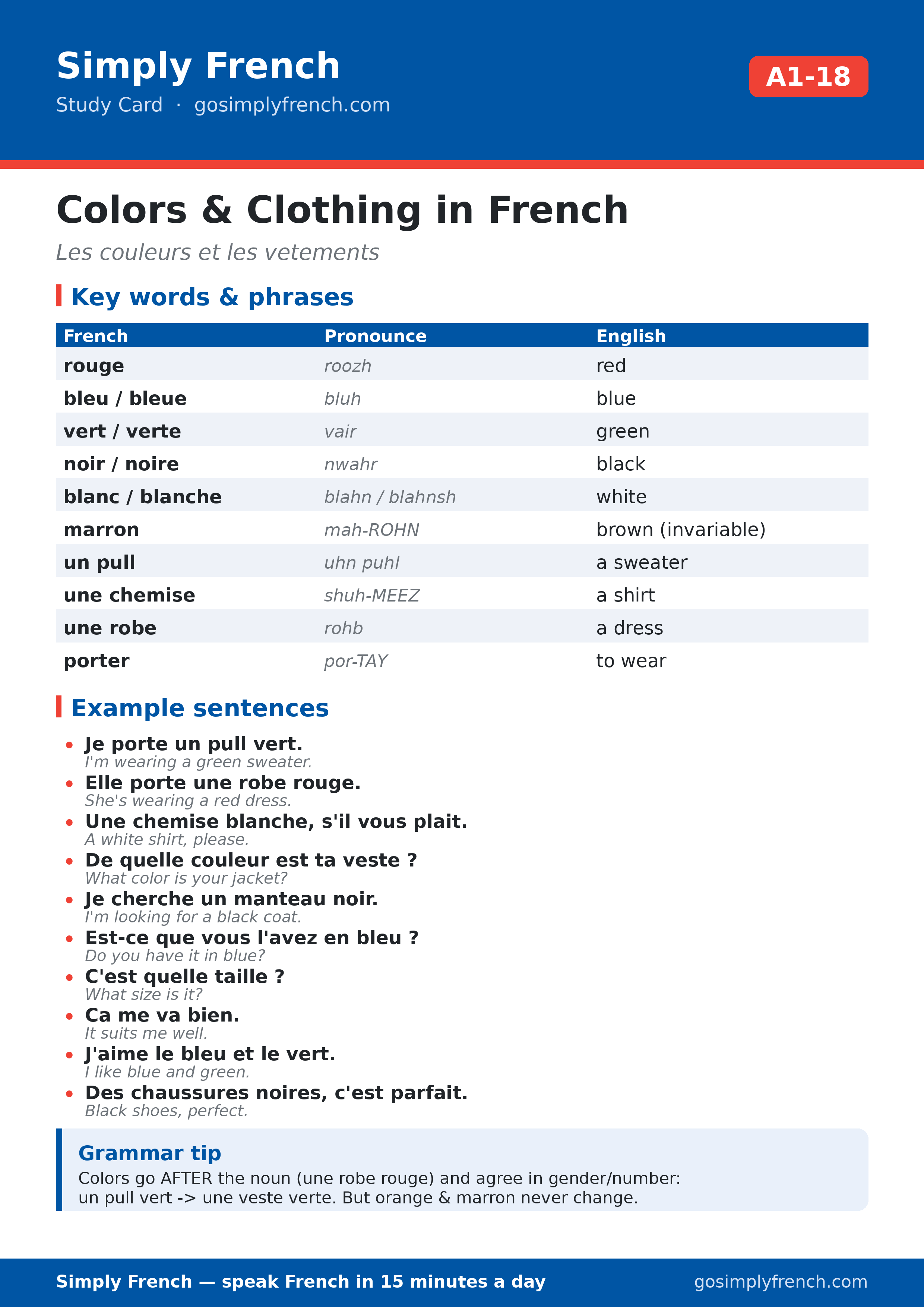
Download the printable study sheet (PDF): Colors and Clothing in French study sheet
Getting dressed, describing what someone is wearing, or pointing at the exact jumper you want in a shop window — almost every daily situation eventually asks you to name a color or a piece of clothing. That is why colors and clothing in French is one of the most useful vocabulary sets you can learn early. Once you can say un pull bleu (a blue sweater) or une robe rouge (a red dress), you can describe your outfit, shop with confidence, and understand a huge amount of everyday conversation.
This lesson gives you the color words, the clothing words, the small grammar rules that make them agree correctly, and ready-made phrases you can say out loud today. Let's get dressed in French.
The colors in French (les couleurs)
French colors are adjectives, and the good news is that the core list is short and high-frequency. Here are the ones you will use every single day, with a rough English-based pronunciation hint.
| French | Pronunciation (hint) | English |
|---|---|---|
| rouge | roozh | red |
| bleu / bleue | bluh | blue |
| vert / verte | vair / vairt | green |
| jaune | zhohn | yellow |
| noir / noire | nwahr | black |
| blanc / blanche | blahn / blahnsh | white |
| gris / grise | gree / greez | grey |
| rose | rohz | pink |
| violet / violette | vyoh-LEH / vyoh-LET | purple |
| orange | oh-RAHNZH | orange |
| marron | mah-ROHN | brown |
| beige | behzh | beige |
A few quick wins hide in this table. Colors that already end in -e — rouge, jaune, rose, beige — never change for a feminine noun, so they are effortless. And orange and marron are special: they never change at all (more on that below).
Want to go beyond the basics? Once these are solid, you can explore shades and synonyms in our deep dives on the many ways to say blue in French and black in French.
How French color adjectives agree (the one rule to master)
In English, "blue" is "blue" no matter what. In French, most color adjectives change to match the noun — this is called agreement. There are only three moves to learn.
For a feminine noun, add -e: un stylo vert (a green pen) becomes une voiture verte (a green car). For a plural noun, add -s: des stylos verts. For a feminine plural, add -es: des voitures vertes. That is the whole system for regular colors.
Two colors break the pattern in a way worth memorizing. Blanc becomes blanche in the feminine (not "blance"), and violet doubles its t to become violette. So you say une chemise blanche (a white shirt) and une jupe violette (a purple skirt).
The word-order rule: colors go after the noun
This trips up almost every beginner. In French, the color comes after the thing it describes, not before it. You do not say "a red dress" word-for-word — you say une robe rouge, literally "a dress red." Keep this order and you will already sound more natural: un pantalon noir (black trousers), une veste bleue (a blue jacket), des chaussures blanches (white shoes).
The invariable colors: orange and marron
Here is the exception that saves you effort: orange and marron never change, ever — no -e, no -s, in any gender or number. That is because both words started life as nouns (une orange the fruit, un marron the chestnut), and they kept their noun-like refusal to agree. So it is des yeux marron (brown eyes) and des gants orange (orange gloves), with no ending added. You can confirm this invariability in the Le Robert dictionary entry for marron, a trustworthy French-language reference.
Clothing vocabulary in French (les vêtements)
Now for the clothes themselves. The single most important habit in French is to learn each noun with its article (un or une), because the gender decides how your color adjective ends. Here are the everyday essentials.
| French | Pronunciation (hint) | English |
|---|---|---|
| un pull | uhn pühl | a sweater / jumper |
| une chemise | ün shuh-MEEZ | a shirt |
| un tee-shirt | uhn tee-shert | a t-shirt |
| un pantalon | uhn pahn-tah-LOHN | trousers / pants |
| un jean | uhn djeen | jeans |
| une robe | ün rohb | a dress |
| une jupe | ün zhüp | a skirt |
| une veste | ün vest | a jacket |
| un manteau | uhn mahn-TOH | a coat |
| des chaussures (f.) | day shoh-SÜR | shoes |
| des baskets (f.) | day bas-KET | trainers / sneakers |
| un chapeau | uhn shah-POH | a hat |
| une écharpe | ün ay-SHARP | a scarf |
| des chaussettes (f.) | day shoh-SET | socks |
Two things to notice. First, un pantalon and un jean are singular in French even though English uses "pants" and "jeans" — one pair is un pantalon, not "des pantalons." Second, chemise is feminine even when it refers to a man's shirt, so it is always une chemise blanche regardless of who wears it. Learn the gender once and every phrase after that falls into place.
If you want the full shopping experience — asking for sizes, colors, and prices, and handling the checkout — pair this lesson with our complete guide on how to go shopping in French.
Putting colors and clothing together
This is where the two halves click. To describe an outfit, name the garment, then add the color (agreeing with the garment's gender):
| French | Pronunciation (hint) | English |
|---|---|---|
| un pull vert | uhn pühl vair | a green sweater |
| une robe rouge | ün rohb roozh | a red dress |
| une chemise blanche | ün shuh-meez blahnsh | a white shirt |
| un manteau gris | uhn mahn-toh gree | a grey coat |
| des chaussures noires | day shoh-sür nwahr | black shoes |
| une jupe bleue | ün zhüp bluh | a blue skirt |
The verb you need to talk about wearing clothes is porter (to wear). It is a regular -er verb, so it is friendly for beginners: Je porte un jean bleu. (I'm wearing blue jeans.), Elle porte une robe noire. (She's wearing a black dress.), Ils portent des baskets blanches. (They're wearing white trainers.)
Describing what someone wears is the natural next step after talking about their hair and eyes. If you have not covered that yet, see our lesson on how to describe people in French for the être vs avoir patterns that pair perfectly with clothing vocabulary.
Real phrases for the shop and the mirror
Vocabulary sticks when it lives inside sentences. Here are practical lines for describing, shopping, and choosing — the exact kind of speaking you'll rehearse in Simply French.
| French | English |
|---|---|
| De quelle couleur est ta veste ? | What color is your jacket? |
| J'aime le bleu et le vert. | I like blue and green. |
| Je cherche un manteau noir. | I'm looking for a black coat. |
| Est-ce que vous l'avez en rouge ? | Do you have it in red? |
| C'est quelle taille ? | What size is it? |
| Je fais du 40. | I'm a size 40. |
| Ça me va bien. | It suits me / fits me well. |
| Je préfère la chemise blanche. | I prefer the white shirt. |
Cultural tip: French clothing sizes use the European system, so a size that reads 38 or 40 on the label is completely normal and not the same as US or UK numbers. When in doubt, say Je fais du… and let the assistant help — asking is polite and expected. And in a boutique, always open with a Bonjour before anything else; skipping the greeting is the fastest way to seem rude. Our lesson on how to say hello and goodbye in French covers that opening move.
This is exactly what you'll practice out loud in Lesson A1-18: Colors and Clothing inside Simply French — you say the phrase, and the app scores your pronunciation instantly so you know une chemise blanche actually landed. Fifteen minutes a day of speaking beats hours of silent reading.
A short dialogue to say out loud
Read this aloud twice — once slowly, once at a natural pace.
— Bonjour ! Je cherche une veste bleue. (Hello! I'm looking for a blue jacket.) — Bonjour ! Quelle taille faites-vous ? (Hello! What size are you?) — Je fais du 38. Est-ce que vous l'avez en noir aussi ? (I'm a size 38. Do you have it in black too?) — Oui, voilà une veste noire. Ça vous va très bien ! (Yes, here's a black jacket. It suits you very well!) — Parfait, je la prends. Merci ! (Perfect, I'll take it. Thank you!)
Notice how bleue and noire both take the feminine -e because veste is feminine — the grammar you learned above, working in a real conversation.
Frequently asked questions
Do colors come before or after the noun in French?
Colors come after the noun in French. You say une robe rouge (a red dress), literally "a dress red," and un pull vert (a green sweater). This is the opposite of English, and keeping the order right is one of the quickest ways to sound natural.
Why don't orange and marron change form?
Because both were originally nouns — une orange (the fruit) and un marron (the chestnut). Colors borrowed from nouns stay invariable, so you write des chaussures orange and des yeux marron with no added -e or -s, no matter the gender or number.
How do I ask what color something is in French?
Use De quelle couleur est…? — for example, De quelle couleur est ta veste ? (What color is your jacket?). For plural items, use De quelle couleur sont…? The answer is simply Elle est bleue (It's blue) or Ils sont noirs (They're black).
Is "pantalon" singular or plural in French?
It's singular. Unlike English "pants" or "trousers," French treats un pantalon as one item, so you say Je porte un pantalon (I'm wearing trousers). The same goes for un jean and un short.
What's the most important thing to memorize with clothing words?
The gender — always learn un pull, une robe, and so on with the article attached. The gender determines how your color adjective ends (un pull blanc but une chemise blanche), so learning the two together saves you from fixing mistakes later.
How can I practice colors and clothing in French out loud?
Speaking beats memorizing lists. Pick one garment and one color, build a sentence (Je porte une chemise blanche), and say it aloud. Simply French turns this into a daily 15-minute drill with instant pronunciation scoring, so you build real speaking confidence, not just a vocabulary list.
Related lessons
- How to Go Shopping in French (A1-9) — sizes, prices, and the full checkout conversation.
- How to Describe People in French (A1-17) — pair clothing with hair, eyes, and personality.
- French Numbers 1-100 (A1-4) — read sizes and prices with confidence.
- 9 ways to say "beautiful" in French — compliment an outfit like a local.
For a deeper grammar reference on any noun's gender, the free WordReference French–English dictionary lists the article next to each entry.
Start speaking today
You now have the core colors and clothing in French you need to describe an outfit, shop for the exact item you want, and understand what people around you are wearing. The vocabulary is short; the payoff is daily. The only missing piece is saying it out loud until it feels automatic.
Try Simply French free for 7 days and turn these words into confident speech with native-speed listening and instant pronunciation scoring: start your free trial. Fifteen minutes a day is all it takes to describe your world in French.
Tags
Now find out how you actually sound.
Simply French listens to you say each sentence and scores it word by word, so you can hear the difference you have just read about — and fix it while it is still fresh.
Takes about 10 minutes. No card needed to start.
Related Articles
You Understand French But Can't Speak It — Here's the Missing Step
You can follow the podcast and still freeze when someone asks you a question. Three separate bottlenecks produce that gap — ten minutes of tests to find which one is yours, and what each one actually needs.
How to Say Hello and Goodbye in French
Learn how to say hello and goodbye in French — bonjour, salut, au revoir, and more — with formal vs. informal tips, pronunciation, and cultural notes.
How to Introduce Yourself in French: A1 Speaking Guide
Learn how to introduce yourself in French with simple phrases for your name, origin, and job, plus polite greetings and full example lines you can say today.