
Days of the Week & Months in French (A1-6)
Learn the days of the week in French, plus months and dates, with pronunciation, example sentences, and a free printable study sheet. Start speaking today.
Simply French Team
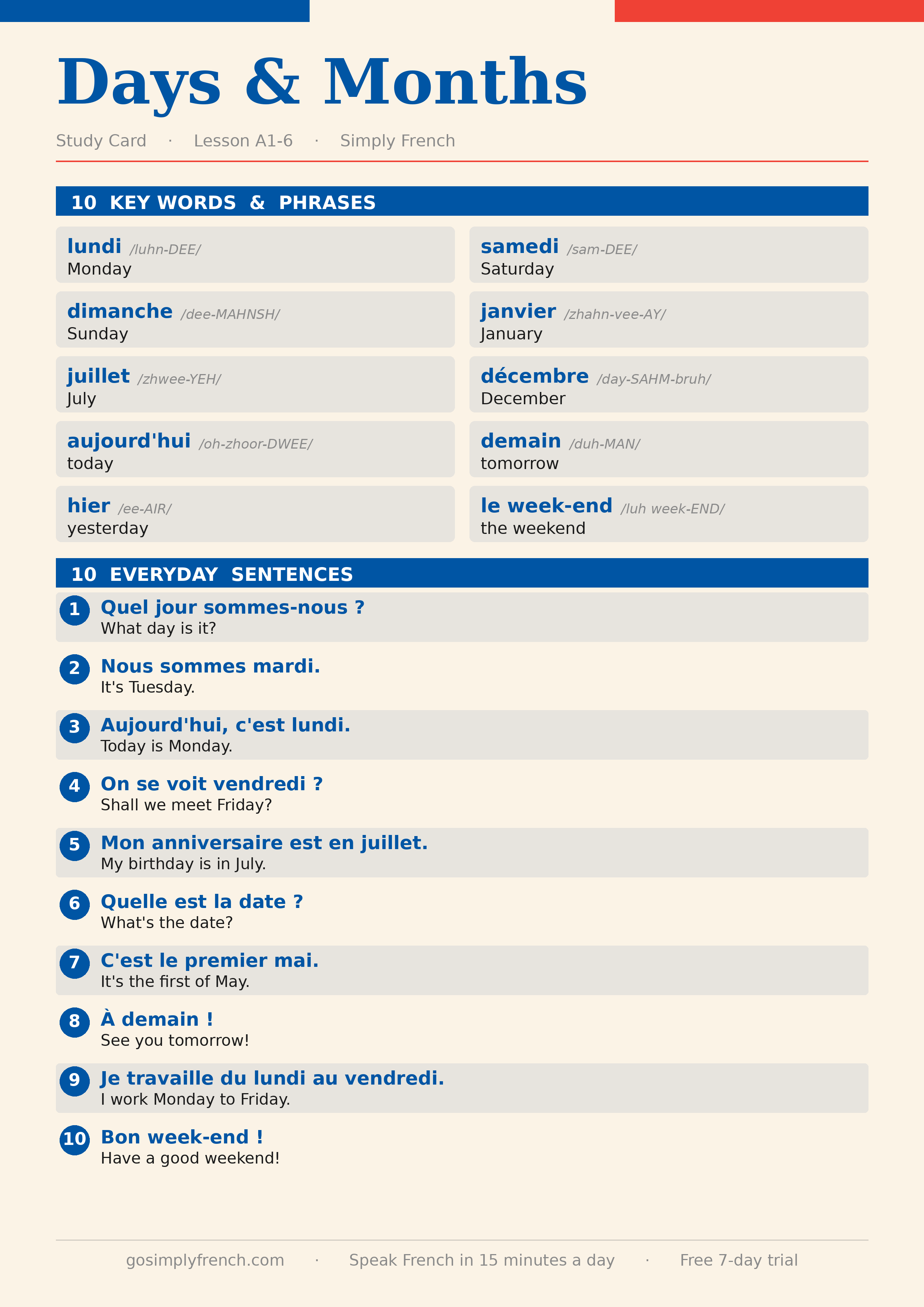
Download the printable study sheet (PDF): Days & Months in French study sheet
If you want to make a dinner reservation, plan a weekend trip, or simply answer "See you Friday!" without freezing, you need the calendar words first. The days of the week in French are one of the most useful sets of vocabulary a beginner can learn, because you will use them in almost every conversation about plans, work, travel, and appointments. In this guide you will learn all seven days, the twelve months, how to say the date, and the little time words like today and tomorrow that hold a sentence together, all with simple pronunciation hints and real example sentences.
By the end you will be able to answer Quel jour sommes-nous ? ("What day is it?"), tell someone your birthday month, and set up a meeting, out loud and with confidence.
The days of the week in French (les jours de la semaine)
Here are the seven days of the week in French. Notice that they are not capitalized (unless they start a sentence), and every day is masculine: le lundi, le mardi, and so on.
| French | Pronunciation | English |
|---|---|---|
| lundi | luhn-DEE | Monday |
| mardi | mar-DEE | Tuesday |
| mercredi | mair-kruh-DEE | Wednesday |
| jeudi | zhuh-DEE | Thursday |
| vendredi | vahn-druh-DEE | Friday |
| samedi | sam-DEE | Saturday |
| dimanche | dee-MAHNSH | Sunday |
A helpful memory hook: five of the seven days end in -di, which comes from the Latin dies ("day"). Lundi is the day of the moon (lune), mardi of Mars, mercredi of Mercury, and so on. The French week officially starts on lundi (Monday), not Sunday, so a French calendar will put Monday in the first column.
Example sentences with the days
- Aujourd'hui, c'est lundi. — Today is Monday.
- On se voit mardi ? — Shall we meet on Tuesday?
- Je travaille du lundi au vendredi. — I work from Monday to Friday.
- Le musée est fermé le mardi. — The museum is closed on Tuesdays.
How to use the days of the week in French
Two small rules will make you sound much more natural.
1. No word for "on." In English we say "on Monday." In French you just say the day: On se voit vendredi means "We're meeting on Friday." Do not add a preposition.
2. Add le for something that happens every week. Compare:
- Je pars lundi. — I'm leaving (this) Monday. (one specific day)
- Le lundi, je fais du sport. — On Mondays, I play sports. (every Monday, a habit)
That single little le is the difference between "this Monday" and "every Monday," so it is worth practicing out loud until it feels automatic. Getting these rhythms right is easier when you hear them at native speed and repeat them, which is exactly what you will do with the French listening practice drills.
The months of the year in French (les mois de l'année)
The months (les mois) are also lowercase and masculine. Several look close to their English cousins, so they are quick to learn.
| French | Pronunciation | English |
|---|---|---|
| janvier | zhahn-vee-AY | January |
| février | fay-vree-AY | February |
| mars | marss | March |
| avril | ah-VREEL | April |
| mai | may | May |
| juin | zhwan | June |
| juillet | zhwee-YEH | July |
| août | oot | August |
| septembre | sep-TAHM-bruh | September |
| octobre | ok-TOH-bruh | October |
| novembre | noh-VAHM-bruh | November |
| décembre | day-SAHM-bruh | December |
To say "in" a month, use en: Mon anniversaire est en juillet ("My birthday is in July"). You will also hear au mois de juillet ("in the month of July"), which means the same thing in a slightly more formal register.
How to say the date in French
Saying the date is simpler than in English because you use plain counting numbers (if you need a refresher, see French numbers 1 to 100). The pattern is:
le + (number) + (month)
- le 14 juillet — the 14th of July (Bastille Day)
- le 25 décembre — December 25th
There is one exception: for the first of the month you use the ordinal premier (1er), not un.
- le premier mai — the first of May
- le premier janvier — January 1st (New Year's Day)
To ask and answer the full date:
| French | Pronunciation | English |
|---|---|---|
| Quelle est la date ? | kel eh lah DAHT | What's the date? |
| Quel jour sommes-nous ? | kel zhoor som-NOO | What day is it? |
| Nous sommes le 3 mars. | noo som luh trwah marss | It's March 3rd. |
| C'est le premier mai. | say luh pruh-mee-AY may | It's the first of May. |
When you write a date numerically, French uses day/month/year: 15/01/2026 means January 15, 2026, not the other way around. This trips up a lot of English speakers booking travel, so double-check when you fill in forms.
This is exactly what you'll practice out loud in Lesson A1-6: Days, Months & Dates inside Simply French, where the app listens to your pronunciation of mercredi, juillet, and le premier and scores it instantly so you know you're being understood.
Today, tomorrow, yesterday, and other time words
These little words appear constantly and glue your calendar sentences together.
| French | Pronunciation | English |
|---|---|---|
| aujourd'hui | oh-zhoor-DWEE | today |
| demain | duh-MAN | tomorrow |
| hier | ee-AIR | yesterday |
| la semaine | lah suh-MEN | the week |
| le week-end | luh week-END | the weekend |
| ce matin | suh ma-TAN | this morning |
| ce soir | suh SWAHR | this evening / tonight |
The word aujourd'hui ("today") is an adverb built, quite literally, from an old phrase meaning "on this day of today," which is why it looks so long (the Larousse dictionary has the full etymology). And the everyday sign-off À demain ! simply means "See you tomorrow!" The word semaine itself ("week") is worth knowing well; you can hear it and see example sentences in the WordReference entry for semaine.
A quick everyday conversation
Put it all together and a simple exchange sounds like this:
— Quel jour sommes-nous aujourd'hui ? (What day is it today?) — Nous sommes jeudi. (It's Thursday.) — Ah, et c'est quelle date ? (Ah, and what's the date?) — C'est le 16 juillet. (It's July 16th.) — Parfait. On se voit samedi ? (Perfect. Shall we meet Saturday?) — Oui, à samedi ! (Yes, see you Saturday!)
Read it aloud twice. The second time, cover the English and see how much you remember. Repetition at a natural pace is what moves these words from "I recognize it" to "I can say it."
A note on the French calendar
If you ever visit a French history museum, you might spot month names like Brumaire or Thermidor. Those come from the short-lived French Republican calendar used after the Revolution, which renamed every month after nature and the seasons. It was abolished in 1806, so no one uses it today, but it is a fun piece of cultural trivia; you can read about it on Wikipedia. For everyday life, the twelve months above are all you need.
Related lessons
Keep building your A1 foundation with these Simply French guides:
- How to say hello and goodbye in French — the greetings that open every conversation.
- French numbers 1 to 100 — essential for dates, prices, and times.
- Please and thank you in French — the politeness basics that make you welcome anywhere.
- How to introduce yourself in French — say who you are with confidence.
Practice the days of the week in French out loud
Reading a chart is a good start, but you will only remember these words once you have said them. Start your free 7-day trial of Simply French and spend 15 minutes a day listening to native speakers and repeating the days, months, and dates out loud, with instant AI pronunciation scoring so you always know you sound right. Print the study sheet above, keep it nearby, and by next week you will be planning your whole week in French.
Frequently asked questions
How do you say the days of the week in French?
The days of the week in French are lundi (Monday), mardi (Tuesday), mercredi (Wednesday), jeudi (Thursday), vendredi (Friday), samedi (Saturday), and dimanche (Sunday). They are all masculine and are not capitalized unless they begin a sentence.
Are days and months capitalized in French?
No. Unlike English, French does not capitalize the days of the week or the months of the year in the middle of a sentence. You write lundi and janvier, not Lundi or Janvier, unless the word starts the sentence.
How do you say "on Monday" in French?
You simply say lundi with no preposition: On se voit lundi means "We're meeting on Monday." If you mean every Monday (a habit), add the article le: le lundi means "on Mondays."
What day does the French week start on?
The French week starts on lundi (Monday). On a French calendar, Monday appears in the first column and Sunday (dimanche) is the last day of the week.
How do you say the date in French?
Use le + the counting number + the month: le 14 juillet (July 14th). The only exception is the first of the month, which uses le premier: le premier mai (the first of May). Written numerically, French dates follow the day/month/year order.
What is "today," "tomorrow," and "yesterday" in French?
Today is aujourd'hui, tomorrow is demain, and yesterday is hier. A common friendly goodbye is À demain ! ("See you tomorrow!").
Tags
Now find out how you actually sound.
Simply French listens to you say each sentence and scores it word by word, so you can hear the difference you have just read about — and fix it while it is still fresh.
Takes about 10 minutes. No card needed to start.
Related Articles
French Adjectives List: 90 Describing Words and the Endings You Have to Say
A French adjectives list built for speaking, not reading. 90+ describing words plus the agreement endings you have to actually pronounce — petit vs petite, heureux vs heureuse — and a 12-pair drill.
Places in Town in French: 80 Words for Getting Around
Every place in a French town you will need to name, find or ask for — shops, services, streets and landmarks — with genders, the à + le trap, and the eight place words English speakers mispronounce.
Family Members in French: The Complete Vocabulary List
Around 80 French family words grouped by the moment you need them — plus the ten that break in your mouth (fils, femme, fille, cousin/cousine) drilled out loud and scored.