Enchaînement: Why Your French Sounds Choppy (Say These 15 Phrases)
Enchainement is why French sounds like one long word. Learn the rule, drill 15 linked phrases out loud, and get scored on every one.
Simply French Team
You have practised avec elle. You know avec. You know elle. You say them, one after the other, carefully — and the French person in front of you tilts their head.
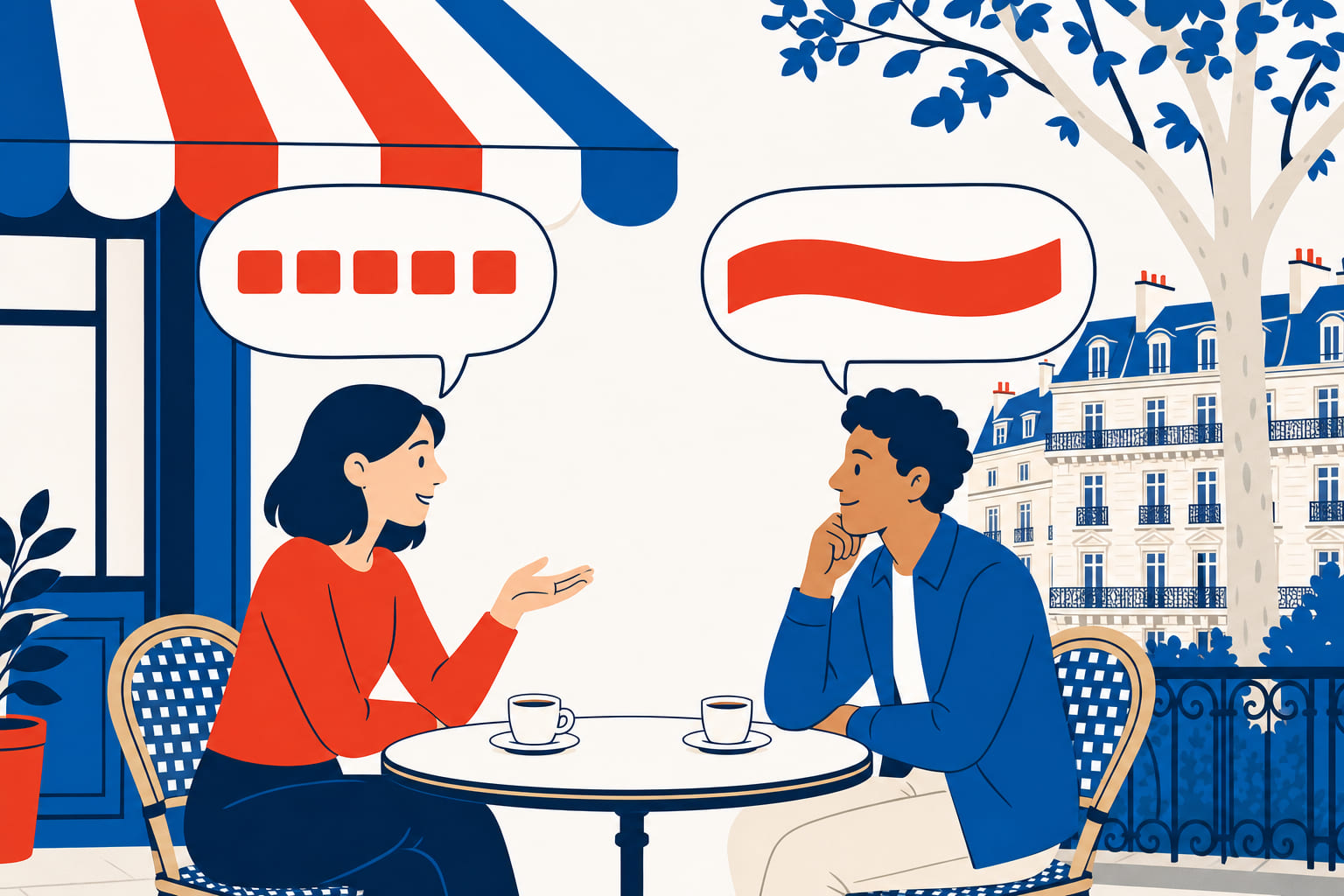
The problem is not either word. The problem is the gap you put between them. French does not have that gap. A native speaker says avec elle as a-veh-KEL — three syllables, no seam, the c of avec jumping across to start the next syllable. That jump has a name: enchaînement. It is the single most audible difference between careful learner French and French that flows, and unlike the R or the nasal vowels, it takes about ten minutes to understand and a week to install.
What enchaînement actually is
Enchaînement happens when a word ends in a consonant you already pronounce and the next word begins with a vowel sound. The consonant does not stay put. It moves forward and becomes the first sound of the next syllable (Lawless French, Enchaînement).
Watch it happen to avec:
| Syllables | Pronounce | |
|---|---|---|
| avec on its own | a-vec | a-VEK |
| avec elle | a-ve-celle | a-veh-KEL |
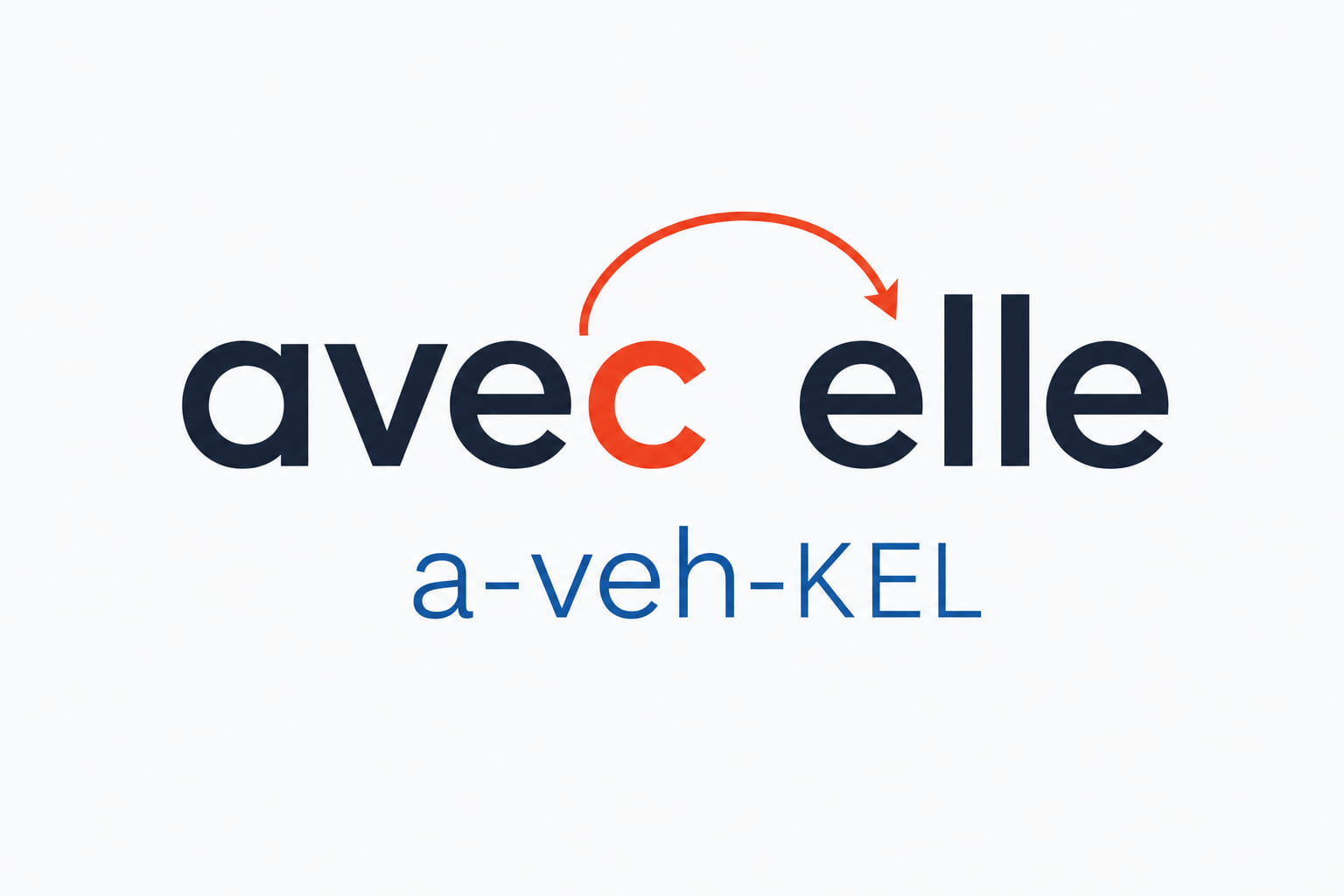
Nothing was added. Nothing was dropped. The c simply changed which syllable it belongs to. French does this relentlessly, because French wants every syllable to end in a vowel if it possibly can. Words have edges on the page. In speech, they do not.
Enchaînement is not liaison — and the difference is one question
Nearly every learner has these two filed under the same label, which is why neither one ever gets fixed. The test is a single question: do you pronounce that final consonant when the word stands alone?
| The final consonant alone | What happens | Example | |
|---|---|---|---|
| Enchaînement | Already pronounced | It moves to the next syllable | elle = [ehl] → elle est = eh-LEH |
| Liaison | Silent | It wakes up, then moves | les = [lay] → les amis = lay-za-MEE |
Elle always ends in an audible l, with or without a following word — so elle est is enchaînement. Les never ends in an audible s on its own — the z sound in les amis appears out of nowhere — so that one is liaison.
Why this matters practically: liaison has obligatory cases, forbidden cases, and optional ones that shift with formality. Enchaînement has almost none of that. If the consonant is already there and a vowel follows, it links — in every register, whether you are being formal or shouting across a kitchen. There is one lexical exception, the h aspiré, and we will get to it below. Beyond that, it is mechanical. It is the cheapest fluency upgrade in the language, and most courses skip it entirely to spend three weeks on liaison instead.
Drill 1 — 15 phrases, said the French way
Read the middle column, not the left one. The left column is spelling; the middle column is speech. Say each line out loud five times, and let the linked syllable be the loud one.
| Written | What you actually say | Pronounce | English |
|---|---|---|---|
| il est | i-lest | ee-LEH | he is |
| elle a | e-lla | eh-LAH | she has |
| avec elle | a-ve-celle | a-veh-KEL | with her |
| une amie | u-na-mie | ü-na-MEE | a friend (f.) |
| quelle heure | que-lleure | keh-LUR | what time |
| il arrive | i-la-rrive | ee-la-REEV | he's arriving |
| cette année | ce-tta-nnée | seh-ta-NAY | this year |
| par exemple | pa-re-xemple | pa-reg-ZAHMPL | for example |
| bonne idée | bo-nni-dée | bo-nee-DAY | good idea |
| votre adresse | vo-tra-dresse | vo-tra-DRESS | your address |
| pour aller | pou-ra-ller | poo-ra-LAY | to go to |
| sur une table | su-ru-ne-table | sü-rün-TABL | on a table |
| quatre euros | qua-treu-ros | ka-truh-ROH | four euros |
| elle habite ici | e-lla-bi-ti-ci | eh-la-bee-tee-SEE | she lives here |
| sept heures | se-tteures | seh-TUR | seven o'clock |
Two of these deserve a note.
Elle habite ici links twice in a row. The l of elle jumps onto habite — the h of habiter is an h muet, a letter with no sound at all, so it blocks nothing — and then the t of habite jumps onto ici. Five syllables, zero seams. This is what people mean when they say spoken French sounds like one long word. (Not every French h behaves this way; see below.)
Sept heures is the one that catches everybody. In sept, the p is silent and the t is pronounced — so the t is the consonant that moves. Not set-EUR. Seh-TUR, one smooth word.
The vowel version nobody teaches you
There is a second kind of enchaînement, and English speakers break it constantly without noticing.
When two vowels meet across a word boundary, French glides straight from one to the other. English does not — English inserts a tiny catch in the throat, the same catch that sits in the middle of uh-oh. Linguists call it a glottal stop, and it is all over your French.
| Written | English speakers say | French says |
|---|---|---|
| tu as | tü — [catch] — AH | tü-AH |
| j'ai été | zhay — [catch] — ay-TAY | zhay-ay-TAY |
| il a eu | ee-la — [catch] — Ü | ee-la-Ü |
| tu es ici | tü — [catch] — eh — [catch] — ee-SEE | tü-eh-ee-SEE |
You will not hear yourself doing this. That catch is so automatic in English that it is below the level of attention — which is exactly why an external ear, or a scoring engine that flags the break, finds it faster than you ever will on your own.
Where enchaînement does not happen
Three places. Learn them and you are done.
A real pause. If you stop to think, the link stops too. Elle est… fatiguée. That is fine — hesitation is human, and enchaînement resumes on the other side of it.
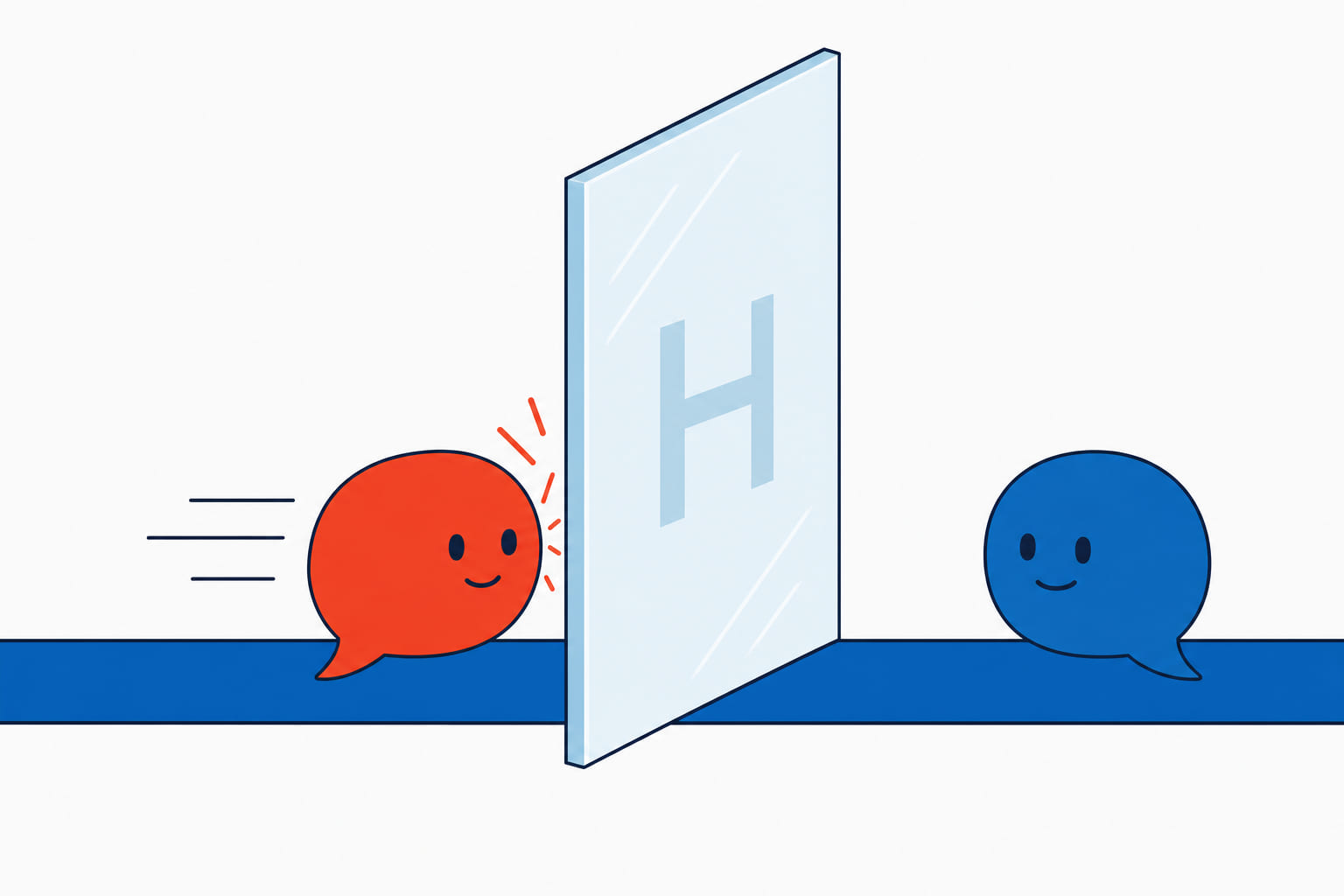
Before an aspirated h. A set of words carry an h aspiré, which behaves like an invisible wall and blocks both enchaînement and liaison: le héros stays luh ay-ROH, never l'héros, and les haricots stays lay a-ree-KOH with no z. Compare l'homme, where the h is mute and everything links normally. There is no way to tell which is which by looking. Most h aspiré words came into French from Germanic or from later borrowings, which is a partial clue, but in practice you learn them as you meet them — and they are the one genuine exception list enchaînement has.
Across a real grammatical break. In careful speech, the link is weaker between, say, a subject group and what follows. In everyday conversation you will hear it link anyway. Do not lose sleep over this one.
A real conversation
Léa : Salut Tom ! Il est quelle heure ? Tom : Il est sept heures et demie. Léa : Déjà ? On a une réservation à huit heures. Tom : Claire vient aussi ? Léa : Oui, j'arrive avec elle. Elle habite ici, juste à côté. Tom : Bonne idée. C'est où exactement, le restaurant ? Léa : À cette adresse-là. Il y a un bus pour aller au centre. Tom : Parfait, on y va.
Here are thirteen of the enchaînements in there: il est, quelle heure, sept heures, heures et, huit heures, avec elle, elle habite, habite ici, juste à, bonne idée, cette adresse, pour aller, il y a. That is not even all of them — il est comes round twice, and j'arrive avec links as well. Eight short lines, fifteen links. That density is normal; it is not a stylistic flourish, it is how the language is built.
And notice what is not on that list. On a and on y va also sound linked, but those are liaisons — on alone is ohn, with no audible n at all. Same smooth result, different mechanism. Once enchaînement is automatic, liaison is the next thing to learn, and it will be much easier, because you will already be linking by default.
Frequently asked questions
Is enchaînement optional?
No, not in the way liaison is. Liaison has obligatory, optional, and forbidden cases that shift with formality. Enchaînement is mechanical: pronounced consonant plus following vowel equals link, in every register, from a news broadcast to an argument on a bus. The three things that stop it are an h aspiré, a genuine pause, and a strong grammatical break in careful speech — that is the whole list. Skipping it does not sound formal. It sounds foreign.
What is the difference between enchaînement and liaison, in one line?
Liaison brings a silent consonant back to life; enchaînement moves a consonant that was already alive. Ask whether you would pronounce that letter with the word standing on its own — if yes, it is enchaînement.
Does enchaînement change the meaning of words?
It can create real ambiguity, which is why it also trains your ear. The classic pair is petit ami ("boyfriend") and petite amie ("girlfriend"): both come out as puh-tee-ta-MEE, identical. One gets its t from liaison — petit alone ends in a silent t — and the other from enchaînement, since petite ends in an audible one. Two different mechanisms, one sound. Native speakers resolve it by context without noticing, and so will you, once the links stop surprising you.
Why does French sound so much faster than it is?
Largely because of this. French runs consonants across word boundaries and drops schwas, so the word boundaries you are listening for simply are not in the signal — elle habite ici arrives as one five-syllable block. English leaves far more edges to grab onto. The speed is partly an illusion created by the lack of seams, and it stops being intimidating the moment you can produce that seamlessness yourself.
I can hear the difference but I can't produce it. Now what?
That is the normal order, and it is the exact point where reading another article stops helping. The gap between recognising a linked phrase and saying one is a motor skill, and motor skills close through repetition with feedback — say it, hear what came out, adjust, repeat.
Related lessons
- French Pronunciation Practice — how to build a daily fifteen-minute pronunciation habit.
- Master the Phonetics French Alphabet — the sound-by-sound foundation underneath all of this.
- 5 Common Mistakes English Speakers Make — enchaînement is number one on most teachers' lists.
- 7 "Secret" French Phrases That Make You Sound Fluent — phrases worth linking correctly.
Practise it out loud
You cannot learn enchaînement by reading about enchaînement. The whole skill lives in your mouth, and your mouth has spent your entire life putting a small gap between words because English rewards that.
So take the fifteen phrases above and say them. Not once — until avec elle comes out as one word rather than two, and you stop hearing the seam because there isn't one.
That is what Simply French is built for: fifteen minutes a day of listening at native speed, speaking drills, and instant AI pronunciation scoring that tells you which syllable slipped and where the seam still is. Start your free 7-day trial and drill these fifteen phrases until they link themselves.
Allez-y.
Tags
Now find out how you actually sound.
Simply French listens to you say each sentence and scores it word by word, so you can hear the difference you have just read about — and fix it while it is still fresh.
Takes about 10 minutes. No card needed to start.
Related Articles
Mastering passe compose in french: A Practical Guide to the Past Tense
Learn passe compose in french with clear rules on avoir vs. etre, agreement, and common irregulars to describe past events confidently.
How to Order Coffee in French and Sound Like a Local
Learn how to order coffee in French with confidence. This guide covers key phrases, cultural etiquette, and vocabulary for ordering in France and Quebec.
How to Read a Menu in French Without Feeling Lost
Confidently read any menu in French with our 2026 guide. Learn key vocabulary, ordering phrases, and cultural tips to dine like a local in France.