
French Numbers 1-100: How to Count (A1-4)
Learn French numbers 1 to 100 the speaking way: clear tables, phonetic hints, the 70/80/90 rule, and real phrases for prices, ages, and phone numbers.
Simply French Team
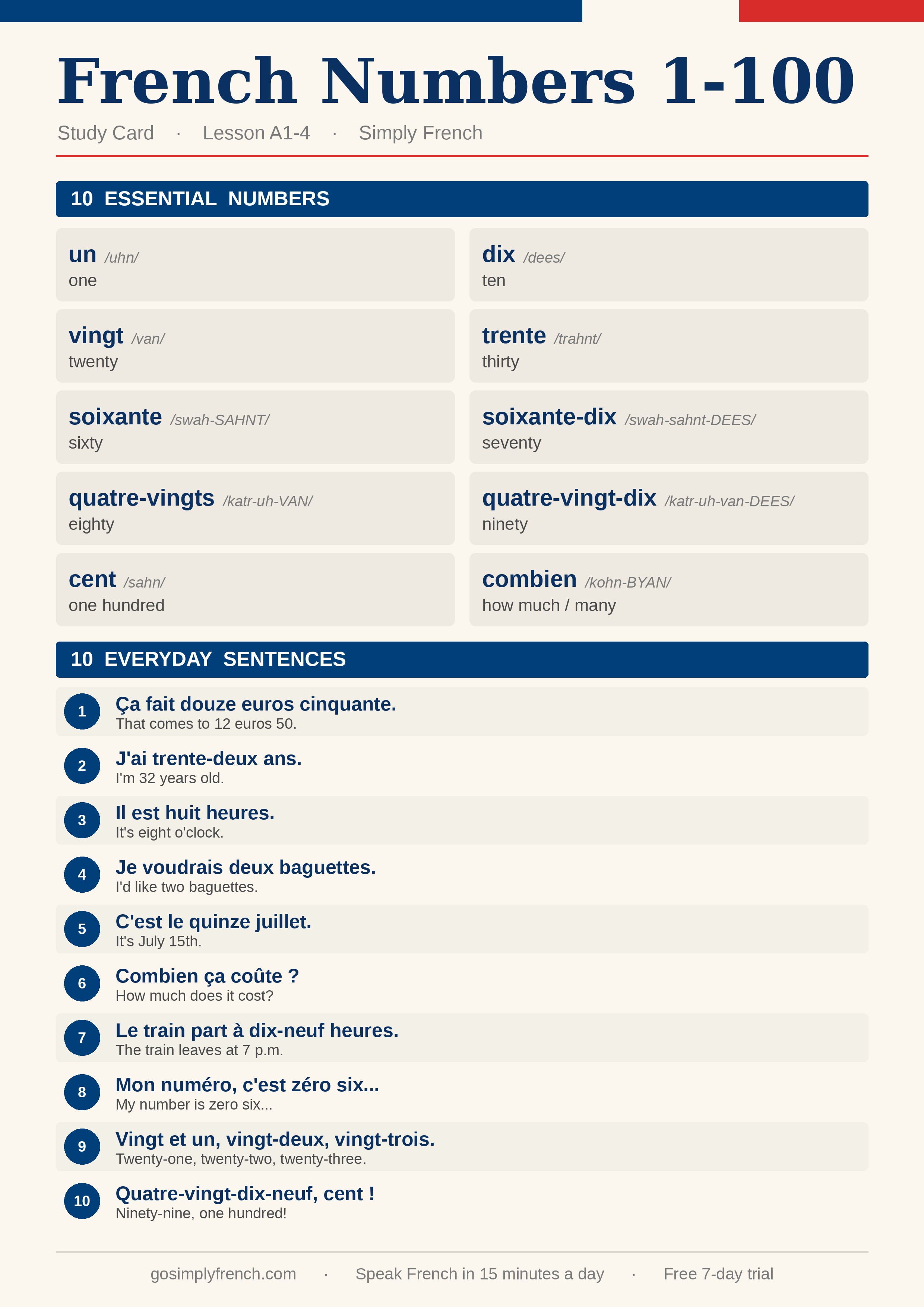
Save or print the French Numbers 1-100 study card for quick daily review.
Download the printable study sheet (PDF): French Numbers 1-100 study sheet
Numbers are the first thing you actually use in France. You hear them at the bakery when the cashier says the price, you say them when you give your phone number, and you need them the moment someone asks your age or the time. Learn to count out loud and a huge slice of everyday French suddenly clicks into place. This guide walks you through French numbers from 1 to 100, with pronunciation hints you can say today and the one "French math" rule that trips up almost every beginner.
The good news: French numbers are wonderfully regular up to 69. The famously odd part - 70, 80, and 90 - follows a simple pattern once you see it. By the end of this lesson you will be able to count, say prices, and read a phone number aloud.
The building blocks: counting from 0 to 20
Everything else is built from these twenty-one words, so it is worth saying them out loud until they feel automatic. The phonetic hints below are approximations for English speakers, not strict phonetics.
| Number | French | Pronunciation |
|---|---|---|
| 0 | zéro | zay-ROH |
| 1 | un | uhn |
| 2 | deux | duh |
| 3 | trois | trwah |
| 4 | quatre | KATR |
| 5 | cinq | sank |
| 6 | six | sees |
| 7 | sept | set |
| 8 | huit | weet |
| 9 | neuf | nuhf |
| 10 | dix | dees |
| 11 | onze | onz |
| 12 | douze | dooz |
| 13 | treize | trez |
| 14 | quatorze | kah-TORZ |
| 15 | quinze | kanz |
| 16 | seize | sez |
| 17 | dix-sept | dee-SET |
| 18 | dix-huit | dee-ZWEET |
| 19 | dix-neuf | deez-NUHF |
| 20 | vingt | van |
Notice that 17, 18, and 19 are simply "ten-seven," "ten-eight," and "ten-nine." French stops making brand-new words after seize (16) and starts stacking them - a habit that returns in a big way at 70.
Counting by tens: 20 to 60
From twenty to sixty, French is beautifully predictable. Learn these five words and you can build every number in between.
| Number | French | Pronunciation |
|---|---|---|
| 20 | vingt | van |
| 30 | trente | trahnt |
| 40 | quarante | kah-RAHNT |
| 50 | cinquante | san-KAHNT |
| 60 | soixante | swah-SAHNT |
To fill the gaps, you attach the single digit with a hyphen: vingt-deux (22), trente-quatre (34), cinquante-huit (58). The only special case is the "one" of each ten, which traditionally takes et un ("and one") with no hyphen: vingt et un (21), trente et un (31), quarante et un (41), cinquante et un (51), soixante et un (61). The 1990 spelling reform also allows the fully hyphenated vingt-et-un, so you will see both - either is correct.
The tricky part: 70, 80, and 90
Here is where French makes you do a little arithmetic. Instead of inventing new words for seventy, eighty, and ninety, French reaches back to twenty and counts in twenties - a leftover of an old base-twenty (vigesimal) counting system.
| Number | French | Literally | Pronunciation |
|---|---|---|---|
| 70 | soixante-dix | "sixty-ten" | swah-sahnt-DEES |
| 71 | soixante et onze | "sixty and eleven" | swah-sahnt-ay-ONZ |
| 72 | soixante-douze | "sixty-twelve" | swah-sahnt-DOOZ |
| 80 | quatre-vingts | "four-twenties" | katr-uh-VAN |
| 81 | quatre-vingt-un | "four-twenty-one" | katr-uh-van-UHN |
| 90 | quatre-vingt-dix | "four-twenty-ten" | katr-uh-van-DEES |
| 91 | quatre-vingt-onze | "four-twenty-eleven" | katr-uh-van-ONZ |
| 99 | quatre-vingt-dix-neuf | "four-twenty-ten-nine" | katr-uh-van-deez-NUHF |
So seventy is "sixty-ten," and you keep counting the teens: 75 is soixante-quinze ("sixty-fifteen"), 79 is soixante-dix-neuf ("sixty-nineteen"). Eighty is literally "four twenties," and ninety is "four-twenty-ten," so 95 is quatre-vingt-quinze.
One spelling detail worth knowing: quatre-vingts takes a final s only when it stands alone as exactly 80. As soon as another number follows, the s disappears - quatre-vingt-deux (82), quatre-vingt-dix (90). This is confirmed by the Larousse dictionary entry for quatre-vingts, the reference most French people themselves check.
If you travel to Belgium or French-speaking Switzerland, you will hear the friendlier septante (70) and nonante (90), and in parts of Switzerland huitante (80). France and Canada stick with the "sixty-ten" system, so that is the one to master first.
How to build any number from 21 to 99
Put the pieces together and a pattern emerges. Say the ten, then add the digit - with et only before un (and before onze at 71).
| Number | French | Pronunciation |
|---|---|---|
| 21 | vingt et un | van-tay-UHN |
| 35 | trente-cinq | trahnt-SANK |
| 42 | quarante-deux | kah-rahnt-DUH |
| 56 | cinquante-six | san-kahnt-SEES |
| 68 | soixante-huit | swah-sahnt-WEET |
| 77 | soixante-dix-sept | swah-sahnt-dee-SET |
| 88 | quatre-vingt-huit | katr-uh-van-WEET |
| 100 | cent | sahn |
And that is the whole system. Once you can count to sixty smoothly and you have made peace with "sixty-ten" and "four-twenties," every number below one hundred is within reach. Cent (100) is a clean, single word - a nice reward at the top.
Saying the numbers out loud without freezing
Reading numbers is easy; saying them at speed is the real skill, and it is exactly what daily practice is for. A few pronunciation traps to watch:
- Silent letters wake up before vowels. The final consonant in six, dix, huit, and neuf is often silent alone but pronounced when a word follows. Six on its own is "sees," but six ans (six years) sounds like "see-ZAHN," and dix becomes "dee-ZAHN" in dix ans.
- Cinq keeps its final "k" sound in most everyday speech: "sank."
- Neuf turns its f into a v sound before ans and heures: neuf ans is "nuh-VAHN."
- Vingt is nasal ("van") and the t is usually silent, though it returns softly in 21-29: vingt-deux is "van-DUH."
Do not aim for perfection on day one. Native listeners understand you long before your accent is flawless - the goal is to keep talking. This is exactly what you will practice out loud in Lesson A1-4: French Numbers 1-100 inside Simply French, where instant pronunciation scoring tells you which numbers still need a little polish.
Numbers in real life: prices, age, and phone numbers
Here is where the payoff arrives. These are the sentences you will actually reach for in a shop, a café, or a first conversation.
| French | English | Pronunciation hint |
|---|---|---|
| Ça fait douze euros cinquante. | That comes to 12 euros 50. | sah-fay-dooz-uh-roh-san-KAHNT |
| J'ai trente-deux ans. | I am 32 years old. | zhay-trahnt-duh-ZAHN |
| Il est huit heures. | It is eight o'clock. | eel-ay-weet-UHR |
| Je voudrais deux baguettes. | I would like two baguettes. | zhuh-voo-dray-duh-bah-GET |
| C'est le quinze juillet. | It is July 15th. | say-luh-kanz-zhwee-YAY |
| Mon numéro, c'est zéro six... | My number is zero six... | mohn-noo-may-roh-say-zay-roh-SEES |
| Le train part à dix-neuf heures. | The train leaves at 7 p.m. | luh-tran-par-ah-deez-nuhv-UHR |
| Combien ça coûte ? | How much does it cost? | kohn-byan-sah-KOOT |
Two cultural notes. French speakers say prices as "12 euros 50," not "12 point 50." And French phone numbers are read in pairs: 06 42 17 88 05 becomes zéro-six, quarante-deux, dix-sept, quatre-vingt-huit, zéro-cinq. That pairing is why the tens above are so worth drilling - you will hear them constantly.
Related lessons
Numbers slot neatly into the phrases you have already met. Keep building your first conversations with these lessons:
- How to say hello and goodbye in French - the greetings that open every exchange.
- How to say "how are you" in French - small talk before you get down to numbers.
- How to introduce yourself in French - where "I'm 32" (j'ai trente-deux ans) finally comes in handy.
For a deeper look at the grammar behind these forms, the Larousse entry for vingt is a reliable reference, and the Wikipedia overview of French numerals explains the vigesimal history in more detail.
Ready to stop reading numbers and start saying them? Start your free 7-day trial of Simply French and drill French numbers out loud, at native speed, with instant feedback on every one.
Frequently asked questions
Why is 70 "sixty-ten" in French?
French kept a trace of an old base-twenty counting system. Instead of a unique word for seventy, it says soixante-dix ("sixty-ten") and continues counting the teens up to soixante-dix-neuf (79). Eighty is quatre-vingts ("four twenties") for the same reason. It feels strange at first, but the pattern is completely consistent.
When does "quatre-vingts" lose its final s?
Quatre-vingts takes a final s only when it means exactly 80 and stands alone. When another number follows, the s disappears: quatre-vingt-deux (82), quatre-vingt-dix (90). The same holds for cent, which becomes cents only in round hundreds like deux cents.
Do I write "vingt et un" or "vingt-et-un"?
Both are accepted. The traditional spelling is vingt et un with no hyphens around et. The 1990 spelling reform recommends hyphenating every part of a written-out number, giving vingt-et-un. Choose one style and stay consistent - French readers accept either.
How do French people say phone numbers?
In pairs of two digits. The number 06 42 17 88 05 is read zéro-six, quarante-deux, dix-sept, quatre-vingt-huit, zéro-cinq. Practising the tens from 20 to 90 makes reading and hearing phone numbers far easier.
What is the fastest way to memorise French numbers?
Count out loud daily in short bursts rather than staring at a list. Say them in useful chunks - prices, your age, the time - and repeat until the words come without translating in your head. Speaking aloud with instant pronunciation feedback, as in Simply French, turns recognition into real recall.
Are the numbers different in Belgium and Switzerland?
Yes. Belgium and much of French-speaking Switzerland use septante (70) and nonante (90), and some Swiss regions use huitante (80). France, Quebec, and most of the French-speaking world use soixante-dix, quatre-vingts, and quatre-vingt-dix, so learn those first.
Tags
Now find out how you actually sound.
Simply French listens to you say each sentence and scores it word by word, so you can hear the difference you have just read about — and fix it while it is still fresh.
Takes about 10 minutes. No card needed to start.
Related Articles
T'as, Y'a, Chuis: Say Spoken French the Way It's Actually Said
Tu becomes t', il becomes i, il y a becomes y'a. The three families of French spoken contractions, why they exist, and 50 lines to drill out loud until they stop sounding like a different language.
How to Tell If Your French Accent Is Actually Good (Self-Test)
You cannot hear your own French accent — your ear filters it through English. Six self-tests that isolate what English speakers actually get wrong, each one you can check on your own, plus a 12-point scorecard.
How to Talk About Hobbies in French (A1-21)
Learn to talk about hobbies in French with 40+ phrases, the faire de vs jouer a rule, pronunciation hints, a sample dialogue and a free printable study sheet.