
How to Ask for Directions in French (A1-8)
Learn how to ask for directions in French: essential travel phrases for où est, tout droit, left and right, plus polite tips so you never get lost in France.
Simply French Team
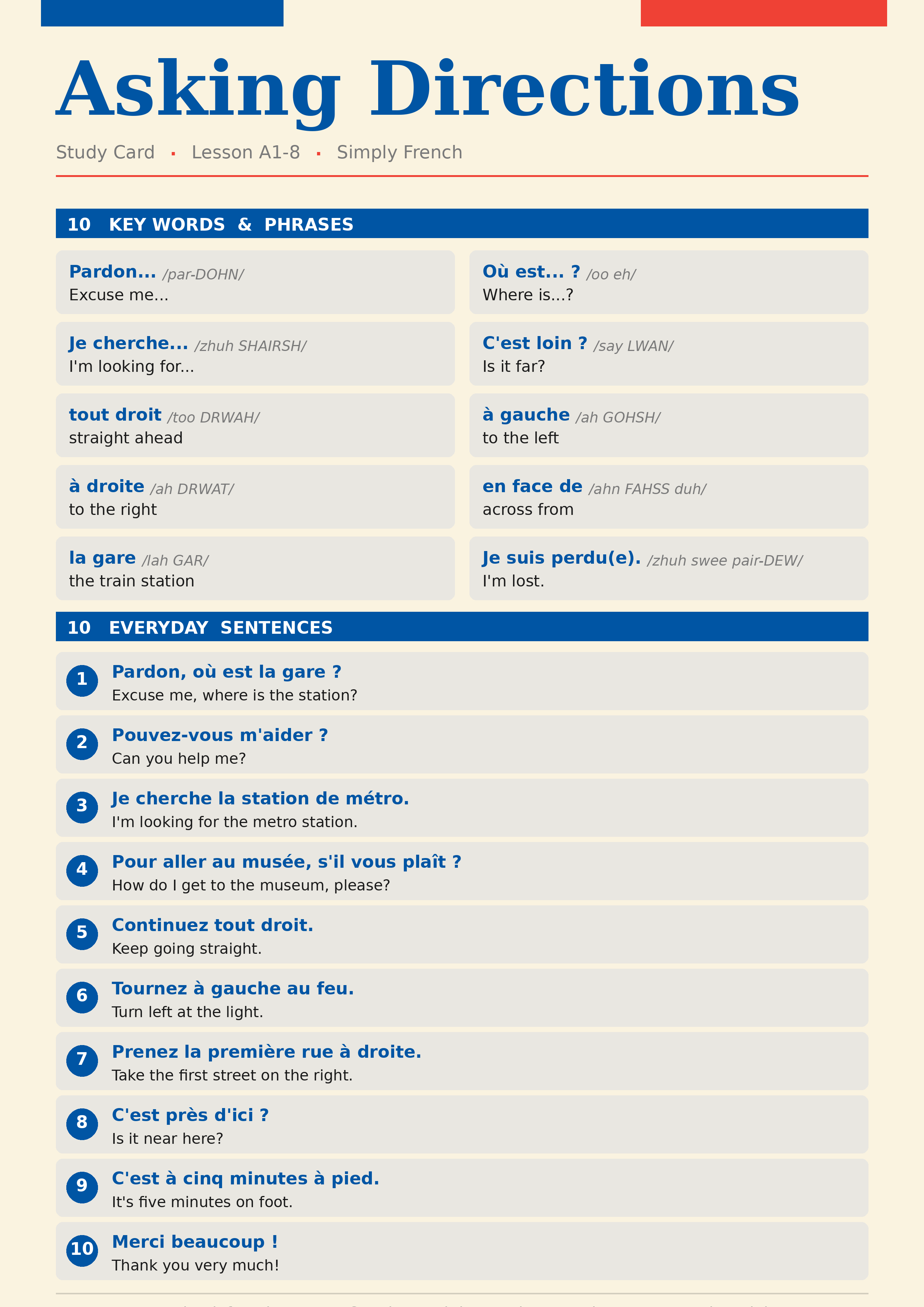
Download the printable study sheet (PDF): Asking for Directions in French study sheet
Sooner or later, every traveler in France ends up on a corner, looking for a train station that stubbornly refuses to appear. Knowing how to ask for directions in French turns that small panic into a quick, friendly exchange -- and it's one of the most satisfying real-world wins a beginner can have. You ask a stranger a question in French, they answer, and you actually get where you're going.
The good news is that you don't need perfect grammar. You need a short, reliable set of phrases to ask where something is, plus enough vocabulary to understand a simple answer like "straight ahead, then left." This lesson gives you exactly that, with pronunciation hints you can practice out loud right away.
Start politely (this is not optional in France)
Before you ask anyone anything in France, open with a courtesy word. A quick Pardon or Excusez-moi -- ideally preceded by Bonjour -- signals respect and makes people far more willing to help. Launching straight into "Where's the station?" comes across as abrupt. If greetings still feel new, our guide to saying hello and goodbye in French covers the essentials in five minutes.
| French | Pronunciation | English |
|---|---|---|
| Pardon... | par-DOHN | Excuse me... (to stop someone) |
| Excusez-moi... | ex-kew-zay-MWAH | Excuse me... (slightly more formal) |
| Pouvez-vous m'aider ? | poo-VAY voo meh-DAY | Can you help me? |
| Je suis perdu(e). | zhuh swee pair-DEW | I'm lost. (add an -e sound if you're female) |
How to ask for directions in French: the core questions
These four question patterns will get you almost anywhere. The single most useful one is Où est... ? ("Where is... ?"). Just add the place you're looking for and finish with s'il vous plaît.
| French | Pronunciation | English |
|---|---|---|
| Où est... ? | oo eh | Where is... ? |
| Où sont les toilettes ? | oo sohn lay twah-LET | Where are the toilets? |
| Je cherche... | zhuh SHAIRSH | I'm looking for... |
| Pour aller à..., s'il vous plaît ? | poor ah-LAY ah | How do I get to..., please? |
| C'est loin ? | say LWAN | Is it far? |
| C'est près d'ici ? | say preh dee-SEE | Is it near here? |
Notice how s'il vous plaît (please) does a lot of quiet work here. Politeness is the grease that keeps these interactions smooth, so if those courtesy words still feel shaky, spend a few minutes with our lesson on please and thank you in French.
This is exactly what you'll practice out loud in Lesson A1-8: Asking for Directions inside Simply French, where the app listens to your pronunciation and scores it instantly -- so a real Parisian will understand you the first time.
Understanding the answer: left, right, and straight ahead
Asking the question is only half the battle; you also have to understand the reply. These directional words are the ones you'll hear most. Watch the classic trap: tout droit means "straight ahead," while à droite means "to the right." They sound similar but send you in completely different directions.
| French | Pronunciation | English |
|---|---|---|
| tout droit | too DRWAH | straight ahead |
| à gauche | ah GOHSH | to/on the left |
| à droite | ah DRWAT | to/on the right |
| en face de | ahn FAHSS duh | across from |
| à côté de | ah koh-TAY duh | next to |
| au coin de | oh KWAN duh | at the corner of |
| près de / loin de | preh duh / lwan duh | near / far from |
That tout droit versus à droite distinction is worth burning into memory. As the Larousse entry for gauche notes, gauche is simply the side of your body where your heart is, and the adverb droit means "in a straight line" -- so tout droit literally means "all straight," not "to the right." The Le Robert entry for droite confirms droite as the side opposite the heart. Mix them up and you'll walk a very different route.
Full sentences people will say to you
Locals rarely answer with a single word. Here are the complete phrases you'll actually hear, so they won't catch you off guard.
| French | Pronunciation | English |
|---|---|---|
| Continuez tout droit. | kohn-tee-New-ay too DRWAH | Keep going straight. |
| Tournez à gauche. | toor-NAY ah GOHSH | Turn left. |
| Tournez à droite. | toor-NAY ah DRWAT | Turn right. |
| Prenez la première rue à droite. | pruh-NAY lah pruh-MYAIR rew | Take the first street on the right. |
| C'est juste là. | say zhewst LAH | It's right there. |
| C'est à cinq minutes. | say ah sank mee-NEWT | It's five minutes away. |
To catch phrases like la première rue ("the first street") or cinq minutes, it helps to be solid on your French numbers 1-100. And if someone says C'est à cinq minutes, you'll want to be comfortable telling time in French too.
Useful places to name
Half of asking for directions is knowing the name of your destination. Here are the landmarks travelers ask about most.
| French | Pronunciation | English |
|---|---|---|
| la gare | lah GAR | the train station |
| la station de métro | lah stah-SYOHN duh may-TROH | the metro station |
| l'arrêt de bus | lah-REH duh bewss | the bus stop |
| l'office de tourisme | loh-FEESS duh too-REEZM | the tourist office |
| la place | lah PLAHSS | the (town) square |
| le carrefour | luh kar-FOOR | the crossroads / intersection |
| les feux | lay FUH | the traffic lights |
A quick sample conversation
Here's how the whole exchange flows from start to finish:
You: Pardon, madame. Où est la gare, s'il vous plaît ? (Excuse me, madam. Where is the train station, please?) Passerby: Continuez tout droit, puis tournez à gauche au feu. (Keep going straight, then turn left at the light.) You: C'est loin ? (Is it far?) Passerby: Non, c'est à cinq minutes. (No, it's five minutes away.) You: Merci beaucoup ! (Thank you very much!)
Read it aloud a few times. The rhythm of Pardon -> Où est... ? -> merci beaucoup is the backbone of almost every direction you'll ever ask for.
Cultural tips to sound natural
- Greet before you ask. Pardon or Bonjour first -- always. It's the biggest politeness signal in France.
- Use vous, not tu, with strangers. Keep it formal with people you don't know.
- Watch their hands. French speakers gesture a lot; the pointing often tells you as much as the words.
- Ask them to repeat. If you miss it, say Pouvez-vous répéter, s'il vous plaît ? ("Can you repeat, please?"). No shame in it.
Related lessons
Keep building your travel French with these Simply French lessons:
- How to Say Hello and Goodbye in French -- the greetings every request starts with.
- Please and Thank You in French -- the politeness words that make strangers want to help.
- French Numbers 1-100 -- understand "the second street" and "five minutes."
- How to Tell Time in French -- make sense of "it's ten minutes away."
Find your way with confidence
Reading these phrases is step one; saying them so a busy Parisian actually understands you is step two. That's the whole point of Simply French -- you listen at native speed, drill the phrases out loud, and get instant AI pronunciation scoring, all in about 15 minutes a day. Start your free 7-day trial and walk into your next trip ready to ask for directions like a local.
Frequently asked questions
How do you ask where something is in French?
Start politely with Pardon or Excusez-moi, then use Où est... ? ("Where is... ?") followed by the place and s'il vous plaît. For example, Où est la gare, s'il vous plaît ? means "Where is the train station, please?" This simple pattern is the heart of how to ask for directions in French.
What is "straight ahead" in French?
Straight ahead is tout droit (too DRWAH). Be careful not to confuse it with à droite (ah DRWAT), which means "to the right." They sound alike but point you in different directions.
How do you say "I'm lost" in French?
Say Je suis perdu (zhuh swee pair-DEW) if you're male, or Je suis perdue if you're female -- the spelling changes but the pronunciation is the same. Add Pouvez-vous m'aider ? ("Can you help me?") and most people will happily point the way.
How do you ask for the toilets in French?
Ask Où sont les toilettes ? (oo sohn lay twah-LET), meaning "Where are the toilets?" Note that toilettes is always plural in French, so you use sont ("are"), not est.
Is it rude to stop a stranger for directions in France?
Not at all -- as long as you greet them first. A quick Pardon or Bonjour before your question makes all the difference. Skipping the greeting is what feels impolite to French ears.
What's the difference between "tout droit" and "à droite"?
Tout droit means "straight ahead," while à droite means "to the right." According to Larousse, the adverb droit means "in a straight line," which is why tout droit sends you forward, not rightward.
Tags
Now find out how you actually sound.
Simply French listens to you say each sentence and scores it word by word, so you can hear the difference you have just read about — and fix it while it is still fresh.
Takes about 10 minutes. No card needed to start.
Related Articles
T'as, Y'a, Chuis: Say Spoken French the Way It's Actually Said
Tu becomes t', il becomes i, il y a becomes y'a. The three families of French spoken contractions, why they exist, and 50 lines to drill out loud until they stop sounding like a different language.
How to Tell If Your French Accent Is Actually Good (Self-Test)
You cannot hear your own French accent — your ear filters it through English. Six self-tests that isolate what English speakers actually get wrong, each one you can check on your own, plus a 12-point scorecard.
How to Talk About Hobbies in French (A1-21)
Learn to talk about hobbies in French with 40+ phrases, the faire de vs jouer a rule, pronunciation hints, a sample dialogue and a free printable study sheet.