
How to Buy Train Tickets in French (A1-12)
Learn how to buy train tickets in French: ticket-window phrases, aller simple vs aller-retour, platform vocabulary, and a free printable PDF study sheet.
Simply French Team
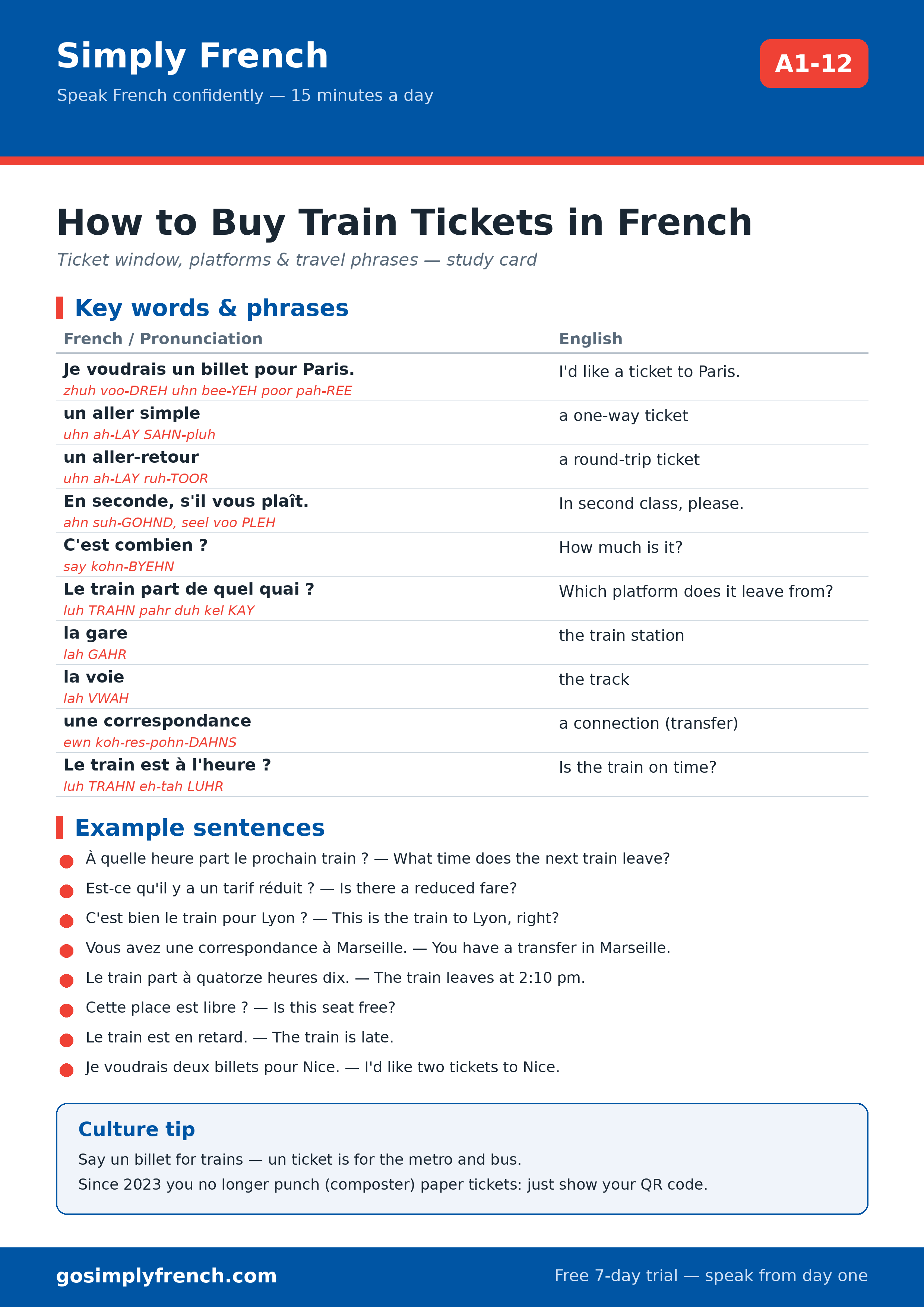
Download the printable study sheet (PDF): How to Buy Train Tickets in French — study sheet
France runs on rail. The TGV connects Paris to Lyon in two hours, regional TER trains reach villages no tour bus visits, and the whole network is far more pleasant when you can handle the ticket window in French. The good news: the conversation to buy train tickets in French is short, predictable, and built almost entirely from phrases you can learn in one sitting.
This lesson gives you the exact sentences for the ticket counter, the vocabulary for the departure board, and the platform phrases that keep you from boarding the wrong train. Every phrase below is what French speakers actually say — not textbook French from 1985.
Billet or ticket? Start with the right word
French uses two different words for what English calls a "ticket," and mixing them up is the classic beginner tell.
| French | English | Phonetic hint |
|---|---|---|
| un billet | a ticket (train, plane, event) | uhn bee-YEH |
| un ticket | a ticket (metro, bus, tram) | uhn tee-KEH |
For trains, always say un billet. Un billet de train pour Lyon — a train ticket to Lyon. Save un ticket for the Paris métro. If you say un ticket de train, people will understand you, but un billet marks you as someone who has done their homework.
The core sentence: je voudrais un billet pour...
Everything at the ticket window builds on one polite pattern you have already met if you followed our lesson on ordering food in French: je voudrais (I would like). It is the conditional of vouloir, and it is the single most useful phrase in transactional French.
| French | English |
|---|---|
| Je voudrais un billet pour Paris, s'il vous plaît. | I'd like a ticket to Paris, please. (zhuh voo-DREH uhn bee-YEH poor pah-REE) |
| Je voudrais deux billets pour Nice. | I'd like two tickets to Nice. |
| Un aller simple, s'il vous plaît. | A one-way ticket, please. (uhn ah-LAY SAHN-pluh) |
| Un aller-retour, s'il vous plaît. | A round-trip ticket, please. (uhn ah-LAY ruh-TOOR) |
| En seconde, s'il vous plaît. | In second class, please. (ahn suh-GOHND) |
| En première classe. | In first class. (ahn pruh-MYEHR klahs) |
| C'est combien ? | How much is it? (say kohn-BYEHN) |
| Est-ce qu'il y a un tarif réduit ? | Is there a reduced fare? (ess keel-ya uhn tah-REEF ray-DWEE) |
| À quelle heure part le prochain train pour Bordeaux ? | What time does the next train to Bordeaux leave? |
| Le train part de quel quai ? | Which platform does the train leave from? (kel KAY) |
Two ticket types cover nearly every trip. Un aller simple is a one-way ticket — literally "a simple go." Un aller-retour is a round trip — "a go-return." The agent will often ask you first: Aller simple ou aller-retour ? Now you can answer without freezing.
Prices and departure times come back at you as numbers, so this is also where your work on French numbers from 1 to 100 pays off. Vingt-quatre euros cinquante — 24.50 euros. If the number flies past you, ask: Vous pouvez répéter lentement, s'il vous plaît ? (Can you repeat slowly, please?)
Reading the departure board: essential station vocabulary
French stations are well signposted, but the signs are in French. These are the twelve words that matter.
| French | English | Phonetic hint |
|---|---|---|
| la gare | the train station | lah GAHR |
| le train | the train | luh TRAHN |
| le quai | the platform | luh KAY |
| la voie | the track | lah VWAH |
| le départ | the departure | luh day-PAHR |
| l'arrivée | the arrival | lah-ree-VAY |
| l'horaire | the schedule | loh-RAIR |
| la correspondance | the connection / transfer | lah koh-res-pohn-DAHNS |
| le guichet | the ticket window | luh ghee-SHEH |
| la borne | the self-service machine | lah BORN |
| en retard | late / delayed | ahn ruh-TAHR |
| à l'heure | on time | ah LUHR |
Watch for the distinction between le quai (the physical platform you stand on) and la voie (the numbered track). Departure boards usually show the voie — Voie 7 — a few minutes before departure, which is why you will see a crowd of French travelers staring up at the board, then suddenly walking fast.
Une correspondance is a connection. Vous avez une correspondance à Marseille — you have a transfer in Marseille. If you hear this word at the window, ask how long: J'ai combien de temps pour la correspondance ?
Asking for help on the platform
Once you have your billet, a few short questions cover the rest of the journey. If you followed our lesson on asking for directions in French, the pattern Où est... ? (Where is...?) will look familiar.
| French | English |
|---|---|
| Excusez-moi, où est le quai numéro trois ? | Excuse me, where is platform three? |
| C'est bien le train pour Lyon ? | This is the train to Lyon, right? |
| Cette place est libre ? | Is this seat free? |
| Le train est à l'heure ? | Is the train on time? |
| Où sont les toilettes, s'il vous plaît ? | Where are the toilets, please? |
C'est bien le train pour... ? is worth memorizing exactly. That little bien turns the sentence into "This IS the train to..., right?" — the confirmation question every traveler needs thirty seconds before the doors close.
A real conversation at the guichet
Here is how the whole exchange sounds at a ticket window in Lyon:
Vous : Bonjour, je voudrais un billet pour Paris, s'il vous plaît. L'agent : Bien sûr. Aller simple ou aller-retour ? Vous : Un aller-retour, s'il vous plaît. En seconde. L'agent : Le prochain train part à quatorze heures dix. Ça vous convient ? Vous : Oui, parfait. C'est combien ? L'agent : Quarante-huit euros. Vous : Très bien. Le train part de quel quai ? L'agent : Voie 5. Bon voyage ! Vous : Merci, bonne journée !
Notice the shape of the exchange: greeting first, request second, confirmation questions last. The bonjour is not optional — as in every French transaction, walking up to the window without a greeting starts the interaction on the wrong foot. Note also quatorze heures dix (14:10): French rail runs on the 24-hour clock, so a quick review of how to tell time in French before your trip is time well spent.
Reading this dialogue is one thing; saying it at a real counter with a queue behind you is another. This is exactly what you'll practice out loud in Lesson A1-12: Buying Train Tickets inside Simply French — you speak each line, and the AI scores your pronunciation instantly until aller-retour rolls out naturally.
Cultural notes: machines, apps, and the end of composting
The yellow machines are the norm now. Most travelers buy from les bornes libre-service (self-service machines) or the SNCF Connect app rather than the staffed guichet. The machines have an English option, but selecting French is free listening practice with zero risk — you can always start over. For live schedules and bookings, the official SNCF Connect site is the authoritative source.
You no longer need to composter. For decades, travelers had to validate paper tickets in orange punch machines before boarding — composter son billet — and forgetting meant a fine. The verb is real French: Larousse defines composter as validating a travel ticket by punching or stamping it. But since January 1, 2023, the SNCF no longer requires composting, because nearly all tickets are now digital with QR codes. The orange composteurs are disappearing from stations. If a guidebook tells you to hunt for the punch machine, it is out of date — just keep your e-billet ready on your phone.
Second class is not a downgrade. French trains' seconde is comfortable, and most French travelers use it. Première buys you a bit more space and quiet, not a different experience.
Book TGV tickets early. TGV and Intercités trains use dynamic pricing like airlines — the same aller simple can triple in price on the day of travel. Regional TER tickets, by contrast, have fixed prices and can be bought minutes before departure.
Frequently asked questions
How do I ask for a train ticket in French?
Say Je voudrais un billet pour [city], s'il vous plaît — "I'd like a ticket to [city], please." Start with bonjour, and specify un aller simple (one-way) or un aller-retour (round trip) when asked.
What is the difference between "aller simple" and "aller-retour"?
Un aller simple is a one-way ticket; un aller-retour is a round trip. The ticket agent will usually ask which one you want right after you name your destination.
Do I say "billet" or "ticket" for a train in French?
Use un billet for trains and planes, and un ticket for the metro, bus, or tram. Un billet de train is a train ticket; un ticket de métro is a metro ticket.
Do I still need to validate (composter) my train ticket in France?
No. Since January 1, 2023, the SNCF no longer requires paper tickets to be punched in the orange machines. Almost all tickets are digital now — just show the QR code on your phone to the conductor.
What is the difference between "quai" and "voie"?
Le quai is the physical platform you stand on; la voie is the numbered track. Departure boards typically announce the voie (e.g. Voie 7) shortly before the train leaves.
How early should I buy French train tickets?
For TGV and Intercités trains, book weeks ahead — prices rise like airfares. For regional TER trains, prices are fixed, so buying at the station minutes before departure costs the same.
Related lessons
- How to Check Into a Hotel in French (A1-11) — the natural next step once your train arrives
- How to Ask for Directions in French (A1-8) — find the gare in the first place
- How to Tell Time in French (A1-7) — master the 24-hour clock the SNCF uses
- French Numbers 1-100 (A1-4) — understand prices and platform numbers instantly
Practice out loud before you travel
You can read every phrase on this page and still freeze at the guichet — because reading and speaking are different skills. Simply French's 15-minutes-a-day method fixes that: you listen to these exact phrases at native speed, say them out loud, and get instant AI pronunciation scoring until the words come out on their own. Start your free 7-day trial at gosimplyfrench.com and have Lesson A1-12 down before your next trip.
Bon voyage !
Tags
Now find out how you actually sound.
Simply French listens to you say each sentence and scores it word by word, so you can hear the difference you have just read about — and fix it while it is still fresh.
Takes about 10 minutes. No card needed to start.
Related Articles
T'as, Y'a, Chuis: Say Spoken French the Way It's Actually Said
Tu becomes t', il becomes i, il y a becomes y'a. The three families of French spoken contractions, why they exist, and 50 lines to drill out loud until they stop sounding like a different language.
How to Tell If Your French Accent Is Actually Good (Self-Test)
You cannot hear your own French accent — your ear filters it through English. Six self-tests that isolate what English speakers actually get wrong, each one you can check on your own, plus a 12-point scorecard.
How to Talk About Hobbies in French (A1-21)
Learn to talk about hobbies in French with 40+ phrases, the faire de vs jouer a rule, pronunciation hints, a sample dialogue and a free printable study sheet.