
How to Describe People in French (A1-17)
Learn how to describe people in French: appearance, hair, eyes, and personality adjectives with pronunciation, agreement rules, and real example sentences.
Simply French Team
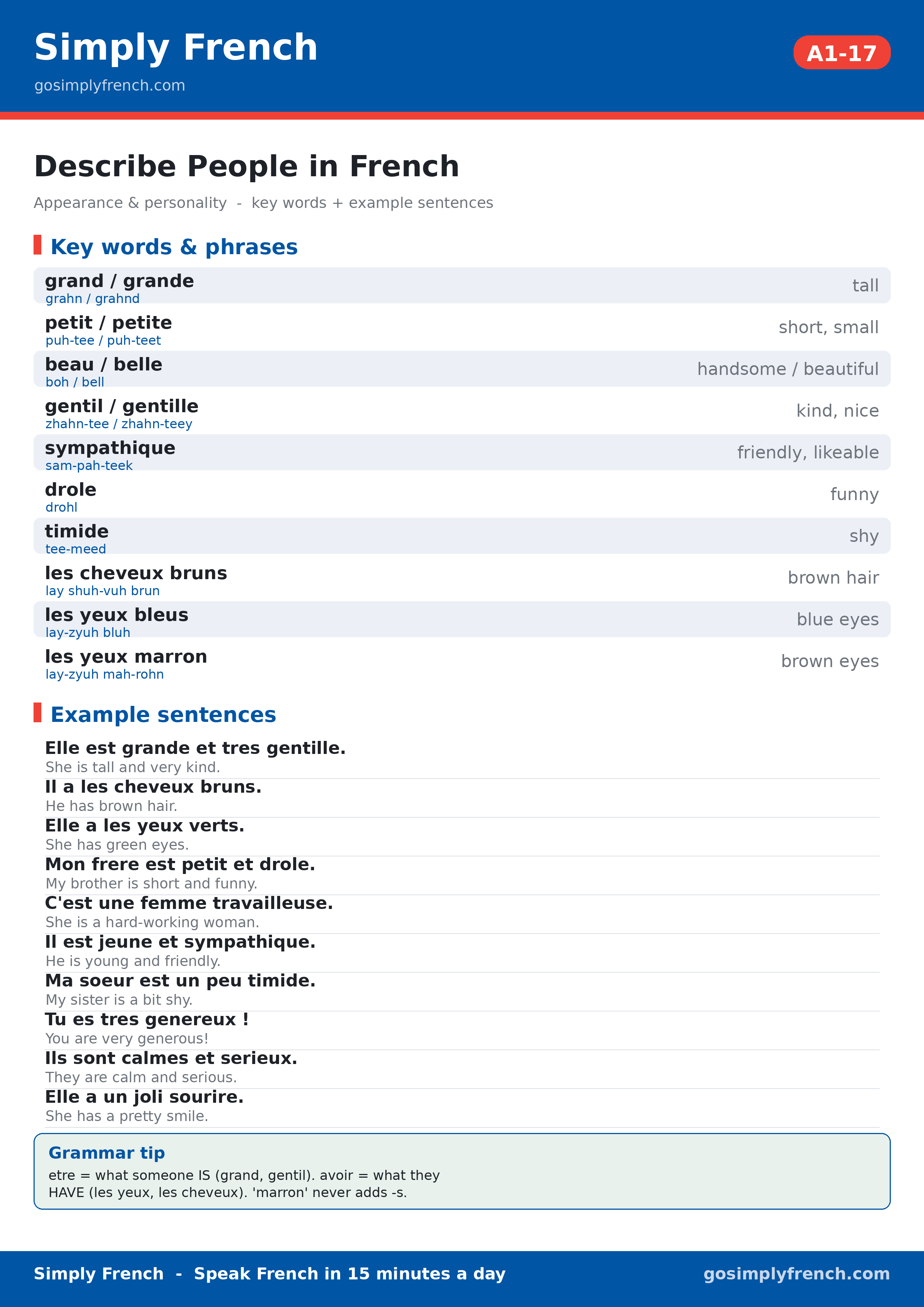
Download the printable study sheet (PDF): Describe People in French study sheet
Being able to describe people in French is one of the most useful everyday skills you can build early. You use it to point out a friend in a crowd, tell a hotel receptionist who you are waiting for, gossip kindly about a coworker, or simply answer "What's she like?" When you can describe people in French with confidence, ordinary conversations suddenly open up, because almost every story you tell involves a person.
The good news: you only need a handful of verbs and a well-chosen set of adjectives. The trick that trips up most beginners is not vocabulary at all. It is agreement — the way a French adjective changes its ending to match whether you are talking about a man or a woman, one person or several. Get that pattern into your ear and mouth, and describing people becomes automatic.
The two verbs you need: être and avoir
French splits descriptions between two verbs, and knowing which one to reach for is half the battle.
Use être (to be) for qualities the person is — tall, kind, young, funny:
- Elle est grande. — She is tall.
- Il est gentil. — He is kind.
Use avoir (to have) for features the person has — hair, eyes, freckles:
- Elle a les cheveux bruns. — She has brown hair.
- Il a les yeux bleus. — He has blue eyes.
Notice that English says "she has brown hair" but French says les cheveux bruns — literally "the brown hair." French uses the definite article les here, not a possessive. This small difference sounds instantly natural once you get used to it.
Core adjectives for physical appearance
Here is your starter set for talking about how someone looks. The masculine form is listed first, then the feminine.
| French (m / f) | Phonetic hint | English |
|---|---|---|
| grand / grande | grahn / grahnd | tall, big |
| petit / petite | puh-tee / puh-teet | short, small |
| beau / belle | boh / bell | handsome / beautiful |
| joli / jolie | zho-lee | pretty |
| jeune / jeune | zhun | young |
| vieux / vieille | vyuh / vyay | old |
| mince / mince | mans | slim |
| fort / forte | for / fort | strong, sturdy |
A few of these — grand, petit, beau, joli, jeune, vieux — belong to a small group that goes before the noun: une petite fille (a little girl), un beau garçon (a handsome boy). Most other adjectives come after the noun, so this early group is worth memorizing as exceptions.
Hair and eyes
These almost always use avoir. Say Il a les cheveux… or Elle a les yeux… and add the color.
| French | Phonetic hint | English |
|---|---|---|
| les cheveux bruns | lay shuh-vuh brun | brown hair |
| les cheveux blonds | lay shuh-vuh blohn | blond hair |
| les cheveux châtains | lay shuh-vuh shah-tan | light-brown/chestnut hair |
| les cheveux roux | lay shuh-vuh roo | red hair |
| les cheveux gris | lay shuh-vuh gree | grey hair |
| les yeux bleus | lay-zyuh bluh | blue eyes |
| les yeux verts | lay-zyuh vair | green eyes |
| les yeux marron | lay-zyuh mah-rohn | brown eyes |
One color to watch: marron (brown, for eyes) never changes its ending. You say les yeux marron, not les yeux marrons, because marron comes from the noun for a chestnut and stays invariable — a point confirmed by the Le Robert entry for "yeux marron". The same is true of orange. Every other color adjective on this list agrees normally.
This is exactly what you'll practice out loud in Lesson A1-17: Describing People and Personality inside Simply French, where the AI listens to your cheveux and yeux and scores your pronunciation on the spot.
Personality adjectives that do the heavy lifting
Appearance is a nice opener, but personality is where descriptions get interesting. These adjectives use être.
| French (m / f) | Phonetic hint | English |
|---|---|---|
| gentil / gentille | zhahn-tee / zhahn-teey | kind, nice |
| sympathique | sam-pah-teek | friendly, likeable |
| drôle | drohl | funny |
| timide | tee-meed | shy |
| sérieux / sérieuse | say-ryuh / say-ryuhz | serious |
| travailleur / travailleuse | trah-vah-yur / trah-vah-yuhz | hard-working |
| bavard / bavarde | bah-var / bah-vard | talkative, chatty |
| calme | kalm | calm |
| têtu / têtue | tay-tü | stubborn |
| généreux / généreuse | zhay-nay-ruh / zhay-nay-ruhz | generous |
The everyday word for "nice" is gentil, and its feminine gentille is worth saying aloud a few times because the ending softens to a "y" sound; the Larousse entry for "gentil" is a good reference for its shades of meaning. Sympathique (often shortened to sympa in speech) is the go-to compliment for someone you like — Elle est super sympa means "She's really nice."
The agreement rule, made simple
Every adjective you have seen changes to match the person. Here is the pattern that covers the large majority of cases:
- Masculine singular: the base form — Il est grand.
- Feminine singular: usually add -e — Elle est grande.
- Masculine plural: usually add -s — Ils sont grands.
- Feminine plural: add -es — Elles sont grandes.
Adjectives that already end in -e (calme, timide, drôle, jeune, sympathique) do not change in the feminine — Il est calme and Elle est calme look identical. Some have their own feminine forms worth learning as pairs: beau → belle, vieux → vieille, gentil → gentille, sérieux → sérieuse, travailleur → travailleuse. Learn these as two-word chunks and you will rarely stumble.
One reassuring fact for speakers: many of these endings are silent, so grand and grands sound the same. The -e in the feminine, though, often makes a previously silent consonant come alive — grande clearly voices the "d." Training your ear to hear that difference is one of the fastest ways to sound native.
Putting it together: full sentences
| French | English |
|---|---|
| Mon frère est grand et il a les cheveux bruns. | My brother is tall and has brown hair. |
| Ma sœur est petite et très drôle. | My sister is short and very funny. |
| Elle a les yeux verts et un joli sourire. | She has green eyes and a pretty smile. |
| Mon voisin est un peu timide mais très gentil. | My neighbor is a bit shy but very kind. |
| C'est une femme sérieuse et travailleuse. | She is a serious, hard-working woman. |
| Il est jeune, sympathique et toujours calme. | He is young, friendly, and always calm. |
Notice un peu (a little) and très (very) doing the work of softening or strengthening. Adding très, un peu, assez (fairly), or trop (too) in front of an adjective instantly makes your description sound more human and less like a textbook list.
A quick cultural note
The French tend to describe personality with a light touch and often reach for understatement. Rather than gushing, a French speaker might say someone is sympa or pas mal (not bad) as genuine praise. Physical descriptions among friends are common and rarely considered rude, but commenting on a stranger's looks is best kept to yourself. When in doubt, gentil(le) and sympathique are always safe, warm compliments.
Frequently asked questions
How do I describe a woman versus a man in French?
The vocabulary is the same, but the adjective ending changes to agree with gender. For a man use the masculine form (Il est grand), and for a woman usually add -e (Elle est grande). Some adjectives have special feminine forms to memorize, such as beau → belle and gentil → gentille.
Do I use être or avoir to describe someone?
Use être for what someone is — traits and qualities like tall, kind, or funny (Elle est drôle). Use avoir for features someone has, especially hair and eyes (Il a les yeux bleus). Matching the right verb to the right kind of description is the key habit to build.
Why doesn't "marron" change to agree with "les yeux"?
Because marron originally names a chestnut and is treated as invariable when used as a color, so it never takes an -s or -e. You always write les yeux marron. The color orange behaves the same way, while ordinary colors like bleu and vert agree normally.
Where do adjectives go — before or after the noun?
Most French adjectives come after the noun (une personne gentille). A small, common group comes before it: beauty, age, goodness, and size words like beau, joli, jeune, vieux, bon, grand, and petit. Learn that short group as exceptions and place everything else after the noun.
What's the easiest way to start describing people out loud?
Begin with one person you know well and build a three-part sentence: a être trait, an avoir feature, and a personality word — for example Ma mère est petite, elle a les cheveux gris et elle est très gentille. Repeating that frame with different people trains both the grammar and your pronunciation.
Related lessons
- How to Introduce Yourself in French — the natural first step before you start describing others.
- How to Talk About Your Family in French — the perfect people to practice your new adjectives on.
- How to Talk About Your Job in French — describe what people do as well as what they are like.
- How to Say How Are You in French — pair descriptions with everyday small talk.
Practice describing people out loud
Reading adjectives is easy; producing them at conversation speed, with the right agreement and a clean accent, takes reps. Inside Simply French, Lesson A1-17 has you describe real people out loud, listen to native audio at natural speed, and get instant AI pronunciation scoring so you can hear whether your gentille and travailleuse land. Fifteen focused minutes a day is enough to make it stick. Start your free 7-day trial of Simply French and describe your first person in French today.
Tags
Now find out how you actually sound.
Simply French listens to you say each sentence and scores it word by word, so you can hear the difference you have just read about — and fix it while it is still fresh.
Takes about 10 minutes. No card needed to start.
Related Articles
You Understand French But Can't Speak It — Here's the Missing Step
You can follow the podcast and still freeze when someone asks you a question. Three separate bottlenecks produce that gap — ten minutes of tests to find which one is yours, and what each one actually needs.
How to Say Hello and Goodbye in French
Learn how to say hello and goodbye in French — bonjour, salut, au revoir, and more — with formal vs. informal tips, pronunciation, and cultural notes.
How to Introduce Yourself in French: A1 Speaking Guide
Learn how to introduce yourself in French with simple phrases for your name, origin, and job, plus polite greetings and full example lines you can say today.