
How to Order Food in French: 50+ Phrases for Confident Dining
Learn how to order food in French with 50+ real restaurant phrases, from 'Je voudrais' to 'L'addition, s'il vous plaît.' A beginner guide you'll actually use.
Simply French Team
How to Order Food in French: 50+ Phrases for Confident Dining
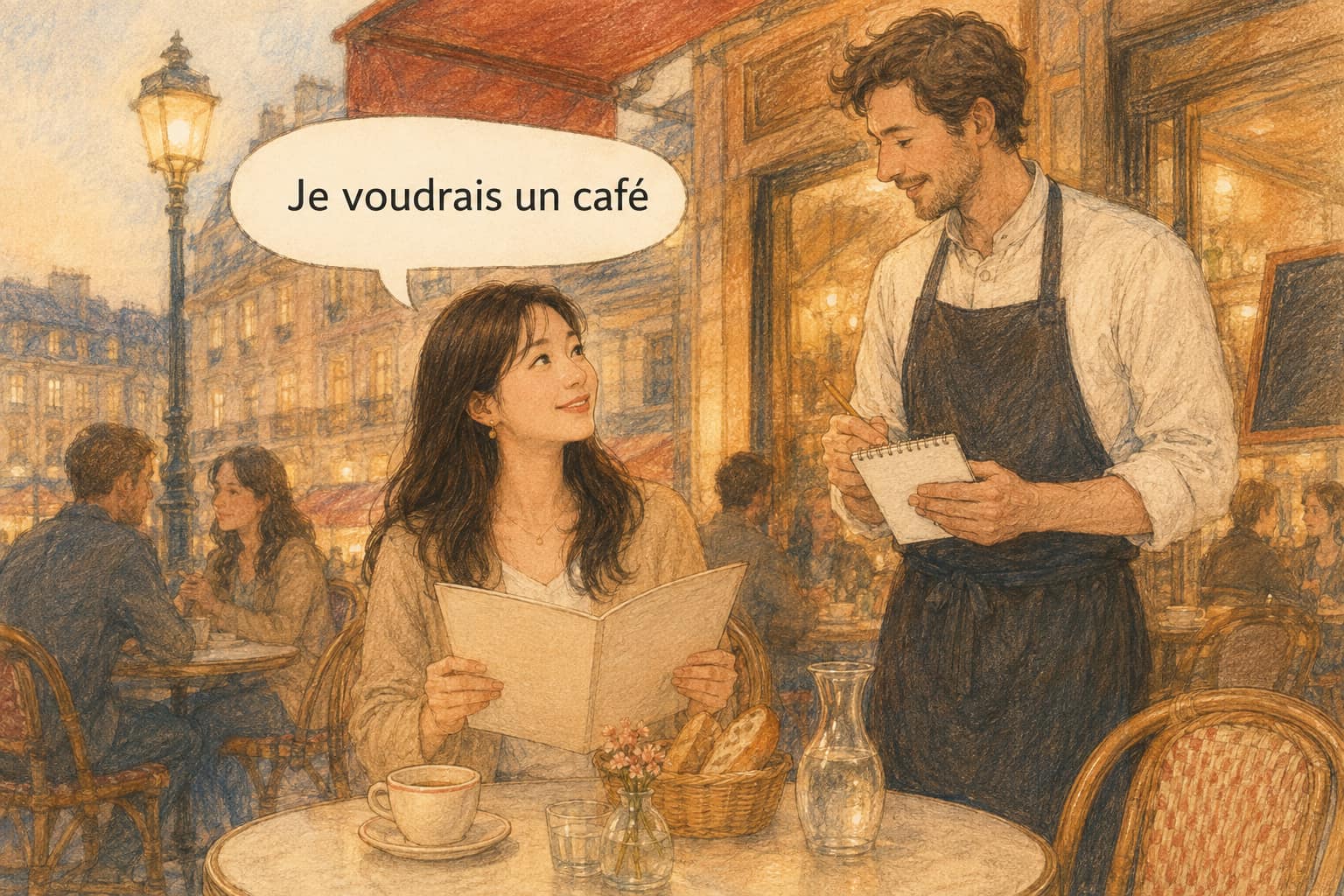
Standing in a Paris café, menu in hand, heart racing as the waiter approaches — and all you can manage is a nervous "Je voudrais un... um..." If that sounds familiar, you're in the right place. Learning how to order food in French is one of the fastest ways to feel genuinely capable in the language, because it's something you'll use the very next time you travel (or even at your local bistro).
This guide walks you through every stage of a French meal, from being seated to paying the bill, with the exact phrases native speakers actually use. No dusty grammar rules — just practical French restaurant phrases you can memorize today and use tomorrow.
Why ordering food is the perfect first French skill
Restaurant French is high-value for a simple reason: it's predictable. A meal follows the same steps almost every time, which means a small set of phrases covers 90% of what you'll need to say. Master this handful of expressions and you'll handle a real conversation from start to finish — a huge confidence boost early in your learning.
It's also deeply cultural. In France, food is taken seriously, and showing that you've made an effort to order politely in French earns you warmth and respect from servers. A little "Bonjour" goes a long way.
Step 1: Getting seated
Before you order anything, you'll need a table. The golden rule of French politeness: always greet the staff first. Walking in and immediately asking for something feels rude to French ears.
| French | English |
|---|---|
| Bonjour ! | Hello! (say this first, always) |
| Une table pour deux, s'il vous plaît. | A table for two, please. |
| Une table pour deux personnes, s'il vous plaît. | A table for two people, please. |
| Avez-vous une table en terrasse ? | Do you have a table on the terrace? |
| Nous avons une réservation au nom de… | We have a reservation under the name… |
Step 2: Asking for the menu
Once seated, you'll want to see your options. Note that la carte means the à la carte menu, while le menu often refers to a fixed-price set meal — a useful distinction in France.
| French | English |
|---|---|
| La carte, s'il vous plaît. | The menu, please. |
| Puis-je avoir la carte des vins ? | May I have the wine list? |
| Quel est le plat du jour ? | What is the dish of the day? |
| Qu'est-ce que vous recommandez ? | What do you recommend? |
| Quelles sont vos spécialités ? | What are your specialties? |
Step 3: How to order food in French
Here's the heart of it. The single most useful structure is "Je voudrais…" (I would like…). It's polite, it's correct, and it works in almost every ordering situation. An equally natural alternative is "Je vais prendre…" (I'll have…).
| French | English |
|---|---|
| Je voudrais le poulet, s'il vous plaît. | I would like the chicken, please. |
| Je vais prendre la soupe. | I'll have the soup. |
| Pour moi, le steak-frites. | For me, the steak and fries. |
| Comme entrée, je voudrais la salade. | For a starter, I'd like the salad. |
| Et comme plat principal, le saumon. | And for the main course, the salmon. |
| C'est tout, merci. | That's all, thank you. |
Pro tip: "Je voudrais" is the conditional form of "vouloir" (to want). Using it instead of the blunt "Je veux" ("I want") is what makes you sound polite rather than demanding. This one small swap instantly upgrades your French.
Step 4: Ordering drinks (and coffee like a local)
Want to blend in? Skip the bottled water. Simply ask for une carafe d'eau and you'll get a free jug of tap water — completely normal and expected in France.
| French | English |
|---|---|
| Une carafe d'eau, s'il vous plaît. | A jug of tap water, please. |
| De l'eau plate ou gazeuse ? | Still or sparkling water? |
| Un verre de vin rouge, s'il vous plaît. | A glass of red wine, please. |
| Un café, s'il vous plaît. | A coffee (espresso), please. |
| Un crème, s'il vous plaît. | A coffee with milk, please. |
| Une noisette. | An espresso with a dash of milk. |
A quick note on ordering coffee in French: if you ask for un café, you'll get a small espresso, not a large American-style coffee. For something closer to a latte, order un crème (short for café crème).
Step 5: Dietary restrictions and allergies
If you have dietary needs, speak up as soon as you're seated so the kitchen can plan ahead. Be specific — vegetarianism is less common in France, so it helps to spell out exactly what you can't eat.
| French | English |
|---|---|
| Je suis végétarien. / Je suis végétarienne. | I'm vegetarian. (m. / f.) |
| Je suis végan. / Je suis végane. | I'm vegan. (m. / f.) |
| Je ne mange ni viande ni poisson. | I don't eat meat or fish. |
| Je suis allergique aux fruits de mer. | I'm allergic to seafood. |
| Sans gluten, s'il vous plaît. | Gluten-free, please. |
| Est-ce qu'il y a de la viande dans ce plat ? | Is there meat in this dish? |
Step 6: During and after the meal
A few phrases smooth over the rest of the experience — asking for something extra, complimenting the food, and settling up.
| French | English |
|---|---|
| Excusez-moi… | Excuse me… (to get the waiter's attention) |
| Encore du pain, s'il vous plaît. | More bread, please. |
| C'était délicieux ! | It was delicious! |
| L'addition, s'il vous plaît. | The bill, please. |
| Est-ce que je peux payer par carte ? | Can I pay by card? |
| Gardez la monnaie. | Keep the change. |
The one phrase to burn into memory here is "L'addition, s'il vous plaît." In France, servers won't rush you or bring the bill until you ask — so this is how you signal you're ready to leave.
A full ordering conversation, start to finish
Here's how it all fits together in a real exchange:
You: Bonjour ! Une table pour deux, s'il vous plaît.
Waiter: Bien sûr. Suivez-moi.
You: La carte, s'il vous plaît… Qu'est-ce que vous recommandez ?
Waiter: Le plat du jour est excellent : le poulet rôti.
You: Parfait. Je voudrais le poulet, et une carafe d'eau, s'il vous plaît.
(after the meal)You: C'était délicieux ! L'addition, s'il vous plaît.
Read that a few times out loud. Notice how the same five or six phrases carry the entire conversation. That's the beauty of restaurant French.
The fastest way to actually remember these phrases
Reading a phrase list is easy. Recalling it under pressure, with a waiter waiting and other diners nearby, is the hard part. The gap between knowing a phrase and saying it confidently comes down to one thing: speaking practice out loud, before you ever set foot in the restaurant.
That's exactly what Simply French is built for. In just 15 minutes a day, you'll listen to real French, repeat phrases out loud, and get instant AI-powered pronunciation scores — like having a patient tutor available 24/7. You make your mistakes with a friendly app instead of a judgmental waiter, so by the time you order in real life, it already feels natural.
Start your 7-day free trial → and order your first café like a local.
Frequently asked questions
How do you say "I would like" when ordering food in French?
Say "Je voudrais…" (zhuh voo-DRAY), which means "I would like." It's the polite conditional form and works for almost any order — for example, "Je voudrais le poulet, s'il vous plaît" ("I would like the chicken, please").
How do you ask for the bill in French?
Say "L'addition, s'il vous plaît" (lah-dee-see-YON, seel voo PLEH), meaning "The bill, please." In France, the waiter won't bring your bill until you ask for it, so this phrase is essential.
How do you order a coffee in French?
Ask for "Un café, s'il vous plaît" to get a small espresso. If you'd prefer coffee with milk, order "un crème" instead. A regular café in France is much smaller than a typical American coffee.
What's the difference between "la carte" and "le menu" in France?
"La carte" is the full à la carte list of individual dishes, while "le menu" usually refers to a fixed-price set meal with several courses. If you want to choose dishes individually, ask for la carte.
Do I need to tip in a French restaurant?
Service is included by law (service compris), so tipping isn't required. It's common to leave a small amount — rounding up or a few euros — if you enjoyed the meal, but it's entirely optional.
Tags
Now find out how you actually sound.
Simply French listens to you say each sentence and scores it word by word, so you can hear the difference you have just read about — and fix it while it is still fresh.
Takes about 10 minutes. No card needed to start.
Related Articles
You Understand French But Can't Speak It — Here's the Missing Step
You can follow the podcast and still freeze when someone asks you a question. Three separate bottlenecks produce that gap — ten minutes of tests to find which one is yours, and what each one actually needs.
How to Say Hello and Goodbye in French
Learn how to say hello and goodbye in French — bonjour, salut, au revoir, and more — with formal vs. informal tips, pronunciation, and cultural notes.
How to Introduce Yourself in French: A1 Speaking Guide
Learn how to introduce yourself in French with simple phrases for your name, origin, and job, plus polite greetings and full example lines you can say today.