
How to Order Food in French (A1-10)
Learn how to order food in French with polite phrases, pronunciation hints, and a real restaurant dialogue. Speak confidently at any French café or bistro.
Simply French Team
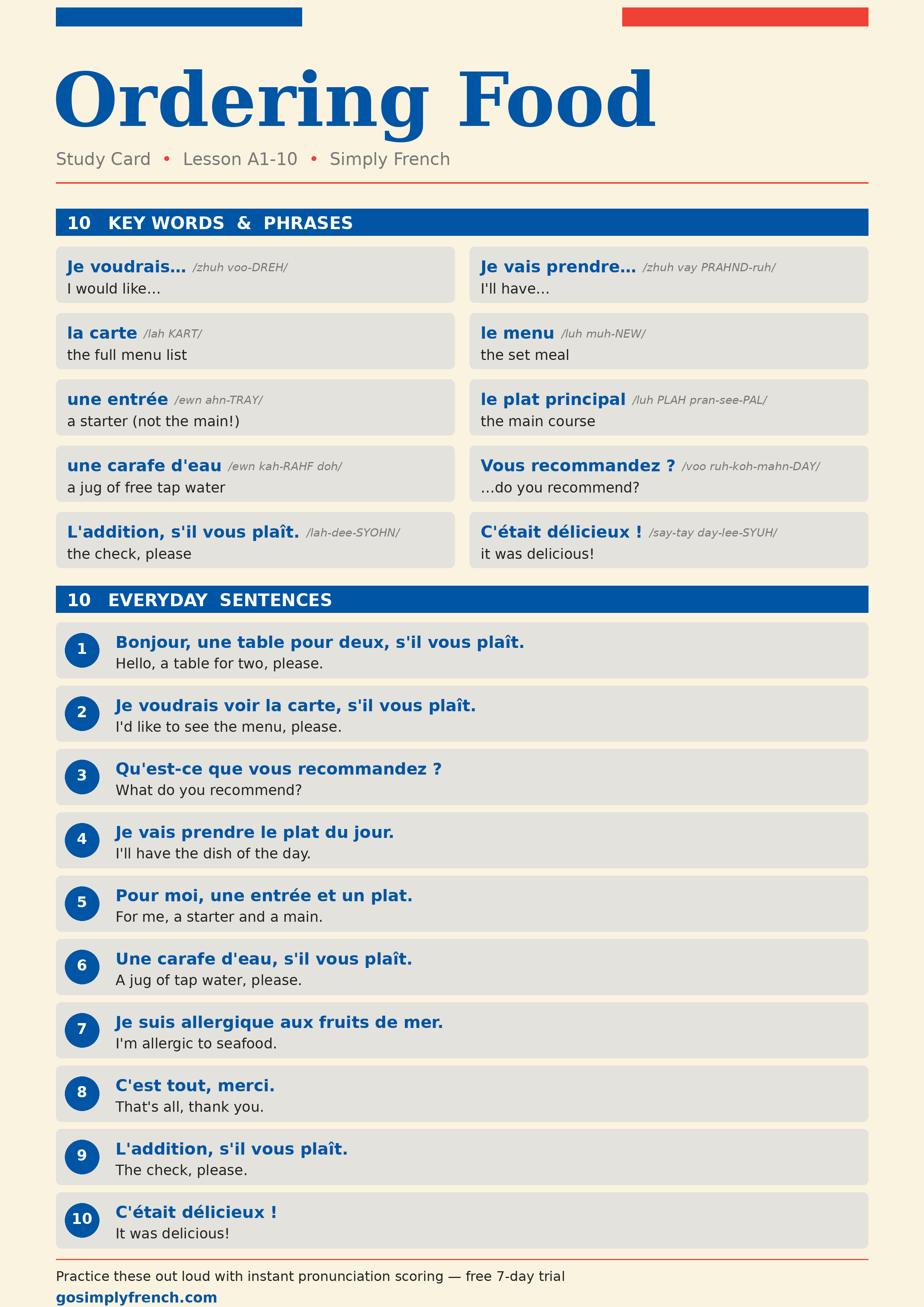
Save this study card, then practice the phrases out loud.
Download the printable study sheet (PDF): how-to-order-food-in-french-study-sheet.pdf
Sitting down at a Parisian café or a small village bistro is one of the great joys of travel — until the waiter appears, notebook in hand, and your mind goes blank. The good news: learning how to order food in French takes far fewer words than you think. With a handful of polite phrases and a little practice saying them out loud, you can walk into any restaurant in France and order like you belong there.
This guide gives you every phrase you need, from getting a table to asking for the check, with simple pronunciation hints and real example sentences. By the end you'll know exactly how to order food in French without freezing, pointing, or defaulting to English.
Why ordering food in French matters more than you'd expect
In France, sitting down to eat is a small ritual, and the language you use is part of the etiquette. A polite "Bonjour" and a well-placed "s'il vous plaît" signal that you respect the table you're at — and French servers notice. Making the effort to order in French, even imperfectly, almost always earns you warmer service and a more relaxed meal.
The other reason this lesson is so useful: the phrases repeat everywhere. The same structures you use to order a coffee work for ordering a three-course dinner, buying a pastry, or grabbing a sandwich at a train station. Master this skill once, and you've unlocked dozens of everyday situations.
Start with a greeting (always)
Before you order anything, greet the person. In France, walking up and launching straight into a request feels abrupt. A simple greeting opens every interaction warmly. If you want a full refresher on this, see our lesson on how to say hello and goodbye in French.
| French | English | Pronunciation hint |
|---|---|---|
| Bonjour ! | Hello! (daytime) | bohn-ZHOOR |
| Bonsoir ! | Good evening! | bohn-SWAHR |
| Une table pour deux, s'il vous plaît. | A table for two, please. | ewn TAH-bluh poor DUH |
| Vous avez une table ? | Do you have a table? | vooz ah-VAY ewn TAH-bluh |
The key phrases for how to order food in French
Here's the core toolkit. These are the phrases native speakers actually use, and they'll carry you through the entire meal. Notice how often "s'il vous plaît" appears — politeness is doing a lot of the work.
| French | English | Pronunciation hint |
|---|---|---|
| Je voudrais… | I would like… | zhuh voo-DREH |
| Je vais prendre… | I'll have… | zhuh vay PRAHND-ruh |
| Pour moi, … | For me, … | poor MWAH |
| Qu'est-ce que vous recommandez ? | What do you recommend? | kess-kuh voo ruh-koh-mahn-DAY |
| Je suis allergique à… | I'm allergic to… | zhuh swee zah-lair-ZHEEK ah |
| L'addition, s'il vous plaît. | The check, please. | lah-dee-SYOHN seel voo PLEH |
| C'était délicieux ! | It was delicious! | say-tay day-lee-SYUH |
The single most useful phrase here is Je voudrais ("I would like"). It's the polite conditional form, and it works for absolutely everything: a dish, a drink, the menu, the bill. The dictionary Larousse defines the verb commander — "to order" — as asking, in a restaurant or café, that certain dishes or drinks be served. But in practice, French speakers rarely say "je commande"; they soften it to je voudrais or je vais prendre. Avoid "je veux" ("I want") — it's grammatically correct but sounds blunt, almost demanding, at a table.
This is exactly what you'll practice out loud in Lesson A1-10: Ordering Food inside Simply French, with instant pronunciation scoring so you know your je voudrais actually lands before you're standing in front of a real waiter.
"La carte" vs "le menu": the trap that catches everyone
Here's the mistake nearly every English speaker makes on their first trip. In English, "menu" means the list of everything you can order. In French, it's the opposite of what you expect:
| French | What it actually means | Pronunciation hint |
|---|---|---|
| la carte | the full à la carte list of everything | lah KART |
| le menu | a fixed-price set meal (starter + main, etc.) | luh muh-NEW |
| le plat du jour | the dish of the day | luh PLAH dew ZHOOR |
| la formule | a fixed-price combo, often lunch | lah for-MEWL |
So if you want to browse everything, ask for la carte, not "le menu." If you say "le menu," the server will point you to the set-price options — which are often a great deal, but not what you meant if you wanted the full list. When you want the complete choices, say: "La carte, s'il vous plaît."
Talking about the food itself
Once you have the carte in hand, these words help you navigate the courses and describe what you want. French meals are structured, and knowing the parts makes ordering smooth.
| French | English | Pronunciation hint |
|---|---|---|
| une entrée | a starter (not the main course!) | ewn ahn-TRAY |
| le plat principal | the main course | luh PLAH pran-see-PAL |
| le dessert | dessert | luh deh-SAIR |
| une boisson | a drink | ewn bwah-SOHN |
| une carafe d'eau | a jug of free tap water | ewn kah-RAHF doh |
| l'addition | the bill / check | lah-dee-SYOHN |
Two quick cultural notes. First, une entrée is a starter, not the main dish — another false friend that trips up English speakers. Second, you can always ask for une carafe d'eau, a jug of ordinary tap water, which is free and completely normal to request. You don't have to buy bottled water.
A real ordering dialogue, start to finish
Here's how a whole interaction flows. Read it out loud — that's how it sticks.
You: Bonjour ! Une table pour deux, s'il vous plaît. (Hello! A table for two, please.)
Server: Bien sûr, suivez-moi. (Of course, follow me.)
You: La carte, s'il vous plaît. (The menu, please.)
You: Qu'est-ce que vous recommandez ? (What do you recommend?)
Server: Le plat du jour, c'est le poulet rôti. (The dish of the day is roast chicken.)
You: Très bien. Je vais prendre le plat du jour. Et une carafe d'eau, s'il vous plaît. (Very good. I'll have the dish of the day. And a jug of tap water, please.)
Server: Une entrée aussi ? (A starter as well?)
You: Non merci, c'est tout. (No thank you, that's all.)
…later…
You: C'était délicieux ! L'addition, s'il vous plaît. (It was delicious! The check, please.)
Notice that last line: in France the server won't bring the bill until you ask, because lingering at the table is part of the experience. You have to request l'addition yourself.
Handling special requests and dietary needs
Traveling with an allergy or a preference? These phrases keep you safe and clear:
| French | English | Pronunciation hint |
|---|---|---|
| Je suis allergique aux fruits de mer. | I'm allergic to seafood. | zhuh swee zah-lair-ZHEEK oh frwee duh MAIR |
| Je suis végétarien(ne). | I'm vegetarian. | zhuh swee vay-zhay-tah-RYAN / RYEN |
| Sans gluten, c'est possible ? | Gluten-free, is that possible? | sahn glew-TEN say poh-SEEBL |
| Il y a de la viande dedans ? | Is there meat in it? | eel-YAH duh lah VYAHND duh-DAHN |
Numbers make ordering easier
Ordering "two coffees" or "a table for four" means you'll need your numbers ready. If they feel shaky, spend five minutes with our guide to French numbers 1 to 100 before your trip — it pays off the moment you say "une table pour trois."
And once the meal is over, the transaction feels a lot like paying in a shop. The same politeness and phrasing you learned in how to go shopping in French apply directly at the register.
Cultural tips for the table
A few small habits will make you feel — and sound — much more at home:
Greet before you order, always. "Bonjour" first, request second. Skipping the greeting is the fastest way to seem rude, even if your French is perfect.
Keep "s'il vous plaît" flowing. Attach it to nearly every request. It's the politeness glue of French service, and pairs naturally with the manners you practiced in please and thank you in French.
Don't rush the check. Meals are unhurried. Ask for l'addition only when you're genuinely ready to leave.
Tipping is optional. Service is included by law (service compris), so a tip is a small extra for good service, not an obligation.
Practice out loud before you go
Reading these phrases is a start, but ordering food in French is a speaking skill — and speaking only gets comfortable through repetition, out loud, at something close to real speed. That's the whole idea behind Simply French: 15 minutes a day of listening at native pace and speaking drills, with AI pronunciation scoring that tells you instantly whether your "Je voudrais…" sounds right. Start your free 7-day trial and practice this exact restaurant scenario until it's automatic.
Frequently asked questions
What's the most polite way to order food in French?
Use Je voudrais ("I would like") or Je vais prendre ("I'll have"), always followed by s'il vous plaît. Both are softer and more polite than Je veux ("I want"), which can sound demanding at a table. Starting with Bonjour before you order matters just as much as the phrase itself.
What's the difference between "la carte" and "le menu"?
La carte is the full à la carte list of everything the restaurant offers. Le menu is a fixed-price set meal, usually a starter and main (and sometimes dessert) for one price. If you want to see all the choices, ask for la carte, not "le menu."
How do I ask for the bill in French?
Say "L'addition, s'il vous plaît" (lah-dee-SYOHN seel voo PLEH). In France the server won't bring the check automatically — lingering is normal — so you need to ask when you're ready to pay.
Is tap water free at French restaurants?
Yes. Ask for une carafe d'eau (ewn kah-RAHF doh), a jug of ordinary tap water. It's free and a completely normal request, so you never have to buy bottled water unless you want to.
What does "une entrée" mean in French?
It means the starter or first course — not the main dish, as "entrée" does in American English. The main course is le plat principal. This false friend catches a lot of English speakers off guard.
Do I need to tip when ordering food in French?
Not really. Service is included by law (service compris), so tipping is optional. Rounding up or leaving a euro or two for especially good service is appreciated but never expected.
Related lessons
Tags
Now find out how you actually sound.
Simply French listens to you say each sentence and scores it word by word, so you can hear the difference you have just read about — and fix it while it is still fresh.
Takes about 10 minutes. No card needed to start.
Related Articles
T'as, Y'a, Chuis: Say Spoken French the Way It's Actually Said
Tu becomes t', il becomes i, il y a becomes y'a. The three families of French spoken contractions, why they exist, and 50 lines to drill out loud until they stop sounding like a different language.
How to Tell If Your French Accent Is Actually Good (Self-Test)
You cannot hear your own French accent — your ear filters it through English. Six self-tests that isolate what English speakers actually get wrong, each one you can check on your own, plus a 12-point scorecard.
How to Talk About Hobbies in French (A1-21)
Learn to talk about hobbies in French with 40+ phrases, the faire de vs jouer a rule, pronunciation hints, a sample dialogue and a free printable study sheet.