
How to Say How Are You in French
Learn how to say how are you in French the casual way: master ça va, comment ça va, quoi de neuf and natural replies with easy pronunciation and examples.
Simply French Team
Once you can say bonjour, the very next thing a French conversation asks of you is a friendly "how are you?" Knowing how to say how are you in French, and just as importantly how to answer it, is what turns a stiff greeting into a real exchange. The good news: casual French leans on one tiny, endlessly useful phrase — ça va — and a handful of natural replies you can learn in a single sitting.
In this beginner lesson you will learn how to say how are you in French with friends and peers, how to reply whether you feel great or a little "meh," and how to keep the small talk flowing. Every phrase comes with a simple pronunciation hint and an example you can copy today.
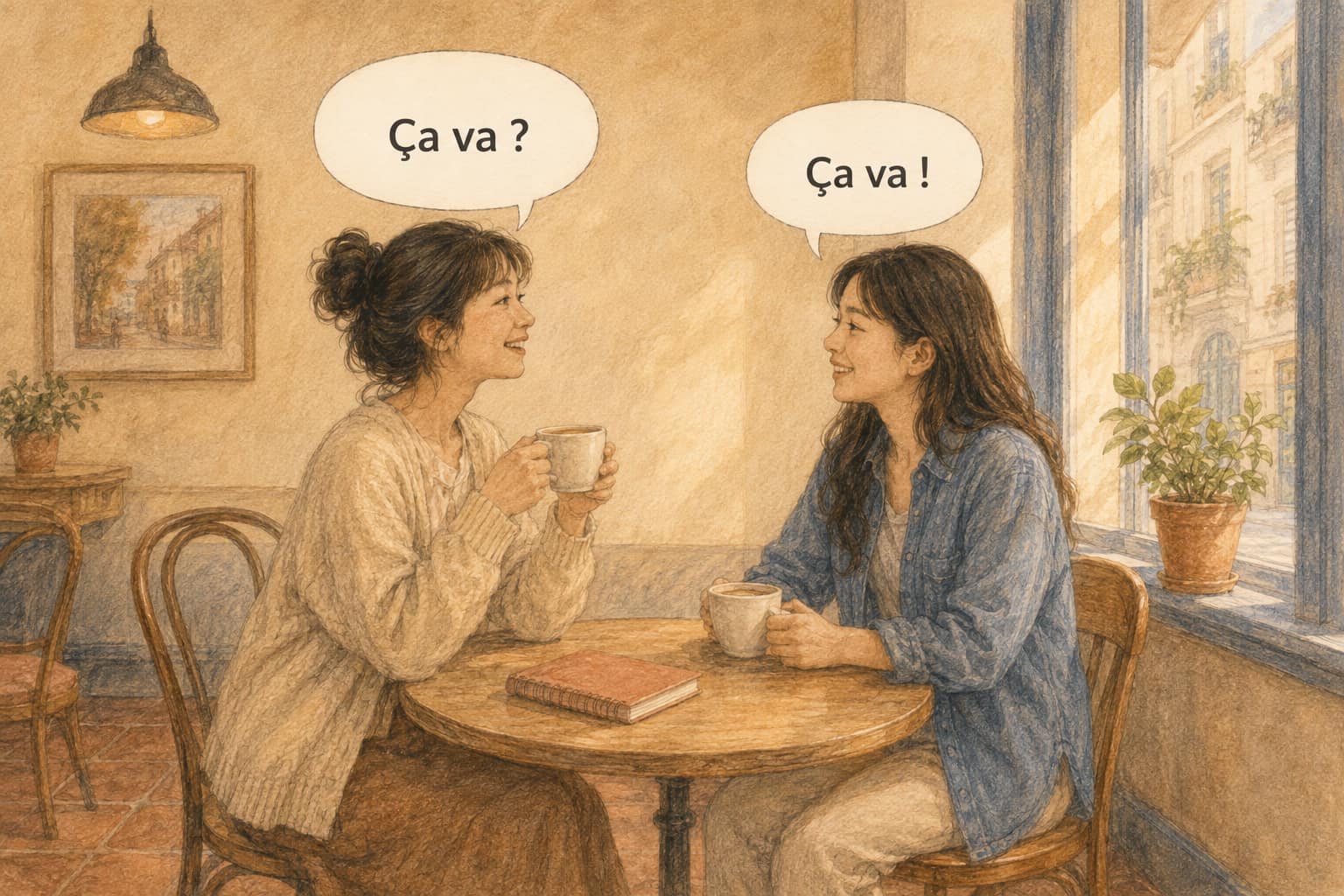
Formal or informal? Pick the right "how are you?"
French has two registers, and your choice signals respect. In polite or professional settings you use the formal comment allez-vous ? with vous — the version we covered in the guide to saying hello and goodbye in French. With friends, family, classmates, and anyone your own age in a relaxed setting, you switch to the casual phrases below, which use tu. When in doubt, start formal and let the other person set the tone.
How to say how are you in French: the casual essentials
Here are the everyday ways to ask how someone is doing, from the ultra-short to the slightly more curious. The pronunciation hints are approximate English sounds, so say them out loud and don't chase perfection.
| French | English | Pronunciation (approx.) | Note |
|---|---|---|---|
| Ça va ? | How's it going? | sah VAH | The everyday go-to |
| Comment ça va ? | How are you doing? | koh-mahn sah VAH | A touch more curious |
| Tu vas bien ? | Are you doing well? | tew vah BYAN | Friendly and warm |
| Ça roule ? | Everything good? | sah ROOL | Very casual, slangy |
| Quoi de neuf ? | What's new? | kwah duh NUHF | Like "what's up?" |
Example: you run into a friend and open with "Salut ! Ça va ?" — hello plus "how's it going?" in three easy words. That single line is the backbone of casual French and works dozens of times a day.
The star here is ça va, which literally means "it goes." You can dig into the verb behind it, aller ("to go"), in a reference like the WordReference French–English dictionary, but for now just remember: ça va both asks and answers.
How to answer "ça va ?"
The beauty of ça va is that the same phrase bounces right back as your reply. Add a word to say how you actually feel, then return the question with et toi ? ("and you?"). Here are natural responses sorted from great to not-so-great.
| French | English | Pronunciation (approx.) | Mood |
|---|---|---|---|
| Ça va bien, merci ! | I'm doing well, thanks! | sah vah byan, mair-SEE | Good |
| Super, et toi ? | Great, and you? | soo-PAIR, ay TWAH | Great |
| Ça va, et toi ? | I'm fine, and you? | sah vah, ay TWAH | Neutral |
| Pas mal. | Not bad. | pah MAHL | Neutral |
| Comme ci, comme ça. | So-so. | kom see kom SAH | Meh |
| Bof… pas terrible. | Meh… not great. | BOFF, pah teh-REEBL | Low |
| Je suis fatigué(e). | I'm tired. | zhuh swee fah-tee-GAY | Low |
Two quick notes. First, add an extra e to fatiguée in writing if you are a woman; the sound is identical. Second, bof is a wonderfully French little word — a shrug turned into a sound — meaning "meh." Use it sparingly and it will make you smile every time.
"Ça va" is both the question and the answer
This is the trick that makes casual French feel easy. The exact same two words work as a question with a rising tone and as an answer with a flat tone:
- "Ça va ?" (rising) = "How's it going?"
- "Ça va." (flat) = "I'm fine."
So a complete mini-exchange can be almost comically short: one friend says "Ça va ?" and the other replies "Ça va, et toi ?" Nobody is being rude; this is simply how the French keep everyday contact warm and light without turning it into a deep conversation.
Keep the small talk going
Once you have traded a quick "how are you," a couple of follow-up lines keep things friendly before you move on.
| French | English | Pronunciation (approx.) |
|---|---|---|
| Quoi de neuf ? | What's new? | kwah duh NUHF |
| Rien de spécial. | Nothing special. | ryan duh spay-SYAL |
| Tu travailles beaucoup ? | Are you working a lot? | tew trah-VYE boh-KOO |
| Tu veux un café ? | Do you want a coffee? | tew vuh uhn kah-FAY |
| À plus tard ! | See you later! | ah plew TAR |
Example: "Salut ! Ça va ? — Ça va, et toi ? — Bof, je suis fatigué. — Tu veux un café ? — Oh oui, avec plaisir !" A whole friendly moment, built entirely from A1 phrases.
Cultural tips for casual French
A few habits will help you sound natural. Casual greetings travel with the pronoun tu, so save comment allez-vous ? and vous for shopkeepers, elders, and formal settings. Among friends, salut replaces bonjour and can even mean "bye." And don't over-answer: when a French friend asks ça va ?, they usually expect a short, upbeat reply and the question tossed back, not a full status report. Save the details for when someone genuinely asks comment tu te sens ? ("how do you feel?").
This is exactly what you'll practice out loud in Lesson A1-2: Greeting (informal) & "How are you?" inside Simply French, where the app plays natural-speed audio and scores your pronunciation of ça va and its replies on the spot.
Put it all together: a casual conversation
Here is how the pieces click into a real exchange between two friends:
- Marie: Salut Pierre ! Ça va ? (Hi Pierre! How's it going?)
- Pierre: Oui, ça va bien, et toi ? (Yes, I'm well, and you?)
- Marie: Bof… pas terrible. Je suis fatiguée. (Meh… not great. I'm tired.)
- Pierre: Ah, d'accord. Tu veux un café ? (Oh, okay. Do you want a coffee?)
- Marie: Oh oui, avec plaisir ! (Oh yes, with pleasure!)
- Pierre: Allez, à plus tard ! (Come on, see you later!)
Read it aloud twice. At A1 level the goal is fluency of the mouth, not grammar rules — you want these lines to arrive automatically.
Ready to practice speaking?
Reading ça va is easy; saying it with the right rising or falling tone is what makes you understood. The fastest way there is to speak out loud and get feedback. That is exactly what Simply French does: 15 minutes a day of listening at native speed and speaking drills with instant AI pronunciation scoring. Start your free 7-day trial of Simply French and drill today's casual greetings before your next chat.
Related lessons
Casual "how are you" builds directly on your first greetings. Read the companion guide on how to say hello and goodbye in French to lock in bonjour, bonsoir, and au revoir. More A1 speaking lessons are on the way and will be linked here as they publish.
Frequently asked questions
How do you say "how are you?" in French?
Casually, say ça va ? (sah VAH), which literally means "it goes" and works like "how's it going?" A slightly fuller version is comment ça va ? ("how are you doing?"). In formal settings use comment allez-vous ? with vous instead.
What does "ça va" mean in French?
Ça va literally means "it goes." With a rising tone it asks "how are you?"; with a flat tone it answers "I'm fine." That double duty is what makes it the most useful phrase in casual French.
How do you respond to "ça va ?"
Reply with how you feel and bounce the question back: ça va bien, merci — et toi ? ("I'm well, thanks — and you?"). Neutral options include pas mal ("not bad") and comme ci, comme ça ("so-so"); a low-energy answer is bof, je suis fatigué(e) ("meh, I'm tired").
What is the difference between "ça va ?" and "comment allez-vous ?"
Ça va ? is informal and uses tu, so it is for friends, family, and peers. Comment allez-vous ? is formal and uses vous, so it is for strangers, elders, and professional settings. Start formal with new people and switch to casual once invited.
What does "quoi de neuf" mean?
Quoi de neuf ? means "what's new?" and works like the English "what's up?" A common reply is rien de spécial ("nothing special"). It is casual, so keep it for friends rather than formal introductions.
Tags
Now find out how you actually sound.
Simply French listens to you say each sentence and scores it word by word, so you can hear the difference you have just read about — and fix it while it is still fresh.
Takes about 10 minutes. No card needed to start.
Related Articles
You Understand French But Can't Speak It — Here's the Missing Step
You can follow the podcast and still freeze when someone asks you a question. Three separate bottlenecks produce that gap — ten minutes of tests to find which one is yours, and what each one actually needs.
How to Say Hello and Goodbye in French
Learn how to say hello and goodbye in French — bonjour, salut, au revoir, and more — with formal vs. informal tips, pronunciation, and cultural notes.
How to Introduce Yourself in French: A1 Speaking Guide
Learn how to introduce yourself in French with simple phrases for your name, origin, and job, plus polite greetings and full example lines you can say today.