
How to Tell Time in French (A1-7)
Learn how to tell time in French with quelle heure est-il, et quart, et demie, the 24-hour clock, and real example sentences you can say out loud today.
Simply French Team
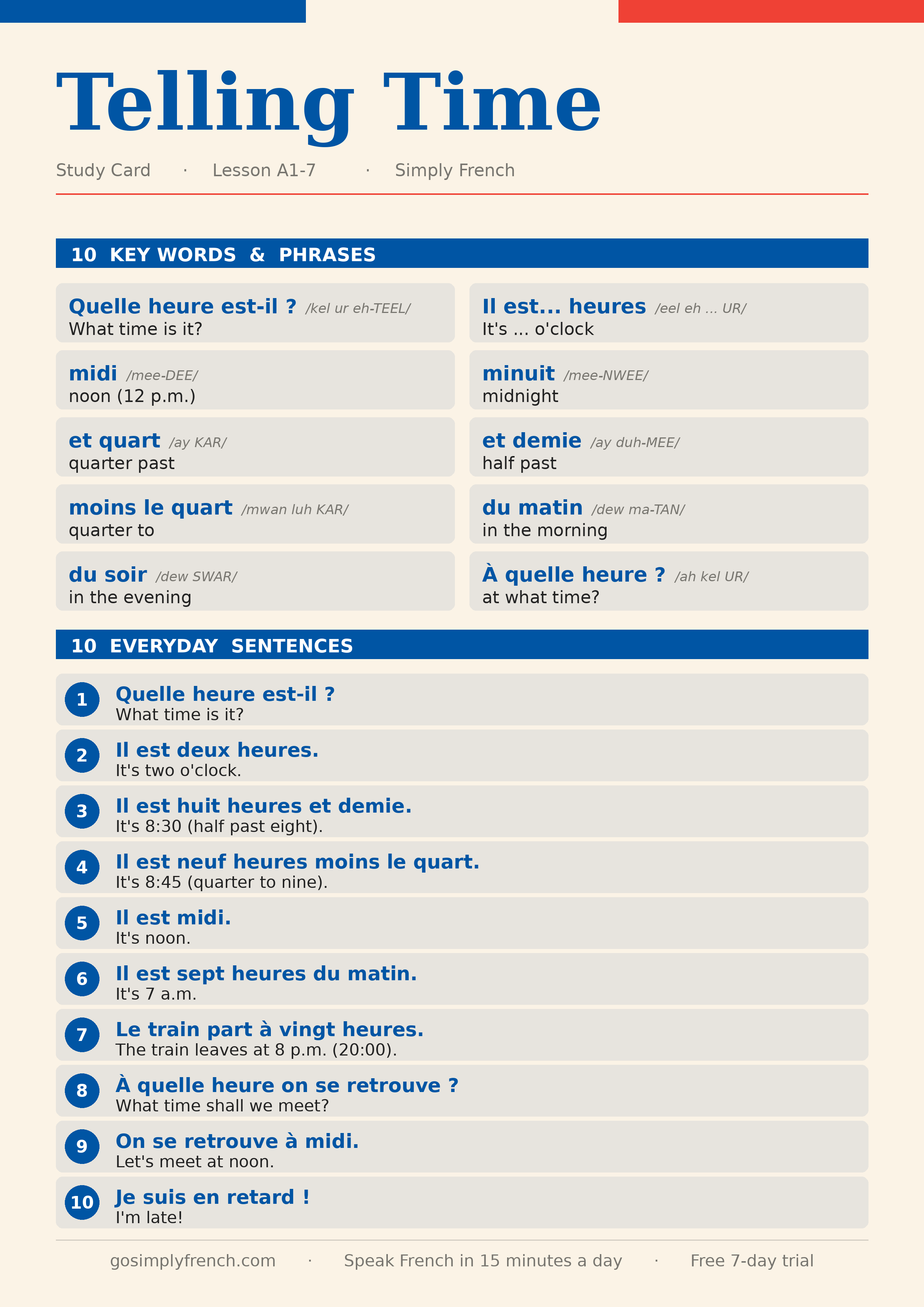
Download the printable study sheet (PDF): Telling Time in French study sheet
If you can count to sixty and say "it is," you already have almost everything you need to tell time in French. Time comes up constantly in real life: catching a train, meeting a friend for coffee, asking when a shop opens, or explaining that dinner is at eight. Learning how to tell time in French early means you can handle dozens of everyday moments without switching back to English.
This guide walks you through asking the time, giving the time, the quarter-and-half shortcuts, the 24-hour "official" clock you'll see on French train tickets, and how to say morning, afternoon, and evening. Every phrase comes with a simple English pronunciation hint and a real example sentence, so you can start saying them out loud right away.
Start with one question: "Quelle heure est-il ?"
There is one question that unlocks the whole topic, and it's worth memorizing today.
| French | Pronunciation | English |
|---|---|---|
| Quelle heure est-il ? | kel ur eh-TEEL | What time is it? |
| Il est quelle heure ? | eel eh kel UR | What time is it? (casual) |
| Vous avez l'heure, s'il vous plait ? | voo-zah-vay LUR seel voo PLEH | Do you have the time, please? |
| A quelle heure ? | ah kel UR | At what time? |
Quelle heure est-il ? is the textbook version and always correct. In relaxed conversation, French speakers often flip it to Il est quelle heure ? If you're stopping a stranger on the street, soften it with politeness: Excusez-moi, vous avez l'heure ? A little courtesy goes a long way, which is exactly what we cover in the please and thank you in French lesson.
The basic formula: Il est + number + heure(s)
To answer, you use one reliable pattern: Il est ("it is") + the number + heure (one o'clock) or heures (everything else). Heure literally means "hour," and it stays in the sentence.
| French | Pronunciation | English |
|---|---|---|
| Il est une heure. | eel eh ewn UR | It's one o'clock. |
| Il est deux heures. | eel eh duh-ZUR | It's two o'clock. |
| Il est trois heures. | eel eh trwah-ZUR | It's three o'clock. |
| Il est sept heures. | eel eh seh-TUR | It's seven o'clock. |
| Il est dix heures. | eel eh dee-ZUR | It's ten o'clock. |
Notice that "one" is une here, not un, because heure is a feminine noun. If your numbers feel shaky, spend ten minutes reviewing French numbers 1-100 first; every time expression is built on them.
Noon, midnight, and the special hours
Two moments of the day get their own words instead of a number.
| French | Pronunciation | English |
|---|---|---|
| Il est midi. | eel eh mee-DEE | It's noon (12 p.m.). |
| Il est minuit. | eel eh mee-NWEE | It's midnight (12 a.m.). |
| Il est midi et demi. | eel eh mee-dee ay duh-MEE | It's half past twelve (noon). |
| Il est minuit dix. | eel eh mee-nwee DEES | It's 12:10 a.m. |
Midi is noon and minuit is midnight. A quick example: On dejeune a midi (We have lunch at noon).
Quarter past, half past, and quarter to
French has the same friendly shortcuts English does. Add them right after the hour.
| French | Pronunciation | English |
|---|---|---|
| Il est trois heures et quart. | eel eh trwah-zur ay KAR | It's 3:15 (quarter past three). |
| Il est huit heures et demie. | eel eh wee-tur ay duh-MEE | It's 8:30 (half past eight). |
| Il est neuf heures moins le quart. | eel eh nuh-vur mwan luh KAR | It's 8:45 (quarter to nine). |
| Il est six heures moins cinq. | eel eh see-zur mwan SANK | It's 5:55 (five to six). |
Et quart is "and a quarter," et demie is "and a half," and moins le quart literally means "minus the quarter" -- you name the next hour and subtract fifteen minutes.
One spelling point that trips up learners: it's et demie after heures (with an -e), but et demi after midi and minuit (no -e). The word demi agrees in gender with the noun before it, and heure is feminine while midi and minuit are masculine. You can confirm this in the Larousse dictionary entry for demi/demie. So: huit heures et demie but midi et demi.
Minutes in between
For any other minute, simply say the hour, then the minutes.
| French | Pronunciation | English |
|---|---|---|
| Il est huit heures dix. | eel eh wee-tur DEES | It's 8:10. |
| Il est dix heures vingt. | eel eh dee-zur VAN | It's 10:20. |
| Il est une heure vingt-cinq. | eel eh ewn ur van-SANK | It's 1:25. |
| Il est quatre heures moins dix. | eel eh kat-rur mwan DEES | It's 3:50 (ten to four). |
For minutes 1 to 30, count up from the hour. For minutes past the half hour, French speakers often count down to the next hour with moins ("minus").
Morning, afternoon, and evening
The 12-hour clock is ambiguous, so French adds a time-of-day tag when it matters. There's no direct "a.m./p.m."
| French | Pronunciation | English |
|---|---|---|
| du matin | dew ma-TAN | in the morning (a.m.) |
| de l'apres-midi | duh la-preh-mee-DEE | in the afternoon |
| du soir | dew SWAR | in the evening (p.m.) |
| Il est sept heures du matin. | eel eh seh-tur dew ma-TAN | It's 7 a.m. |
| Il est neuf heures du soir. | eel eh nuh-vur dew SWAR | It's 9 p.m. |
So trois heures du matin is 3 a.m., while trois heures de l'apres-midi is 3 p.m. Naming the part of the day pairs naturally with the days of the week and months in French when you're setting up plans.
The 24-hour clock (l'heure officielle)
Here's a difference from English: France runs on the 24-hour clock for anything official -- train and bus schedules, TV listings, opening hours, and appointments. Instead of "2 p.m." you'll see and hear quatorze heures (14:00). To convert, add 12 to any afternoon or evening hour.
| French | Pronunciation | English |
|---|---|---|
| Il est quatorze heures. | eel eh ka-torz UR | It's 14:00 (2 p.m.). |
| Il est dix-huit heures trente. | eel eh dee-zwee-tur TRAHNT | It's 18:30 (6:30 p.m.). |
| Le train part a vingt heures. | luh tran par ah van-TUR | The train leaves at 20:00 (8 p.m.). |
| Le magasin ferme a vingt et une heures. | luh ma-ga-zan ferm ah van-tay ewn UR | The shop closes at 21:00 (9 p.m.). |
With the official clock you drop the quarter-and-half shortcuts and just say the minutes: quinze (15), trente (30), quarante-cinq (45). If you want the full background, the Wikipedia overview of the 24-hour clock is a helpful reference.
Asking the time and making plans
Telling the time is most useful when you're arranging your day. Here's a short exchange you can adapt for a cafe, a meeting, or a train.
| French | Pronunciation | English |
|---|---|---|
| A quelle heure on se retrouve ? | ah kel ur on suh ruh-TROOV | What time shall we meet? |
| On se retrouve a midi. | on suh ruh-troov ah mee-DEE | Let's meet at noon. |
| Le musee ouvre a dix heures. | luh mew-zay oovr ah dee-ZUR | The museum opens at ten. |
| Le rendez-vous est a quatorze heures. | luh ron-day-voo eh ah ka-torz UR | The appointment is at 2 p.m. |
| Je suis en retard ! | zhuh swee zon ruh-TAR | I'm late! |
This is exactly what you'll practice out loud in Lesson A1-7: Telling Time inside Simply French, where the app listens to your pronunciation and scores it instantly so neuf heures and "nuh-vur" finally click.
A quick note on pronunciation
The trickiest part of telling time in French is the liaison -- the way heures links to the number before it. The final consonant of the number "wakes up" and glides into the vowel: deux heures sounds like "duh-ZUR," trois heures like "trwah-ZUR," and dix heures like "dee-ZUR." With neuf, the f softens to a v: neuf heures becomes "nuh-VUR." Say these slowly a few times and the pattern becomes automatic. Hearing yourself is how the liaison sticks.
Related lessons
Keep building your A1 speaking foundation with these Simply French lessons:
- French Numbers 1-100: How to Count -- the base skill behind every time expression.
- Days of the Week & Months in French -- pair dates with times when you make plans.
- How to Introduce Yourself in French -- the first thing you'll say before arranging to meet.
- Please and Thank You in French -- the politeness that makes asking a stranger for the time feel natural.
Start speaking the time out loud
Reading the phrases is a great start, but you'll only remember how to tell time in French once you've said it aloud a few dozen times. Simply French gives you native-speed listening and out-loud speaking drills with instant AI pronunciation scoring, so fifteen minutes a day is enough to make these expressions stick. Start your free 7-day trial and practice telling time in French from your very first session.
Frequently asked questions
How do you ask "What time is it?" in French?
Say Quelle heure est-il ? (kel ur eh-TEEL). In casual conversation you can also say Il est quelle heure ? To ask a stranger politely, start with Excusez-moi, vous avez l'heure ?
What's the difference between "et demie" and "et demi"?
Both mean "half past," but the spelling changes with the noun. You write et demie after heures (as in huit heures et demie) because heure is feminine, and et demi after midi or minuit because those are masculine. The pronunciation is the same.
Does France use the 12-hour or 24-hour clock?
Both. Everyday conversation uses the 12-hour clock with du matin, de l'apres-midi, and du soir to show the time of day. Anything official -- train schedules, opening hours, appointments -- uses the 24-hour clock, so 2 p.m. becomes quatorze heures (14:00).
How do you say "a.m." and "p.m." in French?
There's no direct equivalent. Instead, add a time-of-day phrase: du matin for morning (a.m.), de l'apres-midi for afternoon, and du soir for evening (p.m.). For example, sept heures du matin is 7 a.m. and sept heures du soir is 7 p.m.
Why does "heures" sound different after each number?
That's the French liaison. The final consonant of the number links to the vowel in heures: deux heures becomes "duh-ZUR," neuf heures becomes "nuh-VUR." Saying the hours out loud a few times makes the linking automatic.
How do I say "at" a certain time?
Use a before the time: a midi (at noon), a huit heures (at eight), a quatorze heures trente (at 14:30). To ask, use A quelle heure ? -- for example, A quelle heure ouvre la boulangerie ? (What time does the bakery open?).
Tags
Now find out how you actually sound.
Simply French listens to you say each sentence and scores it word by word, so you can hear the difference you have just read about — and fix it while it is still fresh.
Takes about 10 minutes. No card needed to start.
Related Articles
T'as, Y'a, Chuis: Say Spoken French the Way It's Actually Said
Tu becomes t', il becomes i, il y a becomes y'a. The three families of French spoken contractions, why they exist, and 50 lines to drill out loud until they stop sounding like a different language.
How to Tell If Your French Accent Is Actually Good (Self-Test)
You cannot hear your own French accent — your ear filters it through English. Six self-tests that isolate what English speakers actually get wrong, each one you can check on your own, plus a 12-point scorecard.
How to Talk About Hobbies in French (A1-21)
Learn to talk about hobbies in French with 40+ phrases, the faire de vs jouer a rule, pronunciation hints, a sample dialogue and a free printable study sheet.