
Please and Thank You in French: Politeness (A1-5)
Learn please and thank you in French the natural way: s'il vous plaît, merci, de rien, plus formal vs informal, pronunciation, and real example phrases.
Simply French Team
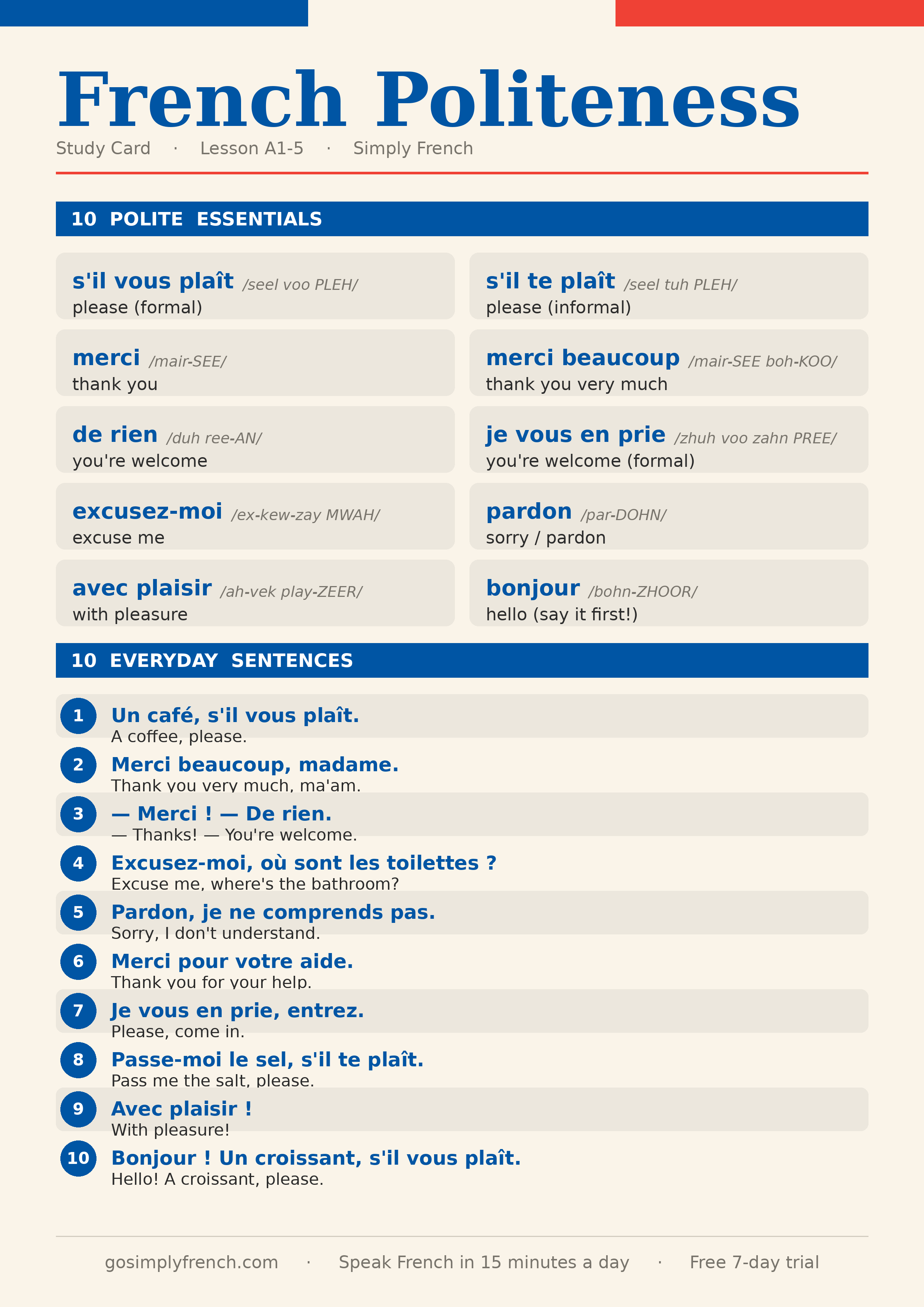
Save or print the French Politeness study card for quick daily review.
Download the printable study sheet (PDF): French Politeness study sheet
If you learn only a handful of words before your first trip to Paris, make them the polite ones. Knowing how to say please and thank you in French is the fastest way to turn a stiff exchange into a warm one, and it signals that you respect the person in front of you. The good news: the core phrases are short, they come up dozens of times a day, and once you say them out loud a few times they stick.
This lesson walks you through please and thank you in French for both formal and informal situations, shows you how to reply when someone thanks you, and covers the little courtesy words that make you sound like a considerate guest rather than a tourist reading from a phrasebook. Say each phrase aloud as you read - that is how they move from your eyes to your mouth.
The two words that open every door
Before we get to full sentences, meet the two anchors of French courtesy.
| French | Pronunciation | English |
|---|---|---|
| S'il vous plaît | seel voo PLEH | Please (formal / plural) |
| S'il te plaît | seel tuh PLEH | Please (informal) |
| Merci | mair-SEE | Thank you |
| Merci beaucoup | mair-SEE boh-KOO | Thank you very much |
S'il vous plaît literally means "if it pleases you." Notice the circumflex on plaît - it is part of the correct spelling, confirmed in Le Robert's dictionary. You will also see it abbreviated on menus and signs as SVP.
A note that surprises many beginners: French speakers do not sprinkle s'il vous plaît and merci into every sentence the way English speakers do. Used well, once per request, they carry real weight. Overusing them can actually sound a little anxious, so aim for natural, not constant.
Please in French: formal vs informal
French has two words for "you," and your choice of please follows the same split. Use the vous form with strangers, shopkeepers, waiters, older people, and anyone in a professional setting. Use the tu form with friends, family, children, and people who have invited you to use tu.
| Situation | Say this | English |
|---|---|---|
| Ordering from a waiter | Un café, s'il vous plaît. | A coffee, please. |
| Getting a stranger's attention | S'il vous plaît, madame ? | Excuse me, ma'am? |
| Asking a friend a favor | Passe-moi le sel, s'il te plaît. | Pass me the salt, please. |
| Talking to a child | Doucement, s'il te plaît. | Gently, please. |
When you are unsure which form to use, default to s'il vous plaît. Sounding a touch too formal is always safer than sounding too familiar with someone you have just met - a rule that also applies when you say hello and goodbye in French.
Thank you in French: from casual to heartfelt
Merci is your workhorse, but a few variations let you match the size of the favor.
| French | Pronunciation | English | When to use |
|---|---|---|---|
| Merci | mair-SEE | Thank you | Everyday, all situations |
| Merci beaucoup | mair-SEE boh-KOO | Thank you very much | A bigger favor |
| Merci bien | mair-SEE byan | Thanks a lot | Casual, friendly |
| Merci pour votre aide | mair-SEE poor votr ED | Thank you for your help | Specific gratitude |
| Merci d'avance | mair-SEE dah-VAHNS | Thanks in advance | Ending a request or email |
You can thank someone for something using merci pour + a noun (merci pour le café - thanks for the coffee) or merci de + a verb (merci de m'aider - thanks for helping me). Both are common; merci pour is the safest choice for beginners. The Larousse dictionary defines merci as the expression of gratitude for a service or a kindness received - exactly the feeling you want it to carry.
You're welcome in French: how to reply to merci
Here is where many learners freeze, because English "you're welcome" has several French cousins and they are not interchangeable. This is one of the most useful parts of mastering please and thank you in French, because the conversation does not end when someone thanks you - you have to answer.
| French | Pronunciation | English | Register |
|---|---|---|---|
| De rien | duh ree-AN | You're welcome ("it's nothing") | Casual, everyday |
| Je vous en prie | zhuh voo zahn PREE | You're welcome | Formal, polite |
| Je t'en prie | zhuh tahn PREE | You're welcome | Informal |
| Il n'y a pas de quoi | eel nyah pah duh KWAH | Don't mention it | Casual, warm |
| Avec plaisir | ah-vek play-ZEER | With pleasure | Friendly, generous |
If you only remember one, remember de rien - it works almost everywhere and literally means "of nothing," the same idea as the Spanish de nada. When you want to sound a little more polished, especially at a hotel desk or in a shop, je vous en prie is elegant and never wrong. You can see how everyday speakers use these replies in the Wiktionnaire entry for de rien.
The courtesy words around please and thank you
Politeness in French is more than two magic words. These small phrases smooth over the moments in between - getting someone's attention, apologizing, or squeezing past on the metro.
| French | Pronunciation | English |
|---|---|---|
| Excusez-moi | ex-kew-zay MWAH | Excuse me (formal) |
| Excuse-moi | ex-kewz MWAH | Excuse me (informal) |
| Pardon | par-DOHN | Sorry / Pardon me |
| Je suis désolé(e) | zhuh swee day-zoh-LAY | I'm sorry |
| Après vous | ah-pray VOO | After you |
Use excusez-moi to start a question to a stranger, and pardon as a quick "sorry" when you bump into someone. For the full range of options, our guides on nine ways to say "excuse me" in French and nine ways to say "sorry" in French go deeper.
The one habit that makes everything work: say bonjour first
Here is the cultural secret that phrasebooks skip. In France, politeness begins before you ask for anything. Walking up to a shopkeeper and launching straight into a request - even a polite one with s'il vous plaît - can feel abrupt. The magic word is actually bonjour.
Say "Bonjour, madame" or "Bonjour, monsieur" first, wait for the reply, and then make your request. That single greeting reframes you as someone who sees the other person, not just the service they provide. Skipping it is the most common way well-meaning visitors accidentally come across as rude. If greetings still feel shaky, spend five minutes with our how are you in French lesson before you travel.
This is exactly what you'll practice out loud in Lesson A1-5: Basic Politeness (Please, Thank You, You're Welcome) inside Simply French, where you say each phrase and get instant pronunciation scoring so you know it lands the way a native ear expects.
Putting it together: a café in four lines
Watch how the pieces click into a real exchange. Read both parts aloud so your mouth learns the rhythm.
Vous : Bonjour ! Un croissant, s'il vous plaît. (Hello! A croissant, please.) Le boulanger : Voilà. Ce sera un euro vingt. (Here you go. That'll be one euro twenty.) Vous : Merci beaucoup. Bonne journée ! (Thank you very much. Have a good day!) Le boulanger : Je vous en prie. Au revoir ! (You're welcome. Goodbye!)
Notice the shape: greet, request with please, thank, and part warmly. That four-beat pattern will carry you through bakeries, ticket windows, restaurants, and hotel desks. Counting out that un euro vingt is easier once you've worked through French numbers 1 to 100.
Common mistakes to avoid
Mixing up tu and vous forms. Saying s'il te plaît to a waiter is not offensive, but it marks you as a beginner. When in doubt, go formal.
Forgetting bonjour. As we saw, the greeting is doing half the politeness work. No bonjour, no warmth.
Answering merci with silence. In English you can smile and move on; in French, a quick de rien or je vous en prie completes the exchange and feels expected.
Reading plaît as "plate." The final t is silent and the vowel is a soft "eh" - say /PLEH/, not /playt/.
Frequently asked questions
How do you say please and thank you in French?
Please is s'il vous plaît (formal) or s'il te plaît (informal), and thank you is merci, or merci beaucoup for a bigger thank-you. These four phrases cover the vast majority of everyday situations.
What is the difference between s'il vous plaît and s'il te plaît?
Both mean "please." Use s'il vous plaît with strangers, in shops and restaurants, and with anyone you would address formally. Use s'il te plaît with friends, family, and children - people you address with tu.
How do you respond when someone says merci?
The easiest reply is de rien ("it's nothing"). For a more polished, formal answer, say je vous en prie. Both mean "you're welcome"; de rien is casual and je vous en prie is elegant.
Is de rien or je vous en prie more polite?
Je vous en prie is more formal and slightly more polite, making it the better choice in professional or upscale settings. De rien is friendly and perfectly fine in everyday life. When unsure, je vous en prie is never wrong.
Do French people really say please and thank you less than English speakers?
Somewhat, yes. French speakers use s'il vous plaît and merci deliberately rather than reflexively, so the words carry more weight. Once per request is plenty; you do not need to stack them the way English often does.
How do you say "excuse me" in French?
Say excusez-moi (formal) or excuse-moi (informal) to get attention or apologize, and pardon as a quick "sorry" when you bump into someone.
Related lessons
- How to Say Hello and Goodbye in French (A1-1)
- How to Say How Are You in French (A1-2)
- How to Introduce Yourself in French (A1-3)
- French Numbers 1-100 (A1-4)
- 9 Ways to Say "Thank You" in French
Start speaking politely today
Reading these phrases is a great start, but politeness only works when it comes out of your mouth smoothly and at the right moment. The way to get there is to say them out loud, often, until s'il vous plaît and merci feel automatic. Practice please and thank you in French at native speed and get instant pronunciation feedback with your free 7-day trial of Simply French - fifteen minutes a day is all it takes to sound courteous and confident on your next trip.
Tags
Now find out how you actually sound.
Simply French listens to you say each sentence and scores it word by word, so you can hear the difference you have just read about — and fix it while it is still fresh.
Takes about 10 minutes. No card needed to start.
Related Articles
You Understand French But Can't Speak It — Here's the Missing Step
You can follow the podcast and still freeze when someone asks you a question. Three separate bottlenecks produce that gap — ten minutes of tests to find which one is yours, and what each one actually needs.
How to Say Hello and Goodbye in French
Learn how to say hello and goodbye in French — bonjour, salut, au revoir, and more — with formal vs. informal tips, pronunciation, and cultural notes.
How to Introduce Yourself in French: A1 Speaking Guide
Learn how to introduce yourself in French with simple phrases for your name, origin, and job, plus polite greetings and full example lines you can say today.