
French Everyday Expressions: 60 Phrases Natives Actually Use
Sixty French expressions natives actually use, grouped by the moment you need them — each with the register that decides whether it lands or offends.
Simply French Team
You spent a month learning Comment allez-vous ? Then you got to France and heard Ça va ? — every time, from everyone, all day.
That gap is the whole problem with textbook French. The phrases are correct. They are just not the ones people reach for.
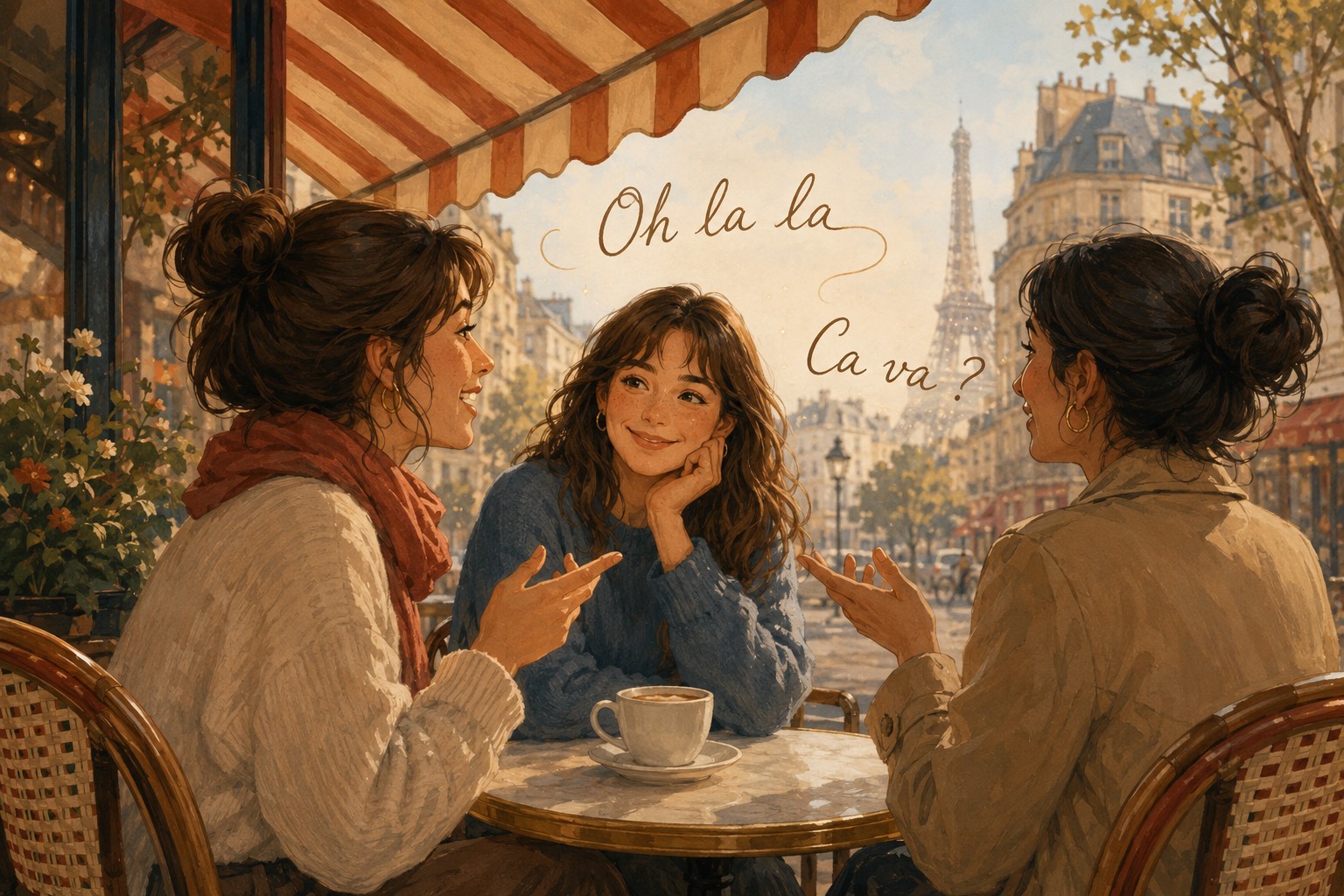
This page is the other list: sixty expressions that actually come out of French mouths, sorted by the moment you need them. Each section links to a fuller breakdown when you want the nine variations and the nuance between them.
One thing to keep in mind as you read: almost every phrase here has a register. Tu or vous, friends or strangers, said out loud or only written. Get that wrong and a perfectly correct sentence lands badly. Where it matters, the tables say so.
When something surprises you
English gives you "wow" and leaves it there. French makes you pick.
| Expression | Register | When |
|---|---|---|
| Oh là là ! | any | The genuine all-purpose one. Not the cliché foreigners think it is — it covers admiration, alarm and exasperation alike |
| La vache ! | casual | Literally "the cow." Closest to "wow" or "damn" |
| Incroyable ! | any | For something impressive rather than shocking |
| Oh mon dieu | any | Stronger than the English "oh my god," and less throwaway |
| Qu'est-ce qui s'est passé ? | neutral | "What happened?" — the full form. In speech it collapses to il s'est passé quoi ? |
| C'est quoi, ce bruit ? | casual | "What's that noise?" — bruit is the everyday word; vacarme and boucan are louder |
→ Nine ways to say "wow" · nine ways to say "oh my god" · "what happened" · "noise"
Hello, goodbye, and the bit in between
| Expression | Register | When |
|---|---|---|
| Ça va ? | casual | Greeting and question at once. The answer is ça va |
| Quoi de neuf ? | casual | "What's new?" — to someone you have not seen in a while |
| Ça roule ? | very casual | Friends only. Literally "is it rolling?" |
| Prends soin de toi | warm | "Take care of yourself." Sincere, not a sign-off |
| Fais gaffe | very casual | "Watch yourself" — the street version of fais attention |
| Viens ici | direct | "Come here." Approchez-vous is the polite plural |
Prends soin de toi is worth dwelling on. English "take care" has worn down to mean roughly "bye." The French has not — say it and people hear that you mean it.
→ Nine ways to say "what's up" · "take care" · "come here"
Agreeing, disagreeing, and "it's fine"
| Expression | Register | When |
|---|---|---|
| Je suis d'accord | neutral | The full "I agree" |
| C'est ça | casual | "That's it" / "exactly" — the one you will use most |
| Absolument | neutral | Emphatic agreement |
| C'est vrai | neutral | "That's true." Il est vrai que… is the formal written form |
| C'est faux | direct | "That's false." Blunter than English — ce n'est pas vrai is softer |
| Pas de problème | casual | "No problem" |
| Il n'y a pas de souci | casual | Same idea, more reassuring. Often shortened to pas de souci |
→ "I agree" · "it is true" · "it is false" · "it's okay" · "problem"
When you don't know — and when you have an opinion
| Expression | Register | When |
|---|---|---|
| Je ne sais pas | neutral | The full form |
| J'sais pas | spoken | What it actually sounds like. The ne is gone and so is most of the je |
| Aucune idée | casual | "No idea" |
| À mon avis | neutral | "In my opinion" — the standard opener |
| Un point de vue | neutral | A point of view, as a thing you hold |
| Une réflexion | neutral | A thought, in the considered sense — not a passing one |
Une pensée and une idée both translate as "thought," but they split: une idée is the thing that occurs to you, une pensée the thing you dwell on.
→ "I don't know" · "question" · "answer" · "idea" · "opinion" · "thought"
What your body is telling you
French does hunger, thirst and exhaustion with avoir and être, not with adjectives. You have hunger.
| Expression | Register | When |
|---|---|---|
| J'ai faim | neutral | "I'm hungry" |
| J'ai la dalle | very casual | Slang. Roughly "I'm starving" |
| J'ai soif | neutral | "I'm thirsty" |
| Je meurs de soif | casual | "I'm dying of thirst" |
| Je suis crevé | casual | "I'm wiped out." Crevé literally means punctured |
| Il fait un froid de canard | idiomatic | "A duck's cold" — bitterly cold |
| C'est la canicule | neutral | Heatwave. What the news says in August |
→ "I'm hungry" · "I'm thirsty" · "I'm tired" · "it's cold" · "it's hot"
Getting people to move
| Expression | Register | When |
|---|---|---|
| Allons-y | neutral | "Let's go." Slightly formal in speech |
| On y va | casual | What people actually say |
| C'est parti | casual | "Here we go" — starting something, not leaving |
| Allez ! | casual | "Come on!" Encouragement or impatience, tone decides |
| Dépêche-toi | direct | "Hurry up" |
| Grouille-toi | very casual | Same, ruder |
| Je m'en vais | neutral | "I'm off" — more final than je pars |
| J'ai besoin de… | neutral | "I need…" — il me faut… is the more French-sounding alternative |
→ "let's go" · "come on" · "hurry up" · "I'm leaving" · "I need"
Warnings, and telling someone to be quiet
| Expression | Register | When |
|---|---|---|
| Attention ! | any | The all-purpose warning. Not "attention" — it means "look out" |
| Fais attention | neutral | "Be careful," ongoing rather than urgent |
| Méfie-toi | neutral | "Be wary" — of a person or a situation, not a falling object |
| Chut ! | casual | "Shh" |
| Tais-toi | direct | "Be quiet." Sharper than it looks on the page |
| Ferme-la | rude | "Shut it." Know it; do not use it |
→ "be careful" · "look out" · "silence"
Love, longing and loathing
| Expression | Register | When |
|---|---|---|
| Je t'aime | intimate | "I love you." Also "I like you" for a friend — context carries it |
| Je t'adore | warm | Affectionate, and weaker than je t'aime, not stronger |
| Tu me manques | intimate | "I miss you" — but literally "you are missing from me." The subject flips |
| Je déteste | neutral | "I hate" |
| J'ai horreur de | neutral | "I can't stand" — about things, more than people |
Tu me manques catches everyone. The person you miss is the subject. Say je te manque and you have told them that they miss you.
→ "I love you" · "I miss you" · "I hate"
When something went wrong
| Expression | Register | When |
|---|---|---|
| Une erreur | neutral | A mistake, in the general sense |
| Une faute | neutral | A mistake you are at fault for — spelling, rules, morals |
| Une gaffe | casual | A blunder, socially. Faire une gaffe |
| Un mensonge | neutral | A lie. Mentir is the verb |
| La vérité | neutral | The truth |
| Le prétexte | neutral | The reason someone gives, as opposed to la raison, the real one |
Erreur and faute are the pair worth learning properly. A wrong sum is une erreur; a spelling mistake is une faute.
→ "mistake" · "lie" · "truth" · "reason"
Talking about talking
| Expression | Register | When |
|---|---|---|
| Un mot | neutral | A word |
| La parole | neutral | Speech, or the right to speak. Prendre la parole |
| Une phrase | neutral | A sentence — not a phrase |
| La voix | neutral | The voice |
| Le timbre | neutral | Its quality — what makes a voice recognisable |
| Un truc | casual | "A thing," when you cannot name it. Machin and bidule do the same job |
→ "word" · "sentence" · "voice" · "sound" · "thing"
Can and must
| Expression | Register | When |
|---|---|---|
| Je peux | neutral | "I can" — ability and permission both |
| Je suis capable de | neutral | Capability specifically |
| Je dois | neutral | "I must" |
| Il faut que je… | neutral | "I have to…" — impersonal, and far more common in speech |
Il faut is one of the highest-value constructions in French. It takes the subjunctive, which is why learners avoid it, and natives use it constantly.
The part that is not on this page
You can read all sixty of these and still not be understood.
Everyday French is fast and linked — je ne sais pas comes out as chais pas, il n'y a pas as y'a pas. The words on this page are correct; the version that reaches a French ear is compressed. That is a separate skill, and it is the one that decides whether people switch to English on you.
Start here for the vocabulary. Then say the phrases out loud and find out which ones your mouth is getting wrong.
Tags
Now find out how you actually sound.
Simply French listens to you say each sentence and scores it word by word, so you can hear the difference you have just read about — and fix it while it is still fresh.
Takes about 10 minutes. No card needed to start.
Related Articles
Emotions in French: How to Say How You Actually Feel
Thirty French emotion words with IPA, the nine whose sound changes in the feminine, etre vs avoir feelings, the register ladder, and four faux-amis that get learners in trouble.
French Work and School Vocabulary: 100 Everyday Words
The French you need for the classroom and the office — people, subjects, supplies, exams, jobs and meetings — with genders, the false friends that change your meaning, and the eight work words English speakers mispronounce.
French Adjectives List: 90 Describing Words and the Endings You Have to Say
A French adjectives list built for speaking, not reading. 90+ describing words plus the agreement endings you have to actually pronounce — petit vs petite, heureux vs heureuse — and a 12-pair drill.