
How to Check Into a Hotel in French (A1-11)
Learn to check into a hotel in French with confidence: polite check-in phrases, pronunciation hints, and a real front-desk dialogue for your trip to France.
Simply French Team
You have landed, you have found your way from the station, and now you are standing at the front desk of a small hotel in Lyon. The receptionist looks up and says "Bonsoir." This is one of the very first real conversations most travelers have in France — and the good news is that it follows a script. Learn a dozen phrases and you can check into a hotel in French smoothly, politely, and without switching to English.
This lesson gives you everything for that moment: the booking vocabulary, the check-in exchange itself, questions about breakfast and Wi-Fi, and the phrases you need when something small goes wrong with the room.
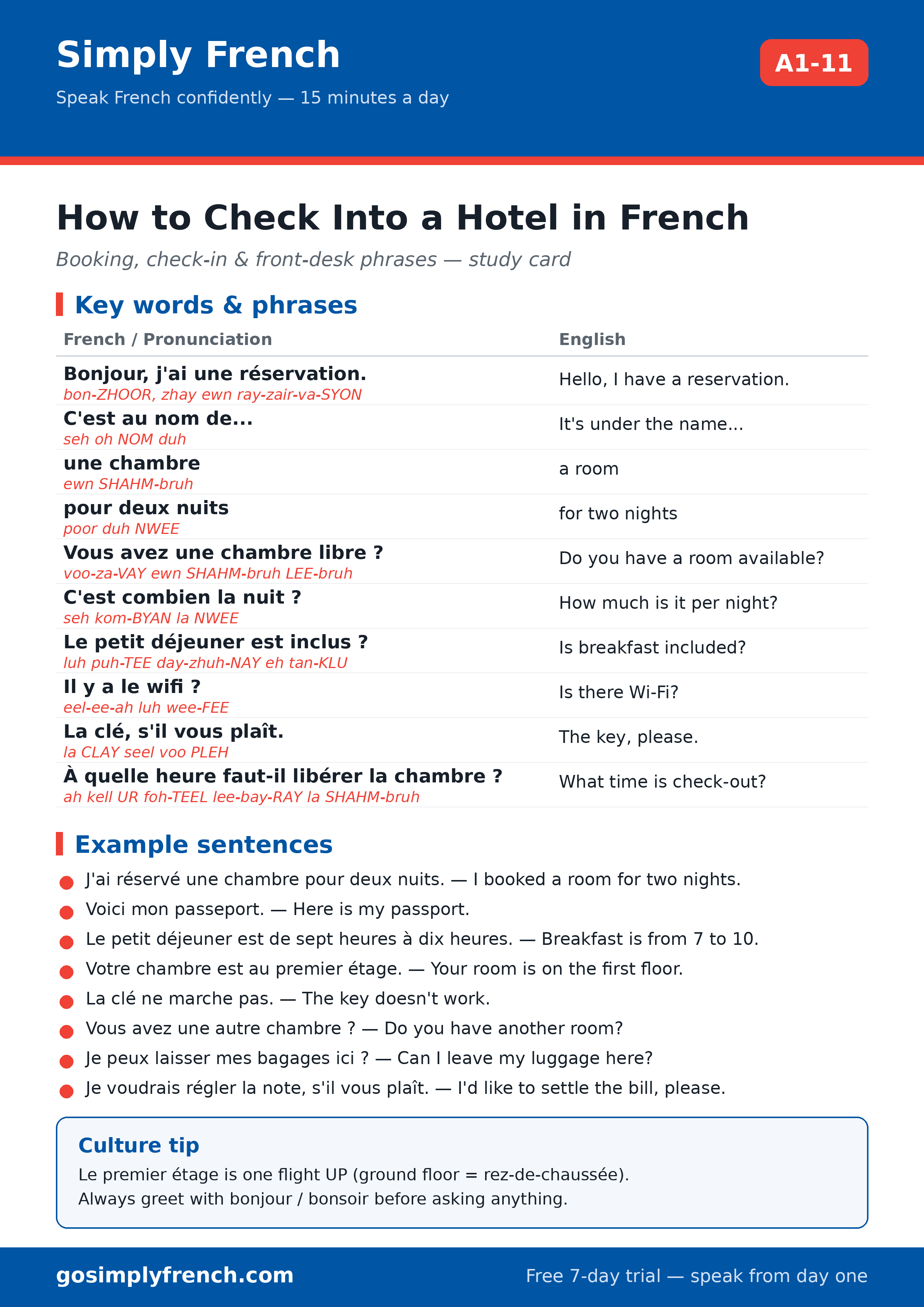
Download the printable study sheet (PDF): Hotel check-in study sheet
The three words that run the whole conversation
Almost everything at a hotel front desk is built from three words. Une chambre is a room. Une réservation is a booking. And réserver is the verb "to book" — Larousse defines it precisely with the hotel example réserver une chambre d'hôtel, "to book a hotel room."
So before you memorize full sentences, anchor these:
| French | Pronunciation | English |
|---|---|---|
| une chambre | ewn SHAHM-bruh | a room |
| une réservation | ewn ray-zair-va-SYON | a reservation |
| réserver | ray-zair-VAY | to book, to reserve |
| la clé | la CLAY | the key |
| la réception | la ray-sep-SYON | the front desk |
| une nuit | ewn NWEE | one night |
Notice that chambre is feminine — une chambre, la chambre. Getting the little words right is exactly the kind of detail that makes a receptionist stay in French with you instead of switching to English.
Essential phrases to check into a hotel in French
Here is the core script. Say bonjour (or bonsoir after about 6 p.m.) before anything else — walking up to the desk without a greeting is the classic tourist mistake in France.
| French | Pronunciation | English |
|---|---|---|
| Bonjour, j'ai une réservation. | bon-ZHOOR, zhay ewn ray-zair-va-SYON | Hello, I have a reservation. |
| C'est au nom de Martin. | seh oh NOM duh mar-TAN | It's under the name Martin. |
| J'ai réservé une chambre pour deux nuits. | zhay ray-zair-VAY ewn SHAHM-bruh poor duh NWEE | I booked a room for two nights. |
| Vous avez une chambre libre ? | voo-za-VAY ewn SHAHM-bruh LEE-bruh | Do you have a room available? |
| Pour deux personnes. | poor duh pair-SON | For two people. |
| C'est combien la nuit ? | seh kom-BYAN la NWEE | How much is it per night? |
| Le petit déjeuner est inclus ? | luh puh-TEE day-zhuh-NAY eh tan-KLU | Is breakfast included? |
| À quelle heure est le petit déjeuner ? | ah kell UR eh luh puh-TEE day-zhuh-NAY | What time is breakfast? |
| Il y a le wifi ? | eel-ee-ah luh wee-FEE | Is there Wi-Fi? |
| Voici mon passeport. | vwa-SEE mon pass-POR | Here is my passport. |
| La clé, s'il vous plaît. | la CLAY seel voo PLEH | The key, please. |
| À quelle heure faut-il libérer la chambre ? | ah kell UR foh-TEEL lee-bay-RAY la SHAHM-bruh | What time is check-out? |
If numbers like room 204 or 45 euros a night still trip you up, review French numbers from 1 to 100 first — the front desk is where numbers come at you fastest.
A real check-in dialogue
Here is how the whole exchange actually sounds. Read it out loud — both parts.
Vous : Bonsoir, j'ai une réservation au nom de Carter.
Réceptionniste : Bonsoir ! Un instant... Oui, une chambre pour deux personnes, trois nuits ?
Vous : Oui, c'est ça.
Réceptionniste : Votre passeport, s'il vous plaît.
Vous : Voici. Le petit déjeuner est inclus ?
Réceptionniste : Oui, de sept heures à dix heures. Voici votre clé, chambre 12, au premier étage.
Vous : Merci beaucoup. Bonne soirée !
Three things to notice. C'est ça ("that's right") is the natural way to confirm. Au premier étage means the first floor above ground level — what Americans would call the second floor. And the receptionist will almost always ask for your passport or ID; handing it over with a simple voici ("here you are") keeps things smooth.
This dialogue is exactly what you'll practice out loud in Lesson A1-11: Checking Into a Hotel inside Simply French — you speak both roles at native speed and get instant pronunciation feedback on every line.
When something goes wrong
Small problems are part of travel. These sentences fix most of them politely:
| French | Pronunciation | English |
|---|---|---|
| La clé ne marche pas. | la CLAY nuh MARSH pah | The key doesn't work. |
| Il n'y a pas d'eau chaude. | eel nya pah doh SHOWD | There's no hot water. |
| La chambre est trop bruyante. | la SHAHM-bruh eh troh brwee-YAHNT | The room is too noisy. |
| Vous avez une autre chambre ? | voo-za-VAY ewn OH-truh SHAHM-bruh | Do you have another room? |
| Je peux laisser mes bagages ici ? | zhuh puh leh-SAY may ba-GAZH ee-SEE | Can I leave my luggage here? |
Keep the tone soft: start with excusez-moi and end with s'il vous plaît. French service culture responds much better to polite persistence than to complaint volume. The same politeness rules you learned in how to say hello and goodbye in French apply doubly at a hotel desk, where the exchange is formal — always vous, never tu.
Checking out
Checking out is mercifully short. Je voudrais régler la note, s'il vous plaît — "I'd like to settle the bill, please." The verb régler is the polite standard for paying a bill; la note is specifically a hotel bill (in a restaurant it's l'addition, as you saw in how to order food in French). Add Je peux payer par carte ? ("Can I pay by card?") and Vous pouvez m'appeler un taxi ? ("Can you call me a taxi?") and you have the full departure covered. If you need to find your way onward, the phrases from asking for directions in French take over from there.
Culture tips for French hotels
The étage system. Le rez-de-chaussée (ground floor) is floor 0. Le premier étage is one flight up. Elevator buttons marked 0 or RC mean the lobby.
La taxe de séjour. Many French hotels collect a small city tourist tax per person per night, often in cash at check-out. It's normal — not a scam.
Breakfast is optional. Le petit déjeuner is usually charged separately unless your rate says petit déjeuner inclus. It's often cheaper (and better) at the café next door.
Your key stays at the desk. In smaller hotels, guests traditionally leave the room key at reception when going out and pick it up when they return.
Practice before you travel
Reading these phrases is step one. Being able to say them at the front desk after a long travel day — with a receptionist who speaks quickly — is a different skill, and it only comes from speaking out loud. Simply French builds that in 15 minutes a day: you listen to the hotel dialogue at native speed, repeat it aloud, and the AI scores your pronunciation instantly so you know you're understood before you ever leave home. Start your free 7-day trial and do the hotel lesson today.
Frequently asked questions
How do I say "I have a reservation" in French?
J'ai une réservation (zhay ewn ray-zair-va-SYON). Add your name with au nom de... — for example, J'ai une réservation au nom de Smith. Greet with bonjour or bonsoir first.
What's the difference between "une chambre" and "une pièce"?
Both can translate as "room," but une chambre is a bedroom or hotel room, while une pièce is a room in a house generally (living room, kitchen, etc.). At a hotel, always use chambre.
Do French hotels ask for your passport?
Very often, yes. Hotels may ask foreign guests to show ID at check-in, and it's routine to be asked for votre passeport, s'il vous plaît. Hand it over with voici — they usually just note the details and hand it straight back.
How do I ask for a room if I haven't booked?
Vous avez une chambre libre pour ce soir ? — "Do you have a room available for tonight?" Then specify: pour une personne / deux personnes, pour une nuit / deux nuits.
What does "libérer la chambre" mean?
Literally "to free the room" — it's the standard way to talk about checking out. À quelle heure faut-il libérer la chambre ? means "What time is check-out?" (usually 11 a.m. or noon in France).
Is "je veux une chambre" rude?
It's blunt. Prefer je voudrais ("I would like") or j'ai réservé if you have a booking. The conditional voudrais is the polite default for any request in French.
Related lessons
Tags
Now find out how you actually sound.
Simply French listens to you say each sentence and scores it word by word, so you can hear the difference you have just read about — and fix it while it is still fresh.
Takes about 10 minutes. No card needed to start.
Related Articles
T'as, Y'a, Chuis: Say Spoken French the Way It's Actually Said
Tu becomes t', il becomes i, il y a becomes y'a. The three families of French spoken contractions, why they exist, and 50 lines to drill out loud until they stop sounding like a different language.
How to Tell If Your French Accent Is Actually Good (Self-Test)
You cannot hear your own French accent — your ear filters it through English. Six self-tests that isolate what English speakers actually get wrong, each one you can check on your own, plus a 12-point scorecard.
How to Talk About Hobbies in French (A1-21)
Learn to talk about hobbies in French with 40+ phrases, the faire de vs jouer a rule, pronunciation hints, a sample dialogue and a free printable study sheet.