How to Get Around in French (A1-23)
Learn how to get around in French: metro, bus, tram and taxi phrases with pronunciation, real dialogue, and the one word that saves you at every transfer.
Simply French Team
You can introduce yourself, order lunch, and ask where the museum is. Then you reach the top of the metro stairs, look at a wall of coloured lines, and realise nobody taught you the sentence you actually need: "Je dois changer où ?"
That gap is what this lesson closes. Learning to get around in French is less about memorising a hundred nouns and more about owning ten short questions you can fire off at a ticket window, a bus driver, or the stranger next to you on the platform. Below you will find those questions, the small set of verbs they hang on, and the cultural details that stop you from being the tourist who validates the wrong thing.
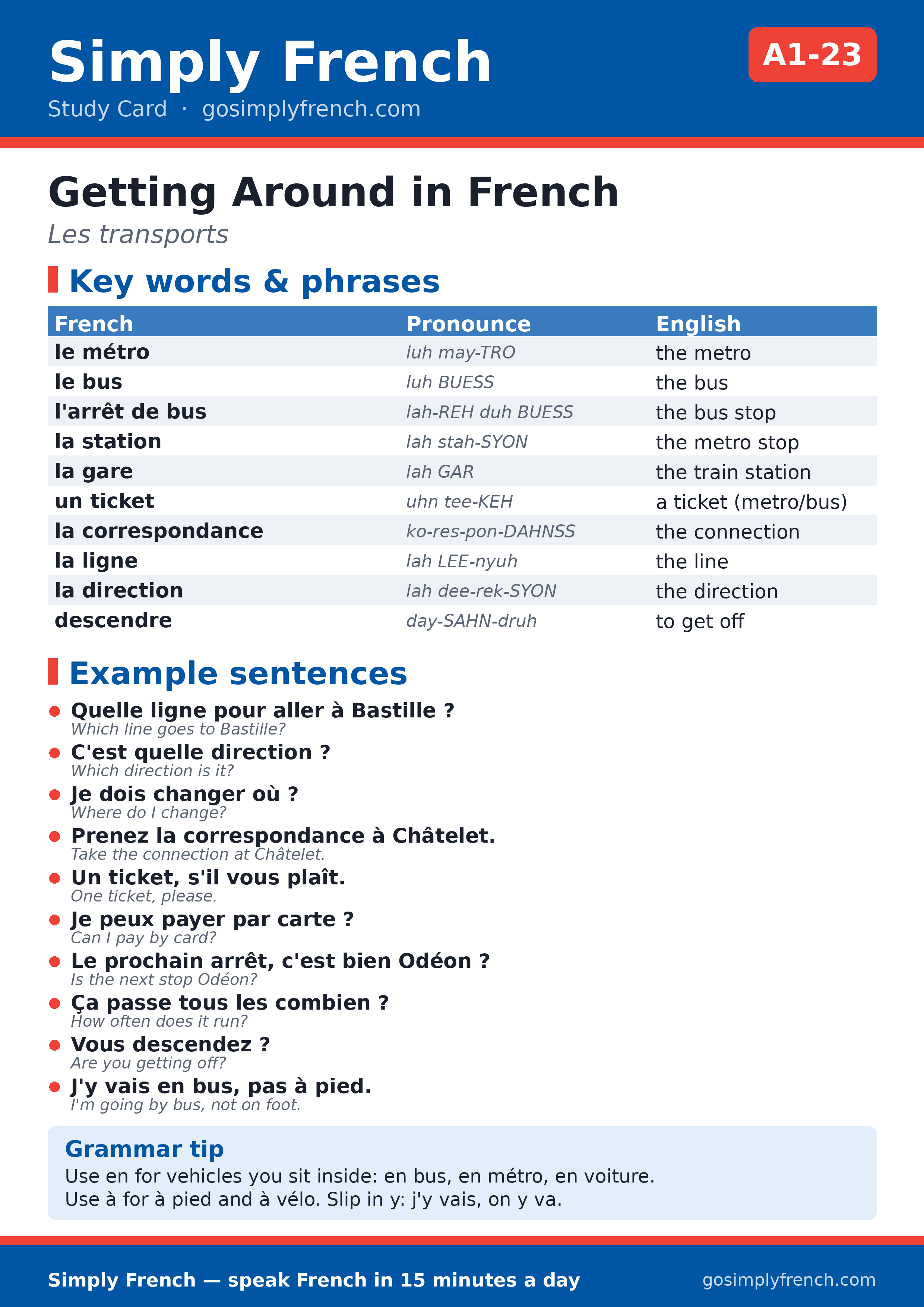
Download the printable study sheet (PDF): How to Get Around in French study sheet
The words you will actually use
French splits transport words more finely than English does, and two of those splits matter on day one.
| French | Pronounce | English |
|---|---|---|
| le métro | luh may-TRO | the metro, the subway |
| le bus | luh BÜSS | the bus |
| le tram (le tramway) | luh TRAM | the tram |
| le RER | luh air-uh-AIR | the regional express train |
| un taxi | uhn tak-SEE | a taxi |
| la station (de métro) | lah stah-SYON | the metro or tram stop |
| l'arrêt de bus | lah-REH duh BÜSS | the bus stop |
| la gare | lah GAR | the train station |
| un ticket | uhn tee-KEH | a ticket (metro, bus, tram) |
| un billet | uhn bee-YEH | a ticket (train, plane) |
Split one: station versus gare. A gare is a mainline train station — Gare du Nord, Gare de Lyon. Metro, tram, and RER stops are stations. Buses stop at un arrêt. Say "la gare de métro" and you will be understood, but it marks you instantly.
Split two: ticket versus billet. You buy un ticket for the metro, bus, and tram, and un billet for a train or a plane. If you are working on longer journeys, our guide to buying train tickets in French covers un aller simple (one-way) and un aller-retour (round trip) in full.
Buying a ticket in 2026
One update worth knowing before you rehearse anything: the famous carnet of ten paper tickets is gone. The RATP phased out cardboard tickets in Paris, and the single ticket t+ was withdrawn in 2025. You now load a ticket Métro-Train-RER or a ticket Bus-Tram onto a reusable Navigo Easy card or your phone.
So drop "un carnet, s'il vous plaît" from your script and use these instead:
| French | Pronounce | English |
|---|---|---|
| Un ticket, s'il vous plaît. | uhn tee-KEH seel voo PLEH | One ticket, please. |
| Je voudrais une carte Navigo Easy. | zhuh voo-DREH ün kart na-vee-GO | I'd like a Navigo Easy card. |
| Ça coûte combien ? | sa koot kom-BYEN | How much does it cost? |
| Je peux payer par carte ? | zhuh puh pay-YAY par KART | Can I pay by card? |
| Où est-ce qu'on valide ? | oo ess kon va-LEED | Where do you validate? |
Valider is the verb for tapping in — "je valide mon ticket". And keep it: inspectors (les contrôleurs) do check, and "j'ai perdu mon ticket" is not a defence.
Asking which line and which direction
Here is the part that trips up learners. French metro directions are not "northbound" or "uptown" — they are named after the last station on the line. Line 1 runs direction La Défense one way and direction Château de Vincennes the other. Read the terminus, not the compass.
| French | Pronounce | English |
|---|---|---|
| Quelle ligne pour aller à Bastille ? | kel LEE-nyuh poor a-lay ah | Which line to Bastille? |
| C'est quelle direction ? | say kel dee-rek-SYON | Which direction is it? |
| Je dois changer où ? | zhuh dwah shahn-ZHAY oo | Where do I change? |
| C'est direct ? | say dee-REKT | Is it direct? |
| Le prochain arrêt, c'est bien Odéon ? | luh pro-shen a-REH say byen | Is the next stop Odéon? |
| Ça passe tous les combien ? | sa pass too lay kom-BYEN | How often does it run? |
| Le dernier métro est à quelle heure ? | luh dair-nyay may-TRO ay ah kel UR | What time is the last metro? |
That last question is worth drilling with real numbers — if the answer "une heure dix" means nothing to you yet, spend ten minutes with how to tell time in French first.
Correspondance: the one word to memorise
If you learn a single transport noun today, make it la correspondance. Larousse defines it, in the transport sense, as the coordination between services that lets you move conveniently from one line or network to another at a set point in the journey (Larousse, correspondance). In practice it is the word on every orange transfer sign in the metro, and the word in the sentence you will hear when you ask for help:
- Prenez la correspondance à Châtelet. — Take the connection at Châtelet.
- J'ai raté la correspondance. — I missed my connection.
Follow the correspondance signs, not the sortie signs. Sortie means exit, and taking one by mistake is how learners end up back on the street paying a second fare.
Three verbs carry almost everything
You do not need many verbs to get around in French. You need three, used precisely.
Prendre — to take a form of transport: je prends le bus, on prend un taxi.
Descendre — to get off. Je descends à Nation. This is also the source of the single most common exchange on a crowded metro: someone behind you asks "Vous descendez ?" ("Are you getting off?"), meaning "if not, please let me past." The answer is "Oui, je descends" or "Non, allez-y." Its opposite is monter, to get on.
Aller — to go, and the verb that decides your preposition:
| Pattern | Example | English |
|---|---|---|
| en • enclosed vehicle | J'y vais en bus. | I'm going by bus. |
| en • métro, train, voiture, taxi, avion | On y va en métro. | We're going by metro. |
| à • pied, vélo | J'y vais à pied. | I'm walking. |
The rough logic: en when you get inside the vehicle, à when you sit on it or use your own legs. Say "à vélo", "à pied" — and "en voiture", "en métro". Note the little word y ("there") slipping in front of the verb: j'y vais, on y va. It is optional in English and near-obligatory in spoken French.
This is exactly what you'll practice out loud in Lesson A1-23: Transport and Getting Around inside Simply French — including the fast, clipped way a bus driver actually says "c'est deux euros cinquante".
Taking a taxi
| French | Pronounce | English |
|---|---|---|
| Vous êtes libre ? | voo zet LEE-bruh | Are you free? |
| À cette adresse, s'il vous plaît. | ah set a-DRESS seel voo PLEH | To this address, please. |
| C'est loin ? | say LWEN | Is it far? |
| Vous pouvez me déposer ici ? | voo poo-vay muh day-po-ZAY ee-see | Can you drop me here? |
| Je peux avoir un reçu ? | zhuh puh a-vwar uhn ruh-SÜ | Can I have a receipt? |
Two habits pay off. First, open with bonjour before anything else — a bare "À cette adresse" reads as an order. Second, show the address on your phone while you say it; French street names have vowels that take months to land, and pointing is not cheating.
A real conversation
Tom : Bonjour ! Je voudrais aller au musée d'Orsay. C'est quelle ligne ? Employée : Bonjour ! Prenez la ligne 12, direction Mairie d'Issy. Tom : Et je dois changer où ? Employée : À Concorde, il y a une correspondance. Puis le RER C. Tom : D'accord. Ça passe tous les combien ? Employée : Toutes les cinq minutes environ. Tom : Parfait. Un ticket, s'il vous plaît. Je peux payer par carte ? Employée : Bien sûr. Bonne visite !
Notice how short Tom's turns are. Every one of them is four to six words. That is the realistic target for A1 travel speech — not long sentences, but fast, correct short ones.
Three cultural notes
Say hello, then ask. In France a question that arrives without bonjour is heard as rudeness, not efficiency. This matters more at a ticket window than almost anywhere else. Our lesson on saying hello and goodbye in French has the full set.
Buses do not always stop for you. At many stops you raise a hand for the bus you want, and press the arrêt demandé button to get off. Standing still and hoping is how you watch your bus leave.
Point and confirm. Combining a phrase with a gesture is a legitimate A1 strategy. Ask "Le prochain arrêt, c'est bien Odéon ?" while pointing at the map and you will get a clear yes or no. Pair this with our guide to asking for directions in French and you can navigate almost any French city.
Frequently asked questions
What is the difference between un ticket and un billet?
Un ticket is a small fare for local transport — metro, bus, tram. Un billet is a train or plane ticket, and also the word for a banknote. Ask for un billet at a metro window and you will probably still be served, but ticket is the natural choice.
Do I say en métro or par métro?
Say en métro. French uses en for transport you sit inside — en bus, en train, en voiture, en avion, en taxi — and à for à pied and à vélo. Par appears in written or formal contexts (par le train) but sounds stiff in conversation.
How do French people give metro directions?
By terminus. Instead of a compass bearing, a line is labelled with its final station in each direction — direction Nation, direction Porte Dauphine. Find your destination on the map, trace it to the end of the line, and follow that name.
What do I say if someone is blocking the door?
"Vous descendez ?" — "Are you getting off?" It is polite, standard, and functions as "excuse me, let me through." If someone asks you, answer "Oui, je descends" or step aside with "Non, allez-y."
Can I still buy a carnet of ten tickets in Paris?
No. Paper carnets were withdrawn, and the single ticket t+ was discontinued in 2025. Fares now load onto a Navigo Easy card or a phone as a ticket Métro-Train-RER or ticket Bus-Tram. Ask "Je voudrais une carte Navigo Easy" on arrival.
How much transport vocabulary do I need before a trip?
Far less than you think. The ten nouns and seven questions above cover the vast majority of real journeys. Depth beats breadth: being able to say "Je dois changer où ?" without hesitating is worth more than recognising fifty words you cannot pronounce.
Related lessons
- How to Ask for Directions in French (A1-8) — the questions that come before you board.
- How to Buy Train Tickets in French (A1-12) — aller simple, aller-retour, platforms and delays.
- French Phrases for the Airport (A1-13) — check-in, security, and baggage.
- How to Tell Time in French (A1-7) — for timetables and that last-metro answer.
Practise it out loud
Reading these phrases will not get you through a ticket hall. Saying them will. Print the study sheet, then read every line aloud until "Je dois changer où ?" comes out as one word rather than four.
That is the whole design of Simply French: fifteen minutes a day of listening at native speed, speaking drills, and instant AI pronunciation scoring that tells you which syllable slipped. Start your free 7-day trial and drill Lesson A1-23 until the metro stops being intimidating.
Bon voyage.
Tags
Now find out how you actually sound.
Simply French listens to you say each sentence and scores it word by word, so you can hear the difference you have just read about — and fix it while it is still fresh.
Takes about 10 minutes. No card needed to start.
Related Articles
How to Say Hello and Goodbye in French
Learn how to say hello and goodbye in French — bonjour, salut, au revoir, and more — with formal vs. informal tips, pronunciation, and cultural notes.
How to Introduce Yourself in French: A1 Speaking Guide
Learn how to introduce yourself in French with simple phrases for your name, origin, and job, plus polite greetings and full example lines you can say today.
How to Order Food in French: 50+ Phrases for Confident Dining
Learn how to order food in French with 50+ real restaurant phrases, from 'Je voudrais' to 'L'addition, s'il vous plaît.' A beginner guide you'll actually use.