Talk About Your Daily Routine in French (A1-22)
Learn to describe your daily routine in French with 40+ phrases, reflexive verb tables, pronunciation hints and a real dialogue. Speak your day out loud today.
Simply French Team
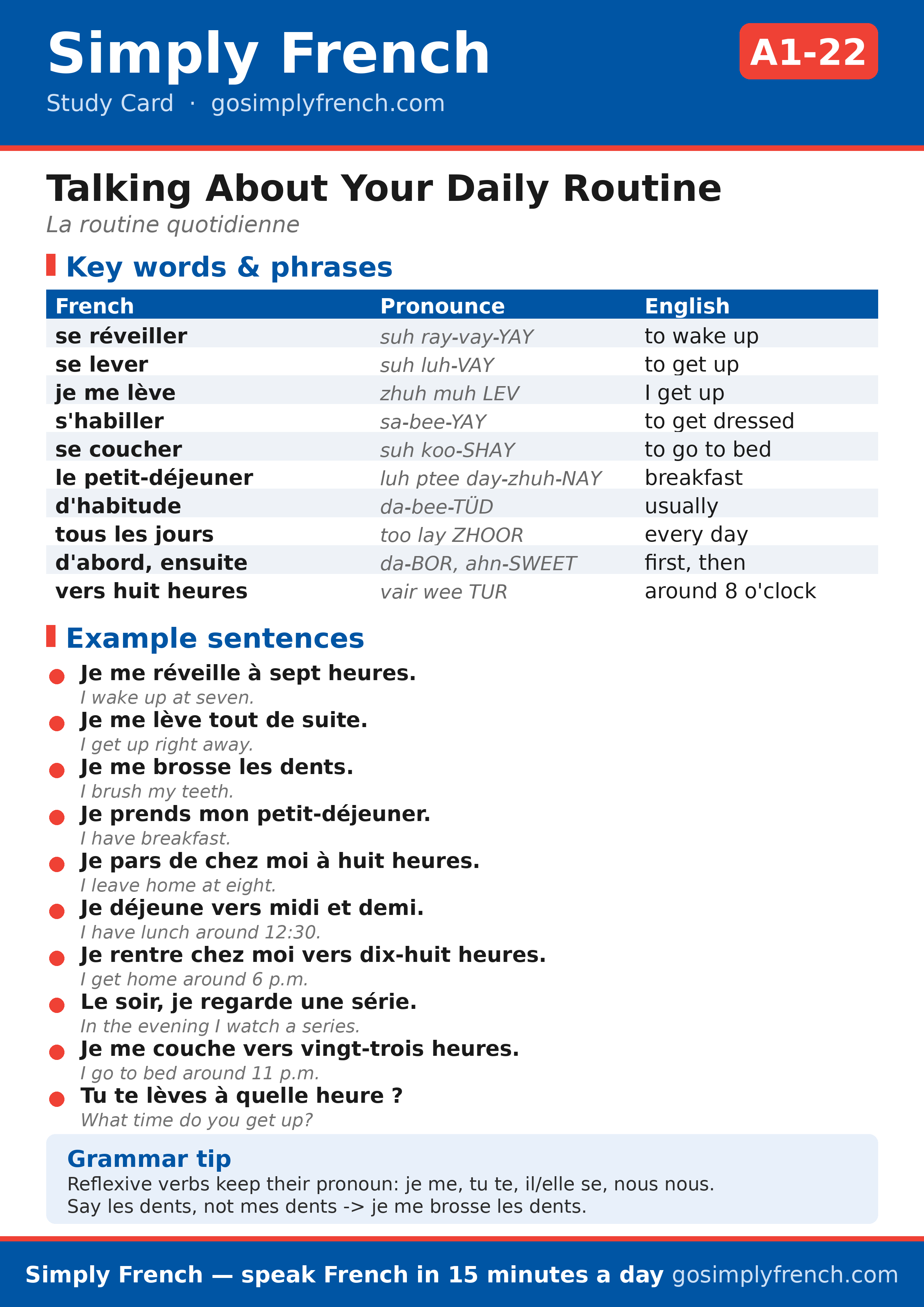
Download the printable study sheet (PDF): Daily Routine in French - A1-22 study sheet
Ask a French person a single question — "Tu fais quoi, une journée normale ?" — and you will get two minutes of conversation without lifting a finger. Your day is the one topic you are already an expert on. All you are missing is the French.
That is why describing a daily routine in French is one of the highest-value things an A1 learner can master. It hands you a script you can rerun every single day, it covers roughly forty verbs you will need forever, and it quietly teaches you the most French-feeling piece of grammar there is: reflexive verbs.
Here are the phrases, the pronunciation, the grammar in plain English, and a conversation you can perform out loud tonight.
The one grammar idea you need: reflexive verbs
In English, we say "I get up." In French, you say the equivalent of "I get myself up." When the action loops back onto the person doing it — washing, dressing, waking, brushing — French adds a pronoun in front of the verb. These are les verbes pronominaux, reflexive verbs, and daily-routine language runs on them. The pronoun changes with the subject:
| Subject | Pronoun | Example | English |
|---|---|---|---|
| je | me | je me lève | I get up |
| tu | te | tu te lèves | you get up |
| il / elle / on | se | elle se lève | she gets up |
| nous | nous | nous nous levons | we get up |
| vous | vous | vous vous levez | you get up (formal/plural) |
| ils / elles | se | ils se lèvent | they get up |
Before a vowel, me, te and se shorten: je m'habille (I get dressed), il s'appelle (his name is), on s'endort (we fall asleep).
Here is the full conjugation of se lever, the verb you will use most. Note the accent grave that appears in every form except nous and vous — it changes the vowel sound from "luh" to "leh":
| French | Pronunciation | English |
|---|---|---|
| je me lève | zhuh muh LEV | I get up |
| tu te lèves | tü tuh LEV | you get up |
| il/elle se lève | eel/el suh LEV | he/she gets up |
| nous nous levons | noo noo luh-VOHN | we get up |
| vous vous levez | voo voo luh-VAY | you get up |
| ils/elles se lèvent | eel/el suh LEV | they get up |
To make any of these negative, wrap ne … pas around both the pronoun and the verb: je ne me lève pas tôt (I don't get up early). In everyday speech the ne usually vanishes — you will hear je me lève pas tôt.
Morning phrases: le matin
Start here. These are the ten phrases that will carry the first half of your day.
| French | Pronunciation | English |
|---|---|---|
| Je me réveille à sept heures. | zhuh muh ray-VAY ah set UR | I wake up at seven. |
| Je me lève tout de suite. | zhuh muh LEV too duh SWEET | I get up right away. |
| Je prends une douche. | zhuh prahn ün DOOSH | I take a shower. |
| Je me brosse les dents. | zhuh muh BROSS lay DAHN | I brush my teeth. |
| Je m'habille. | zhuh mah-BEE-yuh | I get dressed. |
| Je prends mon petit-déjeuner. | zhuh prahn mohn ptee day-zhuh-NAY | I have breakfast. |
| Je bois un café. | zhuh bwah uhn ka-FAY | I drink a coffee. |
| Je pars de chez moi à huit heures. | zhuh par duh shay MWAH ah wee TUR | I leave home at eight. |
| Je vais au travail en métro. | zhuh vay oh tra-VYE ahn may-TRO | I go to work by metro. |
| J'arrive au bureau à neuf heures. | zha-REEV oh bü-RO ah nuh VUR | I arrive at the office at nine. |
Two things English speakers get wrong here. First, je me brosse les dents uses les, not mes — French never says "my teeth" when the owner is already obvious from the reflexive pronoun. Same with je me lave les mains. Second, se réveiller and se lever are not synonyms: you wake up (open your eyes), then you get up (leave the bed). French keeps them separate, and so should you.
Daytime phrases: la journée
| French | Pronunciation | English |
|---|---|---|
| Je travaille de neuf heures à dix-sept heures. | zhuh tra-VYE duh nuh VUR ah dee-set UR | I work from 9 to 5. |
| Je déjeune vers midi et demi. | zhuh day-ZHUN vair mee-DEE ay duh-MEE | I have lunch around 12:30. |
| Je fais une pause. | zhuh fay ün POHZ | I take a break. |
| Je rentre chez moi. | zhuh RAHN-truh shay MWAH | I go back home. |
| Je fais les courses. | zhuh fay lay KOORSS | I do the grocery shopping. |
| Je me repose un peu. | zhuh muh ruh-POHZ uhn PUH | I rest a little. |
For times, French routinely uses the 24-hour clock in anything scheduled — dix-sept heures rather than cinq heures. If the clock still slows you down, the full breakdown of telling time in French walks through both systems.
Evening and night: le soir
| French | Pronunciation | English |
|---|---|---|
| Je prépare le dîner. | zhuh pray-PAR luh dee-NAY | I make dinner. |
| Je dîne vers vingt heures. | zhuh DEEN vair vahn TUR | I have dinner around 8 p.m. |
| Je regarde une série. | zhuh ruh-GARD ün say-REE | I watch a series. |
| Je lis un peu. | zhuh lee uhn PUH | I read a little. |
| Je me couche vers vingt-trois heures. | zhuh muh KOOSH vair vahn-trwah ZUR | I go to bed around 11 p.m. |
| Je m'endors tout de suite. | zhuh mahn-DOR too duh SWEET | I fall asleep right away. |
The words that turn a list into a story
A string of sentences is a vocabulary drill. Add these connectors and it becomes speech:
| French | Pronunciation | English |
|---|---|---|
| d'abord | da-BOR | first |
| ensuite / puis | ahn-SWEET / pwee | then |
| après ça | a-PRAY sah | after that |
| enfin | ahn-FAHN | finally |
| d'habitude | da-bee-TÜD | usually |
| tous les jours | too lay ZHOOR | every day |
| le week-end | luh week-END | on weekends |
| toujours / souvent / parfois | too-ZHOOR / soo-VAHN / par-FWAH | always / often / sometimes |
Chain them: D'abord je me lève, ensuite je prends une douche, après ça je m'habille, et enfin je pars. A natural paragraph from four connectors and four verbs.
This is exactly what you'll practise out loud in Lesson A1-22: Daily Routine inside Simply French — the app plays a native speaker running through their day at full speed, then asks you to describe yours, and scores your pronunciation phrase by phrase.
A conversation you can perform tonight
Camille : Tu te lèves à quelle heure, d'habitude ? What time do you usually get up? Tom : Je me réveille à six heures et demie, mais je me lève à sept heures. I wake up at 6:30, but I get up at seven. Camille : Ah, tu traînes au lit ! Et après ? Ah, you linger in bed! And then? Tom : Je prends une douche, je m'habille, et je bois un café. Je ne mange pas le matin. I shower, get dressed, and drink a coffee. I don't eat in the morning. Camille : Tu pars au travail à quelle heure ? What time do you leave for work? Tom : Vers huit heures. Je rentre vers dix-huit heures trente. Around eight. I get back around 6:30 p.m. Camille : Et le soir, tu fais quoi ? And in the evening, what do you do? Tom : Je dîne, je regarde une série, et je me couche vers minuit. Et toi ? I have dinner, watch a series, and go to bed around midnight. And you?
Notice Tom's last two words. Et toi ? is the cheapest conversational move in French and it works every time — answer, then hand the question back.
Three fixes that make you sound less like a textbook
Say on, not nous. Textbooks teach nous nous levons. Real people say on se lève. On takes the same verb form as il/elle, so it is also easier: le week-end, on se lève tard.
Use vers for approximate times. Je me couche à vingt-trois heures sounds like a train timetable. Je me couche vers vingt-trois heures — "around eleven" — is how people talk about their own evenings.
Learn faire la grasse matinée. Literally "to do the fat morning," it means to sleep in, and it comes up constantly when the weekend does. Le samedi, je fais la grasse matinée.
A cultural note on the French day
The French rhythm is different enough to matter. Breakfast is small — coffee and bread, rarely eggs. Lunch is the meal that counts, often a full hour and traditionally a warm plate, which is why déjeuner carries more weight in conversation than English "lunch" does. Dinner runs late, usually 19h30 to 20h30. And there is a famous three-word phrase for the whole weekday grind: métro, boulot, dodo — commute, work, sleep. Say it with a sigh and any French person will nod.
Two dictionary anchors if you want to go deeper: Larousse defines quotidien as what happens every day, habitually and without anything exceptional about it, while routine carries the heavier sense of actions repeated mechanically — which is why ma journée is the friendlier way to open this topic than ma routine. The WordReference entry for lever lays out lever (to lift something) against se lever (to get oneself up).
Frequently asked questions
Do I always need the reflexive pronoun?
Only when the action returns to the subject. Je me lave is "I wash myself"; je lave la voiture is "I wash the car" — no pronoun, because the car is the target. Drop the pronoun and je lève means you are lifting something, which is why je lève à sept heures confuses people.
How do I say all this in the past tense?
Reflexive verbs form the passé composé with être, not avoir, and the participle agrees with the subject: je me suis levé (male speaker), je me suis levée (female speaker), nous nous sommes levés. It is one of the most reliable rules in French — every reflexive verb, no exceptions.
What is the difference between une journée and un jour?
Un jour is the day as a unit on the calendar; une journée is the day as lived experience, with its duration and its contents. So you describe ma journée, and you wish someone bonne journée — have a good day.
How do I ask someone about their routine?
The everyday version is Tu te lèves à quelle heure ? (What time do you get up?) or Tu fais quoi, le matin ? (What do you do in the morning?). More formally: À quelle heure vous levez-vous ? Notice that the pronoun stays glued to the verb even when the word order flips.
Why is it je me couche and not je vais au lit?
Aller au lit exists but sounds childlike, like something you say to a five-year-old. Se coucher is the neutral adult verb for going to bed, and s'endormir is the separate act of falling asleep — the same wake-up/get-up distinction, at the other end of the day.
Related lessons
- How to tell time in French — the 24-hour clock and the et demie / moins le quart system every routine sentence depends on (A1-7).
- How to talk about hobbies in French — what fills the evenings and weekends you just learned to describe (A1-21).
- How to talk about your job in French — the travail vocabulary that sits in the middle of your weekday (A1-16).
- How to say how are you in French — the opening that leads into every one of these conversations (A1-2).
Practise your day out loud
Reading a daily routine in French takes ten minutes. Being able to say it, at speed, when a French colleague asks over coffee, takes practice out loud.
Simply French gives you fifteen minutes a day of native-speed listening and speaking drills, with instant AI pronunciation scoring on every phrase, so you find out immediately whether your je me lève sounds like je me lave. Start your free 7-day trial and run through your own day tonight.
Describing a daily routine in French is the rare skill you get to rehearse every twenty-four hours, whether you mean to or not.
Tags
Now find out how you actually sound.
Simply French listens to you say each sentence and scores it word by word, so you can hear the difference you have just read about — and fix it while it is still fresh.
Takes about 10 minutes. No card needed to start.
Related Articles
How to Say Hello and Goodbye in French
Learn how to say hello and goodbye in French — bonjour, salut, au revoir, and more — with formal vs. informal tips, pronunciation, and cultural notes.
How to Introduce Yourself in French: A1 Speaking Guide
Learn how to introduce yourself in French with simple phrases for your name, origin, and job, plus polite greetings and full example lines you can say today.
How to Order Food in French: 50+ Phrases for Confident Dining
Learn how to order food in French with 50+ real restaurant phrases, from 'Je voudrais' to 'L'addition, s'il vous plaît.' A beginner guide you'll actually use.