Body Parts and Health in French (A1-19)
Learn body parts in French and the phrases to say what hurts at the doctor or the pharmacy, with pronunciation hints, tables and a free printable study sheet.
Simply French Team
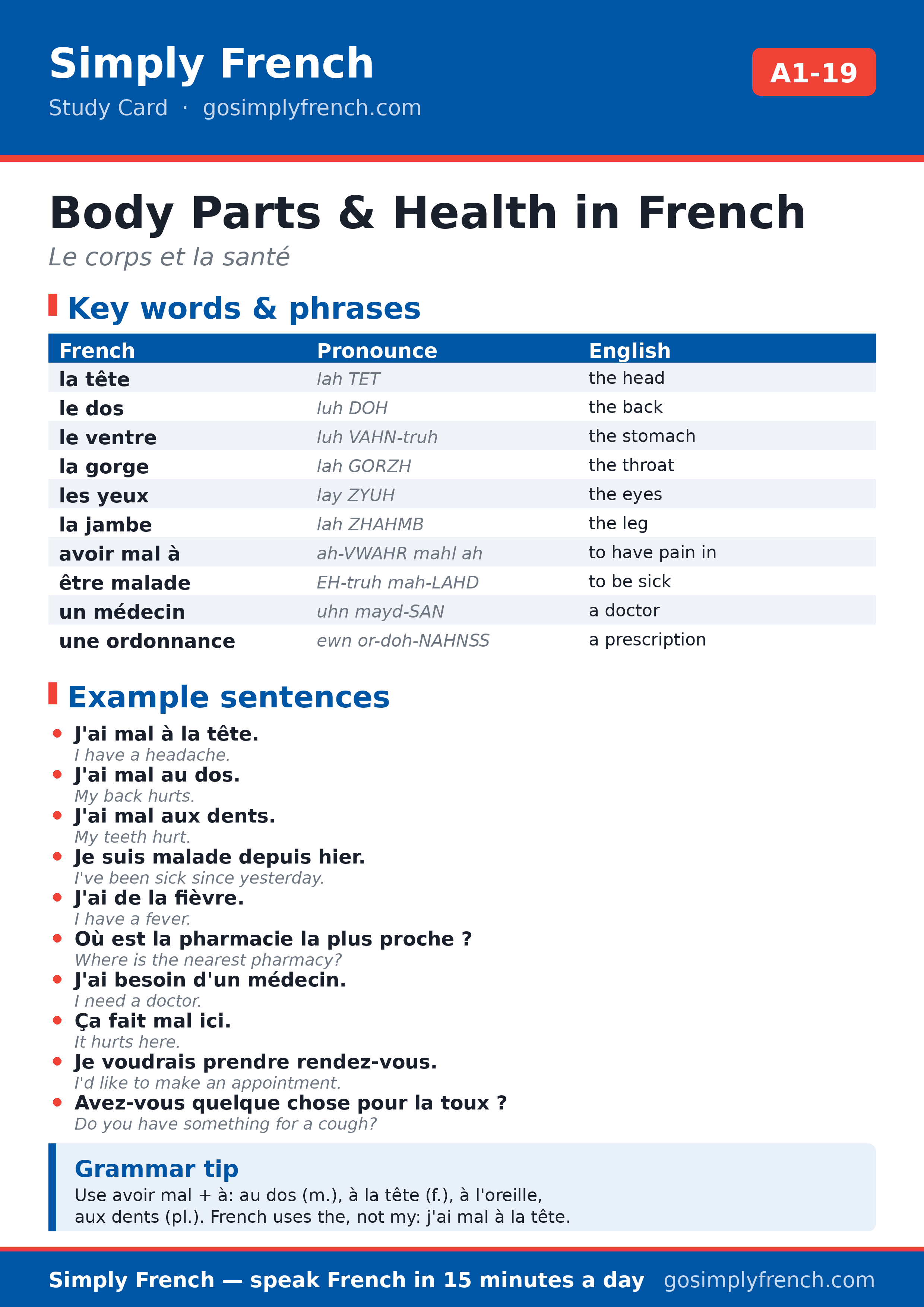
Download the printable study sheet (PDF): Body Parts and Health in French (A1-19) study sheet
There is one French conversation nobody plans for and everybody eventually has: standing in a pharmacy in a town you do not know, trying to explain that your throat is on fire.
The good news is that this is a small, closed topic. You do not need medical French. You need about twenty body parts in French, one grammatical structure, and a handful of sentences you can say without thinking — plus the two irregular plurals that trip up every beginner.
The one structure that unlocks everything: avoir mal à
Before the vocabulary, learn the frame. English says "my head hurts" or "I have a headache." French uses the verb avoir (to have) plus mal (pain) plus à:
J'ai mal à la tête. — I have a headache.
Literally: "I have pain at the head." Slot any body part into that sentence and you can describe almost any complaint.
The only complication is that à merges with the definite article, and which form you use depends on the gender and number of the body part:
| Form | When to use | Example | English |
|---|---|---|---|
| au | masculine singular | J'ai mal au dos. | My back hurts. |
| à la | feminine singular | J'ai mal à la gorge. | My throat hurts. |
| à l' | before a vowel or silent h | J'ai mal **à l'**oreille. | My ear hurts. |
| aux | any plural | J'ai mal aux dents. | My teeth hurt. |
And here is the detail that makes learners sound instantly more natural: French uses the definite article, not a possessive. You say j'ai mal à la tête, never j'ai mal à ma tête. Whose head would it be? French treats it as obvious, so it drops the "my." The same logic runs through the whole language — it is why you say je me lave les mains (I wash my hands), not mes mains.
Body parts in French: the core list
Start with the parts you are actually likely to mention. Gender is marked by the article, so learn each word together with its le or la rather than on its own.
| French | Pronunciation hint | English |
|---|---|---|
| la tête | lah TET | the head |
| les cheveux | lay shuh-VUH | the hair |
| l'œil / les yeux | luhy / lay ZYUH | the eye / the eyes |
| le nez | luh NAY | the nose |
| la bouche | lah BOOSH | the mouth |
| la dent / les dents | lah DAHN | the tooth / the teeth |
| l'oreille (f.) | loh-RAY | the ear |
| la gorge | lah GORZH | the throat |
| le cou | luh KOO | the neck |
| l'épaule (f.) | lay-POHL | the shoulder |
| le bras | luh BRAH | the arm |
| la main | lah MAN | the hand |
| le doigt | luh DWAH | the finger |
| le dos | luh DOH | the back |
| le ventre | luh VAHN-truh | the stomach, belly |
| la jambe | lah ZHAHMB | the leg |
| le genou / les genoux | luh zhuh-NOO | the knee / the knees |
| le pied | luh PYAY | the foot |
Two plurals are irregular and worth memorising as a pair. L'œil becomes les yeux — completely different word, and yeux is one of the most common nouns in spoken French. Le genou becomes les genoux with an -x, not an -s; the Larousse dictionary entry for genou confirms it belongs to the small family of nouns (bijou, caillou, chou, genou, hibou, joujou, pou) that take -x in the plural.
Note also that le doigt has a silent g and a silent t — it is just dwah. French spelling is generous with letters it has no intention of pronouncing, which is why listening practice beats reading practice at this level.
Saying you are unwell
The body parts in French above get you halfway. These general health phrases get you the rest of the way.
| French | Pronunciation hint | English |
|---|---|---|
| Je suis malade. | zhuh swee mah-LAHD | I am sick. |
| Je ne me sens pas bien. | zhuh nuh muh sahn pah BYAN | I don't feel well. |
| J'ai de la fièvre. | zhay duh lah fee-EV-ruh | I have a fever. |
| J'ai de la toux. / Je tousse. | zhay duh lah TOO / zhuh TOOSS | I have a cough. / I'm coughing. |
| J'ai un rhume. | zhay uhn ROOM | I have a cold. |
| Je suis fatigué(e). | zhuh swee fah-tee-GAY | I'm tired. |
| Ça fait mal. | sah fay MAHL | It hurts. |
| Ça fait mal ici. | sah fay mahl ee-SEE | It hurts here. |
| Depuis hier / trois jours | duh-PWEE ee-YAIR | Since yesterday / for three days |
| Je suis allergique à… | zhuh swee zah-lair-ZHEEK ah | I'm allergic to… |
Ça fait mal and j'ai mal are not interchangeable in feel. Ça fait mal is the sensation right now — the reaction when a doctor presses somewhere. J'ai mal describes an ongoing state. Both are everyday spoken French, and knowing which one to reach for is the difference between translating and speaking.
One small warning about fatigué: the adjective agrees with you, so a woman says je suis fatiguée (the pronunciation is identical). If agreement still feels unfamiliar, the same rule you met in colors and clothing in French is at work here.
At the doctor or the pharmacy
In France the pharmacie — marked by a green cross — is the first stop for anything minor. Pharmacists are trained to advise and can recommend over-the-counter treatment without an appointment. For anything more serious you see a médecin généraliste (GP). The French public health system, described on the official Ameli health insurance site, reimburses part of the cost, and visitors from the EU can use a European Health Insurance Card.
| French | Pronunciation hint | English |
|---|---|---|
| Où est la pharmacie la plus proche ? | oo ay lah far-mah-SEE lah plew PROSH | Where is the nearest pharmacy? |
| J'ai besoin d'un médecin. | zhay buh-ZWAN duhn mayd-SAN | I need a doctor. |
| Je voudrais prendre rendez-vous. | zhuh voo-DRAY prahndr rahn-day-VOO | I'd like to make an appointment. |
| Avez-vous quelque chose pour la toux ? | ah-vay-VOO kel-kuh shohz poor lah TOO | Do you have something for a cough? |
| C'est sans ordonnance ? | say sahn zor-doh-NAHNSS | Is it available without a prescription? |
| une ordonnance | ewn or-doh-NAHNSS | a prescription |
| un médicament | uhn may-dee-kah-MAHN | a medicine |
| une pharmacie de garde | ewn far-mah-see duh GARD | an on-duty (after-hours) pharmacy |
| Appelez une ambulance ! | ah-play ewn ahn-bew-LAHNSS | Call an ambulance! |
Asking for the pharmacy is really a directions question in disguise, so the follow-up vocabulary — à gauche, à droite, tout droit — comes straight from the lesson on how to ask for directions in French. And every one of these sentences should open with bonjour and close with merci; skipping the greeting is the single most common way English speakers come across as brusque in a French shop, as covered in please and thank you in French.
For emergencies, the number to know is 15 (SAMU, medical), or 112 anywhere in the EU.
A short conversation to practise out loud
Pharmacien : Bonjour, je peux vous aider ? — Hello, can I help you? Vous : Bonjour. Je suis malade depuis hier. — Hello. I've been sick since yesterday. Pharmacien : Où avez-vous mal ? — Where does it hurt? Vous : J'ai mal à la gorge et j'ai de la fièvre. — My throat hurts and I have a fever. Pharmacien : Avez-vous une ordonnance ? — Do you have a prescription? Vous : Non. Avez-vous quelque chose sans ordonnance ? — No. Do you have something over the counter?
Read it aloud twice. Then cover the English and read it again. Then swap the body part — j'ai mal au ventre, j'ai mal aux dents, j'ai mal au dos — until the au / à la / aux choice happens without a pause. That switch is the whole lesson.
This is exactly what you'll practise out loud in Lesson A1-19: Body and Health inside Simply French, where you hear the pharmacist at native speed and your answers get scored on pronunciation instantly, so you find out whether j'ai mal à la gorge actually landed before you need it in a real pharmacy.
Three mistakes to avoid
Using a possessive. J'ai mal à ma tête is understandable but wrong. Definite article, always.
Confusing mal and mauvais. Mal is the noun for pain or the adverb "badly"; mauvais is the adjective "bad." Je parle mal français means "I speak French badly." J'ai mal means "I'm in pain." Checking a word like mal in the WordReference French–English dictionary is a habit worth building, because it shows you the word's part of speech and the set phrases it lives in.
Forgetting the depuis frame. French uses the present tense with depuis where English uses a perfect: je suis malade depuis trois jours = "I have been sick for three days." Saying it in the past tense sounds like you have recovered.
Frequently asked questions
How do you say "it hurts" in French?
Ça fait mal (sah fay MAHL) is the everyday phrase. To specify where, use j'ai mal à plus the body part: j'ai mal à la tête, j'ai mal au dos. Both are common; ça fait mal is more of an in-the-moment reaction.
Why is it j'ai mal à la tête and not ma tête?
Because French uses the definite article for body parts when the owner is obvious from context. It is the same reason you say je me lave les mains, not je lave mes mains. Using the possessive is one of the clearest markers of an English-speaking learner.
What are the plurals of œil and genou?
L'œil becomes les yeux (a completely irregular form), and le genou becomes les genoux with an -x. Both are worth learning as fixed pairs rather than deriving them from a rule.
Do I need a prescription at a French pharmacy?
Not for many common remedies. French pharmacists can advise on and sell treatments sans ordonnance (over the counter) for colds, coughs, headaches and minor pain. Ask C'est sans ordonnance ? to check. Prescription medicines require an ordonnance from a doctor.
How do I ask for an after-hours pharmacy?
Ask for la pharmacie de garde — the rotating on-duty pharmacy that stays open at night and on Sundays. Every closed pharmacy posts the address of the nearest one on its door, and Où est la pharmacie de garde ? will get you pointed in the right direction.
How many body parts in French should a beginner learn?
Around eighteen to twenty body parts in French cover virtually every everyday complaint. Learn the list above with its articles, add the avoir mal à structure, and you can handle a pharmacy visit at A1 level.
Related lessons
- How to describe people in French — the physical-description vocabulary that overlaps with this lesson
- How to ask for directions in French — for finding the pharmacy once you can name the problem
- Please and thank you in French — the politeness frame every shop and clinic conversation needs
- Colors and clothing in French — more practice with gender agreement
Practise this out loud today
Vocabulary you have only read is vocabulary you will fumble under pressure. Say the ten sentences from the study card out loud, then say them again swapping the body part, until au, à la and aux stop being a decision.
Simply French gives you exactly that: short daily sessions of listening at native speed and speaking out loud, with instant AI pronunciation scoring so you know whether you were understood. Fifteen minutes a day is enough. Start your free 7-day trial and practise this lesson before you need it.
Tags
Now find out how you actually sound.
Simply French listens to you say each sentence and scores it word by word, so you can hear the difference you have just read about — and fix it while it is still fresh.
Takes about 10 minutes. No card needed to start.
Related Articles
T'as, Y'a, Chuis: Say Spoken French the Way It's Actually Said
Tu becomes t', il becomes i, il y a becomes y'a. The three families of French spoken contractions, why they exist, and 50 lines to drill out loud until they stop sounding like a different language.
How to Tell If Your French Accent Is Actually Good (Self-Test)
You cannot hear your own French accent — your ear filters it through English. Six self-tests that isolate what English speakers actually get wrong, each one you can check on your own, plus a 12-point scorecard.
How to Talk About Hobbies in French (A1-21)
Learn to talk about hobbies in French with 40+ phrases, the faire de vs jouer a rule, pronunciation hints, a sample dialogue and a free printable study sheet.