How to Tell If Your French Accent Is Actually Good (Self-Test)
You cannot hear your own French accent — your ear filters it through English. Six self-tests that isolate what English speakers actually get wrong, each one you can check on your own, plus a 12-point scorecard.
Simply French Team
Your teacher said très bien. Your host family said tu parles bien français. And then a waiter in Lyon listened to eleven words of your French, said "what would you like?" in English, and every compliment you have ever received went out the window.
So which is it? You want a straight answer to a question that sounds simple — is my accent good? — and the honest first answer is uncomfortable: you are the last person who can judge it. Not because you lack the ear. Because the ear you are judging with is the problem.
That is fixable, though, and not by asking someone to be nice to you. Below are six tests. Each one isolates something English speakers reliably get wrong in French, and — this is the part that makes it work — each one has a physical check you can run on yourself, without a teacher, without an app, without guessing.
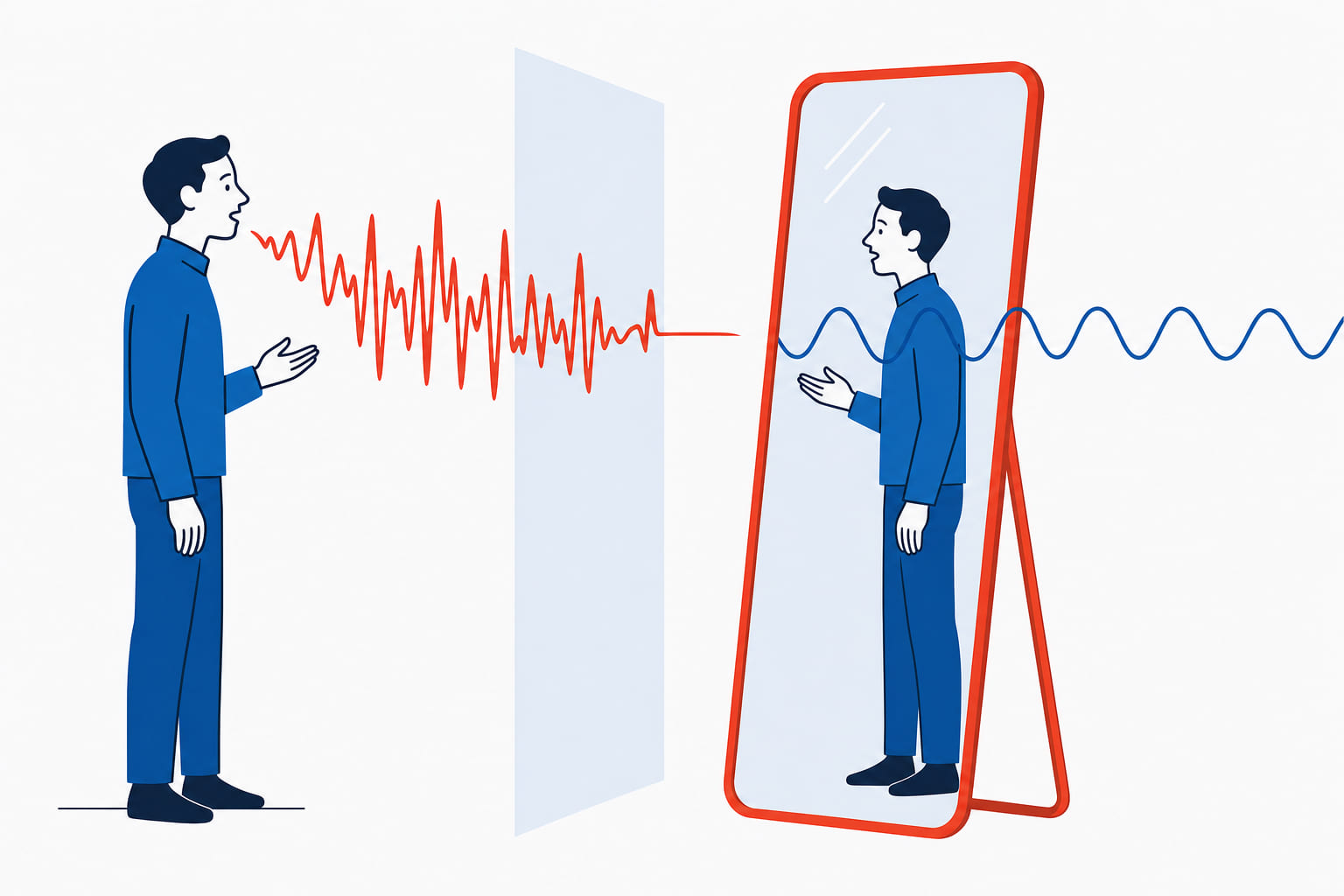
Why you cannot hear your own accent
By about your first birthday, your brain finished sorting the sounds of the world into English boxes. That sorting was a gift — it is why you can understand a stranger with a cold on a bad phone line. It is also a filter that never turns off.
When a French u arrives, your brain does not hear a new sound and file it separately. It reaches for the nearest English box and drops it in — usually the oo box. Then, when you produce a sound that lands in that same oo box, your brain checks it against the box, finds a match, and reports back: correct. Your monitoring system and your production system are running the same faulty filter, so they agree with each other perfectly while both being wrong. Researchers call this perceptual assimilation, and the link between how you sort L2 sounds and how strong your accent is has been measured directly (Frontiers in Psychology, Native Language Interference in Second Language Perception).
This is why "just listen carefully to yourself" fails, and why recording yourself only half works. It is also why the tests below are built the way they are: every one of them checks something you can feel or count, not something you have to hear. Where your mouth is. How many beats came out. Whether the sound changed while you held it. Physical evidence beats self-assessment, because physical evidence does not go through the filter.
Test 1 — The vowel English does not have
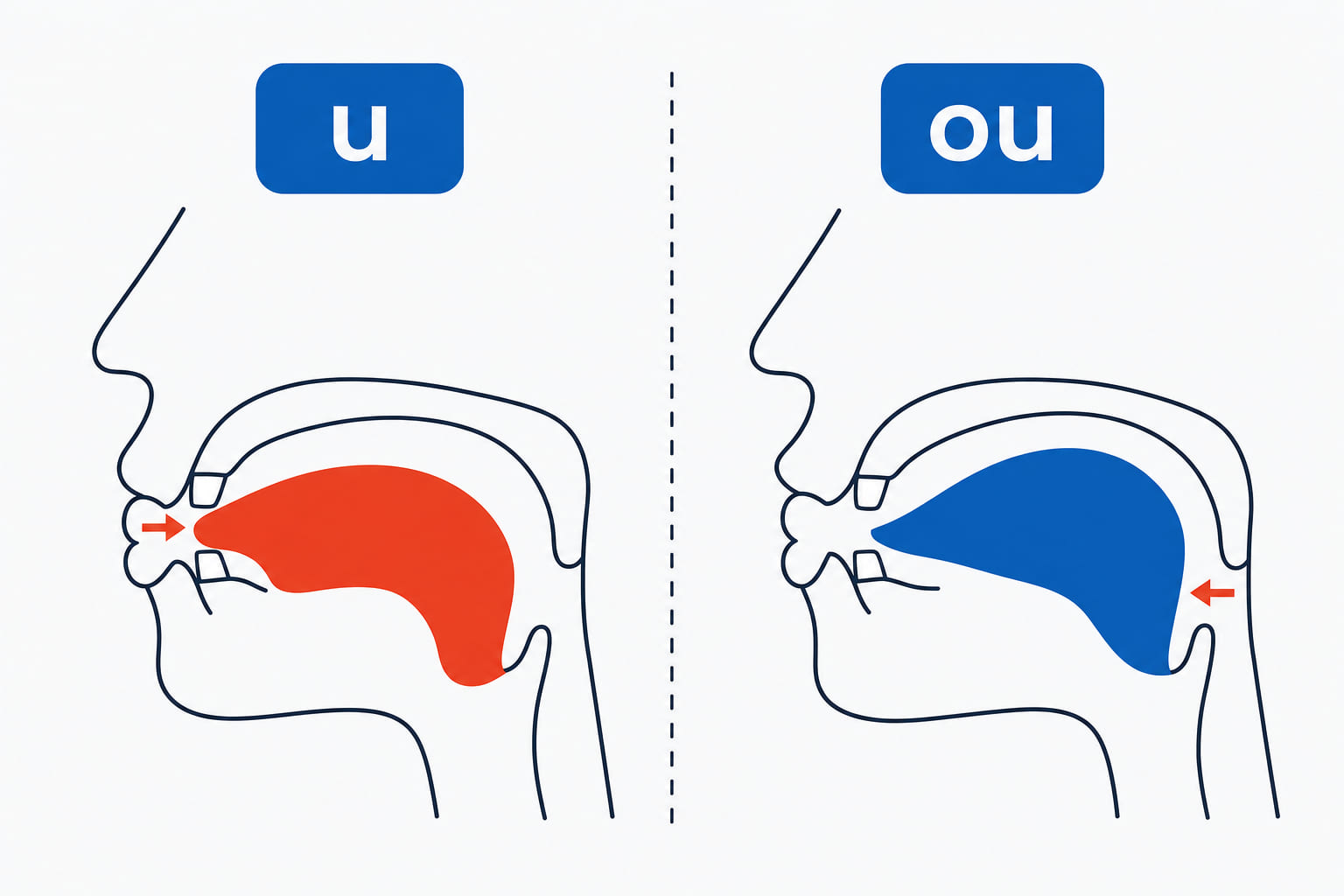
French u and French ou are two different vowels. In English they are one. If they are one in your mouth too, you are saying dessous (underneath) when you mean dessus (on top), and you will never hear it.
Say each pair out loud, left then right:
| u — say ü | ou — say oo | Meaning |
|---|---|---|
| tu | tout | you / everything |
| rue | roue | street / wheel |
| vu | vous | seen / you |
| su | sous | known / under |
| bu | boue | drunk / mud |
| nu | nous | naked / we |
| dessus | dessous | on top / underneath |
The physical check. Put a finger lightly on your chin and watch your lips in a mirror. For ou, your tongue pulls back and your lips push forward into a small circle. For u, your lips do the same small circle — but your tongue must stay exactly where it sits for the English word *ee, right up behind your bottom teeth. Say ee_, freeze your tongue, then round your lips without letting the tongue move. That is_ u*.
You failed if: your tongue slid backwards between the two columns, or your two columns look identical in the mirror.
Test 2 — The vowels that must not move
French vowels are single, steady sounds. English "long" vowels are not: English day is really deh-ee, and English go is really goh-oo. Your mouth glides, and it has been gliding for your whole life, so it glides in French too — and les comes out as lay-ee, beau as boh-oo.
Say each of these and hold the final vowel for a full three seconds:
| Word | Say | English speakers add |
|---|---|---|
| les | LEH | a trailing ee |
| café | ka-FEH | a trailing ee |
| été | ay-TEH | a trailing ee |
| beau | BOH | a trailing oo |
| eau | OH | a trailing oo |
| chaud | SHOH | a trailing oo |
| vélo | vay-LOH | both, one per syllable |
The physical check. This is the most self-detectable test on the page, because a glide takes time and three seconds is long enough to catch it. Hold the vowel and listen for a change during the hold. A French vowel sounds the same at second three as at second one. If yours drifts, closes, or tightens on the way out, you diphthongised it.
You failed if: the sound moved. Not if it sounded wrong — if it moved.
Test 3 — Where you put the emphasis
This is the one that gets you switched to English, and almost nobody tests for it.
English stresses a syllable inside each word, and the position is fixed by the word: RES-taurant, im-POSS-ible, CHO-colate. French does not do this at all. French has no word-level stress; emphasis lands on the final syllable of the whole rhythmic group, and a rhythmic group can be several words long (Lawless French, French Rhythm). Everything before it is even.
So when you import your English stress pattern, you put strong beats in the middle of French phrases where a French listener expects flat ground — and the shape they are listening for never arrives. Individually your vowels may be fine. The parsing still fails.
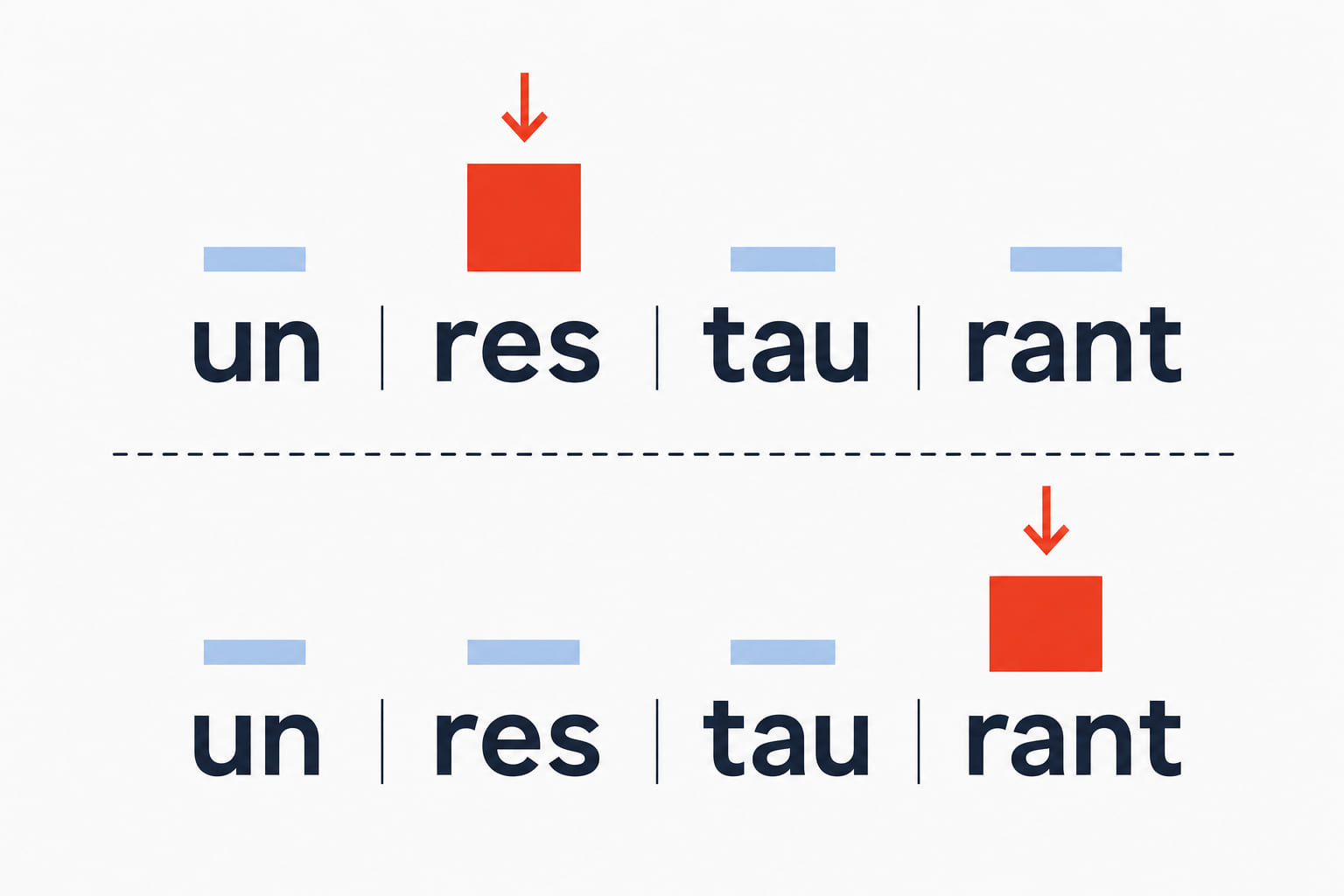
Say these, and make the bold syllable slightly longer and slightly higher — nothing else:
| Phrase | Say | English speakers say |
|---|---|---|
| un restaurant | uhn res-to-RAHN | uhn RES-to-rahn |
| c'est impossible | seh tan-po-SEEBL | seh tan-POSS-eebl |
| un chocolat chaud | uhn sho-ko-la SHOH | uhn SHOK-o-la shoh |
| je voudrais un café | zhuh voo-dreh zuhn ka-FEH | zhuh VOO-dreh uhn KA-feh |
| l'appartement de ma sœur | la-par-tuh-mahn duh ma SUR | la-PART-uh-mahn duh ma sur |
The physical check. Tap the table once, on the syllable you make loudest. Say the phrase at normal speed and let your hand fall where it wants to. Then look at where it landed. If your tap is anywhere except the last syllable of the group, you are speaking French with English rhythm — and you can see it, which means you do not have to hear it.
You failed if: you tapped in the middle. Or if you tapped more than once.
Test 4 — The nasal vowels have no N in them
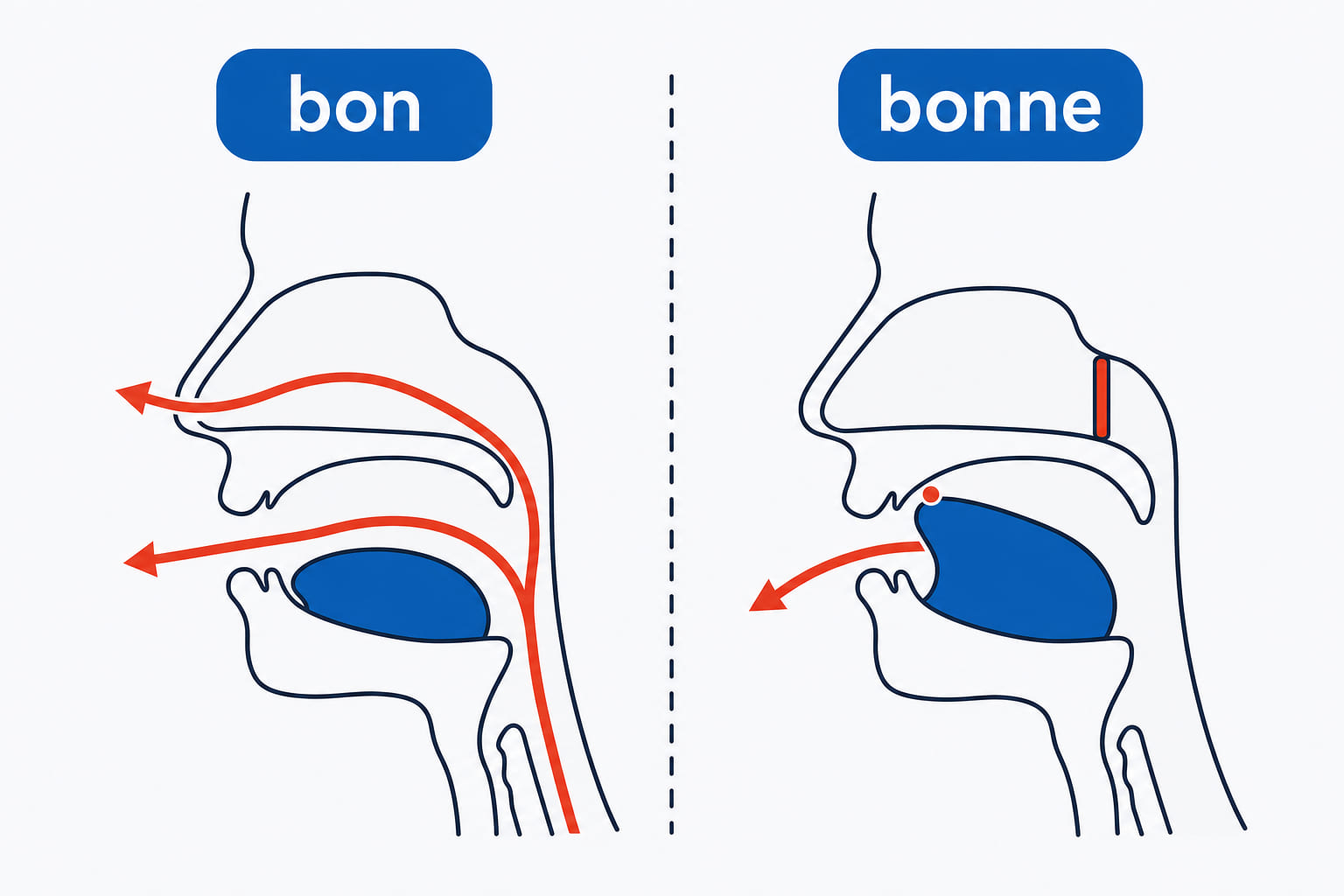
Bon and bonne are different words. Bon is a nasal vowel: air comes out through your nose while you make the vowel, and then it stops. There is no n consonant anywhere in it. Bonne is an ordinary oral vowel followed by a real, tongue-touching n.
English has no nasal vowels, so English speakers produce bon as bonne with extra effort — vowel, then a little n on the end. To a French ear that is simply the other word.
| Nasal — no n at all | Oral + real n | Meaning |
|---|---|---|
| bon — BOHⁿ | bonne — BON | good (m.) / good (f.) |
| an — AHⁿ | Anne — AN | year / Anne |
| plein — PLAⁿ | pleine — PLEN | full (m.) / full (f.) |
| sain — SAⁿ | saine — SEN | healthy (m.) / healthy (f.) |
| cousin — koo-ZAⁿ | cousine — koo-ZEEN | cousin (m.) / cousin (f.) |
| américain — a-may-ree-KAⁿ | américaine — a-may-ree-KEN | American (m.) / (f.) |
The raised ⁿ in the left column is not a consonant to pronounce. It marks the vowel as nasal — the air is going through your nose, and then the word ends.
The physical check. Two of them, and they are decisive. First: pinch your nose shut and say the left column. A true nasal vowel will be strangled and obviously wrong, because you have blocked its only exit. If it comes out sounding fine, it was never nasal. Second: for the left column, your tongue must not touch the roof of your mouth at any point. Say bon slowly and pay attention to the tip of your tongue. If it rises and makes contact at the end, you produced an n, and you said bonne.
You failed if: pinching your nose changed nothing, or your tongue touched down.
There is a fourth nasal, the un of brun, but most speakers in and around Paris now merge it with the in of plein — so brun and brin come out the same for a large share of native speakers (Wikipedia, French phonology). Three is enough to be getting on with.
Test 5 — The R is behind everything else
The standard French R is made at the very back — the uvula, the soft flap at the top of your throat, in the same place you gargle. The English R is made near the front, with the tongue tip curled or bunched. They are not neighbours.
Say: Paris, rue, très, merci, quatre, bonjour, rouge, arriver, France, cœur.
The physical check. Whisper them. A whispered French R still has clear audible friction — a small dry rasp at the back of your throat — because it is a fricative, made by air scraping past a narrow gap. A whispered English R has almost nothing to hear, because it is made by shaping the tongue rather than by friction. Whisper rouge five times. If you hear a scrape, you are in the right place. If you hear only breath, your tongue tip is doing the work.
You failed if: whispering produced silence — or if you felt the tip of your tongue curl back.
A useful shortcut: say the English word aga slowly and notice where the g happens. Now slide that contact a centimetre further back and let a little air through instead of closing completely. That gap is where your R lives.
Test 6 — The gaps between your words
English leaves small edges between words. French does not: a pronounced final consonant hops forward onto the next word's vowel, and two vowels run straight into each other with no catch in the throat.
Say these and count the syllables on your fingers:
| Written | Say | Syllables |
|---|---|---|
| il est | ee-LEH | 2 |
| avec elle | a-veh-KEL | 3 |
| une amie | ü-na-MEE | 3 |
| elle habite ici | eh-la-bee-tee-SEE | 5 |
| tu es ici | tü-eh-ee-SEE | 4 |
| vers huit heures | vehr wee-TUR | 3 |
The physical check. Say each line, then try to insert a small pause between the written words without changing anything else. In English that is easy — the seams are already there. In correct French it is not: to put a gap into avec elle you have to physically re-cut the syllables, because the k has moved house and now belongs to elle. If the gap slots in effortlessly, it was already there, and you are speaking in word-shaped blocks.
You failed if: the pause was easy. Or if elle habite ici came out as anything other than five continuous syllables.
The full mechanism, with fifteen more phrases, is in Enchaînement: Why Your French Sounds Choppy. And note the last row: vers huit heures does not link from vers into huit, because huit behaves like an aspirated h and blocks it — that one is covered in Le Héros vs L'Homme.
Your score
Two points per test if it was clean, one if you only managed it when you concentrated, zero if you failed the physical check.
| Score | What it means | What to do next |
|---|---|---|
| 10–12 | Your segments are in order. If people still switch to English, the problem is speed and rhythm, not sounds. | Work on rhythmic groups and native-speed listening. |
| 6–9 | Two or three specific leaks — and you now know which. This is the normal result for an A2–B1 learner who has never been corrected on pronunciation. | Drill only the tests you failed. Five minutes each, daily. |
| 0–5 | Not "a bad accent." Almost always this means nobody has ever given you feedback on your mouth — which is the default experience of learning from books, apps and podcasts. | Start with Test 3 and Test 6. They cost the least and change comprehensibility the most. |
One thing the score is not: a verdict on whether you should sound French. It is a map of which six things are currently between you and being understood without effort.
The final exam
Read this out loud at conversational speed. Every one of the six is in here.
Léa : Tu es déjà allée au restaurant italien ?
Marc : Pas encore. Il est où, exactement ?
Léa : Rue du Pont, juste en haut. On y va dimanche ?
Marc : Dimanche, c'est impossible. Je pars chez mes cousins.
Léa : Tes cousins de Bordeaux ?
Marc : Non, ceux de Toulouse. Ils habitent près du centre.
Léa : Bon. Alors mardi, vers huit heures ?
Marc : Mardi, parfait. Tu réserves ?
What to watch, line by line: Tu es and Rue du against Toulouse and où (Test 1). Allée, Bordeaux, parfait held steady (Test 2). Restaurant ita-LIEN, c'est impo-SSIBLE, près du CENTRE — emphasis at the end of each group, nowhere else (Test 3). Pont, encore, cousins, centre, Bon with no tongue contact (Test 4). Restaurant, Rue, Bordeaux, réserves at the back of the throat (Test 5). Il est où and Ils habitent running together — but en haut and vers huit keeping their seam (Test 6).
One more, free of charge: ils habitent is eel-za-BEET. The -ent is completely silent, and the z on ils is the only thing telling your listener it was plural — which is its own lesson.
Frequently asked questions
Can't I just ask a French friend?
You can, and they will say très bien. Not to flatter you — because correcting an adult's pronunciation mid-conversation is socially expensive, and because they are listening for meaning, not for phonetics. The one question worth asking is narrower and much harder to be polite about: "say these two words back to me the way I just said them." If they produce the same word twice, you have your answer.
Is it too late to fix my accent as an adult?
No, and the age question is mostly a distraction. What actually separates learners who improve from learners who plateau is not age — it is whether anyone ever told them which specific sound was wrong. Most adults have simply never had that. Pronunciation is a motor skill, and motor skills respond to targeted repetition with feedback at any age. What is genuinely harder after childhood is hearing the difference, which is why the tests above are built around physical checks instead.
Which of the six matters most for being understood?
Tests 3 and 6 — stress and linking. Individual vowels are what learners worry about, but a listener parsing speech in real time is using rhythm to find the word boundaries. Get the rhythm wrong and every correct vowel arrives in the wrong place. This is also why people who "know all the rules" still get switched to English.
How long before this changes anything?
Weeks, if you do it in small daily doses. A single 45-minute session does far less than five minutes a day for a month, because you are rewiring a motor habit rather than learning a fact. Expect the sound to be produceable in days and automatic in weeks — automatic meaning it survives you thinking about something else, like what you actually want to say.
Should I be aiming to sound like a native speaker?
Almost certainly not, and it is a poor target because it is unmeasurable. A far better one: your listener should not have to work. An accent that keeps the rhythm, the linking and the vowel contrasts is completely comfortable to listen to, and nobody minds where you are from.
Related lessons
- Enchaînement: Why Your French Sounds Choppy — Test 6 in full, with fifteen phrases to drill.
- Le Héros vs L'Homme: The Aspirated H, Drilled — the one place where the gap is correct.
- Ils Parlent Sounds Like Il Parle — the endings you are not supposed to say.
- Master the Phonetics French Alphabet — the sound-by-sound foundation under all six tests.
- 5 Common Mistakes English Speakers Make — four of the six show up on most teachers' lists.
Where self-testing runs out
The six checks above work because they measure things you can feel: tongue position, syllable count, whether a vowel moved, whether blocking your nose changed anything. That is real evidence, and it will take you further than listening to your own recordings ever will.
But it has a ceiling, and it is worth naming honestly. A physical check tells you that your tongue stayed put. It cannot tell you whether the vowel that came out actually landed inside the French u rather than somewhere in the gap between u and ou. It tells you that you tapped on the last syllable. It cannot tell you whether the beat you made reads as emphasis to a French ear. For that you need something outside your own head — not encouragement, and not très bien, but a verdict on the sound that actually left your mouth.
That is the whole design of Simply French: fifteen minutes a day of listening at native speed, speaking drills, and instant AI pronunciation scoring that tells you which syllable slipped and by how much. Run these six tests today, then start your free 7-day trial and find out what your score really is.
À vous de parler.
Tags
Now find out how you actually sound.
Simply French listens to you say each sentence and scores it word by word, so you can hear the difference you have just read about — and fix it while it is still fresh.
Takes about 10 minutes. No card needed to start.
Related Articles
T'as, Y'a, Chuis: Say Spoken French the Way It's Actually Said
Tu becomes t', il becomes i, il y a becomes y'a. The three families of French spoken contractions, why they exist, and 50 lines to drill out loud until they stop sounding like a different language.
How to Talk About Hobbies in French (A1-21)
Learn to talk about hobbies in French with 40+ phrases, the faire de vs jouer a rule, pronunciation hints, a sample dialogue and a free printable study sheet.
How to Make Plans in French (A1-20)
Learn how to make plans in French: invite a friend, say yes, decline politely, and set a time and place, with phrase tables, phonetics, and a free PDF.