
How to Make Plans in French (A1-20)
Learn how to make plans in French: invite a friend, say yes, decline politely, and set a time and place, with phrase tables, phonetics, and a free PDF.
Simply French Team
Here is a small secret about French social life: nobody says "Would you like to accompany me to the cinema on Saturday evening?" Real invitations are short, warm, and built from about three little openers. Once you can ask Tu es libre samedi ? and answer Avec plaisir ! without hesitating, you can fill your week with coffees, dinners, and walks — which is precisely how a language becomes a life.
In this lesson you'll learn how to make plans in French from start to finish: checking if someone is free, inviting them, saying yes, saying no without freezing the friendship, and pinning down the time and place.
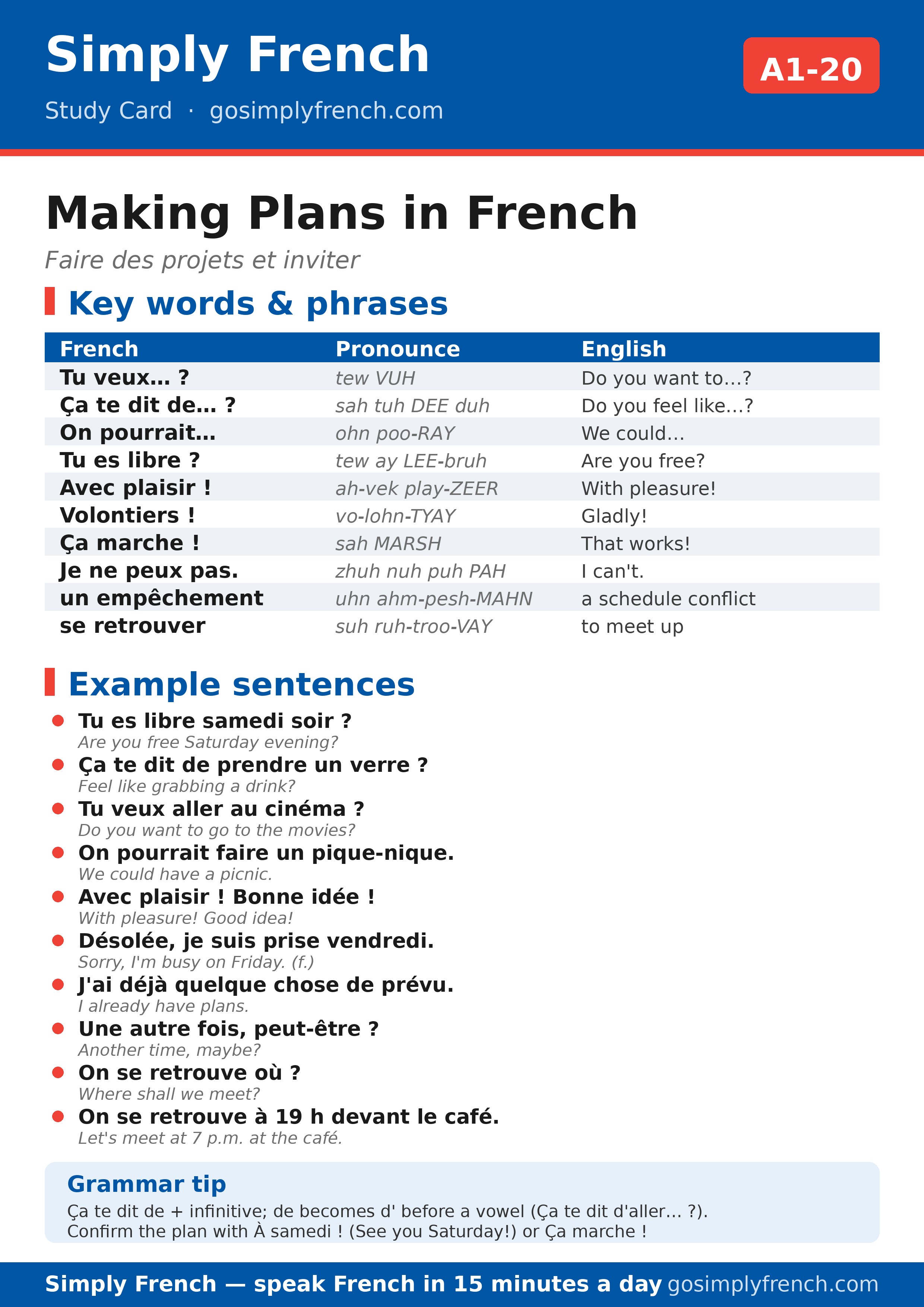
Download the printable study sheet (PDF): Making plans in French study sheet
The three friendly openers
Most everyday invitations start with one of these three patterns. Learn them as chunks and you can invite anyone to do anything.
| French | Pronounce | English |
|---|---|---|
| Tu veux… ? | tew VUH | Do you want to…? |
| Ça te dit de… ? | sah tuh DEE duh | Do you feel like…? |
| On pourrait… | ohn poo-RAY | We could… |
Each opener is followed by an infinitive — the dictionary form of the verb:
| French | English |
|---|---|
| Tu veux aller au cinéma ? | Do you want to go to the movies? |
| Ça te dit de prendre un verre ? | Do you feel like grabbing a drink? |
| Ça te dit d'aller au restaurant ? | Do you feel like going to a restaurant? |
| On pourrait faire un pique-nique. | We could have a picnic. |
Ça te dit is the most French of the three: casual, friendly, zero pressure. Its formal or plural cousin is Ça vous dit… ? And On pourrait is the soft launch — you're floating an idea rather than asking a direct question, which makes it easy for the other person to add their own suggestion.
Asking if someone is free
Before the invitation, check availability. These two questions do almost all the work:
| French | Pronounce | English |
|---|---|---|
| Tu es libre samedi ? | tew ay LEE-bruh sahm-DEE | Are you free on Saturday? |
| Qu'est-ce que tu fais ce week-end ? | kess kuh tew FAY suh wee-KEND | What are you doing this weekend? |
| Vous êtes libre lundi soir ? | voo zet LEE-bruh luhn-DEE SWAHR | Are you free Monday evening? (formal) |
Slot in any day you like — if the days of the week still feel wobbly, review the days and months in French first, because every plan you ever make will hang on one of them.
Saying yes: accepting with enthusiasm
French speakers accept invitations with short, upbeat formulas. Any of these makes you sound delighted rather than merely willing:
| French | Pronounce | English |
|---|---|---|
| Avec plaisir ! | ah-vek play-ZEER | With pleasure! |
| Oui, volontiers ! | wee vo-lohn-TYAY | Yes, gladly! |
| Bonne idée ! | bun ee-DAY | Good idea! |
| Ça marche ! | sah MARSH | That works! |
| Pourquoi pas ? | poor-KWAH pah | Why not? |
Ça marche ! (literally "it walks") is the everyday all-rounder: it accepts the plan and confirms the details in one breath. You'll hear it from waiters, friends, and colleagues a dozen times a day.
Saying no politely
Declining is where beginners panic, so here is the reassuring truth: a polite French refusal is just three ingredients — an apology, a short reason, and (ideally) a counter-proposal.
| French | Pronounce | English |
|---|---|---|
| Désolé, je ne peux pas. | day-zo-LAY zhuh nuh puh PAH | Sorry, I can't. (m.) |
| Je suis prise samedi. | zhuh swee PREEZ sahm-DEE | I'm busy on Saturday. (f.) |
| J'ai déjà quelque chose de prévu. | zhay day-ZHAH kel-kuh SHOHZ duh pray-VEW | I already have plans. |
| J'ai un empêchement. | zhay uhn ahm-pesh-MAHN | Something has come up. |
| Une autre fois, peut-être ? | ewn OH-truh fwah puh-TET-ruh | Another time, maybe? |
Two small agreement notes: a woman writes désolée and says je suis prise; a man writes désolé and says je suis pris. And J'ai un empêchement is the magic phrase for cancelling gracefully — it means "an obstacle has arisen" and requires no further explanation.
Put together, a kind refusal sounds like this: Désolée, je ne peux pas vendredi, je suis prise. Mais samedi, ça te dit ? — Sorry, I can't on Friday, I'm busy. But how about Saturday?
Setting the time and place
The plan isn't real until you know where and when. The key verb is se retrouver — to meet up:
| French | Pronounce | English |
|---|---|---|
| On se retrouve où ? | ohn suh ruh-TROOV oo | Where shall we meet? |
| On se retrouve à quelle heure ? | ohn suh ruh-TROOV ah kel UHR | What time shall we meet? |
| On se retrouve à 19 h devant le cinéma. | ohn suh ruh-TROOV ah deez-nuhf UHR | Let's meet at 7 p.m. in front of the cinema. |
| À samedi ! | ah sahm-DEE | See you Saturday! |
| À tout à l'heure ! | ah too tah LUHR | See you in a bit! |
Remember that everyday France runs on the 24-hour clock, so a dinner invitation says à 20 h, not "8 p.m." If reading 19 h 30 still takes you a second, our lesson on how to tell time in French covers it step by step.
This is exactly what you'll practice out loud in Lesson A1-20: Making Plans and Invitations inside Simply French — you'll hear each invitation at native speed, say it aloud, and get instant pronunciation feedback.
A real conversation
Here is how the whole dance sounds between two friends, Léa and Marc:
| French | English |
|---|---|
| Léa : Salut Marc ! Tu es libre vendredi soir ? | Hi Marc! Are you free Friday evening? |
| Marc : Vendredi… oui, je suis libre. Pourquoi ? | Friday… yes, I'm free. Why? |
| Léa : Ça te dit de prendre un verre après le travail ? | Feel like grabbing a drink after work? |
| Marc : Avec plaisir ! On se retrouve où ? | With pleasure! Where shall we meet? |
| Léa : Devant le café de la gare, à 18 h 30 ? | In front of the station café, at 6:30 p.m.? |
| Marc : Ça marche ! À vendredi ! | That works! See you Friday! |
Six lines, no long sentences — and every single one comes from the tables above.
Cultural tips: rendez-vous, treats, and being (slightly) late
Un rendez-vous is not automatically a date. In French it simply means any arranged meeting — with your doctor, your banker, or yes, someone charming. The Larousse dictionary entry for rendez-vous defines it as a meeting agreed between people at the same time and place. So J'ai rendez-vous chez le médecin raises no eyebrows, and for romance the French often say un rencard (informal) instead.
Je t'invite means "my treat." If a French friend says Je t'invite au restaurant, they are offering to pay, not merely requesting your company. Accept graciously and return the favor next time.
The quarter-hour of politeness. For a dinner at someone's home, arriving about fifteen minutes late — le quart d'heure de politesse — is considered thoughtful, giving your hosts breathing room. But for restaurants, movies, and anything with a booking, be on time.
Tu or vous? Among friends, family, and fellow students, invite with tu (Tu veux… ? Ça te dit… ?). With colleagues you don't know well or anyone you'd greet formally, use vous: Vous êtes libre jeudi ? Ça vous dit de déjeuner ensemble ?
Frequently asked questions
What does "ça te dit" literally mean?
Literally, "does it say (anything) to you?" — the verb dire means "to say," as the WordReference entry for dire shows, and in this idiom something "speaks to you" if it appeals to you. So Ça me dit bien means "I'm quite up for it," and Ça ne me dit rien means "I don't feel like it at all."
Is "un rendez-vous" romantic?
Not by default. It covers any appointment: un rendez-vous chez le dentiste is a dental appointment. Context (or un rencard) carries the romantic meaning. Related verb: prendre rendez-vous means "to book an appointment."
How do I decline an invitation without being rude?
Use the three-part recipe: apologize (Désolé(e)), give a light reason (je suis pris(e) or j'ai un empêchement), and offer an alternative (Une autre fois, peut-être ?). Proposing another day is what signals that the "no" is about the calendar, not the person.
What's the difference between "tu veux" and "ça te dit"?
Tu veux… ? asks directly about wanting; Ça te dit… ? asks about mood and appeal, more like "are you in the mood for…?" Both are friendly; ça te dit sounds a touch more casual and leaves more room to say no.
How do French people confirm plans?
With Ça marche ! or C'est noté ("noted"), often followed by a recap: Alors, samedi 15 h devant la fontaine. By text, expect the ubiquitous On se dit à samedi ! — "we're saying see-you-Saturday, then!"
What should I say if I have to cancel?
Call or text early and say Je suis désolé(e), j'ai un empêchement, je dois annuler. Then immediately propose to reschedule: On peut reporter à la semaine prochaine ? (Can we push it to next week?). Cancelling with a counter-proposal keeps the goodwill intact.
Related lessons
Keep building your conversational week with these lessons:
- Days of the week and months in French — the raw material of every plan
- How to tell time in French — so 18 h 30 never catches you out
- How to order food in French — for when the plan is dinner
- How to say how are you in French — the small talk before the invitation
Practice making plans out loud
Reading invitation phrases is the easy half; the hard half is saying Ça te dit de prendre un verre ? smoothly while your friend waits. Simply French gives you 15-minute daily lessons where you listen at native speed, speak your answers out loud, and get instant AI pronunciation scoring — so the first time you invite someone in French, it won't feel like the first time. Start your free 7-day trial and practice Lesson A1-20 today.
Tags
Now find out how you actually sound.
Simply French listens to you say each sentence and scores it word by word, so you can hear the difference you have just read about — and fix it while it is still fresh.
Takes about 10 minutes. No card needed to start.
Related Articles
T'as, Y'a, Chuis: Say Spoken French the Way It's Actually Said
Tu becomes t', il becomes i, il y a becomes y'a. The three families of French spoken contractions, why they exist, and 50 lines to drill out loud until they stop sounding like a different language.
How to Tell If Your French Accent Is Actually Good (Self-Test)
You cannot hear your own French accent — your ear filters it through English. Six self-tests that isolate what English speakers actually get wrong, each one you can check on your own, plus a 12-point scorecard.
How to Talk About Hobbies in French (A1-21)
Learn to talk about hobbies in French with 40+ phrases, the faire de vs jouer a rule, pronunciation hints, a sample dialogue and a free printable study sheet.