How to Talk About Hobbies in French (A1-21)
Learn to talk about hobbies in French with 40+ phrases, the faire de vs jouer a rule, pronunciation hints, a sample dialogue and a free printable study sheet.
Simply French Team
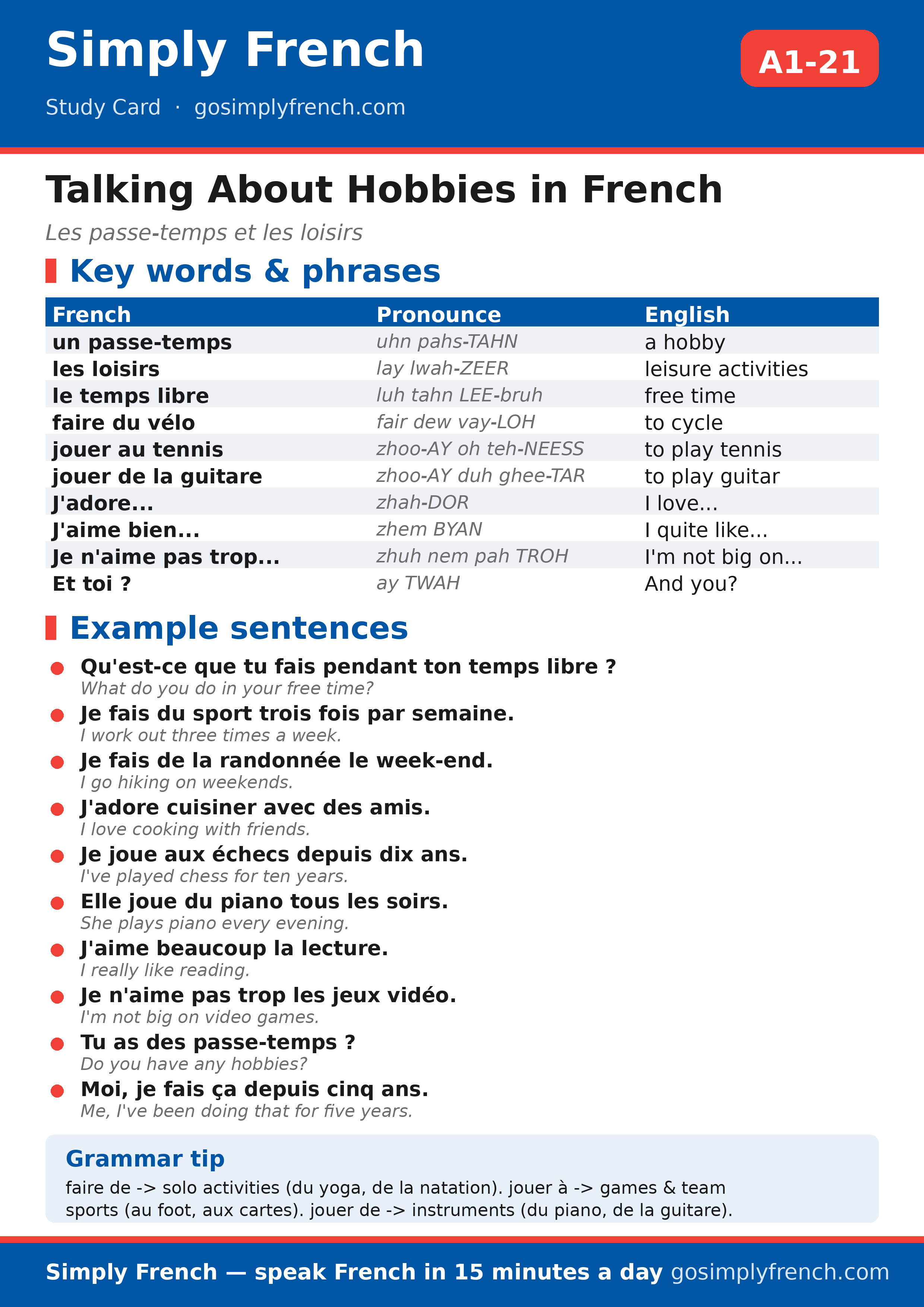
Download the printable study sheet (PDF): Talking About Hobbies in French (A1-21) study sheet
There is a moment in almost every conversation with a new French acquaintance where someone asks what you do for fun. It arrives fast — usually right after names and jobs — and it is the single best doorway into a real friendship. Learning to talk about hobbies in French turns you from someone answering questions into someone having a conversation.
The good news: this topic is generous. You do not need the past tense, you do not need the subjunctive, and you do not need a huge vocabulary. You need three little verb patterns, about twenty nouns, and a couple of phrases for bouncing the question back. That is genuinely it.
The one word you need first: un passe-temps
French has two words that both land near the English "hobby," and knowing the difference makes you sound careful rather than translated.
Un passe-temps is the activity itself. Larousse defines it as a divertissement ou occupation privilégiée — a favoured pastime you give yourself over to in your free moments. It is the closest match to "a hobby."
Les loisirs is the wider category: the free time itself and everything you do with it. Larousse's entry for loisir calls it temps libre dont on dispose en dehors des occupations imposées — time you can use as you please. On official French forms, in city brochures and on gym websites, loisirs is the word you will see.
In practice: your guitar is un passe-temps; the Saturday afternoon you play it in is un loisir. Note that passe-temps is invariable — it is spelled the same in singular and plural (un passe-temps, des passe-temps), and it always keeps its hyphen.
| French | Pronounce | English |
|---|---|---|
| un passe-temps | uhn pahs-TAHN | a hobby |
| les loisirs | lay lwah-ZEER | leisure activities |
| le temps libre | luh tahn LEE-bruh | free time |
| pendant mon temps libre | pahn-DAHN mohn tahn LEE-bruh | in my free time |
| le week-end | luh week-END | the weekend |
The three verb patterns that unlock everything
Here is the part that trips up almost every English speaker. French uses three different structures where English just says "I play" or "I do." Get these three straight and roughly forty hobby sentences become available to you at once.
1. faire de — solo activities and sports you practise
Use faire de for activities you do rather than compete at: swimming, yoga, hiking, cooking, photography. The de contracts with the article that follows:
- de + le becomes du — je fais du yoga
- de + la stays de la — je fais de la randonnée
- de + l' before a vowel — je fais de l'escalade
- de + les becomes des — je fais des photos
2. jouer à — games and team sports
Use jouer à when there is an opponent, a ball, or a board. Same contraction logic: à + le becomes au, à + les becomes aux.
- je joue au tennis, je joue au foot
- je joue aux échecs (chess), je joue aux cartes (cards)
- je joue aux jeux vidéo (video games)
3. jouer de — musical instruments
Use jouer de for any instrument. WordReference's entry for jouer lays out the same split.
- je joue du piano, je joue de la guitare, je joue du violon
A friendly warning: with several ball sports the French themselves waver — je joue au basket (the game tonight) and je fais du basket (the sport I practise) are both correct and both common. Nobody will correct you. Instruments, though, are strict: it is always jouer de.
Core hobby vocabulary
These are the activities that actually come up when you talk about hobbies in French with real people.
| French | Pronounce | English |
|---|---|---|
| faire du sport | fair dew SPOR | to do sport / work out |
| faire de la randonnée | fair duh lah rahn-doh-NAY | to go hiking |
| faire de la cuisine | fair duh lah kwee-ZEEN | to cook |
| faire du vélo | fair dew vay-LOH | to cycle |
| faire de la natation | fair duh lah nah-tah-SYOHN | to swim |
| jouer au football | zhoo-AY oh foot-BALL | to play football |
| jouer aux échecs | zhoo-AY oh zay-SHEK | to play chess |
| jouer de la guitare | zhoo-AY duh lah ghee-TAR | to play the guitar |
| lire | leer | to read |
| voyager | vwah-yah-ZHAY | to travel |
| dessiner | deh-see-NAY | to draw |
| chanter | shahn-TAY | to sing |
| jardiner | zhar-dee-NAY | to garden |
| regarder des séries | ruh-gar-DAY day say-REE | to watch series |
Notice that the last six are plain infinitives. That is deliberate — those hobbies do not take faire or jouer at all. You simply pair them with a liking verb, which is the next piece.
Saying how much you like it
French likes gradations, and using more than one of these makes you sound far less robotic than repeating j'aime six times.
| French | Pronounce | English |
|---|---|---|
| J'adore... | zhah-DOR | I love... |
| J'aime beaucoup... | zhem boh-KOO | I really like... |
| J'aime bien... | zhem BYAN | I quite like... |
| Je n'aime pas trop... | zhuh nem pah TROH | I'm not big on... |
| Je déteste... | zhuh day-TEST | I hate... |
| Ça me détend | sah muh day-TAHN | It relaxes me |
Two structures follow these verbs, and both are easy:
- + infinitive: J'adore cuisiner. (I love cooking.)
- + definite article + noun: J'adore la cuisine française. (I love French cooking.)
That definite article is not optional. English drops it — "I love cooking" — and French keeps it: J'aime la lecture, J'aime le sport. Forgetting it is the single most common mistake English speakers make here.
Asking the question back
A conversation about hobbies in French dies instantly if you only answer. These four questions keep it alive:
| French | Pronounce | English |
|---|---|---|
| Qu'est-ce que tu fais pendant ton temps libre ? | kess-kuh tew FAY pahn-DAHN tohn tahn LEE-bruh | What do you do in your free time? |
| Tu as des passe-temps ? | tew ah day pahs-TAHN | Do you have any hobbies? |
| Tu fais du sport ? | tew fay dew SPOR | Do you play any sports? |
| Depuis combien de temps ? | duh-PWEE kohm-BYAN duh TAHN | For how long? |
| Et toi ? | ay TWAH | And you? |
Use vous instead of tu with someone older, a shopkeeper, or in a professional setting — Qu'est-ce que vous faites pendant votre temps libre ? If you are unsure which to use, the same politeness logic covered in our guide to asking how someone is in French applies here.
A short conversation you can steal
Camille : Qu'est-ce que tu fais pendant ton temps libre ? — What do you do in your free time? Tom : Je fais du vélo le week-end, et j'adore cuisiner. Et toi ? — I cycle on weekends, and I love cooking. And you? Camille : Moi, je joue de la guitare. Je fais ça depuis cinq ans. — Me, I play guitar. I've been doing it for five years. Tom : Ah, super ! Moi, je n'aime pas trop la musique, mais j'aime bien lire. — Oh, great! I'm not big on music, but I quite like reading. Camille : Tu lis quoi en ce moment ? — What are you reading at the moment?
Two things worth copying from that dialogue. First, Moi, je... at the start of a sentence — it is not redundant, it is how French speakers signal "as for me." Second, depuis cinq ans uses the present tense in French where English uses "have been." Je fais ça depuis cinq ans, never j'ai fait.
This is exactly what you'll practise out loud in Lesson A1-21: Hobbies and Free Time inside Simply French — you listen to a native speaker ask the question at full speed, answer out loud, and get an instant pronunciation score on your jouer du and faire de la.
Cultural notes that save you from awkwardness
Hobbies are a real conversation topic, not small talk. Where an American might trade one-line answers, French conversation often digs in: expect follow-up questions about how long you have done it, where, and why. Have one extra sentence ready.
Sport is often a club activity. French adults join une association or un club rather than a commercial gym, and September is la rentrée — the annual sign-up rush. Saying je me suis inscrit à un club de tennis signals you understand how life there works.
Do not translate "I'm a foodie." There is no clean equivalent. Je suis gourmand(e) (I love good food, with a slight sweet-tooth flavour) or je suis passionné(e) de cuisine both work better.
Try this today
Write three sentences about yourself using a different pattern in each: one faire de, one jouer à or jouer de, and one liking verb plus infinitive. Say them out loud five times until you stop thinking about the contractions. Then add Et toi ? to the end.
Ready to say all of this out loud at native speed and hear whether you actually nailed it? Start your free 7-day trial of Simply French and practise Lesson A1-21 with instant pronunciation scoring — 15 minutes a day is all it takes.
Frequently asked questions
What is "hobby" in French?
The standard translation is un passe-temps (uhn pahs-TAHN), which stays spelled the same in the plural: des passe-temps. In everyday speech, French speakers often skip the noun entirely and just name the activity — je fais du vélo rather than mon passe-temps, c'est le vélo. The broader word les loisirs covers free time and leisure activities generally, and is what you will see on official forms and club websites.
When do I use faire de instead of jouer à?
Use jouer à when there is an opponent, a ball, or a board — jouer au tennis, jouer aux cartes. Use faire de for activities you practise on your own — faire du yoga, faire de la randonnée. With several team ball sports both are heard and both are correct, so je joue au basket and je fais du basket will each sound natural. Musical instruments are the strict case: always jouer de, as in jouer du piano.
Why does French say j'aime le sport with "the"?
French requires the definite article before a noun used in a general sense, where English drops it. So "I like sport" is j'aime le sport and "I love reading" is j'aime la lecture. The article disappears only when you follow the verb with an infinitive instead: j'aime lire. Getting this right is one of the fastest ways to stop sounding like a direct translation.
How do I say how long I have had a hobby?
Use depuis with the present tense: je joue du piano depuis trois ans (I have been playing piano for three years). This is one of the clearest differences from English, which needs a past form. To ask, say Depuis combien de temps ? — literally "since how much time?"
What if I do not really have any hobbies?
Say Je n'ai pas vraiment de passe-temps, mais j'aime bien... and finish with something small and true — me promener (going for walks), regarder des séries, voir mes amis. French conversation values a real answer over an impressive one, and the mais j'aime bien structure gives your partner something to ask about.
Is passe-temps ever plural with an "s" on passe?
No. Passe-temps is invariable: the spelling never changes between singular and plural, and neither half takes an added s. Only the article shifts — un passe-temps, des passe-temps. Keep the hyphen; passe temps written as two loose words is a common typo.
Related lessons
- How to make plans in French — the natural next step once you have discovered a shared hobby.
- How to talk about your job in French — the other half of the "so, tell me about yourself" conversation.
- How to introduce yourself in French — the opening moves that lead into this topic.
- How to say how are you in French — choosing between tu and vous with confidence.
Tags
Now find out how you actually sound.
Simply French listens to you say each sentence and scores it word by word, so you can hear the difference you have just read about — and fix it while it is still fresh.
Takes about 10 minutes. No card needed to start.
Related Articles
T'as, Y'a, Chuis: Say Spoken French the Way It's Actually Said
Tu becomes t', il becomes i, il y a becomes y'a. The three families of French spoken contractions, why they exist, and 50 lines to drill out loud until they stop sounding like a different language.
How to Tell If Your French Accent Is Actually Good (Self-Test)
You cannot hear your own French accent — your ear filters it through English. Six self-tests that isolate what English speakers actually get wrong, each one you can check on your own, plus a 12-point scorecard.
How to Make Plans in French (A1-20)
Learn how to make plans in French: invite a friend, say yes, decline politely, and set a time and place, with phrase tables, phonetics, and a free PDF.