T'as, Y'a, Chuis: Say Spoken French the Way It's Actually Said
Tu becomes t', il becomes i, il y a becomes y'a. The three families of French spoken contractions, why they exist, and 50 lines to drill out loud until they stop sounding like a different language.
Simply French Team
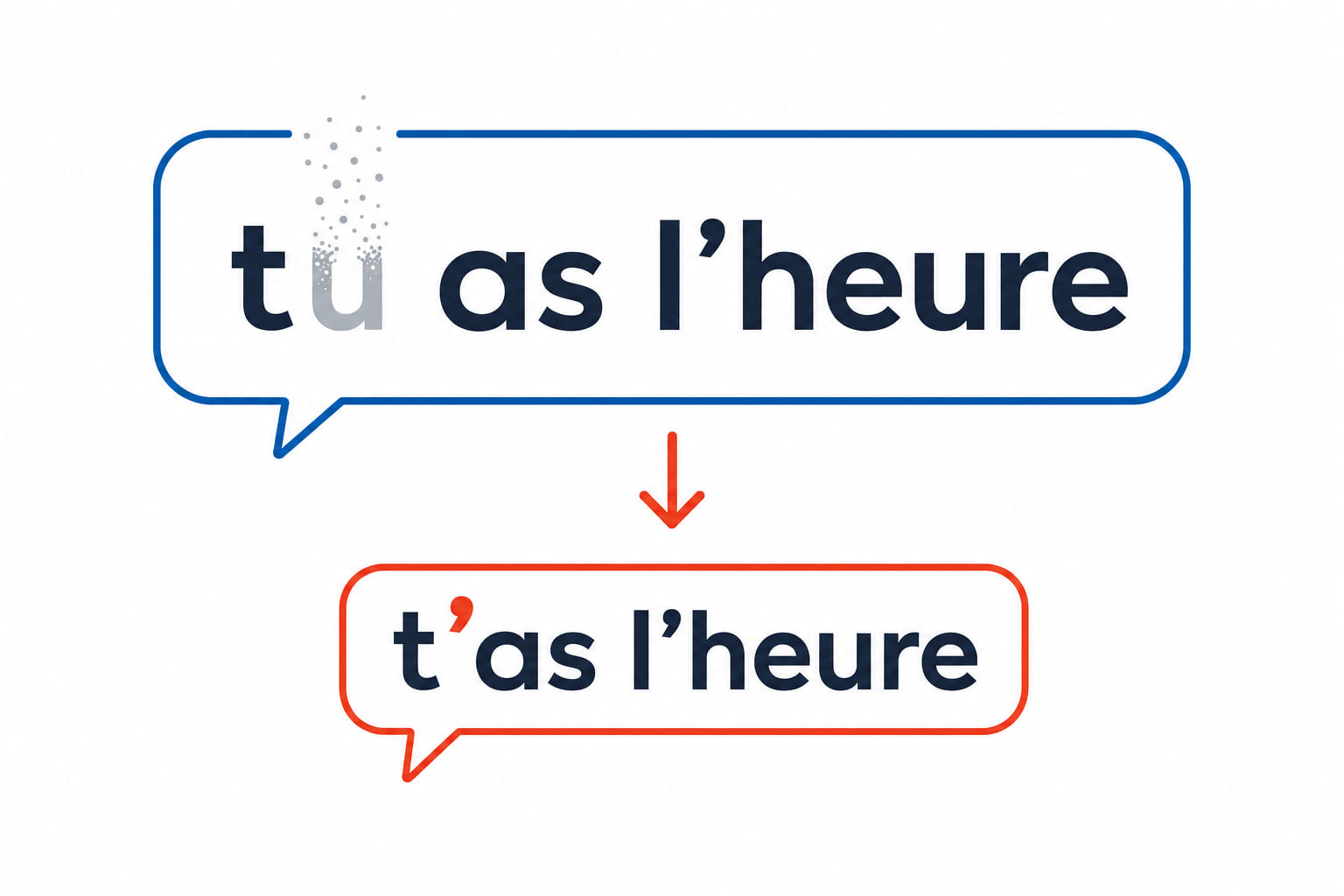
You spent a term learning that you have is tu as. Two words, two syllables, both of them printed on the page. Then a French person leaned over and fired four sounds at you — t'as l'heure ? — and you did not register that a question had happened.
It is tempting to file that under slang, somewhere near verlan and whatever teenagers are doing online. It is not slang. It is the ordinary pronunciation of ordinary French, used by newsreaders and bank managers, in which the small grammar words at the front of a sentence stop behaving like words and fuse into whatever comes next.
Why the front of the sentence collapses
French puts its stress at the end of a rhythmic group. Whatever sits at the start is unstressed by definition, said fast, and given no room to breathe — and the things that sit at the start of a French sentence are almost always the same tiny set of words: je, tu, il, elle, on, ce, il y a, il faut. Say anything a thousand times a day in the weakest position in the sentence and it wears down. That is all a contraction is: erosion at the unstressed end.
This is a different mechanism from the disappearing e muet, even though the two are cousins and constantly stack. There, one optional vowel falls out of a word. Here, whole words lose material and glue themselves to the next one. Je ne sais pas loses a schwa and a negation and a consonant, and lands as chais pas.
Almost all of it fits in three families.
Family 1 — tu becomes t' before a vowel
The rule is narrow and completely reliable: before a vowel or a mute h, tu loses its vowel and attaches to the verb. This is standard informal speech, not a regional quirk — it is "very common in informal speech, but is avoided in careful speech and never used in formal writing" (Wikipedia, Elision (French)).
Before a consonant, tu stays tu: tu vas, tu peux, tu sais. You will hear t'vas and t'sais from plenty of speakers, but that is one step further out than standard casual French, and copying it early tends to sound like an impression rather than an accent. Get t'as and t'es automatic first.
There is one trap worth naming before you drill. T'as is pronounced exactly like ta (your), and t'es exactly like tes (your, plural). T'as ta clé ? is two identical syllables in a row meaning two completely different things. Nobody is confused, because the grammar only allows one reading — but it means you cannot lean on the sound to tell you what you heard.
Drill 1 — t'
Read the middle column, never the left one. The left column is spelling; the middle column is what leaves a French mouth. Five times each, fast enough that the u has no room to sneak back in.
| Written | What you actually say | Pronounce | English |
|---|---|---|---|
| tu as l'heure ? | t'as l'heure ? | ta-LUHR | got the time? |
| tu es prêt ? | t'es prêt ? | teh-PREH | ready? |
| tu es où ? | t'es où ? | teh-OO | where are you? |
| tu as raison | t'as raison | ta-reh-ZOHN | you're right |
| tu as compris ? | t'as compris ? | ta-kohn-PREE | got it? |
| tu en veux ? | t'en veux ? | tahn-VUH | want some? |
| tu y vas ? | t'y vas ? | tee-VAH | are you going? |
| tu aimes ça ? | t'aimes ça ? | tem-SAH | do you like it? |
| tu habites où ? | t'habites où ? | ta-beet-OO | where do you live? |
| tu as envie ? | t'as envie ? | ta-zahn-VEE | do you feel like it? |
| tu n'as pas vu ? | t'as pas vu ? | ta-pah-VÜ | didn't you see? |
| tu étais où ? | t'étais où ? | tay-teh-OO | where were you? |
| tu arrives quand ? | t'arrives quand ? | ta-reev-KAHN | when do you get in? |
| tu as l'air fatigué | t'as l'air fatigué | ta-lehr-fa-tee-GAY | you look tired |
| tu as ta clé ? | t'as ta clé ? | ta-ta-KLAY | got your key? |
Family 2 — il becomes i, elle becomes è
This is the family that costs you the most comprehension, and almost nobody teaches it.
Before a consonant, the l of il and ils disappears entirely. Il fait beau is ee-feh-BOH. Elle and elles do the same thing and land on a bare è (ielanguages, Informal French). Before a vowel, the l survives — because now it has somewhere to go. It hops across and starts the next syllable, which is plain enchaînement.
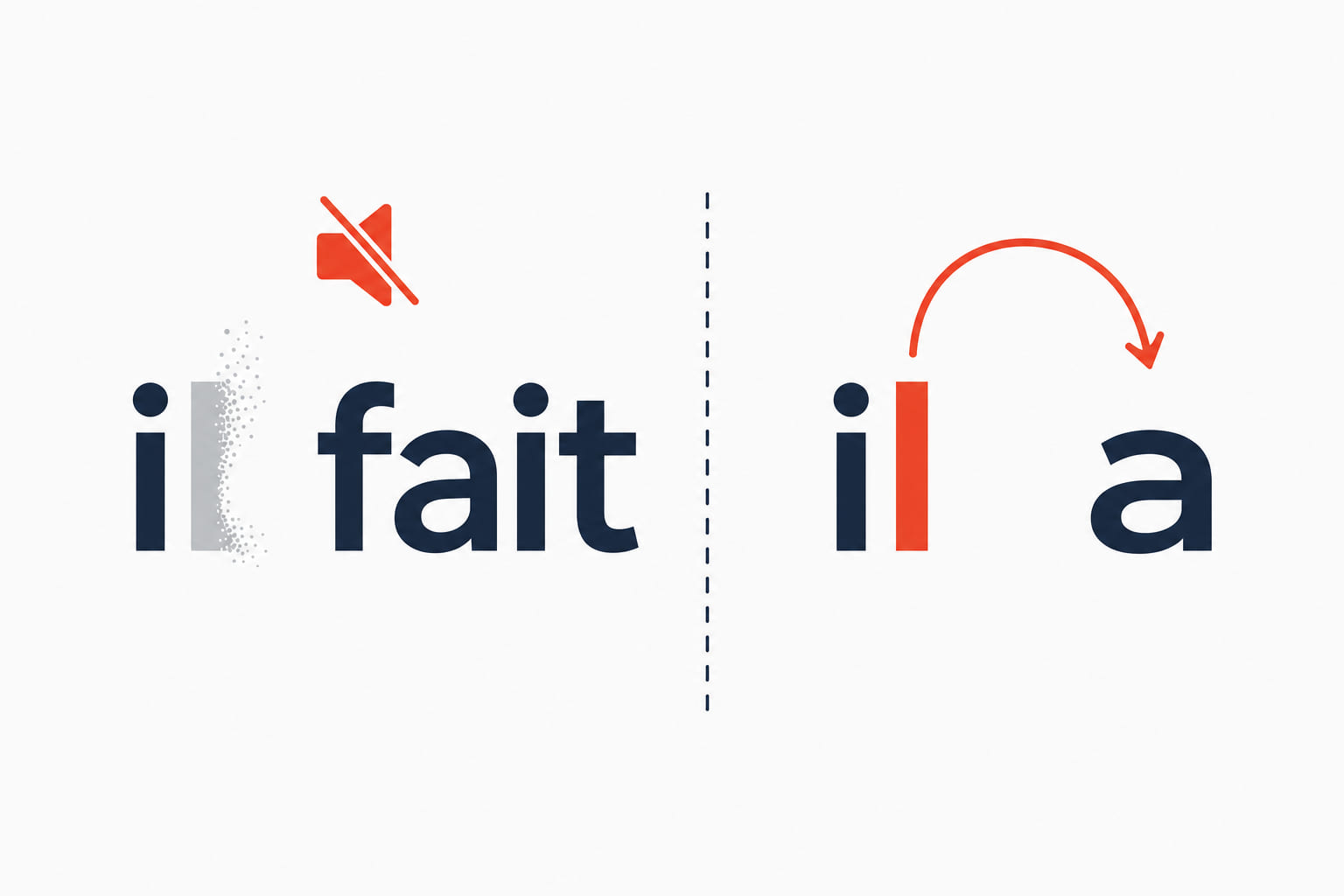
| Next sound | What happens to the l | Example | Pronounce |
|---|---|---|---|
| Consonant | Gone | il fait | ee-FEH |
| Vowel | Survives, links across | il a | ee-LAH |
| Consonant | Gone | elle vient | eh-VYAN |
| Vowel | Survives, links across | elle est | eh-LEH |
The pair worth an hour of your life
Once ils is reduced to i, exactly one sound separates two of the most common phrases in French:
| Written | Said | Pronounce | Meaning |
|---|---|---|---|
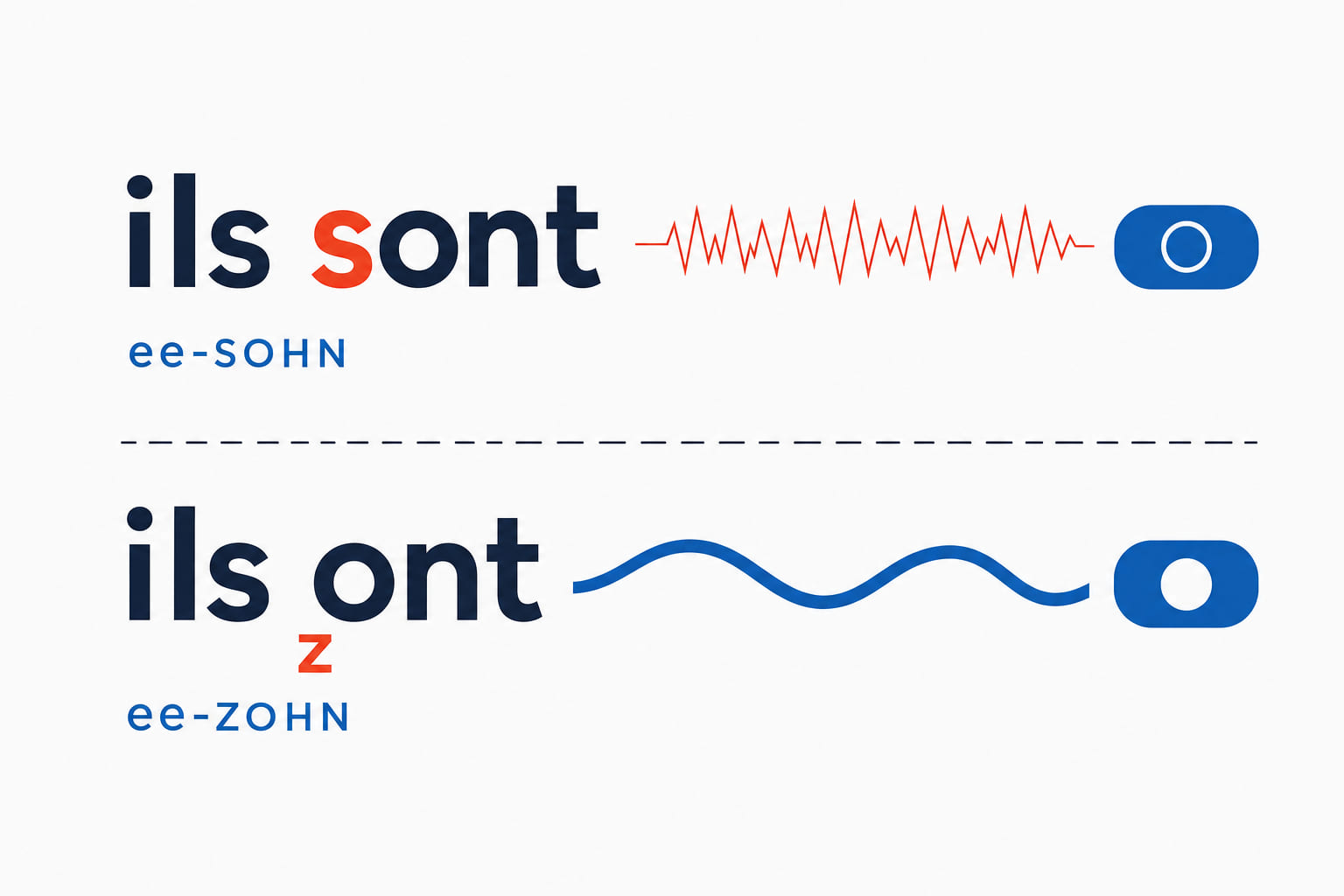
| ils sont | i sont | ee-SOHN | they are |
| ils ont | i zont | ee-ZOHN | they have |
A hiss means are. A buzz means have. That is the whole distinction, and English speakers routinely produce both as the same lazy middle sound, which is how you end up saying they are said it. Say ee-SOHN / ee-ZOHN back to back until your throat can feel which one it is doing.
Drill 2 — i and è
| Written | What you actually say | Pronounce | English |
|---|---|---|---|
| il fait beau | i fait beau | ee-feh-BOH | the weather's nice |
| il vient | i vient | ee-VYAN | he's coming |
| il ne peut pas | i peut pas | ee-puh-PAH | he can't |
| il ne sait pas | i sait pas | ee-seh-PAH | he doesn't know |
| ils sont là | i sont là | ee-sohn-LAH | they're here |
| ils ont dit | i z'ont dit | ee-zohn-DEE | they said |
| ils vont venir | i vont v'nir | ee-vohn-VNEER | they're going to come |
| il est parti | il est parti | ee-leh-par-TEE | he left |
| il a dit | il a dit | ee-la-DEE | he said |
| ils arrivent | ils arrivent | ee-za-REEV | they're arriving |
| elle fait quoi ? | è fait quoi ? | eh-feh-KWAH | what's she doing? |
| elle est là | elle est là | eh-leh-LAH | she's here |
| elles sont parties | è sont parties | eh-sohn-par-TEE | they left |
| il y a un problème | y'a un problème | ya-uhn-pro-BLEM | there's a problem |
| il n'y a personne | y'a personne | ya-pehr-SON | there's nobody |
Family 3 — the fixed reductions
These are not rules, they are shapes. Learn each one the way you learned bonjour: as a single sound with a single meaning, never assembled from its parts.
| Written | Said | Pronounce | English |
|---|---|---|---|
| il y a | y'a | YAH | there is / there are |
| il n'y a pas | y'a pas | ya-PAH | there isn't |
| il faut | faut | FOH | you have to |
| il faut que je parte | faut qu'j'parte | foh-KZHPART | I have to go |
| je suis | chuis | SHWEE | I am |
| parce que | pasque | PASK | because |
| puis | pis | PEE | then / and |
| quelque chose | quèqu'chose | kek-SHOHZ | something |
| quelqu'un | quèqu'un | kek-UHN | someone |
| celui-là | çui-là | swee-LAH | that one |
| peut-être | p't-être | PTETR | maybe |
| d'accord | d'ac | DAK | ok |
| ne t'inquiète pas | t'inquiète | tan-KYET | don't worry |
| s'il vous plaît | siouplaît | syoo-PLEH | please |
| qu'est-ce que tu fais ? | kess'tu fais ? | kess-tü-FEH | what are you doing? |
| à tout à l'heure | à t'à l'heure | a-ta-LUHR | see you shortly |
Two of these deserve a note. Pasque and quèque are documented reductions, not sloppiness — puis is "more commonly pronounced pis, parce que is pronounced pasque, and quelque is pronounced quèque" (ielanguages). And t'inquiète is a different animal from t'as: the t' there is te, the reflexive pronoun, not tu. The whole negation has been eaten and the phrase now means don't worry while looking, on paper, like you worry.
One more that is grammar rather than sound: nous is dead in speech. People say on y va, not nous y allons; on a fini, not nous avons fini. Three syllables become one, and the verb goes to the easy third-person form. If you are still building sentences with nous, you are doing extra work to sound less natural.
Drill 3 — all three families at once
Say each line twice: once as written, then once at speed. The second version is the target.
| Written | At speed | Pronounce | English |
|---|---|---|---|
| Tu as vu qu'il y a du monde ? | T'as vu qu'y a du monde ? | ta-vü-kya-dü-MOHND | Did you see it's packed? |
| Il faut que tu viennes. | Faut qu'tu viennes. | foh-ktü-VYEN | You have to come. |
| Je ne sais pas s'ils sont là. | Chais pas s'i sont là. | sheh-pah-see-sohn-LAH | I don't know if they're here. |
| Tu es sûr qu'elle a compris ? | T'es sûr qu'elle a compris ? | teh-sür-kel-a-kohn-PREE | Are you sure she got it? |
| Ils ont dit qu'il n'y avait personne. | I z'ont dit qu'y avait personne. | ee-zohn-dee-kya-veh-pehr-SON | They said there was nobody. |
| Je suis désolé, je ne peux pas. | Chuis désolé, ch'peux pas. | shwee-day-zo-lay shpuh-PAH | Sorry, I can't. |
| Tu as quelque chose à faire ? | T'as quèqu'chose à faire ? | ta-kek-shoh-za-FEHR | Have you got something on? |
| Il ne veut pas parce qu'il est fatigué. | I veut pas pasqu'il est fatigué. | ee-vuh-pah-pask-ee-leh-fa-tee-GAY | He doesn't want to because he's tired. |
| On y va, puis on verra. | On y va, pis on verra. | ohn-nee-VAH pee-zohn-veh-RAH | Let's go, then we'll see. |
| Tu n'as pas l'heure ? D'accord, ne t'inquiète pas. | T'as pas l'heure ? D'ac, t'inquiète. | ta-pah-LUHR / DAK / tan-KYET | No idea of the time? Fine, don't worry. |
When to keep the full forms
Contractions are the default in speech, not a licence to compress everything everywhere.
In writing, they do not exist. T'as in an email, an essay or a DELF written paper is an error, however universal it is out loud. The only place you will see it written is dialogue, song lyrics and text messages.
In a formal spoken register, back off the strong ones. A job interview, a doctor, an oral exam: keep tu as → t'as if you like, but drop chuis, pasque, d'ac and i sait pas. Nobody has ever been marked down for saying il ne sait pas in full.
Before a vowel, the l comes back. Il a, il est, ils arrivent keep it, and you cannot choose otherwise — the consonant has a vowel to link to, so it links. Trying to say i a is harder than saying it properly.
When you are contrasting, the full form returns and takes the stress. Moi je sais pas, mais LUI il sait. The whole point of a reduced pronoun is that it carries no emphasis; the moment you need emphasis, it un-reduces.
A real conversation
Léa : Salut ! T'es où ? Karim : Chuis encore au bureau. Y a un truc à finir. Léa : Ah bon ? Faut qu'tu restes longtemps ? Karim : Chais pas. Une heure, p't-être. I veulent tout pour demain. Léa : Bon. Les autres, i sont déjà au bar. I z'ont pris une table dehors. Karim : T'as leur numéro ? J'les préviens que j'arrive tard. Léa : T'inquiète, j'leur dis. Tu viens quand même ? Karim : Ouais ouais. Pasque si j'viens pas, i vont encore dire que j'bosse trop. Léa : I z'ont pas tort. Allez, à t'à l'heure.
Written out in full — tu es où, je suis encore au bureau, il y a un truc à finir, il faut que tu restes — those nine lines are textbook French and about a third longer. Said out loud, they are what you will hear in any French office at seven in the evening.
Count what happened: tu elided four times, il/ils stripped of its l five times, il y a down to one syllable, il faut down to one, and a je that turned into ch twice. Not one of those is optional-sounding to a French ear. The full-form version is the one that would sound odd.
Frequently asked questions
Is this slang? Will I sound uneducated?
The opposite. Producing every syllable of tu as, il ne sait pas, il y a marks you as someone who learned French exclusively from print. Reductions are what fluent adults do at every level of society; what varies is how many you drop, not whether you drop them. A minister on the radio says y a and faut. They just also say nous when it matters.
Should I write t'as?
No — not in anything assessed or professional. This is a speech phenomenon with no orthographic status. The apostrophe forms in this article are a reading aid, the same way gonna is: useful for showing you the sound, wrong on a page.
If il and ils both come out as i, how does anyone know singular from plural?
The verb tells you, not the pronoun. I vient (ee-VYAN) versus i viennent (ee-VYEN); i part versus i partent. The consonant that wakes up in the plural is doing the work — the same mechanism behind the silent -ent on French verbs. With -er verbs the two really are identical (i parle / i parlent), and there context carries it — which is exactly what native speakers rely on too.
Isn't this just the silent e again?
Related but distinct. The e muet is one optional vowel dropping inside or at the end of a word. This is whole function words losing consonants and fusing into their neighbour. They compound: je ne sais pas needs the schwa rule and the ne deletion and a voicing change to become chais pas. Learn the e muet first; it makes this one much shorter.
I can hear them fine, but mine still sound wrong.
Almost always one of two things, and neither is audible to you. Either you are re-inserting a ghost vowel where the contraction should be seamless (tü-a-LUHR instead of ta-LUHR, shuh-WEE instead of SHWEE), or you are pronouncing the l of il out of loyalty to the spelling. Your own ear will not flag either one, because it already knows what you meant to say — it hears the intention, not the output. That is the exact point where you need something outside your own head: a French friend with patience, or a scoring engine that marks the syllable.
Related lessons
- The Disappearing E: Why "Je ne sais pas" Becomes "Chais pas" — the vowel half of the same story.
- Enchaînement: Why Your French Sounds Choppy — where the surviving consonants go.
- Ils Parlent Sounds Like Il Parle — how to tell singular from plural once the pronoun is gone.
- Le Héros vs L'Homme: The Aspirated H, Drilled — the one thing that blocks a contraction outright.
- How to Tell If Your French Accent Is Actually Good — a self-test for the errors you cannot hear.
- How to Improve Your French Listening — what to do with the ear once the shapes make sense.
Say them out loud
Reading this page will improve your listening within a week. It will do nothing at all for your speaking, because contractions are a motor skill: your tongue has to learn to go from t straight into a with no u in between, and to leave out an l that your eyes can plainly see on the page.
So take the forty lines above and say them. Not once — until t'as l'heure comes out as two syllables without you assembling it, until ils sont and ils ont feel different in your throat, and until y a stops being three words.
That is what Simply French is built for: fifteen minutes a day of listening at native speed, speaking drills, and instant AI pronunciation scoring that tells you exactly which ghost vowel you inserted and which l you refused to drop. Start your free 7-day trial and drill these until the full forms start sounding strange.
Allez, à t'à l'heure.
Tags
Now find out how you actually sound.
Simply French listens to you say each sentence and scores it word by word, so you can hear the difference you have just read about — and fix it while it is still fresh.
Takes about 10 minutes. No card needed to start.
Related Articles
How to Tell If Your French Accent Is Actually Good (Self-Test)
You cannot hear your own French accent — your ear filters it through English. Six self-tests that isolate what English speakers actually get wrong, each one you can check on your own, plus a 12-point scorecard.
How to Talk About Hobbies in French (A1-21)
Learn to talk about hobbies in French with 40+ phrases, the faire de vs jouer a rule, pronunciation hints, a sample dialogue and a free printable study sheet.
How to Make Plans in French (A1-20)
Learn how to make plans in French: invite a friend, say yes, decline politely, and set a time and place, with phrase tables, phonetics, and a free PDF.