The Disappearing E: Why "Je ne sais pas" Becomes "Chais pas"
The French e muet is the only optional vowel in the language. Why je ne sais pas comes out as chais pas, the three-consonant rule of thumb, and 30 phrases to drill out loud.
Simply French Team
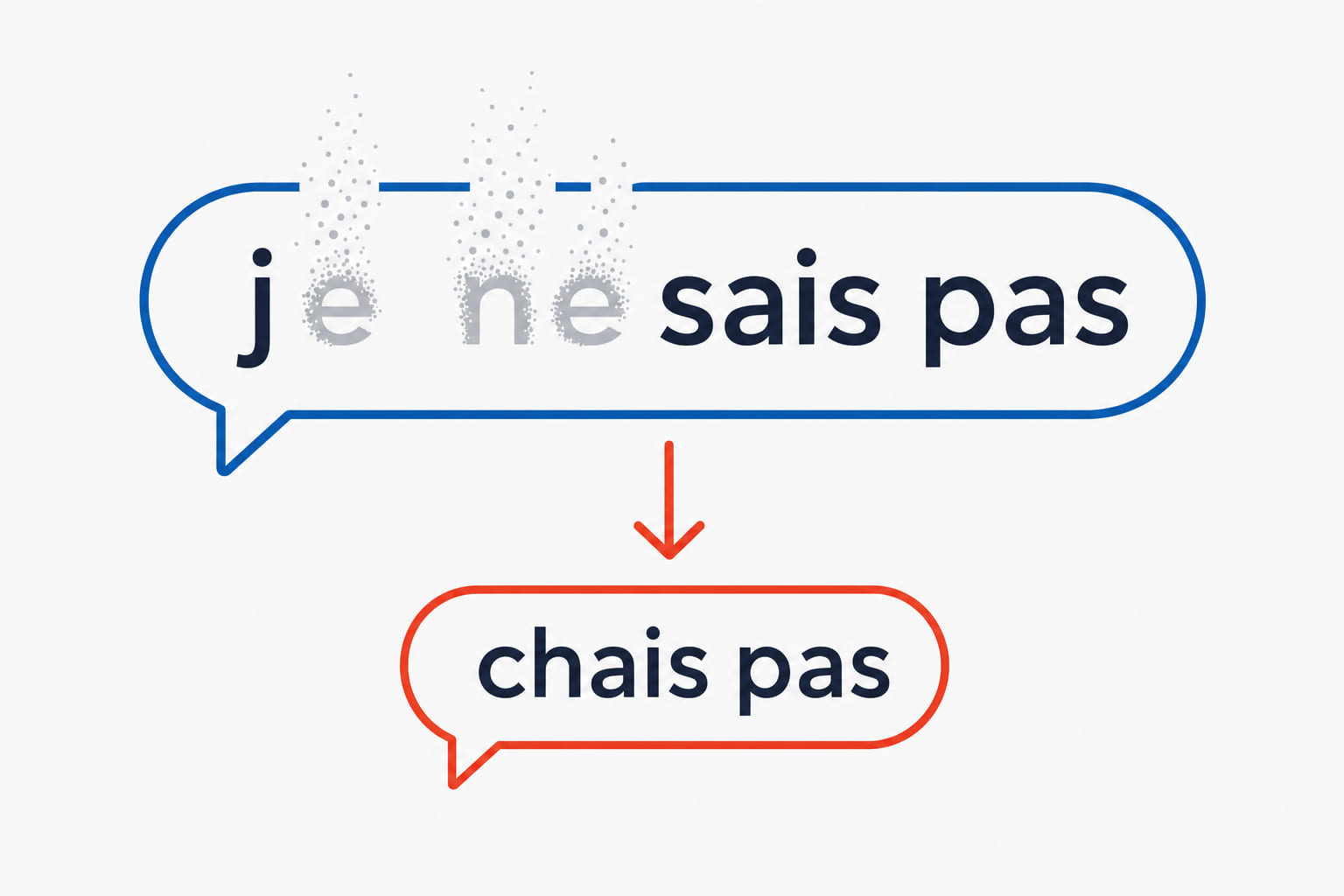
You spent a week learning je ne sais pas. Four words, four syllables, all of them on the page. Then you asked a French person a question, and what came back was one syllable and a shrug: chais pas.
It is tempting to file that under slang, the way you file gonna and wanna. It is not slang. It is the same four words, said at normal speed, with the sounds that French does not bother pronouncing removed. The letter doing most of the disappearing has a name — the e muet — and once you can hear it drop, an enormous amount of spoken French stops sounding like a different language.
The e that was never really there
French has one vowel that is optional. It is written e, with no accent, and it is pronounced [ə] — the schwa, the same neutral uh that sits in the middle of English pencil or about. It goes by three names in French textbooks, all of them describing the same letter: e muet (mute e), e caduc (falling e), and e instable (unstable e). That last name is the honest one.
Every other vowel in French is fixed. The u in tu is always [y]. The ou in vous is always [u]. The schwa is the only one that comes and goes depending on how fast you are talking, where you are from, and what sounds happen to be standing next to it.
Start with the easiest rule, because it covers thousands of words:
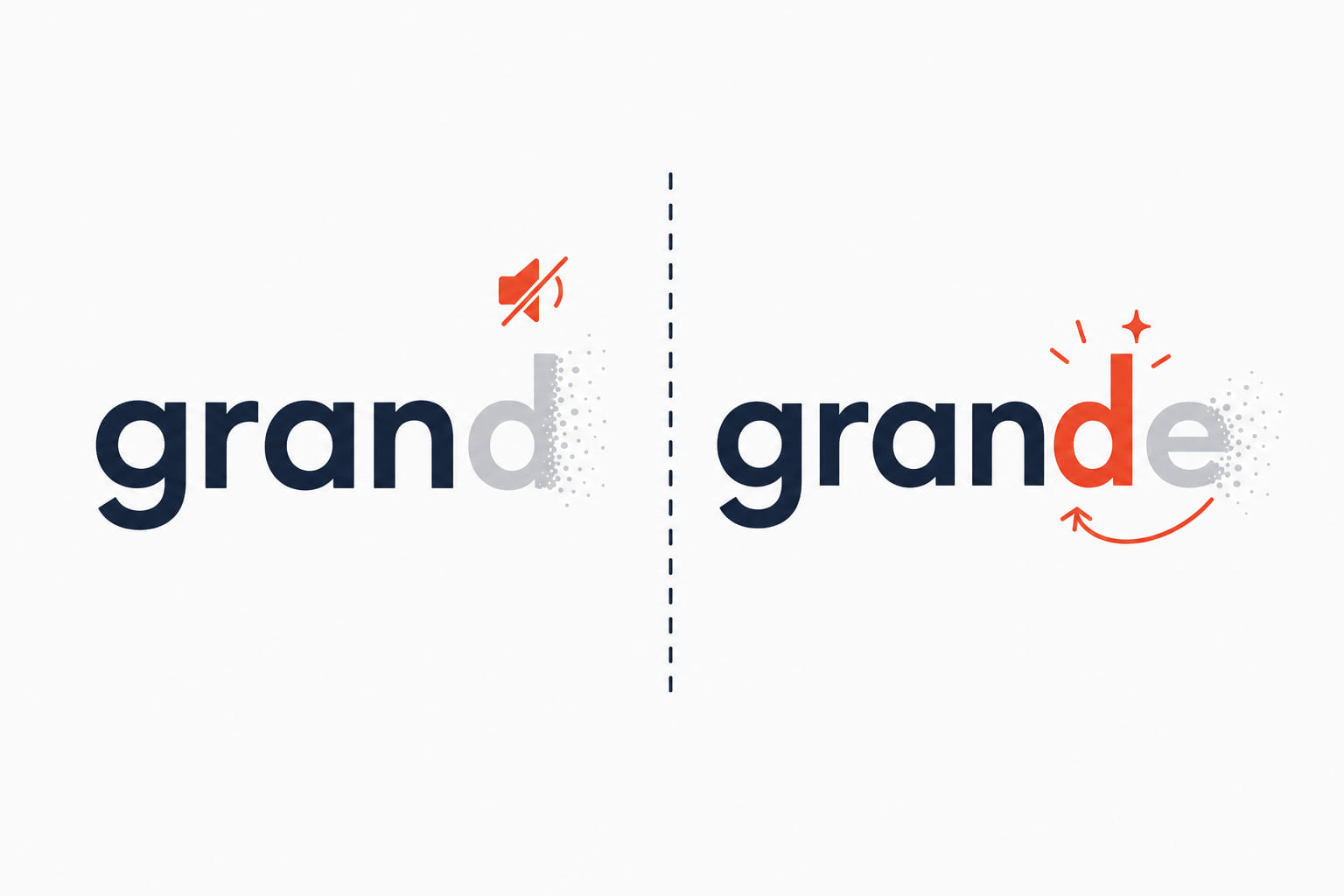
A written e at the end of a word is silent. Parle is PARL, not par-luh. Table is TABL. Une is ÜN. Grande is GRAHND. In standard northern French the final e is not a sound — it is a piece of grammar wearing a vowel costume, there to tell you the word is feminine, or that the verb is first person, or that the preceding consonant gets pronounced.
That last job is the one worth pausing on. Grand is GRAHN with a silent d; grande is GRAHND with an audible one. The e itself makes no sound, but it wakes up the consonant in front of it. This is exactly the mechanism behind the silent -ent on French verbs, and it is the reason so many learners over-pronounce endings that were only ever there to be looked at.
Three positions, three behaviours
Once you are past word-final e, the schwa turns up in two more places, and it behaves differently in each.
| Where the e sits | What happens in normal speech | Example |
|---|---|---|
| End of a word | Always silent | parle → PARL |
| Little grammar words — je, ne, me, te, se, ce, de, le, que | Usually dropped | je pars → ZHPAR |
| Inside a longer word | Depends on the consonants around it | samedi → SAM-dee |
The first row is free. The second row is where chais pas comes from, and we will take it apart below. The third row is the one with an actual rule.
The three-consonant rule of thumb
Here is the classic version, known as Grammont's law of three consonants: the schwa drops unless dropping it would leave three consonants jammed together (Elon.io, Le Schwa /ə/).
The days of the week demonstrate it perfectly, which is lucky, because you already know them.
| Written | Drop the e and you get | Consonants meeting | Result |
|---|---|---|---|
| samedi | sam·di | m + d — two | Dropped: SAM-dee |
| mercredi | mercr·di | k + r + d — three | Kept: mehr-kruh-DEE |
| vendredi | vendr·di | d + r + d — three | Kept: vahn-druh-DEE |
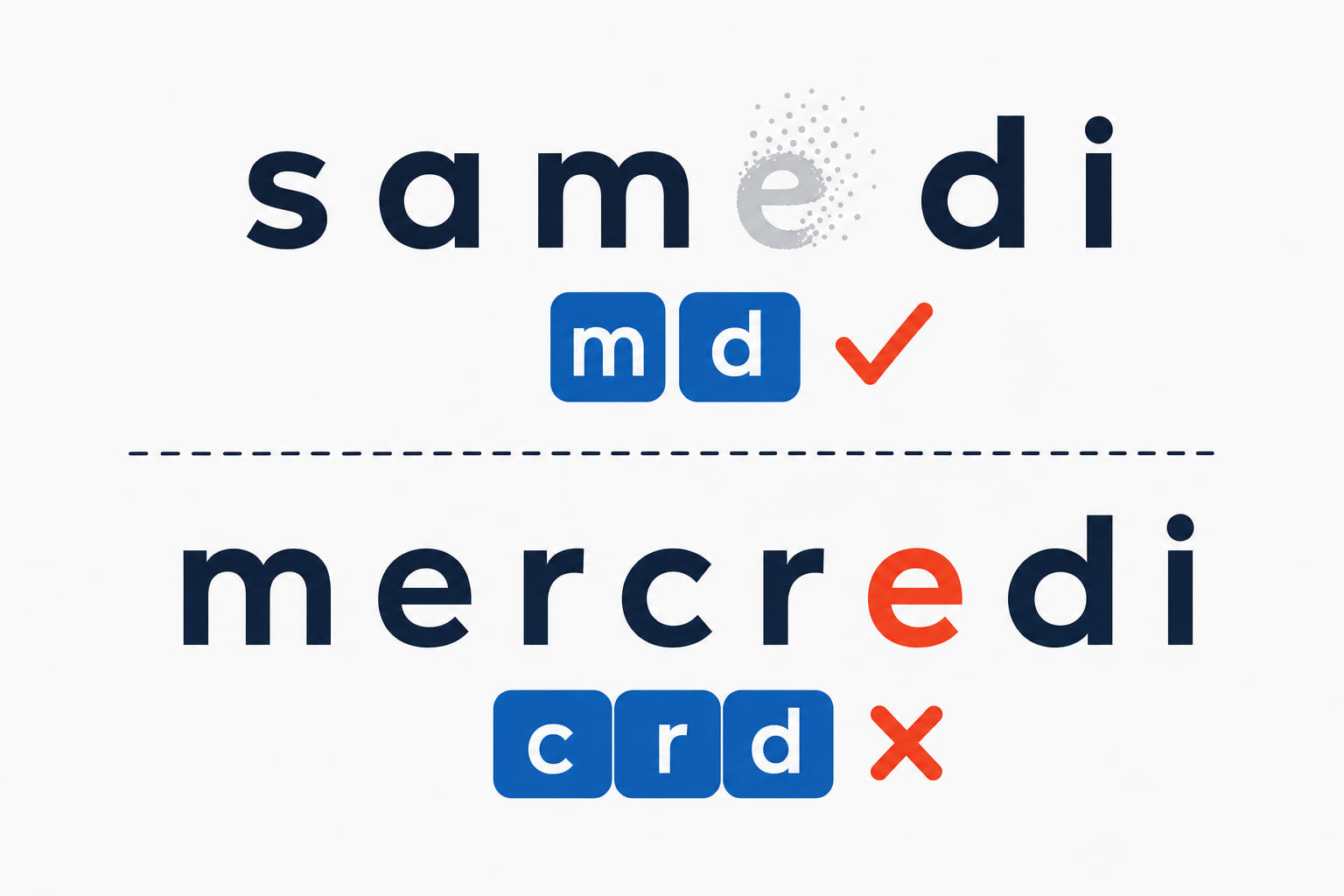
Same position, same spelling pattern, opposite outcome — and nothing decides it except how many consonants would end up shoulder to shoulder. Your mouth is not being lazy at random. It is refusing a cluster it cannot say comfortably.
The same logic keeps the schwa alive in gouvernement (goo-vehr-nuh-MAHN, because rnm is unsayable) and in quatre livres (KA-truh-LEEVR, because trl is worse).
One honest caveat. "Law" oversells it. Recent work testing native speaker judgements found the pattern is gradient rather than absolute — some three-consonant clusters are far more tolerated than others, and speakers disagree at the edges (Storme, Against the Law of Three Consonants in French, LSA). Appartement is the everyday counterexample: plenty of French people say a-par-tuh-MAHN, plenty say a-part-MAHN, and nobody notices either way.
So do not try to count consonants in real time. You will never be fast enough. Learn the twenty or thirty frequent words as fixed shapes, the way you learned bonjour, and let the rule stay in the background as an explanation rather than an instruction.
Drill 1 — twenty phrases with the e removed
Read the middle column, never the left one. The left column is spelling. The middle column is what leaves a French mouth. Say each line out loud five times, fast enough that the dropped syllable has no room to sneak back in.
| Written | What you actually say | Pronounce | English |
|---|---|---|---|
| samedi | sam'di | SAM-dee | Saturday |
| maintenant | maint'nant | mant-NAHN | now |
| la fenêtre | la f'nêtre | la-fNETR | the window |
| la semaine | la s'maine | la-SMEN | the week |
| au revoir | au r'voir | oh-RVWAR | goodbye |
| un petit peu | un p'tit peu | uhn-ptee-PUH | a little bit |
| une petite table | une p'tite table | ün-pteet-TABL | a small table |
| je pars | j'pars | ZHPAR | I'm leaving |
| je vais | j'vais | ZHVEH | I'm going |
| tu me dis | tu m'dis | tü-MDEE | you tell me |
| il se lève | il s'lève | eel-SLEV | he gets up |
| ce que je veux | c'que j'veux | skuh-ZHVUH | what I want |
| parce que | pasque | PASK | because |
| qu'est-ce que c'est | kesk'sé | kess-KSEH | what is it |
| je te dis | j'te dis | SHTUH-dee | I'm telling you |
| s'il te plaît | s'te plaît | stuh-PLEH | please |
| beaucoup de choses | beaucoup d'choses | boh-koo-DSHOHZ | a lot of things |
| il y a | y'a | YAH | there is |
| tu es prêt | t'es prêt | teh-PREH | you're ready |
| je ne sais pas | chais pas | SHEH-pah | I don't know |
Notice what happens to the rhythm. Maintenant on the page is three syllables; in speech it is two. Qu'est-ce que c'est is four on the page and two in the air. This compression is the single biggest reason spoken French outruns your ear — you are listening for syllables that were never transmitted.
How je ne sais pas becomes chais pas
Four steps, none of them mysterious.
| Step | What changes | Result |
|---|---|---|
| 1 | Casual French deletes the ne of negation | je sais pas |
| 2 | The schwa in je drops | j'sais pas |
| 3 | The [ʒ] of j' is now touching the voiceless [s] of sais — and it goes voiceless too, becoming [ʃ] | ch'sais pas |
| 4 | Two near-identical hissing sounds collapse into one | chais pas |
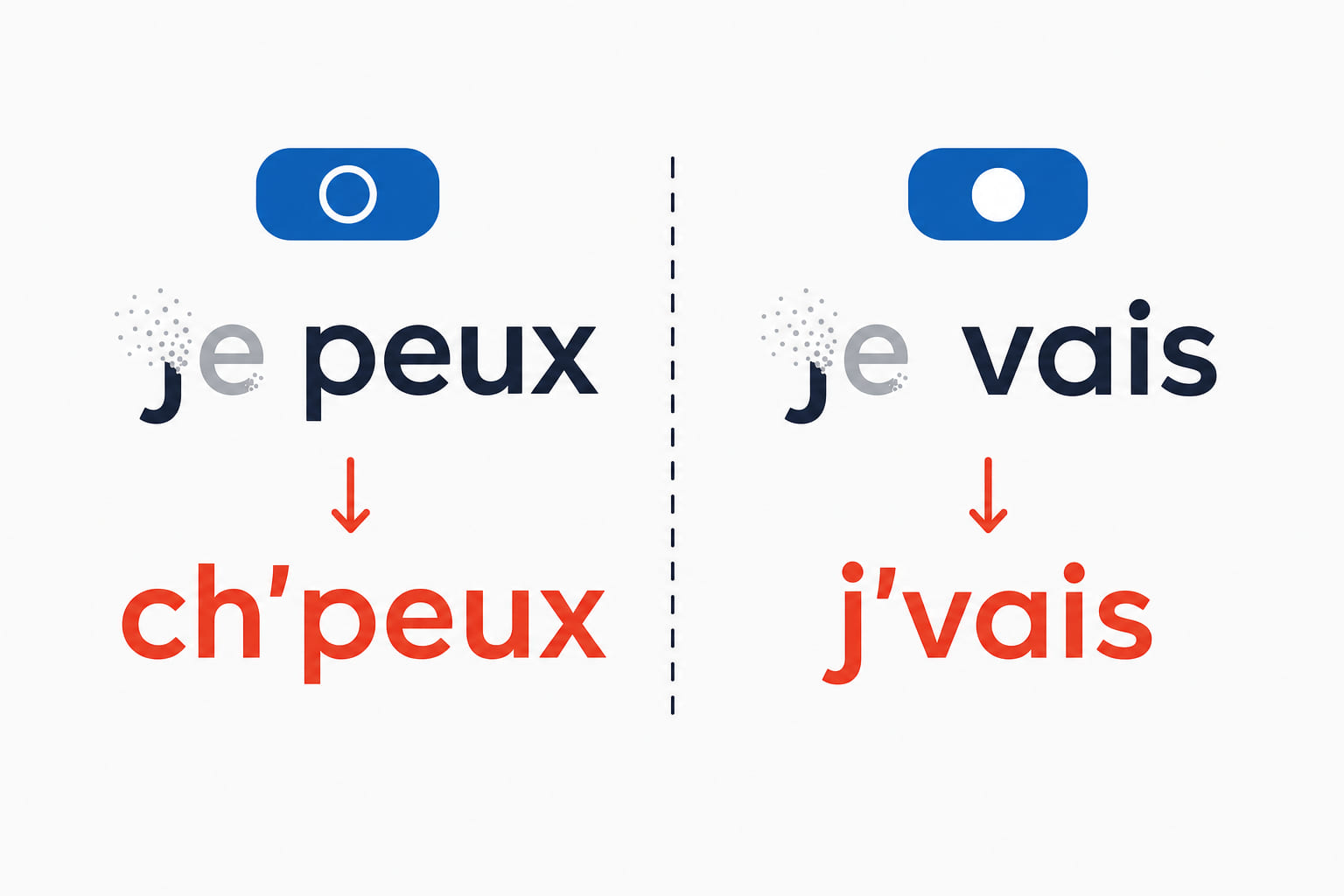
Step 3 is the part almost nobody teaches, and it generalises. When the schwa in je drops, the [ʒ] takes on the voicing of whatever consonant it lands against. Voiceless consonant, and je turns into ch. Voiced consonant, and it stays j.
| Next sound is… | Written | Actually said | Pronounce |
|---|---|---|---|
| Voiceless (p, t, k, s, f) | je peux | ch'peux | SHPUH |
| je pense | ch'pense | SHPAHNS | |
| je trouve | ch'trouve | SHTROOV | |
| je crois | ch'crois | SHKRWAH | |
| je suis | chuis | SHWEE | |
| Voiced (b, d, g, v, z, m, n, l, r) | je vais | j'vais | ZHVEH |
| je dois | j'dois | ZHDWAH | |
| je bois | j'bois | ZHBWAH | |
| je viens | j'viens | ZHVYAN |
You do not have to memorise which consonants are voiced. Your mouth already does this in English — the s in cats is a hiss and the s in dogs is a buzz, and you have never once thought about it. Say ch'peux and j'vais back to back a few times and the pattern installs itself.
Chuis deserves its own line, because it is everywhere. Je suis fatigué comes out as shwee-fa-tee-GAY. If you are waiting to hear zhuh swee, you will miss it every single time.
Drill 2 — the je cluster
Ten sentences you will use this week. Say each one twice: once carefully, the way it is written, then once at speed with the schwa gone. The second version is the target.
| Written | At speed | Pronounce | English |
|---|---|---|---|
| Je ne sais pas. | Chais pas. | SHEH-pah | I don't know. |
| Je suis désolé. | Chuis désolé. | shwee-day-zo-LAY | I'm sorry. |
| Je ne comprends pas. | J'comprends pas. | zhkohn-prahn-PAH | I don't understand. |
| Je pense que oui. | Ch'pense qu'oui. | shpahns-KWEE | I think so. |
| Je te rappelle. | J'te rappelle. | shtuh-ra-PEL | I'll call you back. |
| Je vais y aller. | J'vais y aller. | zhveh-zya-LAY | I'm going to go. |
| Je ne peux pas venir. | Ch'peux pas v'nir. | shpuh-pah-VNEER | I can't come. |
| Ce n'est pas ce que je voulais. | C'est pas c'que j'voulais. | seh-pah-skuh-zhvoo-LEH | That's not what I wanted. |
| Qu'est-ce que tu fais ? | Kess'tu fais ? | kess-tü-FEH | What are you doing? |
| Je ne me souviens pas. | J'me souviens pas. | zhmuh-soo-vyan-PAH | I don't remember. |
When the e comes back
Dropping is the default, not a licence to delete every e you see. Five situations bring it back.
A three-consonant pile-up. Covered above — mercredi, gouvernement, quatre livres. Your mouth will do this for you if you stop forcing the deletion.
The first syllable of a phrase. Schwas are most stable at the start of a rhythmic group. Demain, je pars keeps the e in demain (duh-MAN) and drops the one in je.
After an imperative. Fais-le is feh-LUH, donne-le-moi is don-luh-MWAH. Here the final e is fully pronounced, and it is stressed, because le has moved to the end of the phrase where French puts its emphasis.
Before an h aspiré. Le héros stays luh ay-ROH — the h blocks both elision and linking, so the schwa has to hold the fort. This is the same invisible wall covered in the h aspiré lesson.
Southern French, singing, poetry and anger. In Marseille and across the Midi, final schwas are often pronounced — une belle table can arrive with three extra syllables (Eychenne, On the deletion of word-final schwa in Southern French, Phonology). The same thing happens in song lyrics, in classical theatre, and in an irritated arrê-teuh ! Those extra vowels are stylistic, not standard.
A real conversation
Camille : Salut ! Tu fais quoi samedi ? Marc : Chais pas encore. Pourquoi ? Camille : Y'a une expo au centre. Ch'pense que ça va te plaire. Marc : Ah ouais ? C'est à quelle heure ? Camille : Vers deux heures. Mais j'te préviens, c'est pas gratuit. Marc : Chuis fauché en ce moment. Ch'peux pas trop. Camille : T'inquiète, j'connais quelqu'un qui bosse là. J'vais demander. Marc : Ok, tiens-moi au courant. J'te rappelle mercredi.
Read that aloud, then count what is missing. Ten schwas gone — chais, y'a, ch'pense, j'te préviens, chuis, ch'peux, j'connais, j'vais, j'te rappelle — and one schwa deliberately kept, in mercredi, because krd was never going to work.
Written out in full, those eight lines are textbook French. Said out loud, they are what you will actually hear in the street, and the difference between the two versions is almost entirely this one letter.
Frequently asked questions
Is dropping the e lazy or incorrect French?
Neither. It is the standard pronunciation of standard French. A newsreader on France Inter drops schwas constantly; they simply drop fewer than someone arguing about parking. Pronouncing every e is not more correct or more polite — it is what a text-to-speech engine did in 2004, and it lands the same way.
Is this the same thing as élision?
No, and the confusion is worth clearing up. Élision is a spelling rule: le plus ami is written l'ami, and the apostrophe tells you the vowel is gone before you open your mouth. E caduc dropping is a speech habit with no apostrophe and no warning — je pars is written with all its letters and said without them. Élision you can learn by reading. This you can only learn by saying.
How do I know which e to drop if the rule is only a rule of thumb?
You do not decide word by word, and neither do native speakers. The high-frequency cases — je, ne, me, te, ce, que, petit, maintenant, samedi — get stored as fixed sound shapes through repetition. The rule of thumb only explains why the shapes came out that way. Drill the twenty phrases above and you will have covered most of what you say in a day.
Why can I read French fine but not understand it spoken?
Largely this, plus enchaînement. Your ear is searching the audio for word shapes it learned from the page, and those shapes have had their vowels removed and their consonants relocated. Je ne sais pas is four syllables in your head and one and a half in the air. The signal is not degraded — you are matching against the wrong template.
I can hear the drop but my own version still sounds wrong. What now?
Almost always one of two things: you are inserting a tiny vowel where the schwa used to be (shuh-PUH instead of SHPUH), or you are keeping je voiced before a voiceless consonant (zh'peux instead of ch'peux). Both are inaudible to you, because your ear is already convinced you said it right. That is the point where you need something outside your own head to tell you which one it is — a French friend with patience, or a scoring engine that flags the syllable.
Related lessons
- Enchaînement: Why Your French Sounds Choppy — the other half of why spoken French has no seams.
- Le Héros vs L'Homme: The Aspirated H, Drilled — the one thing that stops a schwa from dropping.
- Ils Parlent Sounds Like Il Parle — silent endings, same family of problem.
- How to Tell If Your French Accent Is Actually Good — a self-test for the errors you cannot hear.
- Master the Phonetics French Alphabet — the sound-by-sound foundation underneath all of this.
Practise it out loud
Reading about the disappearing e will fix your listening a little and your speaking not at all. The whole skill is motor: your tongue has to learn to go from [ʃ] straight into [p] with nothing in between, and it has spent your entire life putting a vowel there because English insists on one.
So take the twenty phrases and the ten je sentences above and say them. Not once. Until chais pas comes out as one syllable and a half without you thinking about it, and until you stop hearing the ghost vowel you have been sliding in.
That is what Simply French is built for: fifteen minutes a day of listening at native speed, speaking drills, and instant AI pronunciation scoring that tells you exactly which syllable you padded and which schwa you failed to drop. Start your free 7-day trial and drill these until the e disappears on its own.
Allez-y.
Tags
Now find out how you actually sound.
Simply French listens to you say each sentence and scores it word by word, so you can hear the difference you have just read about — and fix it while it is still fresh.
Takes about 10 minutes. No card needed to start.
Related Articles
French Nasal Vowels AN EN ON IN: Practice Without Pronouncing the N
In a French nasal vowel the N is not a sound - it is a spelling instruction, and your tongue must never touch the roof of your mouth. The three sounds, the true minimal triples, the denasalization pairs that prove it, and 10 sentences.
French S vs Z: Poisson or Poison, Drilled on 20 Pairs
One S between two vowels is /z/. Two S's are /s/. English trained you to do the opposite in exactly the word where it matters most - dessert. The rule, the boundary exceptions nobody teaches, and 20 pairs to say out loud.
The French R for English Speakers: 12 Words, 5 Minutes a Day
Stop gargling. The French R is made exactly where you say the G in get - and the reason yours is not working is the tip of your tongue. Build it in four steps, then drill 12 words, three weights of R, and 10 sentences.