
French S vs Z: Poisson or Poison, Drilled on 20 Pairs
One S between two vowels is /z/. Two S's are /s/. English trained you to do the opposite in exactly the word where it matters most - dessert. The rule, the boundary exceptions nobody teaches, and 20 pairs to say out loud.
Simply French Team
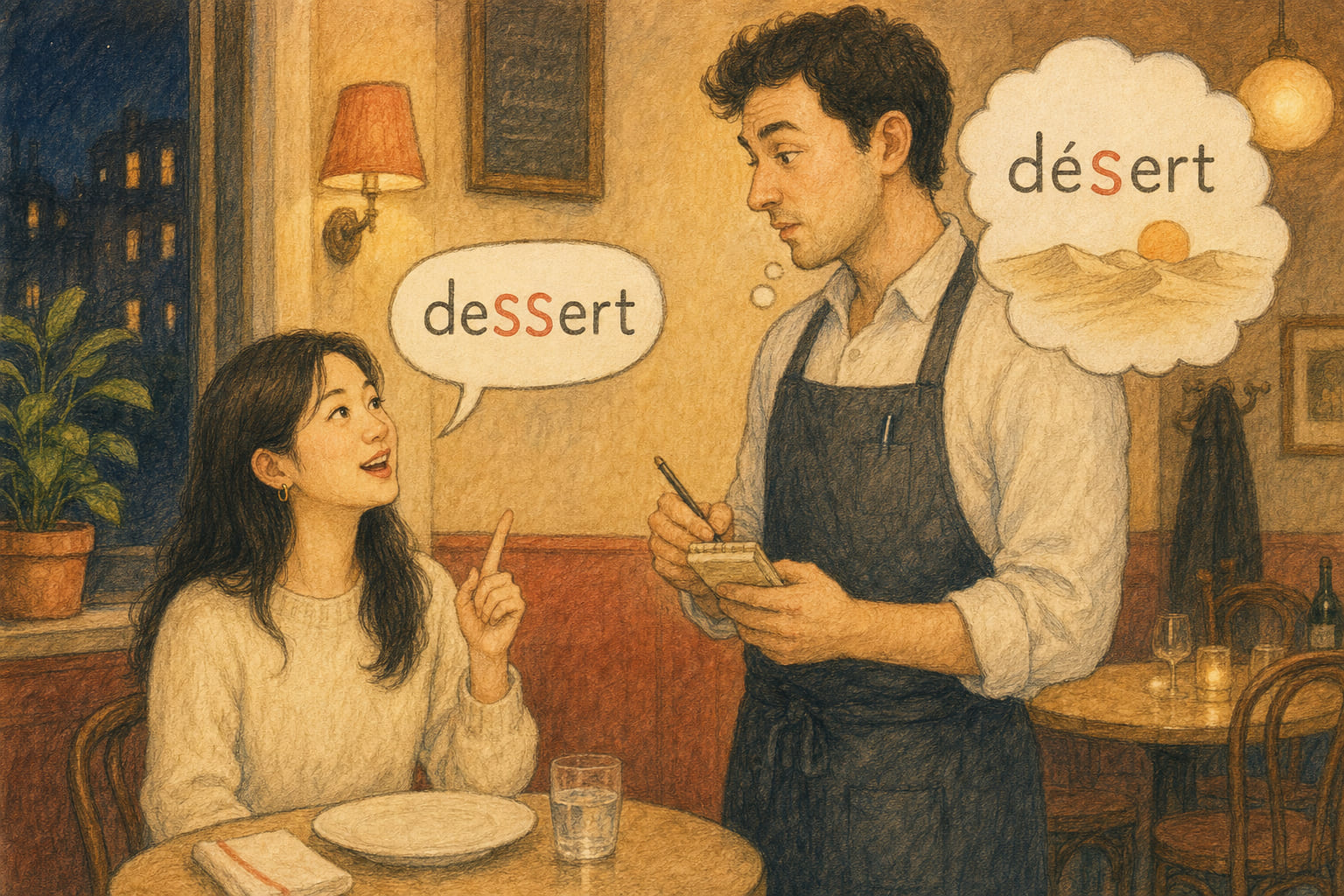
You finish dinner in Lyon, the waiter asks if you want anything else, and you say what you have said a hundred times in English: un dessert. Except the S came out voiced, the way it does in English, and what you actually said was un désert.
You asked for a desert.
This one is not your fault in the usual way. English did not merely fail to prepare you — it trained you into the exact opposite habit, in this exact word.
The rule, in one line
One S between two vowels is /z/. Anything else is /s/.
| Spelling | Sound | Example |
|---|---|---|
| single s between two vowels | /z/ | poison /pwa.zɔ̃/ · maison /mɛ.zɔ̃/ · rose /ʁoz/ |
| double ss between two vowels | /s/ | poisson /pwa.sɔ̃/ · dessert /de.sɛʁ/ |
| s at the start of a word or syllable | /s/ | salut · six · penser |
| s touching a consonant | /s/ | espoir · personne · juste |
| final s | usually silent | trois · temps · les |
That is the whole system. It is one of the tidiest rules in French spelling, which is exactly why it is worth automating — there is no long exception list standing between you and getting it right every time.
Why this one is not a mouth problem
Here is the good news, and it is unusual on this site: you can already make both sounds. English has /s/ and /z/ as a full contrast — sue and zoo, price and prize, loose and lose. Nothing new has to happen in your mouth.
So why does it keep going wrong?
Because the failure is in the mapping, not the muscles. Your eye sees a letter and your mouth fires a sound before you have finished thinking. And English has quietly installed two habits that both push the wrong way.
Habit one: English doubles consonants for vowel length, not for voicing. In dinner, summer, rabbit, the doubled letter tells you about the vowel in front of it. It says nothing about voicing. So the doubled S in a French word registers as decoration. Your eye skips it.
Habit two — and this is the cruel one: in English, the doubled SS in dessert is /z/. English dessert is /dɪˈzɜːt/. English desert, the sandy one, is /ˈdezət/. Both have a z. English keeps them apart with stress and vowel quality, and lets the S go voiced in both.
French does the exact reverse. French uses the S itself, and nothing else, to keep them apart:
| English | French | |
|---|---|---|
| the sweet course | dessert /dɪˈzɜːt/ — z | dessert /de.sɛʁ/ — s |
| the sandy place | desert /ˈdezət/ — z | désert /de.zɛʁ/ — z |
Read that table twice. The French pair is separated by one feature — voicing — and English has trained your tongue to hand that feature to the wrong word.
There is a second, quieter error underneath. English speakers often produce a half-voiced S in French: the vocal folds start late, and maison comes out somewhere between /mɛzɔ̃/ and /mɛsɔ̃/. It is not wrong enough to stop the conversation. It is wrong enough to sound foreign in every third sentence, and you cannot hear it in your own mouth, because the sound you intended is what you hear.
The one place the rule stops
Here is the part almost no page covers, and it is the reason people who "know the rule" still get caught.
The rule is blocked at a seam. When a word is built from a prefix or from two smaller words, the S at the join stays /s/ even though vowels sit on both sides of it.
| Word | Built from | Sound |
|---|---|---|
| parasol /pa.ʁa.sɔl/ | para + sol (sun) | /s/ |
| tournesol /tuʁ.nə.sɔl/ | tourne + sol (sunflower) | /s/ |
| antisocial /ɑ̃.ti.sɔ.sjal/ | anti + social | /s/ |
| vraisemblable | vrai + semblable | /s/ |
| resurgir | re + surgir | /s/ |
The logic is worth holding on to, because it generalises: French spells the sound of the pieces, not the sound of the finished string. Sol starts with /s/ on its own, so it keeps /s/ when something is glued in front of it.
A warning while we are here. You will see aérospatiale listed online as an exception to the intervocalic rule. It is not an exception to anything — the S there is followed by a p, so it was never an intervocalic S in the first place. Whoever wrote that list was not looking at the word.
Drill 1 — Twenty words, sorted by the letter
Say each one out loud. Do not read down one column and then the other — go across, row by row, so your mouth has to switch.
| /z/ — one S | /s/ — two S, or a consonant | ||
|---|---|---|---|
| maison /mɛ.zɔ̃/ | house | poisson /pwa.sɔ̃/ | fish |
| rose /ʁoz/ | pink, rose | tasse /tas/ | cup |
| cousin /ku.zɛ̃/ | cousin | coussin /ku.sɛ̃/ | cushion |
| désert /de.zɛʁ/ | desert | dessert /de.sɛʁ/ | dessert |
| ruse /ʁyz/ | trick | russe /ʁys/ | Russian |
| case /kaz/ | box, square | casse /kas/ | breaks |
| douze /duz/ | twelve | pousse /pus/ | pushes |
| viser /vi.ze/ | to aim | baisser /bese/ | to lower |
| oiseau | bird | assez | enough |
| musique | music | parasol /pa.ʁa.sɔl/ | parasol (the seam) |
The last row is the checkpoint. If parasol came out with a /z/, the rule has gone in but the exception has not.
Drill 2 — Ten pairs where the S is the only difference
Left, right, left, right. Each pair is identical except for one feature of one consonant.
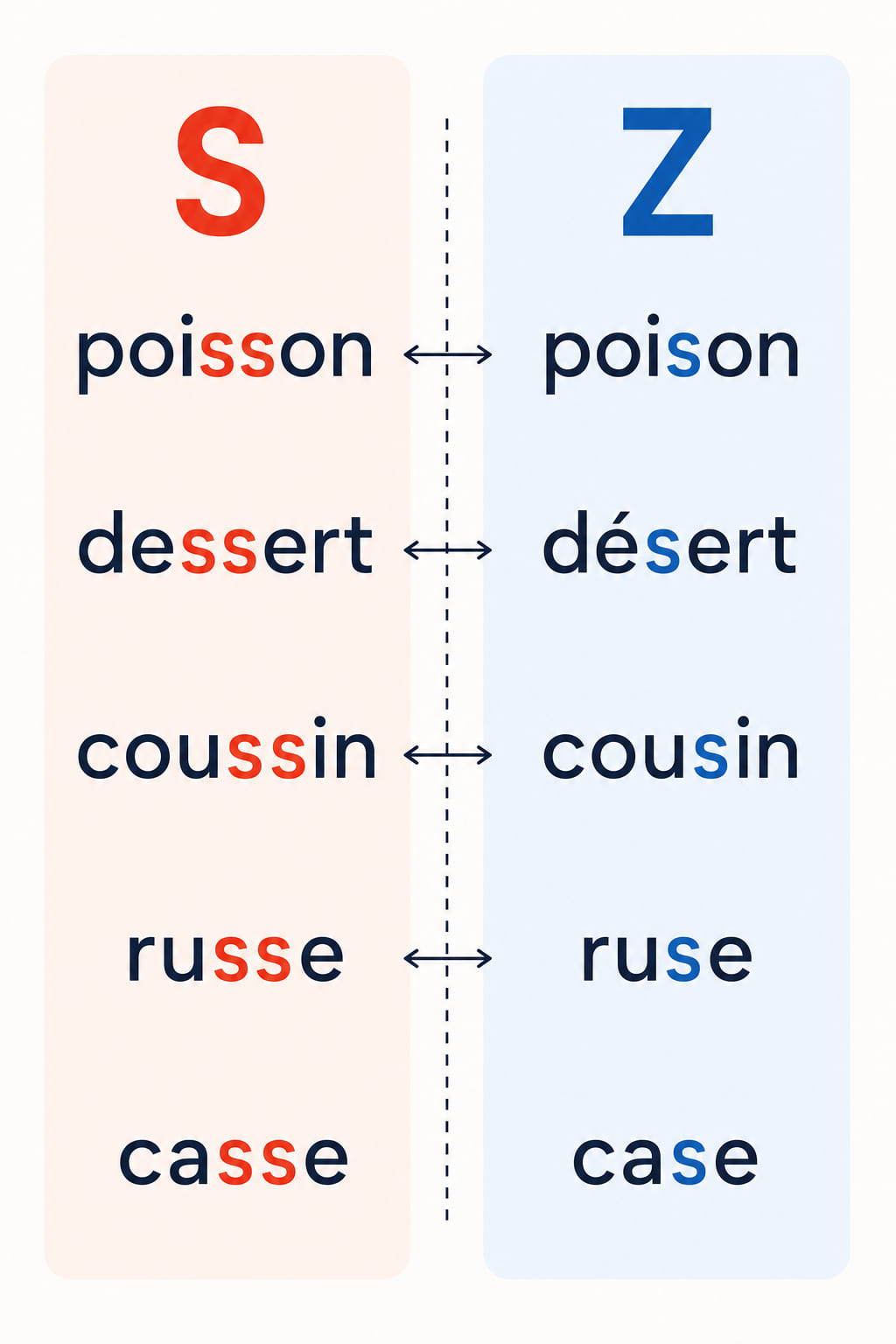
| /s/ | /z/ | ||
|---|---|---|---|
| poisson /pwa.sɔ̃/ | fish | poison /pwa.zɔ̃/ | poison |
| dessert /de.sɛʁ/ | dessert | désert /de.zɛʁ/ | desert |
| coussin /ku.sɛ̃/ | cushion | cousin /ku.zɛ̃/ | cousin |
| russe /ʁys/ | Russian | ruse /ʁyz/ | trick |
| casse /kas/ | breaks | case /kaz/ | box |
| baisser /bese/ | to lower | baiser | a kiss (as a noun) |
| douce | soft (f.) | douze /duz/ | twelve |
| visser | to screw in | viser /vi.ze/ | to aim |
| assis | seated | Asie | Asia |
| pousse | pushes | pouce | thumb (both /s/ — free point) |
That last row is deliberate. Pousse and pouce are homophones — different spellings, identical sound. French does not use the S contrast everywhere it could, and knowing where the contrast is not live saves you from hunting for a distinction that is not there.
Drill 3 — Ten sentences at normal speed
Do not slow down for the target word. Slowing down is how you hide the error from yourself.
- Le poisson n'est pas du poison. — The fish is not poison.
- On prend le dessert au désert ? — Shall we have dessert in the desert?
- Mon cousin a oublié son coussin. — My cousin forgot his cushion.
- Elle a douze roses dans la maison. — She has twelve roses in the house.
- C'est une ruse russe. — It is a Russian trick.
- Range ça dans la case, ne la casse pas. — Put it in the box, do not break it.
- Assez de musique, on va en Asie. — Enough music, we are going to Asia.
- Le parasol est près du tournesol. — The parasol is near the sunflower.
- Il vise le poisson, puis il baisse le bras. — He aims at the fish, then lowers his arm.
- Ce dessert au chocolat, c'est de la poésie. — This chocolate dessert is poetry.
Sentence 1 is the article in one line. Sentence 8 is the exception in one line.
The two places S turns up where you did not expect it
Liaison. A final S is silent — until a vowel follows, at which point it comes back as /z/. This is the single most common /z/ in spoken French.
- les amis /le.z‿a.mi/ · nous avons /nu.z‿a.vɔ̃/ · deux heures /dø.z‿œʁ/ · très intéressant
If you have worked through why spoken French runs together, this is the same machinery: the consonant does not belong to the word it is written on, it belongs to the syllable it lands in.
The letter X. Between vowels, X is also /z/: deuxième /dø.zjɛm/, sixième /si.zjɛm/, dixième /di.zjɛm/. And six, dix are [sis], [dis] standing alone but /z/ in liaison — dix ans /di.z‿ɑ̃/. (Soixante keeps /s/.)
Final S: mostly silent, sometimes not
The general rule is that a final S is silent. The exceptions are frequent enough to be worth a table rather than a shrug.
| Word | Sound | Note |
|---|---|---|
| fils /fis/ | S pronounced | son. But fils meaning "threads" is /fil/ |
| mars /maʁs/ | S pronounced | March |
| sens /sɑ̃s/ | S pronounced | meaning, direction |
| autobus /otobys/, bus /bys/ | S pronounced | |
| ours [uʁs] | S pronounced | bear — singular and plural |
| os [ɔs] | S pronounced | bone. But the plural is [o] — the S goes away |
| tous [tus] | S pronounced | only as a pronoun: ils sont tous là |
| plus /plys/ | S pronounced | when it means "more" |
Two of those are worth a second look. Os is the rare word whose plural is quieter than its singular — un os [ɔs], des os [o]. And tous splits by grammar, not by preference: tous les jours has a silent S, ils sont tous là does not.
In conversation
Serveur : Vous prenez un dessert ?
Vous : Oui. Qu'est-ce que vous avez ?
Serveur : Mousse au chocolat, tarte aux poires, ou l'assiette de fromages.
Vous : La mousse, s'il vous plaît. Et mon cousin prendra la tarte.
Serveur : Très bien. Et le poisson, c'était comment ?
Vous : Excellent. Vraiment excellent.
Serveur : Je transmets en cuisine. Deux desserts, deux cafés ?
Vous : Deux desserts, oui. Un seul café.
Count the S sounds in that exchange: dessert, mousse, assiette, cousin, poisson, desserts, seul. Seven, six of them /s/, and every one a place where an English-trained tongue reaches for /z/.
And notice line three — l'assiette de fromages. Double S, /s/. Then fromages ends in a silent S. Both in one phrase.
FAQ
If English already has both sounds, why do I keep getting it wrong?
Because you are not choosing the sound, you are reading a letter. The choice happens faster than thought, from a spelling habit built over decades. That is why this needs a drill and not an explanation — you are overwriting a reflex, not learning a fact.
Is the rule ever broken inside a simple word?
Essentially no. Single S between vowels is /z/, doubled S is /s/, and the only systematic override is the prefix or compound seam (parasol, vraisemblable, tournesol). Compared with the rest of French spelling, this rule is close to airtight.
What about S at the start of a word, before a consonant?
Always /s/. Salut, ski, sport, stylo. And note that French does not put a vowel in front of the cluster the way Spanish does — it is sport, not esport.
Do I need to pronounce the final S in plus?
It depends on the job the word is doing. Plus meaning "more" is /plys/. Plus in a negative — je n'en veux plus — normally drops it. There is a third case before a vowel where it becomes /z/. That word has three pronunciations and one rule, and it deserves its own page.
Does this hold outside France?
Yes. The single-S/double-S rule is the same in Belgium, Switzerland and Quebec. What varies elsewhere is elsewhere — vowel quality, final consonants, rhythm — not this.
The part you can't do alone
Everything above is checkable on paper. The one thing that is not is whether your vocal folds actually started on time.
A half-voiced S is the most common outcome of this drill, and it is invisible from the inside: you meant /z/, so /z/ is what you hear. Your ear plays back your intention, not your output. Meanwhile the person across the table hears something that is neither poisson nor poison, and quietly switches to English.
Say the ten pairs in Drill 2 into Simply French and get each one scored the moment you say it — voiced or not, pair by pair, with the ones you are collapsing flagged. Fifteen minutes a day, free for seven days.
Keep going
- Enchaînement: Why Your French Sounds Choppy — where the liaison /z/ actually lands
- Nation, Attention, Decision: The -TION Trap — the other place a doubled S changes everything: -ssion versus -sion
- Cheveux or Chevaux? — the same experiment run on a vowel instead of a consonant
- Ils Parlent Sounds Like Il Parle — the other big "the letter is there but the sound is not" problem
- How to Tell If Your French Accent Is Actually Good — a self-test for the errors you cannot hear
- French U vs OU Pronunciation Practice — russe/rousse and puce/pouce live next door to russe/ruse
- French Nasal Vowels AN EN ON IN — poisson, poison, cousin, coussin all end in a nasal vowel
- ILLE Pronunciation in French: Why Fille and Ville Do Not Rhyme — the other rule where a doubled letter, and what sits beside it, decides the sound
Tags
Now find out how you actually sound.
Simply French listens to you say each sentence and scores it word by word, so you can hear the difference you have just read about — and fix it while it is still fresh.
Takes about 10 minutes. No card needed to start.
Related Articles
ILLE Pronunciation in French: Why Fille and Ville Do Not Rhyme
You were told to memorise four exceptions. The real rule is in the letter before the ILL, not the ILL itself - and half the exception lists online are out of date. Three categories, the Academie's own short list, and 20 words to say out loud.
French U vs OU Pronunciation Practice: 20 Minimal Pairs, Scored
Everyone tells you the French u is hard. Nobody tells you your ou is wrong too - English GOOSE is fronted and diphthongal, so you are missing both vowels. Build them separately, then drill 20 minimal pairs out loud.
French Nasal Vowels AN EN ON IN: Practice Without Pronouncing the N
In a French nasal vowel the N is not a sound - it is a spelling instruction, and your tongue must never touch the roof of your mouth. The three sounds, the true minimal triples, the denasalization pairs that prove it, and 10 sentences.