
Cheveux or Chevaux? One Vowel Between Your Hair and a Horse (Say 15, Get Scored)
Cheveux is /ø/, chevaux is /o/ - and English has no /ø/, so your default substitution lands on the other real word. Build the sound, then drill 11 minimal pairs out loud.
Simply French Team
You walk into a salon in Lyon, point at your head, and say what you have practised: "Je voudrais me faire couper les cheveux." The stylist blinks. You said chevaux. You just asked her to cut your horses.
This is not a rare beginner slip. It is the single most predictable vowel error English speakers make in French, and it happens because your mouth is doing exactly what it was trained to do for the last thirty years.

The rule, in one line
Cheveux ends in /ø/. Chevaux ends in /o/. Everything before the last syllable is identical.
| Spelling | IPA | Meaning | |
|---|---|---|---|
| hair | che‑veux | /ʃə.vø/ | the hair on your head |
| horses | che‑vaux | /ʃə.vo/ | plural of cheval |
Say them back to back. If they came out the same, you said chevaux twice — and you would not have heard it, which is the whole problem.
Why English speakers always slide to the horse
French /ø/ does not exist in English. Not a close version, not a regional version — it is simply not in the inventory. So your ear does what every ear does with a foreign sound: it files it under the nearest thing it already owns.
For most English speakers, the nearest thing is the vowel in boat. That vowel is /oʊ/ — French /o/ with a glide stuck on the end. Which means your substitution does not merely sound foreign. It lands squarely on another real French word.
Compare that to the other two common substitutions:
- "her" /ɜː/ — closer than /o/, but it is really /œ/, and if you are American the R‑colouring makes it worse. You get something in the cœur neighbourhood.
- "food" /uː/ — you get "chevoo". Wrong, but at least it is not a horse.
Only the /o/ substitution turns your sentence into a different sentence. That is why this pair is worth ten minutes of your mouth's time.
There is a second error stacked on top. Even learners who find /ø/ let it drift — cheveu‑w — because English long vowels move. French vowels hold still. If you have worked through é vs è vs ê, this is the same discipline applied to a new vowel: one position, no glide, no travel.
Building /ø/ from a sound you already have
You do not need to learn /ø/ from scratch. You need to combine two things you can already do.
- Say "é" as in café. /e/. Hold it. Your tongue is high and forward, your lips are spread.
- Freeze your tongue. This is the whole trick. Do not let it move backwards.
- Round your lips as if you were about to say ou — push them forward into a small tight circle.
- What comes out is /ø/.
Mirror test. Do steps 1–4 in front of a mirror. Your lips must visibly push forward. Your jaw must not drop and your chin must not move. Put one finger under your chin while you go from é to eu — if the finger moves, your tongue moved with it, and you have produced /o/ or /œ/ instead.
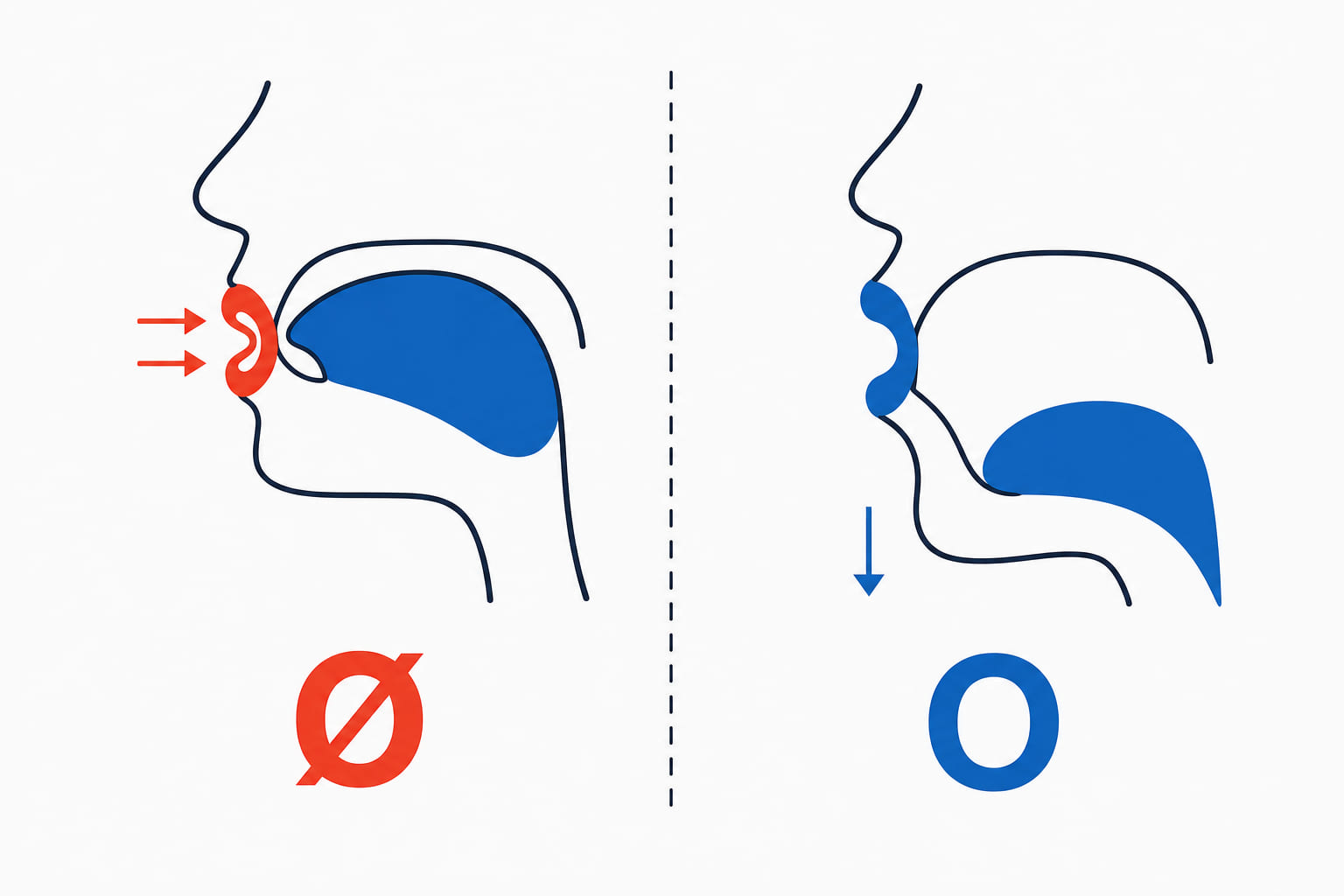
This is the same manoeuvre that builds /y/ and /ɥ/ — tongue of one vowel, lips of another. If you drilled the UI sound in lui and huit, you already own the mechanism. You are just starting from é instead of i.
For /o/, do the opposite and do nothing clever: lips rounded but relaxed and further back, jaw slightly lower, tongue back. And crucially — stop it dead. No ow.
The spelling already told you
Here is the part almost nobody teaches, and it converts this from a party trick into a rule that covers hundreds of words.
The plural ending tells you the vowel. If you know the singular, you never have to guess.
| Singular ends in | Plural | Final sound | Examples |
|---|---|---|---|
| ‑eu | ‑eux | /ø/ | cheveu → cheveux · jeu → jeux · feu → feux · neveu → neveux · lieu → lieux |
| ‑al | ‑aux | /o/ | cheval → chevaux · journal → journaux · animal → animaux · hôpital → hôpitaux · canal → canaux |
| ‑ail | ‑aux | /o/ | travail → travaux · vitrail → vitraux · corail → coraux |
| ‑eau | ‑eaux | /o/ | bureau → bureaux · château → châteaux · gâteau → gâteaux |
Cheveu is an ‑eu noun. Cheval is an ‑al noun. They were never the same word — they only look alike in the plural, and only to the eye.
And this reaches much further than one embarrassing salon moment. ‑eux is one of the busiest endings in the language: heureux, sérieux, nombreux, délicieux, curieux, dangereux, nerveux, merveilleux. Every one of them ends in /ø/. If your mouth defaults to /o/, you are not mispronouncing one noun — you are mispronouncing an entire adjective class, in every sentence, all day.
Drill 1 — Fifteen /ø/ words, one beat each
Say each one out loud. One syllable's worth of vowel, no glide, lips forward the entire time. The ø column is there to stop your eye from reading English into the spelling.
| Word | Say it as | Meaning |
|---|---|---|
| cheveux | che‑vø | hair |
| deux | dø | two |
| peu | pø | little |
| ceux | sø | those |
| feu | fø | fire |
| jeu | ʒø | game |
| bleu | blø | blue |
| lieu | ljø | place |
| vœu | vø | wish |
| nœud | nø | knot |
| neveu | ne‑vø | nephew |
| heureux | ø‑rø | happy |
| sérieux | sé‑ri‑ø | serious |
| dangereux | dan‑ge‑rø | dangerous |
| délicieux | dé‑li‑ci‑ø | delicious |
If any of those came out with a w at the end, you diphthongised. Go back to the mirror test.
Drill 2 — Eleven minimal pairs
Now the real test. Each pair differs by one vowel and nothing else. Say them left, right, left, right. When you can hear the switch yourself, you have the contrast.
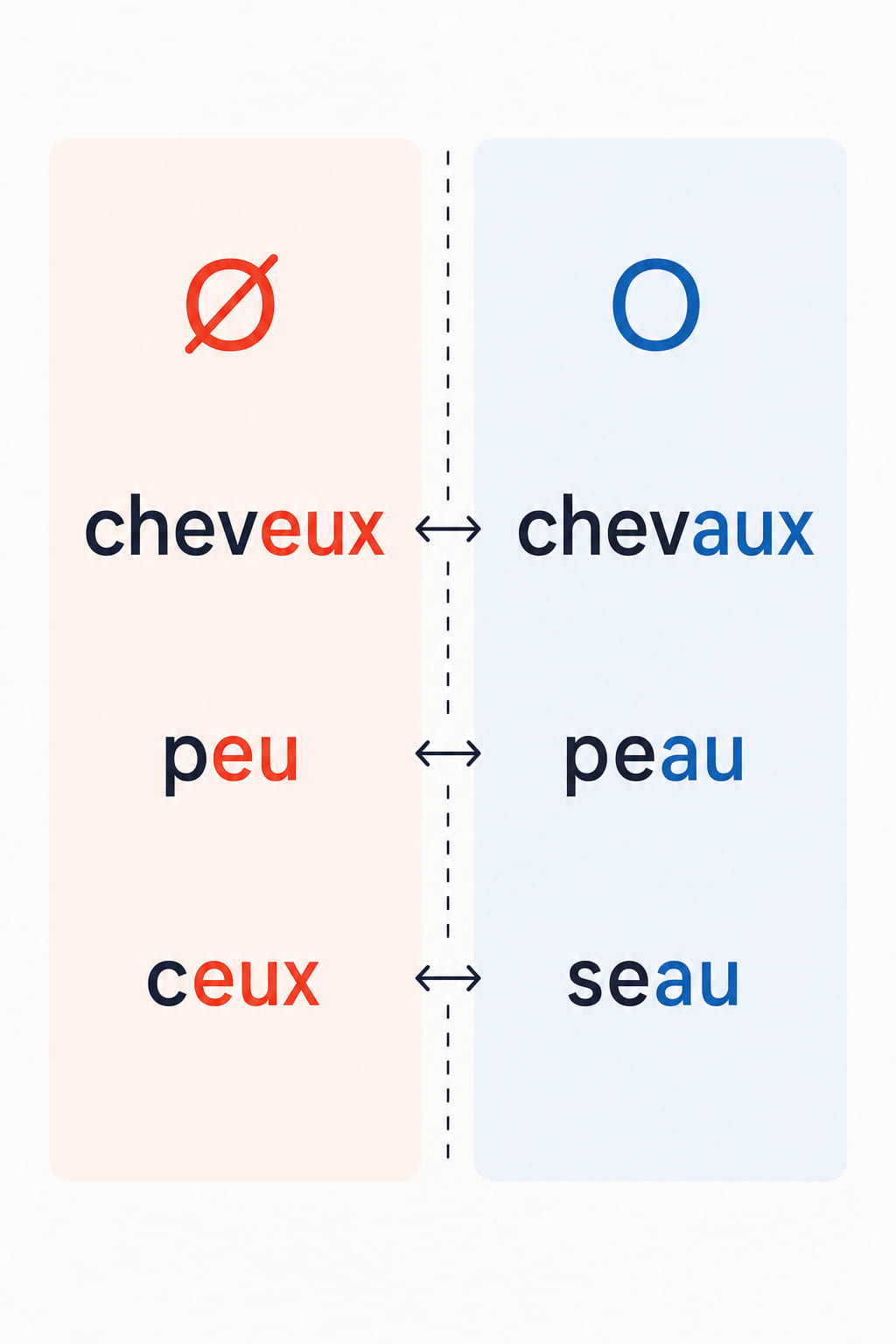
| /ø/ | /o/ | ||
|---|---|---|---|
| cheveux /ʃə.vø/ | hair | chevaux /ʃə.vo/ | horses |
| ceux /sø/ | those | seau /so/ | bucket |
| peu /pø/ | little | peau /po/ | skin |
| deux /dø/ | two | dos /do/ | back |
| feu /fø/ | fire | faux /fo/ | false |
| vœu /vø/ | vow | veau /vo/ | calf |
| veut /vø/ | wants | vaut /vo/ | is worth |
| nœud /nø/ | knot | nos /no/ | our |
| eux /ø/ | them | eau /o/ | water |
| œufs /ø/ | eggs | eaux /o/ | waters |
| bœufs /bø/ | oxen | beaux /bo/ | beautiful |
Two of those deserve a note. Veut and vaut are both extremely common verbs — il veut (he wants) and il vaut (it is worth) are one vowel apart in ordinary conversation. And œufs, bœufs are the famous plurals where the final consonant goes silent, the syllable opens, and /œ/ becomes /ø/: un œuf /œf/ but des œufs /dez‑ø/.
Drill 3 — Ten sentences where it actually matters
Read each sentence aloud at normal speed. Do not slow down for the target word — slowing down is how you hide the error from yourself.
- J'ai les cheveux courts. — My hair is short.
- Il y a des chevaux dans le champ. — There are horses in the field.
- Je voudrais me faire couper les cheveux, s'il vous plaît. — I'd like to get my hair cut, please.
- Elle monte à cheval tous les week‑ends. — She rides every weekend.
- Tes cheveux sont magnifiques. — Your hair is beautiful.
- Deux chevaux, c'est beaucoup. — Two horses is a lot.
- Un peu de peau de veau. — A bit of calf skin. (three of the five words land on the contrast)
- Ceux‑là ont pris un seau d'eau. — Those ones took a bucket of water.
- Il veut savoir ce que ça vaut. — He wants to know what it's worth.
- Mes cheveux bleus font peur aux chevaux. — My blue hair frightens the horses.
Sentence 10 is the whole article in one line. If it came out with the same vowel in cheveux and chevaux, the drill is not finished.
One more thing about these sentences. The first syllable of cheveux and chevaux is a schwa, and in real speech it usually disappears: [ʃvø] and [ʃvo]. That is not sloppy — it is standard, and it is covered in the disappearing e. When the schwa drops, the contrast carries the entire word by itself. There is nowhere left to hide.
In conversation
Coiffeuse : Bonjour ! Qu'est‑ce qu'on fait aujourd'hui ?
Vous : Bonjour. Je voudrais me faire couper les cheveux, pas trop court.
Coiffeuse : D'accord. On enlève deux centimètres ?
Vous : Deux, oui, c'est parfait.
Coiffeuse : Vous avez de très beaux cheveux, vous savez.
Vous : Merci ! On me dit que c'est parce que je monte à cheval.
Coiffeuse : Ah bon ? Les chevaux, ça fait pousser les cheveux ?
Vous : Apparemment. Je n'y crois pas trop non plus.
Line five is worth saying twice: de très beaux cheveux puts /o/ and /ø/ side by side, one word apart. If both came out the same, that is the error, caught in a compliment.
Notice that cheveux and chevaux appear four sentences apart in a completely ordinary exchange. Context does rescue you most of the time — but it rescues you after a half‑second of confusion on the other person's face, and that half‑second is what makes people switch to English.
FAQ
Is cheveu ever singular?
Yes, but it means one individual strand: J'ai trouvé un cheveu dans ma soupe. For hair on your head, French always uses the plural: J'ai les cheveux longs, never j'ai le cheveu long.
Won't context always make it obvious?
For cheveux and chevaux, usually. But the same vowel carries heureux, sérieux, nombreux, dangereux and every other ‑eux adjective, plus veut versus vaut — and there, context does not always save you. You are not drilling one word pair. You are drilling one vowel that shows up in every third sentence.
What about cœur and sœur? They have œu too.
Different sound: /œ/, not /ø/. The rule is the shape of the syllable, not the spelling. Open syllable (nothing after the vowel) → /ø/: peu, deux, cheveux. Closed syllable (a pronounced consonant follows) → /œ/: peur, seul, jeune, cœur. The one systematic exception is before /z/, where it stays /ø/: heureuse /ø.ʁøz/, creuse /kʁøz/.
Does this hold outside Paris?
The /ø/–/o/ contrast holds everywhere French is spoken — France, Belgium, Switzerland, Quebec. What varies is the surroundings: in the south of France, vowel harmony can pull the first syllable of cheveux towards [ʃø‑], and Quebec French lengthens and diphthongises some long vowels. Neither collapses the pair. Nobody, anywhere, says cheveux and chevaux the same way.
Is there a shortcut I can memorise?
Yes, and it is the plural table above. ‑eu → ‑eux is /ø/. ‑al, ‑ail and ‑eau → ‑aux/‑eaux is /o/. If you can name the singular, the vowel is already decided for you.
The part you can't do alone
Everything above is checkable except the one thing that matters: whether the sound leaving your mouth is /ø/ or /o/. Your ear was built by English. It files both under the same category, which is precisely why you can drill for an hour, feel fine, and still order a haircut for a horse.
That is not a discipline problem. It is a hardware problem, and the fix is an outside ear.
Say the eleven pairs in Drill 2 into Simply French and get each one scored the moment you say it — vowel by vowel, with the pair you are actually collapsing flagged. Fifteen minutes a day, free for seven days.
Keep going
- é vs è vs ê: Hear the Difference, Then Prove You Can Say It — the vowel you start from when you build /ø/
- Lui vs Louis, Huit vs Oui: The French UI Sound, Drilled — the same tongue‑plus‑lips trick, one vowel over
- The Disappearing E: Why "Je ne sais pas" Becomes "Chais pas" — why cheveux is really [ʃvø]
- You're Stressing the Wrong Syllable: 20 French Phrases, Scored — the contrast sits in the final syllable, which is the one French lengthens
- T'as, Y'a, Chuis: Say Spoken French the Way It's Actually Said — what else collapses when French speeds up
Tags
Now find out how you actually sound.
Simply French listens to you say each sentence and scores it word by word, so you can hear the difference you have just read about — and fix it while it is still fresh.
Takes about 10 minutes. No card needed to start.
Related Articles
ILLE Pronunciation in French: Why Fille and Ville Do Not Rhyme
You were told to memorise four exceptions. The real rule is in the letter before the ILL, not the ILL itself - and half the exception lists online are out of date. Three categories, the Academie's own short list, and 20 words to say out loud.
French S vs Z: Poisson or Poison, Drilled on 20 Pairs
One S between two vowels is /z/. Two S's are /s/. English trained you to do the opposite in exactly the word where it matters most - dessert. The rule, the boundary exceptions nobody teaches, and 20 pairs to say out loud.
The French R for English Speakers: 12 Words, 5 Minutes a Day
Stop gargling. The French R is made exactly where you say the G in get - and the reason yours is not working is the tip of your tongue. Build it in four steps, then drill 12 words, three weights of R, and 10 sentences.