
ILLE Pronunciation in French: Why Fille and Ville Do Not Rhyme
You were told to memorise four exceptions. The real rule is in the letter before the ILL, not the ILL itself - and half the exception lists online are out of date. Three categories, the Academie's own short list, and 20 words to say out loud.
Simply French Team
Fille is /fij/. Ville is /vil/. Same four letters at the end, two completely different sounds, and every course you have taken handled it the same way: here are the four exceptions, memorise them, good luck.
That is why you still hesitate before saying tranquille, chenille, pupille, jonquille. A list of four does not help you with the fifth word.
There is a rule. It is just not where you were told to look — it is in the letter before the ILL, not in the ILL itself.

The rule, in one line
ILL always spells the Y-sound /j/. The only question is whether an /i/ survives in front of it — and the letter to the left decides.
| What comes before ILL | Result | Examples |
|---|---|---|
| a consonant | /ij/ — "ee-y" | fille /fij/ · famille /famij/ · briller /bʁije/ · papillon /pa.pi.jɔ̃/ |
| a vowel (a, e, eu, œu, ou) | /j/ alone — no "ee" | paille /paj/ · feuille /fœj/ · abeille /a.bɛj/ · citrouille /si.tʁuj/ |
| the letter u (in -uill-) | /ɥij/ | juillet /ʒɥi.jɛ/ · aiguille /e.ɡɥij/ |
| the short exception list | /il/ | ville · mille · tranquille · Lille |
Run fille and ville through it. In fille, the letter before ILL is f — a consonant — so the I stays and you get /fij/. In ville, the letter before is v, also a consonant, so the rule predicts /vij/... and it is wrong, because ville is on the exception list.
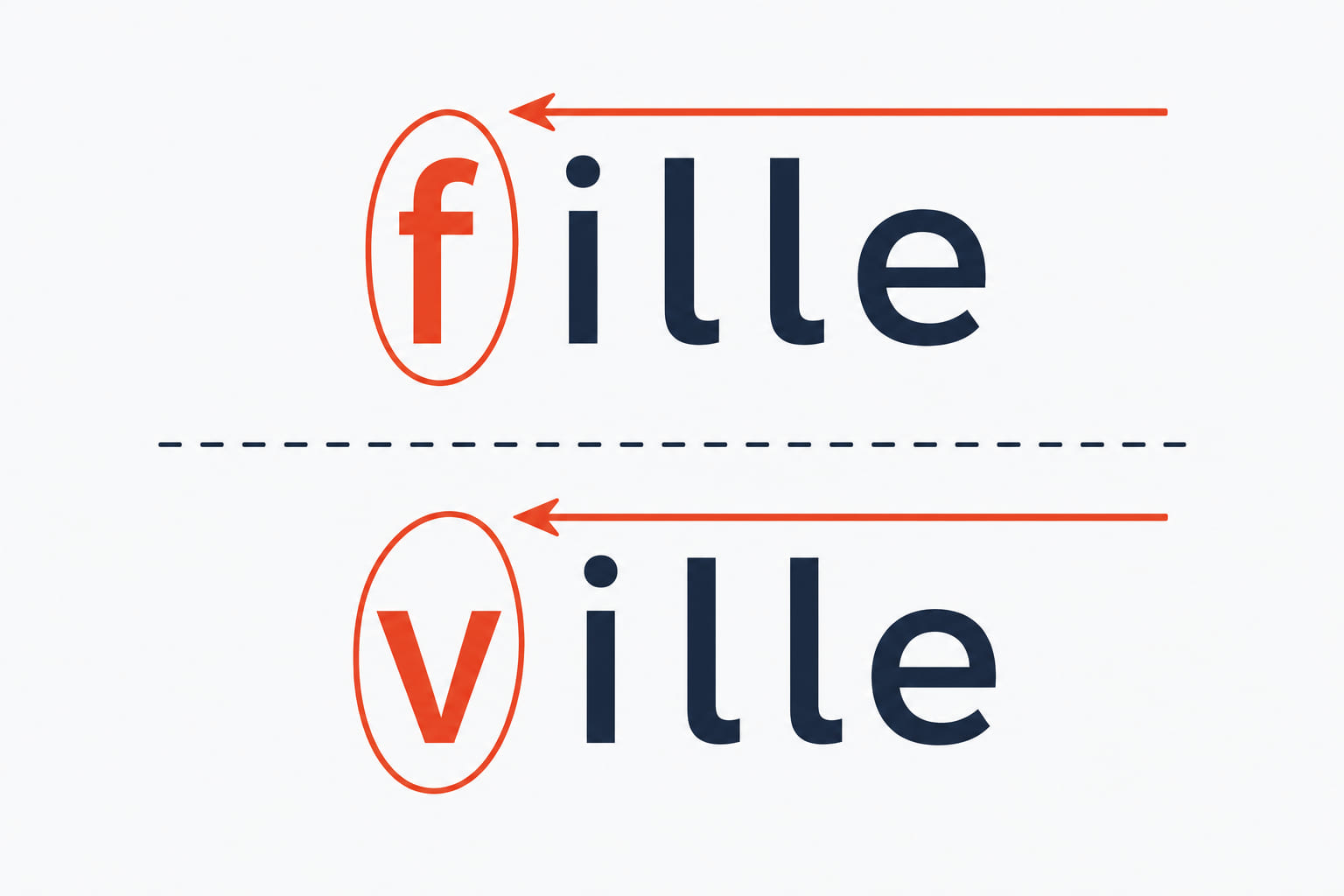
That is honest. The rule handles the enormous majority; the exception list handles the rest. But the list is far shorter than you think, and a good chunk of what circulates online does not belong on it any more.
The exception list, from the Academie itself
The Académie française gives it in a single sentence: ville, mille, million or milliard, tranquille, plus the endings -illaire (capillaire) and -illation (distillation).
Add the place name Lille /lil/, the derivatives of ville (village /vilaʒ/, villa, villageois) and of mille (mille-feuille /milfœj/), plus two technical words — bacille /basil/ and Achille /a.ʃil/ — and you have essentially the whole thing.
And now the words you should take off the list. These are widely printed as /il/ exceptions and are not, in modern French:
| Word | Often printed as | Actually |
|---|---|---|
| vaciller | /vasile/ | /vasije/ — the /il/ reading is marked archaic |
| scintiller | /sɛ̃tile/ | /sɛ̃tije/ — modern dictionaries give only /ij/ |
| pupille | /pypil/ | /pypij/ is the current usual form |
Distiller and osciller do keep /il/. So the pattern is not tidy, and anyone presenting all four -iller technical verbs as one block is copying an old list rather than checking.
The third category nobody separates
Million, milliard and millier are not -ille words at all. They are -illi- followed by a vowel, which gives /ilj/:
- million /mi.ljɔ̃/ — but papillon /pa.pi.jɔ̃/
Say those two back to back. Same ending on the page, different structure underneath: million has an L you pronounce, papillon does not. This pair alone is worth the price of admission, because it is the one place learners who have understood everything else still fall over.
Why the exceptions exist
Briefly, because it makes them easier to hold. Latin ill softened into the Y-sound during the ordinary evolution into French. The words that kept a hard L are learned borrowings — reimported later from written Latin, after the softening had finished, so they never went through it.
You can watch it happen inside a single family: vanille is /vanij/, but the scientific derivatives vanilline and vanillisme take the L. One word came up through speech; the others were built in a laboratory out of writing.
That is also why the /il/ words feel like a strange little club — ville, mille, tranquille are exactly the sort of high-frequency civic and quantitative vocabulary that stayed close to Latin.
Drill 1 — Twenty words with consonant + ILL
All /ij/. Say each one out loud. The trap is your English eye: ill in English is /ɪl/, a short vowel and a hard L, and that reading fires before you can stop it.
| Word | Say it as | Meaning |
|---|---|---|
| fille | /fij/ | girl, daughter |
| famille | /fa.mij/ | family |
| bille | /bij/ | marble |
| quille | /kij/ | skittle, keel |
| chenille | /ʃə.nij/ | caterpillar |
| vanille | /va.nij/ | vanilla |
| cheville | /ʃə.vij/ | ankle |
| jonquille | /ʒɔ̃.kij/ | daffodil |
| béquille | /be.kij/ | crutch |
| coquille | /kɔ.kij/ | shell |
| gentille | /ʒɑ̃.tij/ | kind (f.) |
| briller | /bʁije/ | to shine |
| habiller | /abije/ | to dress |
| papillon | /pa.pi.jɔ̃/ | butterfly |
| pastille | /pas.tij/ | lozenge |
| myrtille | /miʁ.tij/ | blueberry |
| brindille | /bʁɛ̃.dij/ | twig |
| guenille | /ɡə.nij/ | rag |
| sémillant | /se.mi.jɑ̃/ | lively |
| vrille | /vʁij/ | spiral, tendril |
Drill 2 — Twelve words with vowel + ILL
No /i/ here. The vowel in front already occupies the slot, and the ILL contributes the Y-sound only.
paille /paj/ straw · taille /taj/ size · médaille medal · abeille /a.bɛj/ bee · bouteille bottle · oreille ear · vieille old (f.) · feuille /fœj/ leaf · grenouille frog · nouille noodle · citrouille /si.tʁuj/ pumpkin · bouillon /bu.jɔ̃/ broth
The two-beat test. Say famille, then feuille. Famille has three beats — fa-mi-ye. Feuille has one — fœy. If they came out with the same number of beats, you are adding an /i/ where there is none, or dropping one where there is.
Drill 3 — The /il/ list, said properly
Eight words. Hard L, no Y-sound anywhere.
ville /vil/ · village /vilaʒ/ · villa · mille /mil/ · million /mi.ljɔ̃/ · milliard /mi.ljaʁ/ · tranquille /tʁɑ̃.kil/ · Lille /lil/
Then immediately say the confusable partners: fille · famille · papillon. Alternate: ville — fille — ville — fille.
Drill 4 — Real minimal pairs
| /ij/ | /il/ | ||
|---|---|---|---|
| fille /fij/ | girl | file /fil/ | queue, line |
| papillon /pa.pi.jɔ̃/ | butterfly | million /mi.ljɔ̃/ | million |
| bille /bij/ | marble | bile /bil/ | bile |
| quille /kij/ | skittle | kil | litre of wine (slang) |
And one to strike from your notes: ville and vile are not a minimal pair. Both are /vil/ — they are homophones. If a course gave you those two as a contrast exercise, the course was wrong.
Drill 5 — Ten sentences
- Ma fille habite dans cette ville. — My daughter lives in this city.
- Toute la famille est tranquille. — The whole family is calm.
- Un papillon s'est posé sur la feuille. — A butterfly landed on the leaf.
- Mille personnes dans un petit village. — A thousand people in a small village.
- Elle s'est fait mal à la cheville. — She hurt her ankle.
- Une bouteille de vanille, s'il vous plaît. — A bottle of vanilla, please.
- Il gagne un million par an. — He earns a million a year.
- La vieille dame a une belle médaille. — The old lady has a beautiful medal.
- Des nouilles, une citrouille et de l'ail. — Noodles, a pumpkin and some garlic.
- Sa fille est gentille et tranquille. — His daughter is kind and calm.
Sentence 1 is the test. Fille /fij/ and ville /vil/ in the same breath. Sentence 10 stacks all three categories — /ij/, /ij/, /il/.
The other half: final -IL
Same logic, one L. What comes before still decides.
| Before the -il | Sound | Examples |
|---|---|---|
| a vowel | /j/ | travail /tʁa.vaj/ · soleil · œil · fauteuil · orteil · réveil |
| a consonant | /il/ | il · avril · fil · cil /sil/ · civil · exil · péril |
And then the silent-L set. Only four are firm:
gentil /ʒɑ̃.ti/ · fusil /fy.zi/ · outil /u.ti/ · coutil /ku.ti/
Gentil is the one to notice, because it pairs with gentille /ʒɑ̃.tij/ from Drill 1. Masculine: no L, no Y — /ʒɑ̃ti/. Feminine: /ʒɑ̃tij/. The letter that appears is the sound that appears.
Everything else you may have been told is silent is genuinely variable — sourcil, persil, nombril, baril, gril, chenil all have two living pronunciations, and persil is actively getting its L back under the influence of the spelling. Do not memorise those as fixed. Nobody will blink either way.
In conversation
Collègue : Tu habites où, exactement ?
Vous : Dans un petit village à vingt kilomètres de la ville.
Collègue : Ah, tranquille alors !
Vous : Très tranquille. Ma fille adore — il y a des grenouilles dans le jardin.
Collègue : Des grenouilles ! Elle a quel âge ?
Vous : Sept ans. Elle passe ses journées à courir après les papillons.
Collègue : C'est gentil, ça. Bien mieux qu'en ville.
Six lines, and village, ville, tranquille, fille, grenouilles, papillons rotate through all three categories without warning. This is not a constructed drill — that is just what ordinary French does with these letters.
FAQ
How is aiguille actually pronounced?
/e.ɡɥij/ or /ɛ.ɡɥij/ — both are correct, the closed /e/ being the everyday form and the open /ɛ/ the more formal one. The part that matters is the ending: /ɥij/, three segments, not "eg-wee". It is the same /ɥ/ glide as in lui and huit.
Why is million different from papillon?
Because million is spelled -illi- followed by a vowel, not -ill-. That gives /ilj/ — a real L plus a Y — while papillon gives /ij/. Look for the second I.
Are ville and vile a minimal pair?
No, they are homophones — both /vil/. Use fille and file instead if you want a real pair.
Is it gentil or gentille?
Both, depending on gender, and they sound completely different: gentil /ʒɑ̃ti/, gentille /ʒɑ̃tij/. This is one of the clearest cases where the masculine and feminine of an adjective are not just a small ending change.
Do I really only need four exceptions?
Four families, plus the -illaire and -illation endings. Ville and its derivatives, mille and its family, tranquille, Lille, and a couple of technical words. Everything else follows the letter to the left.
The part you can't do alone
The rule is now in your head. That is not the same as being in your mouth.
The /ij/ in fille is two segments — a vowel and a glide — and English speakers routinely produce one and a half: something between /fij/ and /fi/, or with a light L leaking in from the spelling. It is not audibly "wrong" to you, because you know which word you meant, and knowing the word is what your ear plays back.
Meanwhile fille and file are one segment apart, and they are both extremely common words.
Say the twenty words in Drill 1 into Simply French and get each one scored as you say it — with the ones where an L crept in, or where the /i/ went missing, flagged individually. Fifteen minutes a day, free for seven days.
Keep going
- Lui vs Louis, Huit vs Oui: The French UI Sound, Drilled — the /ɥ/ that shows up inside aiguille and juillet
- Ils Parlent Sounds Like Il Parle — more letters that are on the page and not in the mouth
- Cheveux or Chevaux? — one segment apart, two real words, same problem
- Enchaînement: Why Your French Sounds Choppy — what happens to these endings when the next word starts with a vowel
- How to Tell If Your French Accent Is Actually Good — a self-test for what you cannot hear yourself doing
- French S vs Z: Poisson or Poison — the other place a doubled consonant decides the sound
- French Nasal Vowels AN EN ON IN — what the ending of papillon and million is doing after the L
Tags
Now find out how you actually sound.
Simply French listens to you say each sentence and scores it word by word, so you can hear the difference you have just read about — and fix it while it is still fresh.
Takes about 10 minutes. No card needed to start.
Related Articles
French U vs OU Pronunciation Practice: 20 Minimal Pairs, Scored
Everyone tells you the French u is hard. Nobody tells you your ou is wrong too - English GOOSE is fronted and diphthongal, so you are missing both vowels. Build them separately, then drill 20 minimal pairs out loud.
French S vs Z: Poisson or Poison, Drilled on 20 Pairs
One S between two vowels is /z/. Two S's are /s/. English trained you to do the opposite in exactly the word where it matters most - dessert. The rule, the boundary exceptions nobody teaches, and 20 pairs to say out loud.
French Nasal Vowels AN EN ON IN: Practice Without Pronouncing the N
In a French nasal vowel the N is not a sound - it is a spelling instruction, and your tongue must never touch the roof of your mouth. The three sounds, the true minimal triples, the denasalization pairs that prove it, and 10 sentences.