
French Nasal Vowels AN EN ON IN: Practice Without Pronouncing the N
In a French nasal vowel the N is not a sound - it is a spelling instruction, and your tongue must never touch the roof of your mouth. The three sounds, the true minimal triples, the denasalization pairs that prove it, and 10 sentences.
Simply French Team
Say bon out loud right now and pay attention to your tongue.
If the tip of it came up and touched the roof of your mouth at the end, you did not say bon. You said something closer to bonne — which is the feminine form, a different word, and the difference between il est bon and elle est bonne is the whole of French adjective agreement.
The N in bon is not a sound. It never was.

The rule, in one line
The N or M in a French nasal vowel is a spelling instruction, not a consonant. It tells you to send the vowel through your nose. Then it disappears.
Your tongue does not move. Your lips do not close. Nothing touches anything. The only change is that the soft palate at the back of your mouth drops and lets air out through your nose at the same time as your mouth.
That is the entire technique, and it is why this is the fastest big win in French pronunciation — there is no new muscle to train, only one to stop using.
The three sounds (and the fourth one, honestly)
| Sound | Spelled | Examples |
|---|---|---|
| /ɑ̃/ | an, am, en, em, aon | sans · grand · temps · sens · quand /kɑ̃/ |
| /ɔ̃/ | on, om | bon · mon · nom · long · ont |
| /ɛ̃/ | in, im, ain, aim, ein, eim, yn, ym — and en/em after i, é, y | vin · pain · plein · thym /tɛ̃/ · bien · examen /ɛɡzamɛ̃/ |
| /œ̃/ | un, um | un · brun /bʁœ̃/ · parfum · lundi |
About that fourth row. Most speakers in northern France, Paris included, no longer make it — brun and brin come out identical, both /ɛ̃/. But it is fully alive in Belgium, Switzerland, southern France and Quebec, where lundi and humble keep a distinctly rounder vowel.
So the honest answer to "how many nasal vowels does French have" is: three that everyone makes, and a fourth that depends on where your model speaker is from. Anyone who tells you flatly "four" is describing a textbook; anyone who tells you flatly "three" is describing Paris. Learn the three, recognise the fourth, and do not lose sleep over it.
Two more spellings worth knowing now: oin is /wɛ̃/ (loin, point, soin) and ien is /jɛ̃/ (bien, italien, ancien).
Why English fights you here
English does have nasalized vowels. Say can, hand, long — the vowel in each one is nasalized, because your soft palate opens early in anticipation of the consonant coming.
But in English that nasalization is a side effect, and the consonant is still articulated afterwards. It never carries meaning by itself. There is no English pair where the only difference is nose or no nose.
French has hundreds of them. Beau /bo/ and bon /bɔ̃/ differ in exactly one thing.
So your mouth is doing something it already knows how to do — nasalizing a vowel — but it has never had to do it as the last event. English always resolves the nasalization into a consonant. French stops one step earlier, and your English mouth keeps going.
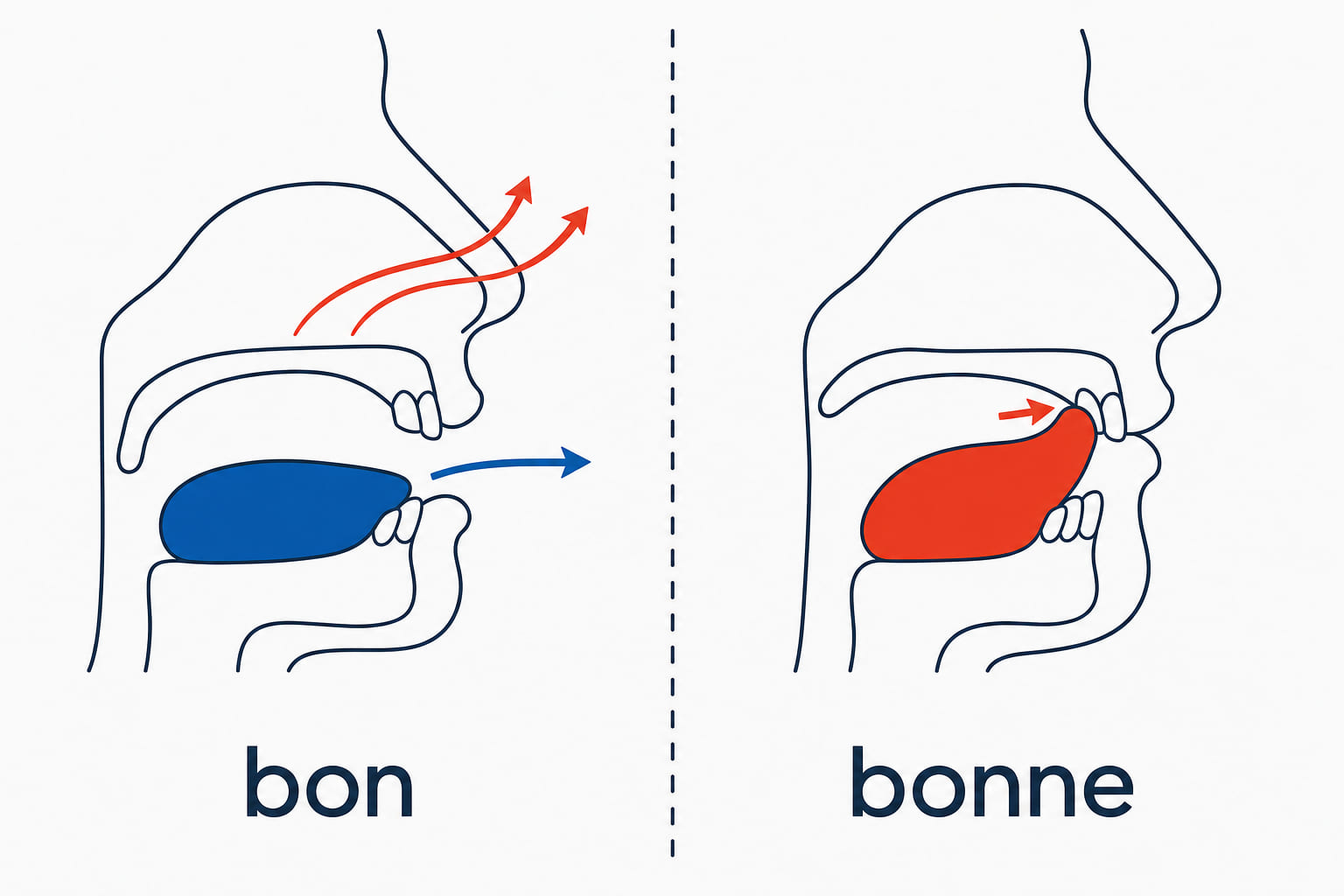
The tongue test. Say bon, and hold the vowel for three seconds. During those three seconds the tip of your tongue must stay resting behind your bottom teeth and your lips must stay apart. Then say bonne and feel the tongue come up and close. Alternate: bon — bonne — bon — bonne. That contact, appearing and disappearing, is the entire lesson. The pinch test. Pinch your nose shut and say beau. Now, still pinching, say bon. If nothing changes, you are not nasalizing at all. If the second one sounds strangled and blocked, the air is going where it should.
Drill 1 — The three sounds, five words each
Say each row across, then down. Tongue tip parked the whole time.
| /ɑ̃/ — an | /ɔ̃/ — on | /ɛ̃/ — in |
|---|---|---|
| sans | son | saint |
| grand | bon | bain |
| temps | nom | pain |
| enfant | maison (second syllable) | matin |
| dimanche | pardon | demain |
Enfant is a good early checkpoint: two nasal vowels, no consonant between them that your tongue can grab onto. If it comes out on-fon with clicks in the middle, slow down.
Drill 2 — Eight true triples
These are the real thing: three words identical except for the nasal vowel. Say them across, left to right, then right to left.
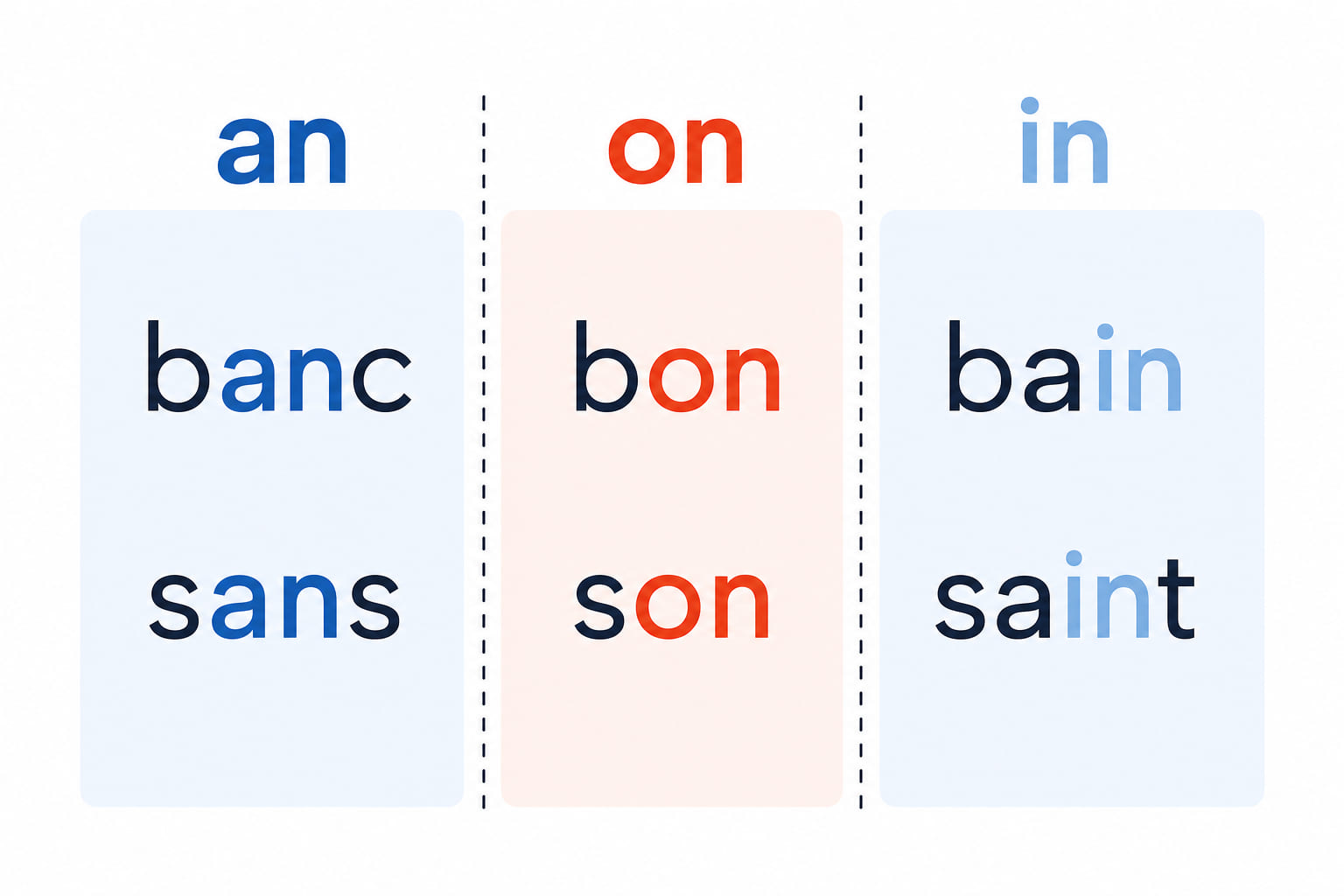
| /ɑ̃/ | /ɔ̃/ | /ɛ̃/ |
|---|---|---|
| banc — bench | bon — good | bain — bath |
| sans — without | son — his/her | saint — holy |
| lent — slow | long — long | lin /lɛ̃/ — linen |
| vent — wind | vont — they go | vin — wine |
| temps — time | ton — your | teint — complexion |
| ment — lies | mon — my | main — hand |
| dans — in | don — gift | daim — suede |
| rang — row | rond — round | rein /ʁɛ̃/ — kidney |
Row four is the one to keep. Vent, vont, vin — wind, they go, wine. Three extremely common words separated by nothing but where the nasal vowel sits.
Drill 3 — The trap: same sound, different spelling
Here is something most pages get wrong, and it costs learners real time. These sets look like minimal pairs. They are not — the words inside each set are identical in sound.
| Sound | Spellings that all give it |
|---|---|
| /pɛ̃/ | pain · pin · peint |
| /vɛ̃/ | vin · vain · vingt |
| /sɑ̃/ | sang · sans · cent |
| /sɛ̃/ | saint · sein · sain · ceint |
| /tɛ̃/ | thym · teint · tain |
Say each row out loud and make every word in it come out the same. This drill is the opposite of the last one, and it is just as important: if you invent a difference between vin and vingt because they are spelled differently, you have added an error, not removed one.
Six or seven spellings, one sound. That is the actual shape of the French /ɛ̃/.
Drill 4 — The proof: when the N comes back
A nasal vowel exists only when the N or M closes the syllable. Put a vowel after it, or double it, and the nasal vowel collapses back into an ordinary vowel plus a real consonant.
This is not a footnote. It is how French marks gender, and it is the strongest evidence that you have been pronouncing the N when you should not.
| Nasal — no consonant | Oral — consonant is back |
|---|---|
| bon /bɔ̃/ | bonne /bɔn/ |
| un /œ̃/ | une /yn/ |
| an /ɑ̃/ | année /ane/ |
| plein /plɛ̃/ | pleine /plɛn/ |
| certain /sɛʁ.tɛ̃/ | certaine /sɛʁ.tɛn/ |
| américain /ameʁikɛ̃/ | américaine /ameʁikɛn/ |
| italien /i.ta.ljɛ̃/ | italienne /i.ta.ljɛn/ |
| ancien /ɑ̃.sjɛ̃/ | ancienne /ɑ̃.sjɛn/ |
| brun /bʁœ̃/ | brune /bʁyn/ |
| paysan | paysanne |
Look at what this means. If you pronounce the N in américain, you have said américaine. You have not merely sounded foreign — you have changed your own gender in the sentence, and you did it while introducing yourself.
Notice brun and brune too: the vowel does not just lose its nasality, it changes completely, /œ̃/ to /y/.
The traps: spellings that look nasal and are not
| Word | Sound | What is going on |
|---|---|---|
| femme | /fam/ | not nasal at all, and the E is an A |
| monsieur | /məsjø/ | no nasal, no R, barely the word it looks like |
| automne | /o.tɔn/ | the M is silent, the N is real, the vowel is oral |
| condamner | /kɔ̃dɑne/ | first syllable nasal, second one not — the M is silent |
| ennemi | /ɛn.mi/ | doubled NN, so no nasal vowel |
| ennui | /ɑ̃.nɥi/ | but here the doubled NN keeps the nasal and adds the consonant |
| emmener | /ɑ̃məne/ | same — nasal vowel plus a pronounced M |
| immense | /i.mɑ̃s/ | first syllable oral, second nasal |
| innocent | /i.nɔ.sɑ̃/ | same pattern |
| parlent | /paʁl/ | the whole ending is silent |
Rows five to seven are worth slowing down for, because they break a rule you will see stated confidently everywhere online: "a doubled N or M always cancels the nasal vowel." It does for in- and im- (innocent, immense) and for ennemi. It does not for en- and em- in ennui and emmener, which keep the nasal vowel and pronounce the consonant as well.
And parlent belongs to a bigger problem — the silent verb ending that makes ils parlent sound exactly like il parle. That one has its own page.
Drill 5 — Ten sentences
- Un bon vin blanc. — A good white wine. (three different nasals in four words)
- Il est américain, elle est américaine. — He is American, she is American.
- On mange à onze heures ? — Shall we eat at eleven?
- Cent ans sans vent. — A hundred years without wind.
- Mon oncle a un grand jardin. — My uncle has a big garden.
- Le pain est bon, le bain est chaud. — The bread is good, the bath is hot.
- Combien de temps ? — How long?
- Ce vin vient de Bordeaux. — This wine comes from Bordeaux.
- Il y a vingt enfants dans le train. — There are twenty children on the train.
- En janvier, on prend rendez-vous. — In January, we make an appointment.
Sentence 2 is the one to record. If both halves sound the same, the whole article has not landed yet.
In conversation
Voisin : Bonjour ! Vous êtes américain ?
Vous : Américaine, oui. Enfin, canadienne, mais on me demande souvent.
Voisin : Ah pardon ! Et vous restez longtemps ?
Vous : Un an. J'ai un contrat de douze mois.
Voisin : Un an, c'est bien. Vous parlez déjà très bien français.
Vous : Merci. C'est gentil, mais j'ai encore un accent.
Voisin : Un tout petit. On comprend très bien.
Line two is doing real work. Américaine and canadienne both end in a pronounced N — and if you have spent the week training your tongue to stay down, this is exactly where you will overcorrect and drop a consonant that is supposed to be there.
The rule cuts both ways. Nasal vowel: no consonant. Written vowel after the N: consonant.
FAQ
Is it three nasal vowels or four?
Three that every French speaker makes, plus /œ̃/ in un and brun, which is merged with /ɛ̃/ for most speakers in northern France but alive and well in Belgium, Switzerland, the south, and Quebec. If you merge them you will sound Parisian. If you keep them apart you will sound like a great many other French speakers. Neither is an error.
Why does my vin sound like the English word "van"?
Because that is how it was taught for fifty years, and the language moved. Modern Parisian /ɛ̃/ has lowered and backed toward [æ̃] — it is closer to the vowel in sang than to the one in van. Older textbooks describing /ɛ̃/ as "an" are describing a pronunciation that has shifted.
Why is bien /jɛ̃/ and not /jɑ̃/?
Because en and em are pronounced /ɛ̃/ after i, é and y, and /ɑ̃/ everywhere else. That gives you bien, rien, chien, moyen, européen, examen, lycéen — all /ɛ̃/. Outside that environment: vent, temps, sens, all /ɑ̃/.
How do I know if I am really nasalizing, or just thinking about it?
Use the pinch test above. Pinch your nose and say beau, then bon. If they sound the same, no air is going through your nose and you are producing an oral vowel with an imaginary N attached.
Does the south of France really sound different?
Yes — southern French often adds a light nasal consonant after the vowel, which is close to what English speakers do by accident. That does not make the error correct; it makes it a regional accent you have not chosen. Pick your target and be consistent.
The part you can't do alone
The pinch test tells you whether air is going through your nose. It does not tell you which of the three vowels came out.
And that is the real problem here. English has no /ɑ̃/–/ɔ̃/–/ɛ̃/ system, so your ear has no categories to file them into. It will hear all three as roughly one sound with a nasal flavour, and it will hear your own attempts as whichever one you meant. You can drill vent, vont, vin for a week, feel that they are different, and be producing the same vowel three times.
That is not a discipline problem. It is a hardware problem, and it needs an outside ear.
Say the eight triples in Drill 2 into Simply French and get each one scored the moment you say it — which nasal vowel you actually produced, and whether a consonant sneaked in at the end. Fifteen minutes a day, free for seven days.
Keep going
- Nation, Attention, Decision: The -TION Trap — /ɔ̃/ at the end of a thousand words you already know
- You're Saying "Croissant" Wrong — the -ant ending, with no T and no N
- Ils Parlent Sounds Like Il Parle — the other ending where the letters are there and the sound is not
- Cheveux or Chevaux? — an oral vowel contrast with the same do-not-move discipline
- How to Tell If Your French Accent Is Actually Good — the nasal vowels are test four of six
- French U vs OU Pronunciation Practice — un becomes une, and the vowel changes completely
- The French R for English Speakers — rond, grand, rein, train: the consonant that keeps arriving just before a nasal vowel
Tags
Now find out how you actually sound.
Simply French listens to you say each sentence and scores it word by word, so you can hear the difference you have just read about — and fix it while it is still fresh.
Takes about 10 minutes. No card needed to start.
Related Articles
French U vs OU Pronunciation Practice: 20 Minimal Pairs, Scored
Everyone tells you the French u is hard. Nobody tells you your ou is wrong too - English GOOSE is fronted and diphthongal, so you are missing both vowels. Build them separately, then drill 20 minimal pairs out loud.
French S vs Z: Poisson or Poison, Drilled on 20 Pairs
One S between two vowels is /z/. Two S's are /s/. English trained you to do the opposite in exactly the word where it matters most - dessert. The rule, the boundary exceptions nobody teaches, and 20 pairs to say out loud.
The French R for English Speakers: 12 Words, 5 Minutes a Day
Stop gargling. The French R is made exactly where you say the G in get - and the reason yours is not working is the tip of your tongue. Build it in four steps, then drill 12 words, three weights of R, and 10 sentences.