
You're Saying "Croissant" Wrong — Here's the Fix (Say It, Get Scored)
Croissant is /kʁwa.sɑ̃/ — two syllables, no T, no N. Three separate problems are stacked in one word. Take them apart, then drill 40 words and 8 counter sentences out loud.
Simply French Team
It is probably the first thing you will order in France, and quite possibly the French word you have said most often in your life.
It is also, for most English speakers, the one you say worst — because you have not been pronouncing a French word at all. You have been pronouncing an English word that happens to be spelled the same way.
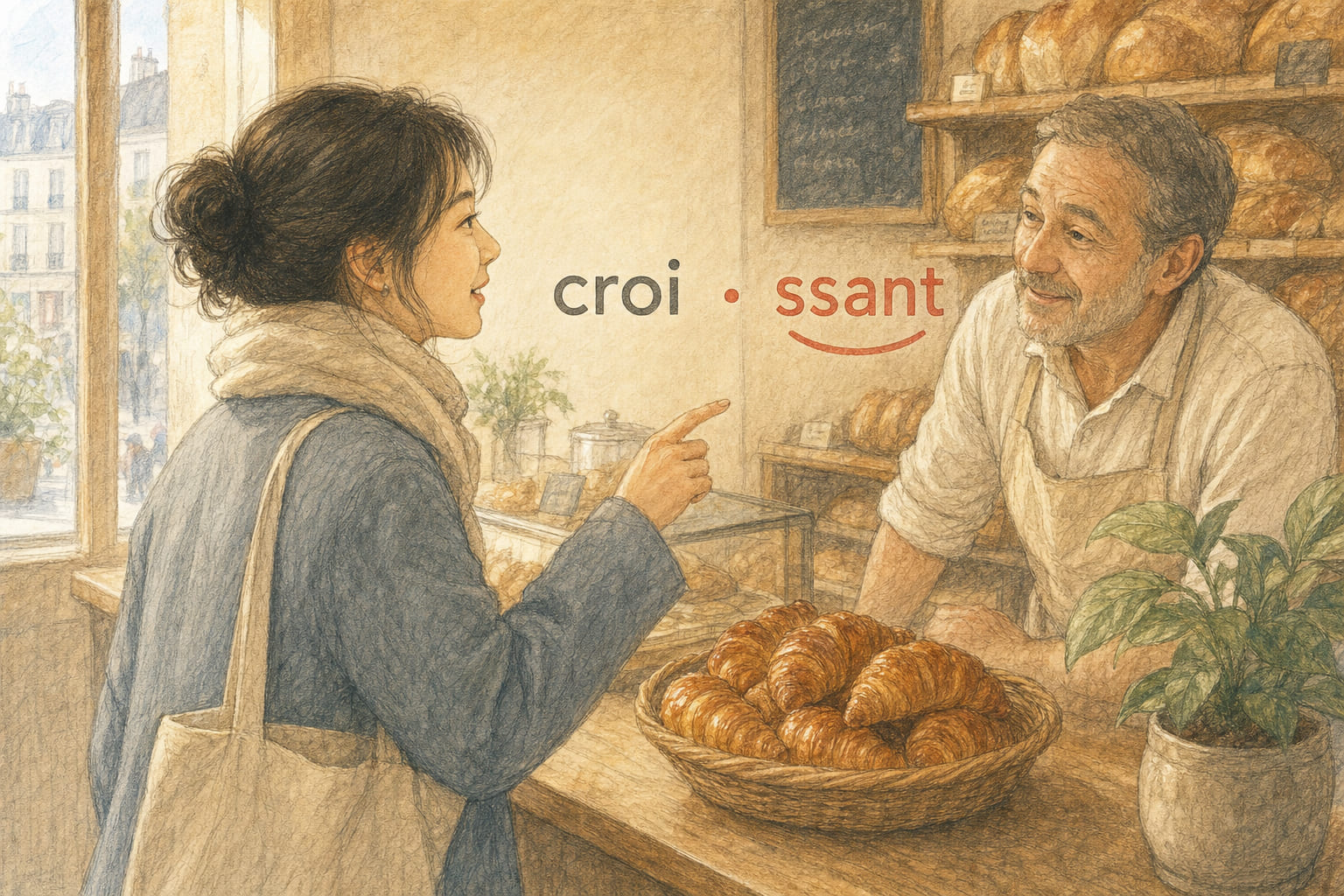
The rule, in one line
croissant = /kʁwa.sɑ̃/ — two syllables, and neither of them contains a t.
| Syllable | Spelling | Sound |
|---|---|---|
| 1 | croi‑ | /kʁwa/ |
| 2 | ‑ssant | /sɑ̃/ |
Two beats. That is the whole word. If you produced three, or ended on a t, or ended on an n, something in the list below is happening.
Your two English versions, and why both fail
English has borrowed this word twice, and neither import survived the trip intact.
| Sounds like | What's broken | |
|---|---|---|
| US English /kɹəˈsɑːnt/ | kruh‑SAHNT | oi collapsed to a schwa · hard final t |
| UK English /ˈk(ɹ)wæsɒ̃/ | KWAH‑song | R often dropped · /æ/ instead of /a/ · stress pulled forward |
| French /kʁwa.sɑ̃/ | — | — |
The British version is closer than most people assume — it keeps the /w/ and it nasalises the ending. Its problem is the dropped R and a front /æ/ where French wants an open /a/. The American version gets the R in but loses the /w/ entirely and then lands hard on a consonant that does not exist.
Neither is unintelligible. You will get your croissant. What they do is mark you, instantly and every single time, because this is a word French speakers hear thousands of times a year and know the shape of perfectly.
Problem 1 — oi is /wa/, not "oy" and not "uh"
In French, oi is always /wa/. Not the oi of boil. Not a schwa. A /w/ glide followed by an open /a/, joined into one syllable.
So croi‑ is not "cruh." It is /kʁwa/ — you must actually round your lips and push through a w on the way to the vowel.
This is the same glide family as the ui in lui: a consonant, a semivowel, and a vowel crammed into a single beat. If that cluster gives you trouble, Lui vs Louis, Huit vs Oui drills the mechanism directly.
Problem 2 — the R is in the worst possible place
French /ʁ/ is made at the back of the throat, near where you gargle. That is hard enough on its own. Here it is wedged between a /k/ — also made at the back — and a /w/, which needs your lips forward.
Three articulations, three different places, one syllable, and it is the first syllable, so there is no run‑up.
Build it backwards. Do not start from the front.
- Say /sɑ̃/ alone. Just the ending.
- Add the vowel: /wa‑sɑ̃/ — "wa‑sahn."
- Add the R: /ʁwa‑sɑ̃/. Let the R be soft, almost a breath. A weak R is far better than a rolled Spanish one or an American /ɹ/.
- Add the K: /kʁwa.sɑ̃/.
Back‑chaining works because the hard part stops being the launch. Most learners fail this word in the first 200 milliseconds and never recover.
Problem 3 — no T, no N, one nasal vowel
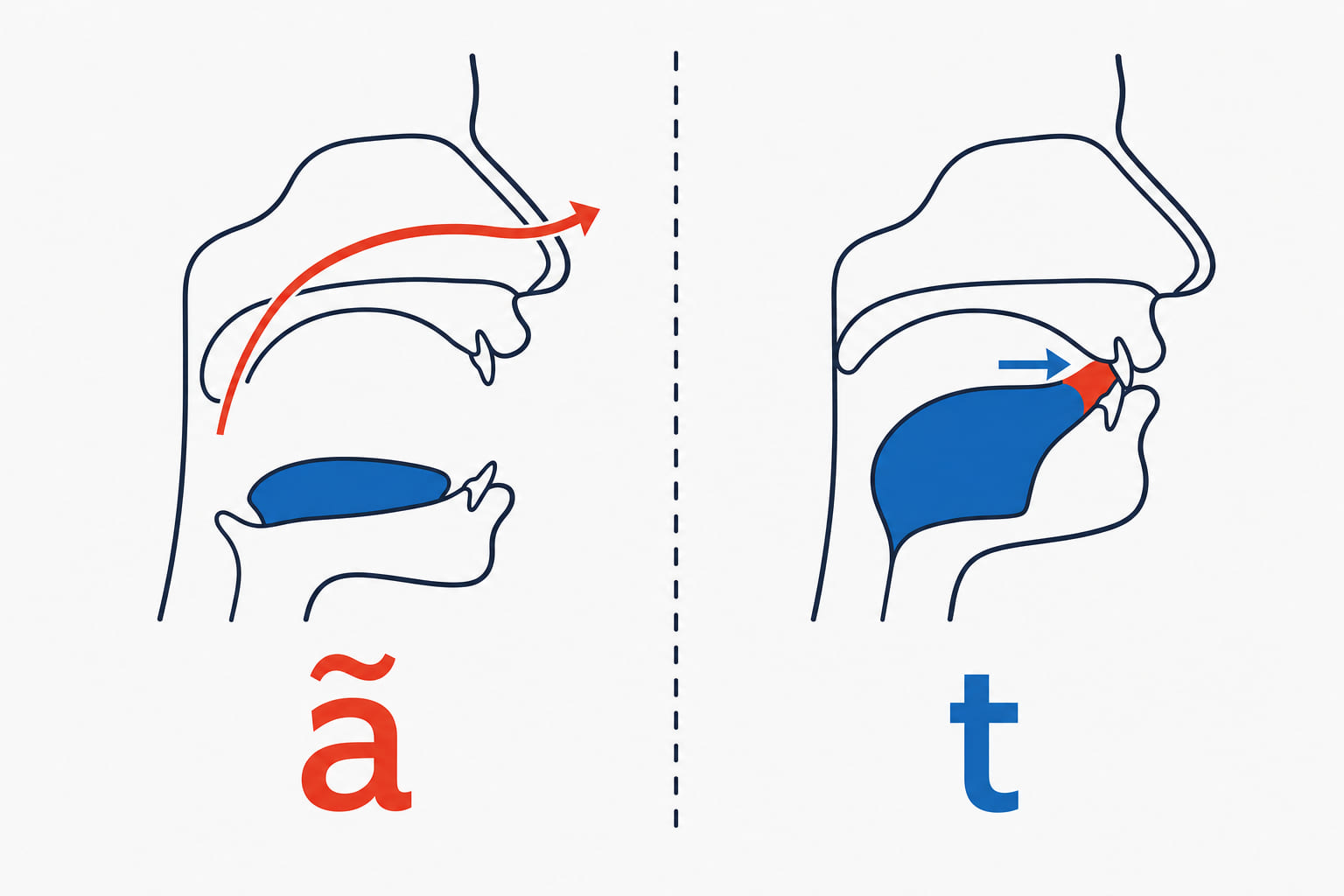
‑ant is /ɑ̃/. A single nasal vowel. The n and the t are both spelling, not sound.
The t is the one that gives Americans away. English hears a written final t and says it — but in French a final t is silent by default, and this one is no exception.
The proof. Croissant also exists as an adjective meaning "growing," and it has a feminine form: croissante /kʁwa.sɑ̃t/. That one has a /t/, because the e after it forces the consonant to be pronounced. The masculine does not.
Say them back to back: croissant · croissante. If they sound the same, you are saying the feminine and ordering a grammatically confused pastry.
And the n is not a consonant either — it is the instruction to send the vowel through your nose. Say the word and hold the end: your tongue tip must stay down. If it rises to touch the roof of your mouth, you added a consonant.
Drill 1 — Twelve oi words
Every one of these is /wa/. Round your lips before the vowel arrives.
| Word | IPA | Meaning |
|---|---|---|
| moi | /mwa/ | me |
| toi | /twa/ | you |
| quoi | /kwa/ | what |
| trois | /tʁwa/ | three |
| froid | /fʁwa/ | cold |
| droit | /dʁwa/ | right · straight |
| croix | /kʁwa/ | cross |
| boire | /bwaʁ/ | to drink |
| noir | /nwaʁ/ | black |
| voiture | /vwa.tyʁ/ | car |
| oiseau | /wa.zo/ | bird |
| croissant | /kʁwa.sɑ̃/ | croissant |
croix is the useful one. It is croissant with the ending amputated — exactly the first syllable, alone. Say croix ten times, then bolt /sɑ̃/ onto the end.
Drill 2 — Twelve ‑ant / ‑ent words, all /ɑ̃/
No final consonant on any of these. Hold the last sound and check your tongue.
| Word | IPA | Meaning |
|---|---|---|
| croissant | /kʁwa.sɑ̃/ | croissant |
| restaurant | /ʁɛs·to·ʁɑ̃/ | restaurant |
| enfant | /ɑ̃.fɑ̃/ | child |
| avant | /a.vɑ̃/ | before |
| devant | /də.vɑ̃/ | in front of |
| pendant | /pɑ̃.dɑ̃/ | during |
| maintenant | /mɛ̃t.nɑ̃/ | now |
| blanc | /blɑ̃/ | white |
| grand | /gʁɑ̃/ | big |
| gant | /gɑ̃/ | glove |
| cent | /sɑ̃/ | hundred |
| temps | /tɑ̃/ | time · weather |
Enfant is two nasals in a row and no consonant at either end — the fastest way to find out whether you are nasalising or just adding _n_s. And cent /sɑ̃/ is literally the second syllable of croissant, standing on its own.
Drill 3 — Ten /kʁ/ clusters
The back‑of‑throat launch, on its own, until it stops being the hard part.
- crème /kʁɛm/ — cream
- crêpe /kʁɛp/ — crepe
- croix /kʁwa/ — cross
- croire /kʁwaʁ/ — to believe (two R's, one syllable)
- croissant /kʁwa.sɑ̃/
- croque‑monsieur /kʁɔk·mə·sjø/
- croître /kʁwatʁ/ — to grow
- crayon /kʁɛ.jɔ̃/ — pencil
- écrire /e.kʁiʁ/ — to write
- sucre /sykʁ/ — sugar
Number 4 is the boss level: croire packs /k/, /ʁ/, /w/, /a/ and a second /ʁ/ into one beat.
Drill 4 — Eight sentences you will actually say
Normal speed. Do not slow down for the target word — slowing down is how you hide the error from yourself.
- Un croissant, s'il vous plaît. — One croissant, please.
- Deux croissants et un café. — Two croissants and a coffee.
- Je voudrais un croissant au beurre. — I'd like a butter croissant.
- Ils sont encore chauds, les croissants ? — Are the croissants still warm?
- Trois croissants, s'il vous plaît — et un pain au chocolat.
- Le croissant est meilleur avec du café noir. — A croissant is better with black coffee.
- Un croissant, une croix, et je crois que c'est tout. — A croissant, a cross, and I think that's it.
- Maintenant je voudrais un croissant, pas cent croissants. — Now I'd like one croissant, not a hundred.
Sentence 8 is the whole article in one line. Maintenant, croissant and cent all end in the identical sound /ɑ̃/ — and cent is croissant's second syllable exactly. If those three endings came out different from each other, that is the drill.
Notice too that the plural changes nothing. Un croissant and des croissants are pronounced identically — the s is as silent as the t.
What the word actually means
Croissant is the present participle of the verb croître, "to grow." It means, literally, growing.
That is also why the moon has one. A croissant de lune is a waxing crescent — the moon in its growing phase — and the pastry is named after the shape, not the other way round.
And it is not originally French. The ancestor is the Austrian kipferl, a crescent‑shaped pastry documented since at least the 13th century. An Austrian officer named August Zang opened a Viennese bakery in Paris in 1838 or 1839; French bakers took the shape, swapped in laminated yeast dough, and renamed it for what it looked like. By 1869 it was a French breakfast fixture.
So the most French thing you can order is a Viennese import with a Latin participle for a name. Worth knowing at the counter.
In conversation
Boulangère : Bonjour ! Qu'est‑ce que ce sera ?
Vous : Bonjour. Deux croissants, s'il vous plaît.
Boulangère : Au beurre ou ordinaires ?
Vous : Au beurre. Ils sont encore chauds ?
Boulangère : Sortis du four il y a dix minutes.
Vous : Parfait. Et un café noir aussi, s'il vous plaît.
Boulangère : Ça fait six euros quarante.
Vous : Voilà. Merci, bonne journée !
Say line two at full speed. In real French, deux croissants runs together — the vowel of deux leans straight into the /kʁw/ with no gap. That linking is what makes the phrase sound French rather than assembled, and it is drilled in Enchaînement.
FAQ
Will they understand me if I say it the English way?
Almost certainly, yes — you are standing in a bakery pointing at croissants. Intelligibility is not the issue. The issue is that this is a high‑frequency word French speakers have a very precise template for, so a mispronounced croissant is the fastest possible signal that the conversation should switch to English.
Is the final T really always silent?
In the noun, yes, always. The t only speaks when something follows it that forces it out — the feminine croissante /kʁwa.sɑ̃t/, or the derived croissance /kʁwa.sɑ̃s/ ("growth"). The pastry never has one.
How bad does my R have to be?
Less bad than you fear. A soft, almost breathy /ʁ/ passes easily. What does not pass is substituting the American /ɹ/, which changes the vowel around it, or rolling it. If in doubt, under‑do it — in this cluster a light R is nearly invisible while a wrong one is loud.
Is it two syllables or three?
Two. The oi is a glide plus a vowel sharing a single beat, not two beats. If you are saying cro‑wa‑sahn, you have split the glide off into its own syllable.
Does it change in Quebec or the south of France?
The word is the same everywhere. Southern French speakers may let a faint consonant colour the nasal, and Quebec French may lengthen the vowel, but nobody anywhere pronounces the final t.
The part you can't check alone
There are exactly three things to get right in this word, and you cannot verify any of them from inside your own head: whether the /w/ is really there, whether the R fired without wrecking the vowel, and whether you closed the word on a nasal vowel or on a consonant.
Your ear was trained by English. It will hear your English croissant as correct, because for thirty years it has been.
Say the eight sentences in Drill 4 into Simply French and get each one scored the moment you say it — the glide, the R and the final nasal, flagged separately. Fifteen minutes a day, free for seven days.
Keep going
- Lui vs Louis, Huit vs Oui: The French UI Sound, Drilled — the same glide mechanism, one vowel over
- Cheveux or Chevaux? One Vowel Between Your Hair and a Horse — holding a French vowel still instead of letting it drift
- How to Tell If Your French Accent Is Actually Good (Self-Test) — six checks, including the R and the nasals
- Enchaînement: Why Your French Sounds Choppy — how deux croissants becomes one smooth phrase
- You're Stressing the Wrong Syllable: 20 French Phrases, Scored — where the weight goes in a French phrase
Tags
Now find out how you actually sound.
Simply French listens to you say each sentence and scores it word by word, so you can hear the difference you have just read about — and fix it while it is still fresh.
Takes about 10 minutes. No card needed to start.
Related Articles
ILLE Pronunciation in French: Why Fille and Ville Do Not Rhyme
You were told to memorise four exceptions. The real rule is in the letter before the ILL, not the ILL itself - and half the exception lists online are out of date. Three categories, the Academie's own short list, and 20 words to say out loud.
French S vs Z: Poisson or Poison, Drilled on 20 Pairs
One S between two vowels is /z/. Two S's are /s/. English trained you to do the opposite in exactly the word where it matters most - dessert. The rule, the boundary exceptions nobody teaches, and 20 pairs to say out loud.
French Nasal Vowels AN EN ON IN: Practice Without Pronouncing the N
In a French nasal vowel the N is not a sound - it is a spelling instruction, and your tongue must never touch the roof of your mouth. The three sounds, the true minimal triples, the denasalization pairs that prove it, and 10 sentences.