
Lui vs Louis, Huit vs Oui: The French UI Sound, Drilled
French ui is not oui. The glide that splits lui from Louis and huit from oui: how to build /ɥ/ out of a tongue and a pair of lips, 12 minimal pairs, and 45 words to say out loud.
Simply French Team
You know the word lui. It shows up in the first month of every French course, it turns up in every second sentence, and you have already said it several thousand times.
A fair number of the French people you say it to hear Louis.
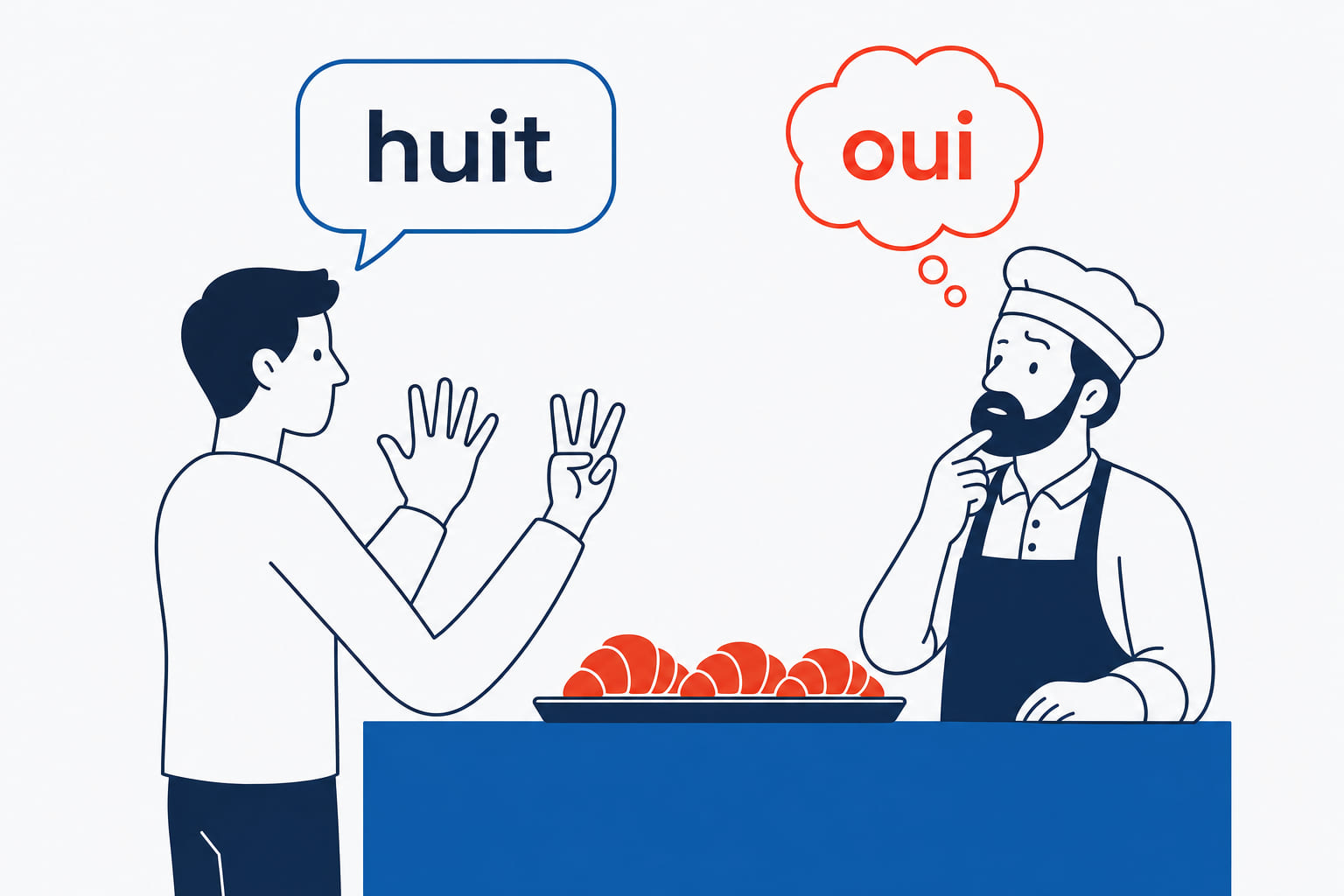
Same with huit. You ask for eight of something, and what leaves your mouth lands closer to oui — not a number, but still a word, so the person behind the counter is now working out what exactly you just agreed to.
This is not a vocabulary problem and it is not a confidence problem. It is one sound. French has a glide, /ɥ/, that English does not have and has nothing close to. Your mouth reaches for the nearest thing it owns, which is /w/ — and in French, /w/ is already taken. It belongs to a different spelling. So you do not produce an accented version of the word you meant. You produce a different word.
The rule, in one line
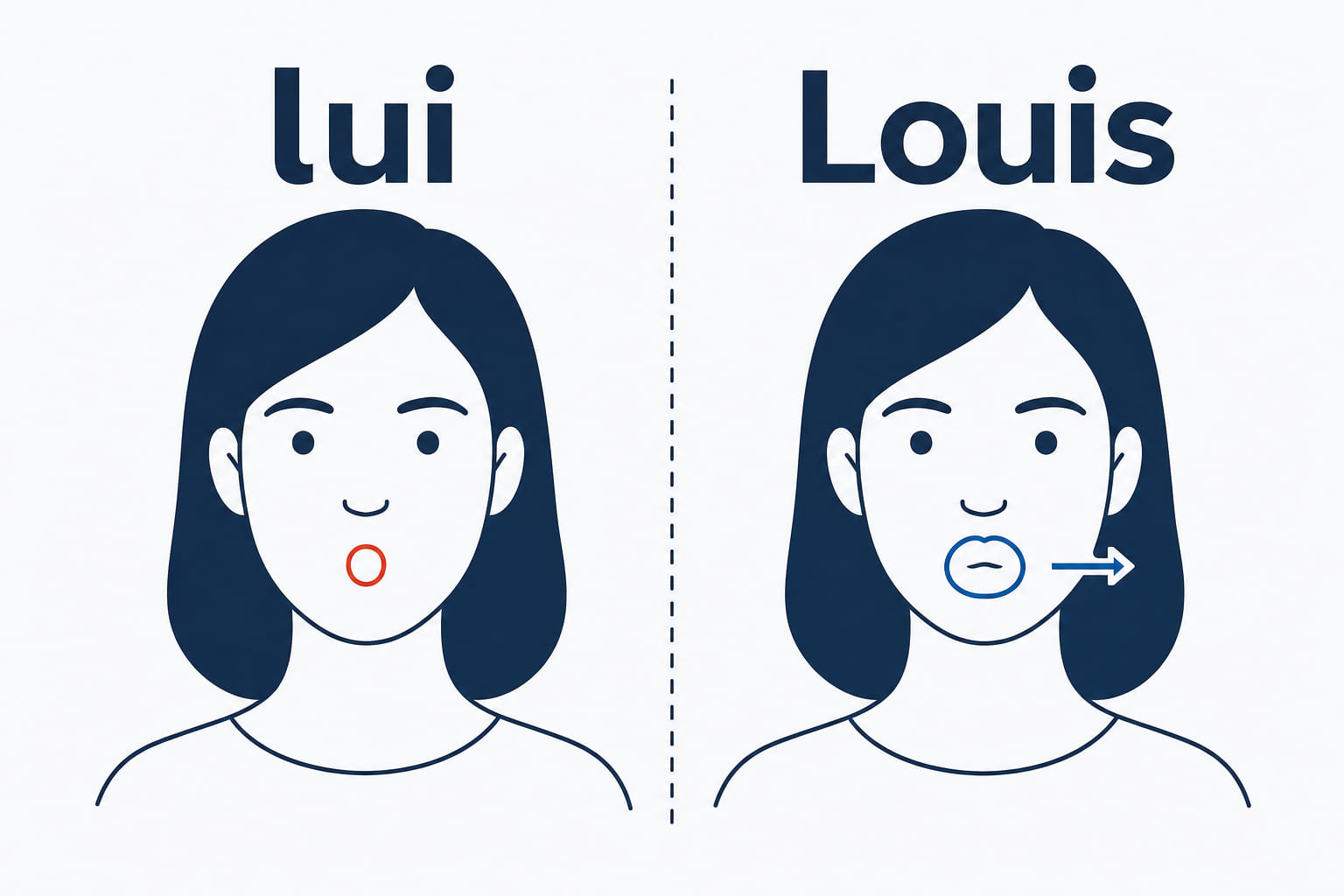
French u before another vowel is /ɥ/ — the tongue of i with the lips of ou, at the same time. French ou before another vowel is /w/, the ordinary English w. Two spellings, two sounds, and English owns only one of them.
Everything below is either a consequence of that line or a drill for it.
Three vowels, three glides
French has three high vowels, and each one stops being a syllable of its own when another vowel follows immediately. It compresses into a glide and hands its beat to the vowel behind it.
| Spelling | Glide | Examples | Does English have it? |
|---|---|---|---|
| i + vowel | /j/ | bien, hier, premier, avion | Yes — the y of yes |
| ou + vowel (and oi) | /w/ | oui, Louis, jouer, moi, soir | Yes — the w of we |
| u + vowel | /ɥ/ | lui, huit, nuit, cuisine, tuer | No — nothing like it |
Two of the three arrive free. You have been making /j/ and /w/ since you were two years old, and French uses them in the same places English does. The third one is not a slightly different version of a sound you know. It is a sound English never built, because English does not have the vowel it is made from either — the u of tu.
So there is nothing to adjust. There is something to construct.
Your mouth already owns both halves
/ɥ/ is not exotic. It is two things you can already do, done at the same time instead of one after the other.
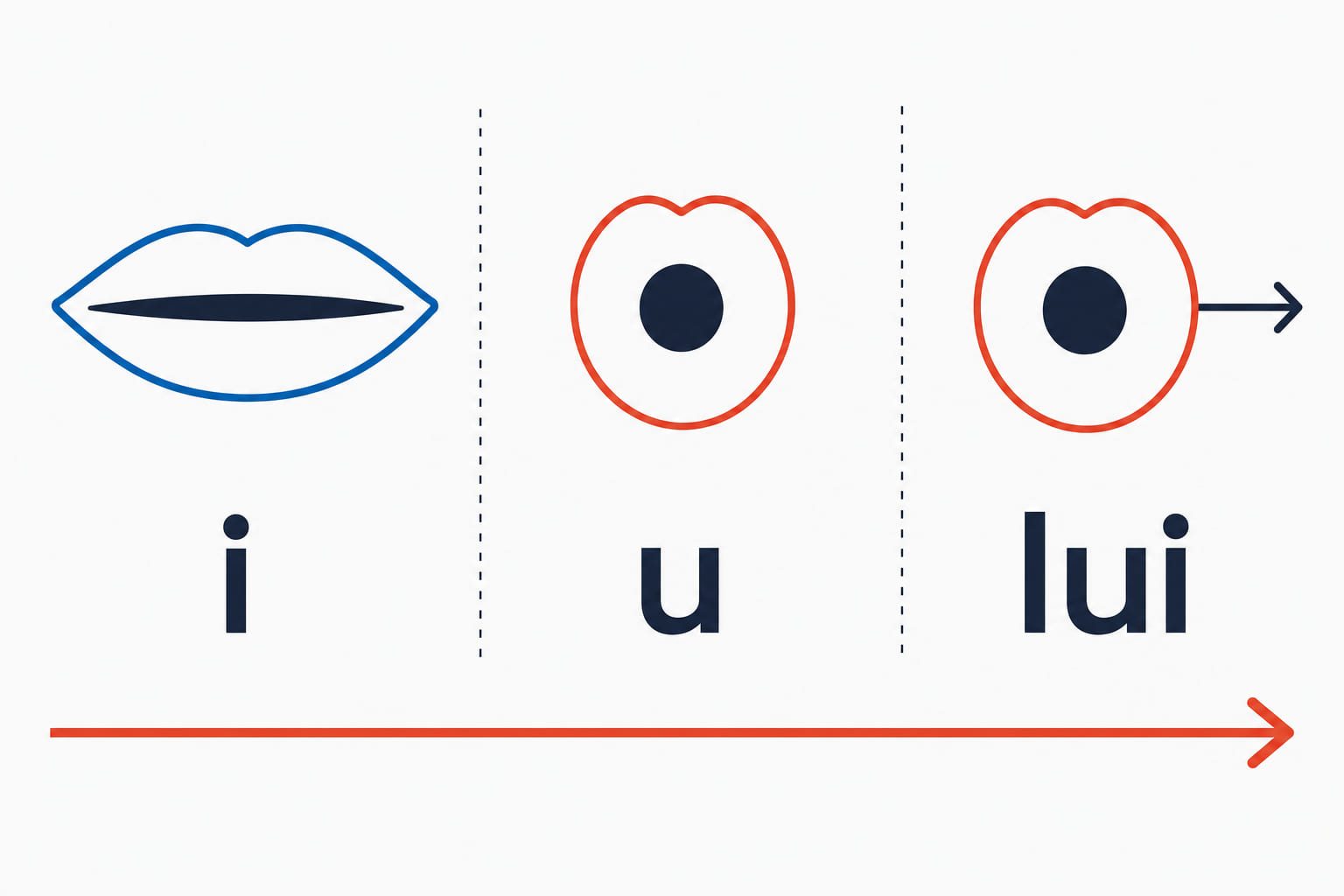
- Say i, as in ici. Lips spread, tongue high and pushed forward, sound bright and thin. Hold it.
- Keep your tongue exactly where it is — do not let it slide back — and round your lips as if you were about to say ou. The sound changes completely. That is /y/, the vowel of tu, and the only thing you changed was your lips.
- Now say that same /y/ but refuse to give it a beat of its own. Let it collapse straight into the vowel behind it. u-i becomes lui, one syllable, no seam.
The mirror test. Say lui, then Louis, in front of a mirror. On lui your lips round into a small tight circle and stay put — nothing pushes forward, and the sound stays bright. On Louis your lips shove forward into a pout and your tongue pulls back, and the sound goes dark and hollow. If both words look the same in the mirror, you said Louis twice.
The mistake is almost never that learners find /ɥ/ hard to make. It is that they never try — the word goes past too fast, /w/ is already loaded and ready, and the substitution happens below the level where you can hear yourself doing it.
Why English hands you /w/, twice over
Two separate forces push you toward the same wrong sound, which is why this one is so persistent.
Your ear does it first. Every language filters incoming sound through the categories it already has. /ɥ/ has no category in English, so your ear files it under the nearest available neighbour, and the nearest available neighbour is /w/ — also rounded, also a glide, also unstressed. By the time the word reaches the part of you that decides what to say, the distinction has already been thrown away.
Then your eye finishes the job. Written ui looks like it should be wee. Huit looks like wheat. And English-language courses reinforce it, glossing huit as weet and lui as lwee — a gloss that is precisely the error, printed and handed to you as the answer.
Every ui is /ɥi/
Here is the single highest-yield fact in this article: in French, the letter pair ui is /ɥi/, always, one syllable, with no exceptions worth memorising.
lui, huit, nuit, minuit, aujourd'hui, puis, depuis, pluie, bruit, fruit, cuisine, cuir, huile, huître, suisse, suivre, suite, ennui, juillet, truite, conduire, celui, autrui, nuire, luire, essuyer
Every one of those: /ɥi/, one beat. Not oo-ee, not w-ee, and not two syllables either.
The one thing that looks like an exception is not one. After g and q, the letter u is frequently not a sound at all — it is a spelling device that keeps the g hard and keeps the q company:
| Word | Sound | What the u is doing |
|---|---|---|
| guitare | /gitaʁ/ | Silent — it stops the g from softening |
| guichet | /giʃɛ/ | Silent, same job |
| qui | /ki/ | Silent — qu is simply how French writes /k/ |
| quitter | /kite/ | Silent |
| équipe | /ekip/ | Silent |
And then a small set of words where gu really is /gɥ/ and the glide comes back: aiguille /egɥij/, linguistique /lɛ̃gɥistik/, ambiguïté /ɑ̃bigɥite/. Those are worth knowing precisely because they sound wrong to a learner who has over-learned the guitare pattern.
/ɥi/ is compulsory. The rest of /ɥ/ is negotiable.
This is where to spend your effort, and almost nobody tells you this part.
Before i, the glide is fixed. Lui is one syllable for every speaker of standard French, and saying lu-i in two beats is as wrong as saying Louis.
Before any other vowel, French is genuinely relaxed about it. Both pronunciations are current, both are correct, and careful or slower speech tends toward two syllables.
| Word | Gliding | Two syllables |
|---|---|---|
| nuage | /nɥaʒ/ | /ny.aʒ/ |
| muet | /mɥɛ/ | /my.ɛ/ |
| ruelle | /ʁɥɛl/ | /ʁy.ɛl/ |
| situation | /sitɥasjɔ̃/ | /sityasjɔ̃/ |
There is a related rule with a satisfying exception. When the u sits after a cluster of a consonant plus l or r, the glide is normally blocked and the vowel keeps its own syllable — cruel is /kʁy.ɛl/, in two beats, not /kʁɥɛl/. But before i, the glide punches through the block anyway: pluie /plɥi/, bruit /bʁɥi/, fruit /fʁɥi/ and truite /tʁɥit/ are all single syllables, cluster or no cluster.
Which lands you back in the same place. If you drill one thing here, drill ui.
The h that changes everything except the sound
Huit and huile both open with a silent h and the same /ɥi/. Grammatically they behave like opposites.
| huit — h aspiré | huile — h muet | |
|---|---|---|
| With le or la | le huit — no elision | l'huile |
| With les or des | les huit — no liaison, /le ɥi/ | des huiles — liaison, /de‿zɥil/ |
| The sound itself | /ɥi/ | /ɥi/ |
So le huit mai keeps its full le, and l'huile d'olive elides — and nobody, French speakers included, can hear a difference in the h itself, because there is none to hear. The h is a grammatical instruction, not a sound. If that distinction is new, the aspirated h has its own drill.
While you are here: huit also drops its final t in front of a consonant. Huit jours is /ɥi ʒuʁ/. Huit ans is /ɥi.t‿ɑ̃/, t restored and linked. Il y en a huit, at the end of the phrase, is /ɥit/.
Drill 1 — 15 words, one syllable each
Say each word and count the beats with a finger on the table. Every ui below is a single beat. In the third column, ü means the vowel of tu, compressed so hard it never gets a beat of its own.
| Word | Meaning | Say it |
|---|---|---|
| lui | him, to him or her | LÜI — one beat, lips round in place, tongue forward |
| huit | eight | ÜIT — the h is silent, the t is not |
| nuit | night | NÜI — never noo-ee |
| minuit | midnight | mi-NÜI — two beats in total |
| aujourd'hui | today | o-jour-DÜI — three beats, and the glide is in the last one |
| puis | then | PÜI |
| depuis | since | de-PÜI |
| pluie | rain | PLÜI — two consonants, then the glide, still one beat |
| bruit | noise | BRÜI — French r, then the glide, no pause between them |
| fruit | fruit | FRÜI — nothing like the English word |
| cuisine | kitchen, cooking | küi-ZINE — the glide hides in the unstressed first beat |
| huile | oil | ÜIL |
| suisse | Swiss | SÜISS |
| ennui | boredom | an-NÜI |
| juillet | July | jüi-YÈ — a /ɥ/ and a /j/ inside two syllables |
Juillet is the one to record. It runs the two glides you already own and the one you do not, back to back, in two syllables.
Drill 2 — 12 minimal pairs
Say each row across, not down. Both words are real French; only the glide separates them. Nothing else changes — same speed, same volume, same length. Your lips round in place on the left and push forward on the right.
| /ɥ/ — lips round, tongue forward | /w/ — lips push forward, tongue back |
|---|---|
| lui — him | Louis — Louis |
| huis — door (as in huis clos) | oui — yes |
| juin — June | joint — joint, seal |
| muette — mute, silent | mouette — seagull |
| buée — condensation | bouée — buoy |
| nuée — cloud, swarm | nouée — knotted |
| enfui — fled | enfoui — buried |
| lueur — glimmer | loueur — renter |
| fuir — to flee | fouir — to dig |
| suint — grease in raw wool | soin — care |
| tuer — to kill | touer — to tow |
| ruelle — alley | rouelle — round slice |
The first four rows carry the whole point. Lui and Louis are two of the most frequent words in the language, and nothing but the glide separates them. Muette and mouette are a silent woman and a seagull. Buée and bouée are the fog on your window and the thing that keeps you afloat. In every case the listener has no context to fall back on and no second cue to check against — one glide, one meaning, decided in about a tenth of a second.
Drill 3 — 10 sentences where the glide is the meaning
Say both halves of each row. The two sentences are identical except for one glide, and that glide changes what you said.
| /ɥ/ | /w/ |
|---|---|
| Je pense à lui. | Je pense à Louis. |
| C'est lui qui paie. | C'est Louis qui paie. |
| Elle est muette. | C'est une mouette. |
| Il y a de la buée. | Il y a une bouée. |
| Le chien s'est enfui. | Le chien s'est enfoui. |
| On se voit en juin. | On refait le joint. |
| Une lueur dans la nuit. | Un loueur de voitures. |
| Il veut fuir. | Il veut fouir. |
| Elle habite dans une ruelle. | Elle achète une rouelle. |
| Il faut le tuer. | Il faut le touer. |
Then run these eight, which stack the sound instead of contrasting it. They are the sentences you will actually need.
- Il est huit heures et demie. — /ɥi.t‿œʁ/, the t restored before the vowel.
- Je suis là depuis huit jours. — three glides, and huit loses its t before the j.
- Aujourd'hui, il pleut — la pluie n'arrête pas.
- Je lui ai dit hier soir.
- On dîne à minuit, dans la cuisine.
- Il n'y a pas de bruit la nuit ici.
- Le huit juillet, on part en Suisse.
- Ce fruit-là, c'est celui que je préfère.
A real conversation
Inès : Tu pars le huit ou le dix ?
Damien : Le huit. Huit jours en Suisse, avec lui.
Inès : Avec Louis ?
Damien : Non — avec lui. Mon frère.
Inès : Ah. Et il fait quoi, la nuit, à minuit, dans les montagnes ?
Damien : Rien. C'est bien ça. Pas un bruit. Aujourd'hui, j'ai besoin d'ennui.
Inès : Et la pluie ?
Damien : En juillet ? Il pleut huit jours sur huit. J'emporte de l'huile pour les chaussures et je m'en fiche.
Read it out loud twice. The first time, only for the ui words: huit, Suisse, lui, nuit, minuit, bruit, aujourd'hui, ennui, pluie, juillet, huile. The second time, watch the one line where it actually matters — Avec Louis ? / Non, avec lui — which is not an exercise. It is the correction a French person makes when your glide slips, and it is the entire reason to drill this.
Frequently asked questions
Do French people really distinguish /ɥi/ from /wi/?
In standard metropolitan French, yes — they are separate phonemes, and the pairs above prove it: lui and Louis, buée and bouée, muette and mouette are different words. Belgian French is the notable exception: huit is commonly /wit/ there and pluie /plwi/, with the two glides merged. You may also hear /lwi/ for lui in fast or regional speech.
None of that is a reason to skip the contrast, because the failure runs one way only. If you merge them and your listener does not, every lui you say arrives ambiguous. If you keep them apart in a region that merges them, nothing at all goes wrong.
Is oui /wi/ or /ɥi/?
/wi/. It is spelled ou, so it takes the ou glide. This is the pair that trips people in both directions: oui is /wi/ and huis is /ɥi/, and learners who have just discovered /ɥ/ often start applying it to oui as well. Spelling decides. ou goes to /w/, u goes to /ɥ/.
Isn't /ɥ/ just a fast u?
Essentially yes, and that is the most useful way to think about it: /ɥ/ is /y/ that never gets its own beat. The trap is the other direction. If you slow down to make sure you are getting it right, you produce lu-i in two syllables, which is a different error from Louis but just as audible. The sound has to be right and compressed. That is why the drills above count beats rather than describing the sound.
Do I have to glide in nuage, situation, muet?
No. Before vowels other than i, both the glided and the two-syllable pronunciation are standard, and you will hear both from native speakers — often from the same speaker at different speeds. Ui is the one that is fixed, which is convenient, because ui is also where the minimal pairs live.
Why is huit sometimes /ɥi/ and sometimes /ɥit/?
The final t follows the ordinary French pattern: pronounced when the word ends a phrase or sits before a vowel, dropped before a consonant. Il y en a huit is /ɥit/. Huit ans is /ɥi.t‿ɑ̃/. Huit jours is /ɥi ʒuʁ/. That is the t behaving, not the glide — the /ɥi/ itself never changes.
Related lessons
- é vs è vs ê: Hear the Difference, Then Prove You Can Say It — the other vowel contrast English ears delete on contact.
- Le Héros vs L'Homme: The Aspirated H, Drilled — why le huit keeps its e and l'huile does not.
- The Disappearing E: Why "Je ne sais pas" Becomes "Chais pas" — the vowel French deletes, next to the one it compresses.
- How to Tell If Your French Accent Is Actually Good — the six-part self-test, including the u vs ou check this article builds on.
- Enchaînement: Why Your French Sounds Choppy — what happens to huit ans and le huit once words start linking.
Practise it out loud
You now have the rule, and the rule was never the bottleneck. Two things stand between you and this sound, and neither of them is knowledge.
The first is that /ɥ/ is a build, not a fix. There is no English sound to adjust into it — you assemble it out of a tongue position and a lip position your mouth has never combined before, and then you have to fit the whole thing into a fraction of a syllable.
The second is worse: you cannot audit it yourself. Your ear was trained on an inventory with no slot for /ɥ/, so when you say lui it files the result under /w/, tells you it sounded fine, and hands Louis to every French person you meet for the next two years. That is not carelessness. It is your first language doing exactly what it was built to do.
So run Drill 2 across, out loud, in front of a mirror — the mirror is doing what your ear cannot. Lui, Louis. Huis, oui. Buée, bouée. If your lips push forward on both words in a row, the glide never changed, whatever it sounded like from the inside.
Closing that gap between what you produce and what you can perceive is exactly what Simply French was built for: fifteen minutes a day of native-speed listening, speaking drills, and instant AI pronunciation scoring that tells you which glide you actually said — not which one you meant. Start your free 7-day trial and run these twelve pairs until lui stops coming out as a first name.
À vous de parler.
Tags
Now find out how you actually sound.
Simply French listens to you say each sentence and scores it word by word, so you can hear the difference you have just read about — and fix it while it is still fresh.
Takes about 10 minutes. No card needed to start.
Related Articles
ILLE Pronunciation in French: Why Fille and Ville Do Not Rhyme
You were told to memorise four exceptions. The real rule is in the letter before the ILL, not the ILL itself - and half the exception lists online are out of date. Three categories, the Academie's own short list, and 20 words to say out loud.
French S vs Z: Poisson or Poison, Drilled on 20 Pairs
One S between two vowels is /z/. Two S's are /s/. English trained you to do the opposite in exactly the word where it matters most - dessert. The rule, the boundary exceptions nobody teaches, and 20 pairs to say out loud.
The French R for English Speakers: 12 Words, 5 Minutes a Day
Stop gargling. The French R is made exactly where you say the G in get - and the reason yours is not working is the tip of your tongue. Build it in four steps, then drill 12 words, three weights of R, and 10 sentences.