
é vs è vs ê: Hear the Difference, Then Prove You Can Say It
é is not the English "ay" — it has no glide, and è is a different vowel entirely. The contrast that separates j'ai parlé from je parlais, why ê is not a third sound, and 45 words and pairs to say out loud.
Simply French Team
You write it correctly every time. J'ai parlé au directeur. Both accents in the right place, and you could explain what each one is doing there.
Then you say it out loud, and the person across from you hears something that is neither j'ai parlé nor je parlais — just a sound in the middle, and a sentence whose tense they now have to guess from context.
That is the whole problem with the accented e, and it is not a spelling problem. English contains neither of these two vowels. One of them you replace with a diphthong. The other you replace with the first one. So both come out wrong, and the accent you got right on paper never survives the trip to your mouth.
The rule, in one line
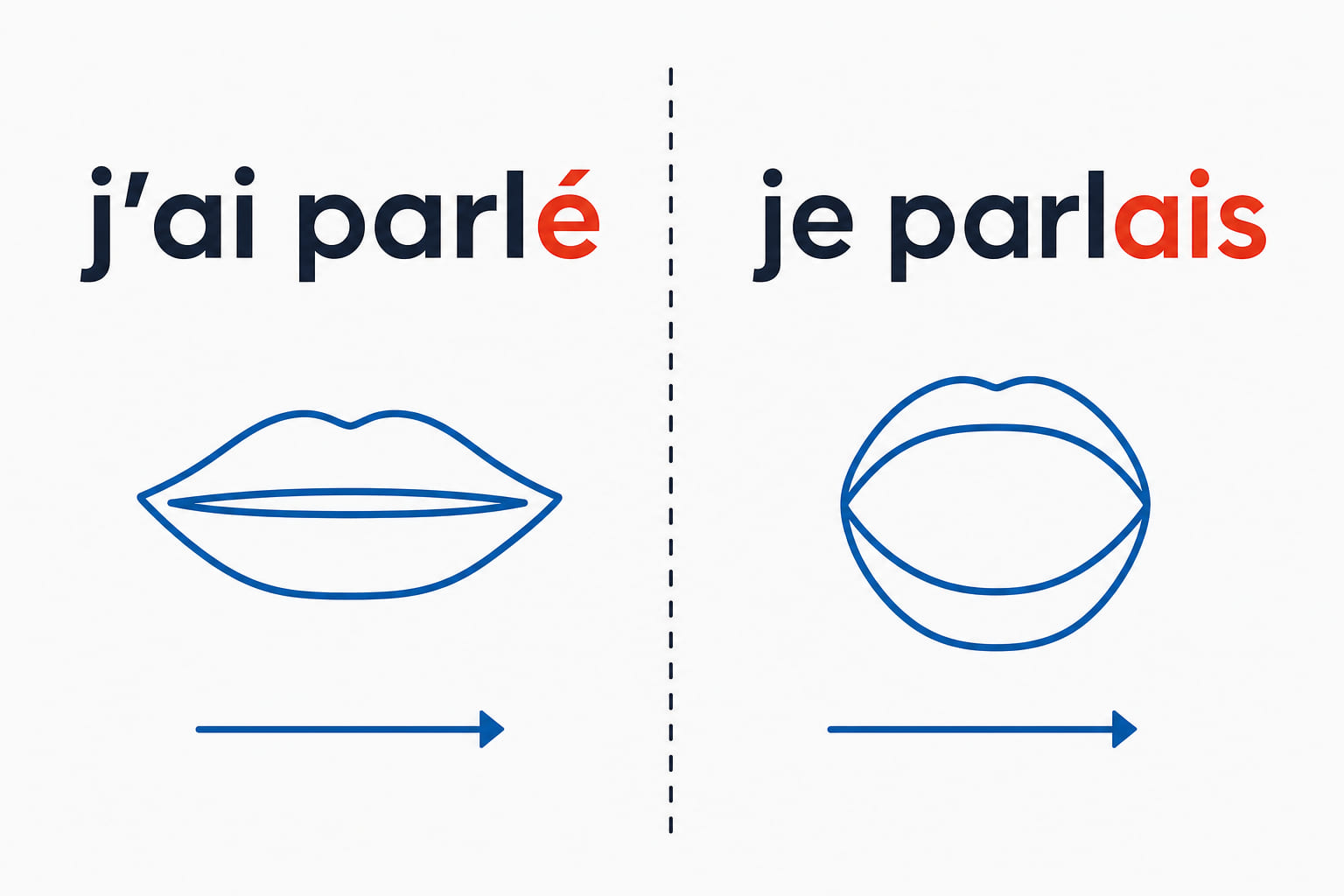
é is /e/ — mouth almost closed, tongue high, and the sound never moves while you hold it. è and ê are both /ɛ/ — the vowel of English bed, jaw dropped. Three accents, two sounds.
Everything below is either a consequence of that line or a drill for it.
"Ay as in say" is the instruction that breaks it
Every beginner course glosses é as ay, as in say. That gloss does more damage than no gloss at all.
English say is not one vowel. It is a diphthong: the vowel starts in one place and slides upward into an ee while you are still holding it. Say say slowly, stretch it out, and you can feel your tongue climbing at the end. Same in day, pay, café when an English speaker says it.
French é does not climb. It is set in one position and it stays there for the entire length of the vowel. Café held for three seconds is ka-fé-é-é-é, one unchanging sound. An English speaker holding the same word produces ka-fay-ee-ee-ee, and by the second beat has arrived at a completely different vowel.
This is the error that outlives all the others. You can have the right accent, the right gender, the right tense, and still be instantly placeable as an English speaker on the word été, because you are producing two vowels where French has one.
The freeze test. Say café and hold the final vowel for three full beats. Wherever your tongue lands on beat one, it has to stay for beats two and three. If you hear the sound brighten toward ee at any point, you glided.
The jaw test — é against è
Now the contrast itself. These are two separate vowels, not one vowel wearing different hats.
| é — /e/ | è and ê — /ɛ/ | |
|---|---|---|
| Jaw | nearly closed | drops open |
| Tongue | high and forward, tense | mid, relaxed |
| Lips | spread, corners pulled back | neutral |
| Nearest English | the start of say, with the slide amputated | the vowel of bed |
| Feel | tight, short, bright | looser, slightly longer, darker |
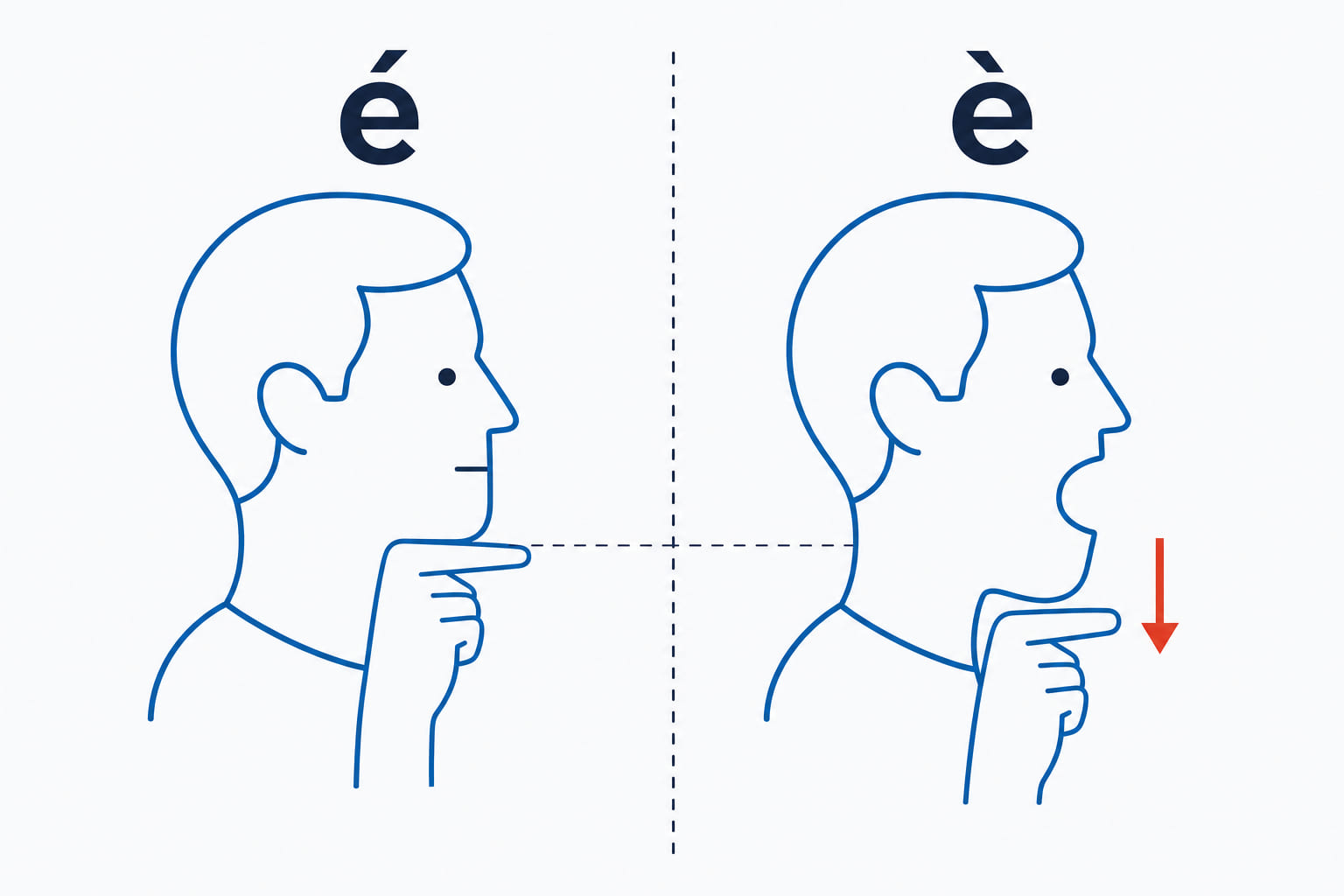
The jaw test. Rest a finger under your chin. Say é — è — é — è, four beats, evenly. Your jaw should push your finger down on every è and come back up on every é. If your finger never moves, you are saying the same vowel four times — which is what most English speakers do without knowing it.
Two things make this hard to self-correct. The movement is small, so it does not feel like a mistake from the inside. And English has no contrast at this spot in the vowel space, so your ear was never trained to file the two apart — it hears both as "the ay-ish one" and stops listening.
ê is not a third sound
In modern French, ê is pronounced exactly like è: /ɛ/. The circumflex is not a pronunciation instruction at all. It is a gravestone. It marks the place where an s used to sit before Old French dropped it, and the English cognate usually still has that s sitting right there.
| Modern French | Older spelling | English cousin with the s intact |
|---|---|---|
| fête | feste | festival, feast |
| forêt | forest | forest |
| bête | beste | beast |
| tête | teste | test, testy |
| fenêtre | fenestre | defenestrate |
| arrêt | arrest | arrest |
| honnête | honeste | honest |
| tempête | tempeste | tempest |
| vêtement | vestement | vestment |
| prêtre | prestre | presbyter |
So when you meet a ê, the useful reading is not "a special vowel" but "there is a missing s here, and the vowel is the open one." Say fête and dès with the identical vowel and you are correct.
The accent is not the rule
Here is the assumption almost every learner carries and almost nobody states out loud: accented e is special, plain e is neutral. It is backwards, and it is the reason reading about this topic never fixes it.
French chooses the vowel by syllable shape, not by accent. A syllable that ends in a consonant sound takes the open /ɛ/. A syllable that ends in its vowel takes the closed /e/. Phonologists call this the loi de position, and the written accent is only added where the spelling would otherwise leave it ambiguous.
Which means enormous numbers of /ɛ/ words carry no accent at all — the consonant right after the e already closes the syllable, so no mark is needed:
mer, cher, hiver, fer, sept, sec, bec, avec, chef, sel, quel, elle, belle, terre, verre, guerre, cette, veste, reste, perdre, merci, servir
Every one of those is /ɛ/. Not a grave accent among them. And the traffic runs the other way too: word-final -er and -ez are /e/ with nothing written on them either — parler, aimer, chanter, allez, avez, chez, nez.
So the accents are a partial subtitle, not the audio track. You cannot read them off the page and expect the sound to follow.
This is also why the accent appears to wander when you conjugate a verb. It is not wandering; it is reporting.
| Infinitive — open syllable, /e/ | Conjugated — closed syllable, /ɛ/ |
|---|---|
| espérer | j'espère |
| préférer | je préfère |
| répéter | je répète |
| céder | je cède |
| compléter | je complète |
In es-pé-rer the middle syllable ends on its own vowel, so it closes to /e/ and gets an é. In j'es-père the ending collapses and that syllable now ends on the r, so it opens to /ɛ/ and the mark switches to è. The accent follows the sound. The sound follows the syllable. Nobody consulted the spelling.
Where the contrast actually costs you something
Inside a word, the loi de position mostly decides for you and there is not much to get wrong. The contrast earns its keep at the end of a word, in an open syllable, where both vowels are legal and only one is right. That is where French keeps its minimal pairs.
| Ending | Sound | Examples |
|---|---|---|
| -é, -ée, -és, -ées | /e/ | parlé, année, café, blé |
| -er (infinitive) | /e/ | parler, aimer, manger |
| -ez | /e/ | parlez, avez, chez, nez |
| -ai (future, and j'ai) | /e/ | j'ai, je serai, j'irai |
| -ais, -ait, -aient (imperfect, conditional) | /ɛ/ | parlais, parlait, serais |
| -et | /ɛ/ | poignet, bonnet, jouet |
| -ès, -êt | /ɛ/ | après, dès, prêt, forêt |
| -ait, -aie, -ais (nouns) | /ɛ/ | lait, plaie, jamais, mais |
Read that table one more time with tenses in mind. Parlé is /e/ and parlais is /ɛ/. Je serai is /e/ and je serais is /ɛ/. The entire difference between "I spoke" and "I was speaking", and between "I will be" and "I would be", is which of these two vowels comes out of your mouth. There is no other cue. No extra syllable, no consonant, no stress shift. One vowel, carrying a whole tense on its back.
That is why this topic does not yield to reading. You already know the rule. The question is whether your mouth makes two different sounds, and you are the one person who cannot hear the answer.
Drill 1 — 15 words, one frozen vowel
Say each word, then hold its final é for two full beats. The vowel must not drift. In the third column, É written twice means the same unchanging sound, not a long ay.
| Word | Meaning | Say it |
|---|---|---|
| été | summer / been | é-TÉ — two identical vowels, neither moving |
| café | coffee | ka-FÉ |
| thé | tea | TÉ — no h, no glide |
| blé | wheat | BLÉ |
| clé | key | KLÉ |
| marché | market | mar-CHÉ |
| santé | health | sahn-TÉ |
| beauté | beauty | bo-TÉ |
| vérité | truth | vé-ri-TÉ — three vowels, two of them identical |
| journée | day | joor-NÉ — the final e adds nothing |
| année | year | a-NÉ |
| fatigué | tired | fa-ti-GÉ |
| désolé | sorry | dé-zo-LÉ |
| préféré | favourite | pré-fé-RÉ — three in a row, all the same |
| aéroport | airport | a-é-ro-POR |
Préféré is the one to record. Three /e/ vowels in one word, and if any of them glides, all three usually do.
Drill 2 — 20 minimal pairs
Say each row across, not down the columns. The mouth has to switch on every row, which is the point. Nothing else about the two words should differ: same speed, same volume, same length. Only the jaw moves.
| /e/ — jaw up | /ɛ/ — jaw down |
|---|---|
| et — and | est — is |
| les — the | lait — milk |
| des — some | dès — as of |
| ses — his, her | c'est — it is |
| fée — fairy | fait — fact |
| pré — meadow | prêt — ready |
| épée — sword | épais — thick |
| poignée — handle | poignet — wrist |
| né — born | naît — is born |
| thé — tea | taie — pillowcase |
| gué — ford | guet — lookout |
| parlé — spoken | parlais — was speaking |
| chanté — sung | chantait — was singing |
| mangé — eaten | mangeait — was eating |
| allé — gone | allait — was going |
| été — been | était — was |
| donné — given | donnait — was giving |
| aimé — loved | aimait — used to love |
| je serai — I will be | je serais — I would be |
| j'irai — I will go | j'irais — I would go |
The first four rows are the highest-frequency words in the language. Et and est alone show up in nearly every French sentence you will ever hear, and they are separated by exactly one jaw position.
Drill 3 — 10 sentence pairs where the vowel is the grammar
Say both halves of each row. Everything is identical except one vowel — and that vowel is carrying the tense.
| Finished — /e/ | Ongoing or hypothetical — /ɛ/ |
|---|---|
| J'ai parlé au directeur. | Je parlais au directeur. |
| J'ai travaillé ici. | Je travaillais ici. |
| J'ai mangé à midi. | Je mangeais à midi. |
| Il a chanté toute la nuit. | Il chantait toute la nuit. |
| Tu as regardé la télé. | Tu regardais la télé. |
| Elle a écouté la radio. | Elle écoutait la radio. |
| On a dîné tard. | On dînait tard. |
| J'ai pensé à toi. | Je pensais à toi. |
| Je serai là demain. | Je serais là demain. |
| J'irai avec toi. | J'irais avec toi. |
The last two rows are worth sitting with. Je serai là demain is a promise. Je serais là demain is a condition waiting for the rest of its sentence. One is a commitment and the other is a hedge, and a French listener sorts them on a single vowel.
A real conversation
Léa : Tu as réservé, finalement ?
Thomas : J'ai réservé hier. Près du marché, le café que je préférais quand j'étais étudiant.
Léa : C'était après la forêt, non ?
Thomas : Après la fenêtre bleue. J'y allais tous les étés.
Léa : Et c'est à quelle heure ?
Thomas : Treize heures. Tout est prêt.
Léa : Tu es sûr ? Tu répètes ça depuis une semaine et tu te trompais à chaque fois.
Thomas : Cette fois, j'ai noté. Si je me trompais encore, je paierais l'addition.
Léa : Ça, je l'ai déjà entendu.
Read it out loud and watch the vowel alternate. Closed /e/: réservé, marché, café, étudiant, les étés, j'ai noté, déjà. Open /ɛ/: c'était, forêt, fenêtre, après, allais, quelle, est, prêt, es, trompais, paierais.
Three lines are worth isolating. "Et c'est à quelle heure ?" puts et /e/ and c'est /ɛ/ back to back — the first pair of Drill 2, live in a sentence nobody planned around it. "que je préférais" carries all three positions inside one word: pré- /e/, -fé- /e/, -rais /ɛ/, and the jaw has to drop only on the last one. And Thomas's final line runs the tenses against each other: si je me trompais /ɛ/ and je paierais /ɛ/, both hypothetical and both open, against j'ai noté /e/, finished and closed.
Frequently asked questions
Is ê really the same sound as è?
In standard metropolitan French, yes — both are /ɛ/, and you should target them as one sound. The circumflex is etymological: it marks where an s dropped out, which is why forêt has a forest on the other side of the Channel. You may hear a longer, slightly drawled ê in careful older Parisian speech, and Quebec French does keep a distinctly longer and diphthongised ê. Neither is something to imitate while you are building the basic contrast.
Do French people actually distinguish parlé from parlais?
In Paris and the northern half of France, yes — /e/ and /ɛ/ are separate phonemes, and pairs like fée against fait prove it. In the southern half of France the opposition has been lost and the two sounds occur only in complementary distribution, so a speaker from Toulouse may well produce them the same way.
That regional split is real, and it is not a reason to skip the contrast. Aim for it anyway, for three reasons. It is the reference standard your listening material uses. It costs you nothing in the south, where nobody is listening for the difference. And the failure mode runs one way only: if you merge them and your listener distinguishes them, every imperfect you say arrives ambiguous.
Why does the accent move — espérer but j'espère?
Because the accent is reporting the sound, and the sound is set by the syllable. Es-pé-rer has that middle syllable ending on its own vowel, so it takes the closed /e/ and gets an é. J'es-père ends that syllable on the r, which opens it to /ɛ/, so the mark changes to è. Every verb in this family behaves the same way: préférer / je préfère, répéter / je répète, céder / je cède.
Can an e with no accent be /e/ or /ɛ/?
Constantly — this is the part that surprises people. Mer, sept, avec, elle, quel, veste are all /ɛ/ with nothing written. Parler, aimer, allez, chez, nez are all /e/ with nothing written. Accents are added where the spelling needs disambiguating, not wherever the sound occurs. Treating an unaccented e as automatically neutral is one of the most common sources of a flat, wrong vowel.
What about ë?
The tréma is not a vowel-quality mark at all. It says: pronounce this letter separately from the one before it, do not merge them into a single sound. Noël is two syllables, no-ÈL, not a woa sound. Israël, Citroën, Gaël work the same way. The e underneath is still the ordinary open /ɛ/.
Related lessons
- The Disappearing E: Why "Je ne sais pas" Becomes "Chais pas" — the third e, the one with no accent and no sound at all.
- How to Tell If Your French Accent Is Actually Good — the pure-vowel self-test, and the five other things English ears miss.
- Le Héros vs L'Homme: The Aspirated H, Drilled — another rule you already know on paper and lose in the mouth.
- Enchaînement: Why Your French Sounds Choppy — what happens to these vowels once words start linking.
Practise it out loud
You now have the rule, and the rule was never the bottleneck. Two things stand between you and the contrast, and neither of them is knowledge.
The first is that the movement is tiny. A few millimetres of jaw, held for a fraction of a second, at the very end of a word where your attention has already moved on to the next sentence.
The second is worse: you cannot hear it in your own mouth. Your ear filters your French through the English vowel inventory it was built on, and English has no slot for this contrast. So it rounds both sounds to the nearest thing it knows, hands you back "that sounded fine", and you carry the merge into every imperfect you speak for the next two years.
So run Drill 2 across, out loud, with a finger under your chin — the finger is doing what your ear cannot. Et, est. Les, lait. Parlé, parlais. If the jaw does not move, the vowel did not change, whatever it sounded like from the inside.
That gap between what you produce and what you can perceive is exactly what Simply French was built to close: fifteen minutes a day of native-speed listening, speaking drills, and instant AI pronunciation scoring that tells you which vowel you actually said — not which one you meant. Start your free 7-day trial and run these twenty pairs until your jaw does it without being asked.
À vous de parler.
Tags
Now find out how you actually sound.
Simply French listens to you say each sentence and scores it word by word, so you can hear the difference you have just read about — and fix it while it is still fresh.
Takes about 10 minutes. No card needed to start.
Related Articles
ILLE Pronunciation in French: Why Fille and Ville Do Not Rhyme
You were told to memorise four exceptions. The real rule is in the letter before the ILL, not the ILL itself - and half the exception lists online are out of date. Three categories, the Academie's own short list, and 20 words to say out loud.
French S vs Z: Poisson or Poison, Drilled on 20 Pairs
One S between two vowels is /z/. Two S's are /s/. English trained you to do the opposite in exactly the word where it matters most - dessert. The rule, the boundary exceptions nobody teaches, and 20 pairs to say out loud.
The French R for English Speakers: 12 Words, 5 Minutes a Day
Stop gargling. The French R is made exactly where you say the G in get - and the reason yours is not working is the tip of your tongue. Build it in four steps, then drill 12 words, three weights of R, and 10 sentences.