
The French R for English Speakers: 12 Words, 5 Minutes a Day
Stop gargling. The French R is made exactly where you say the G in get - and the reason yours is not working is the tip of your tongue. Build it in four steps, then drill 12 words, three weights of R, and 10 sentences.
Simply French Team
Somebody told you the French R is like gargling water. You have been standing at a sink for three weeks. It still is not working.
It is not working because gargling is not the sound. Gargling is a way of finding the place, and once you have found it the water is not only unnecessary, it is actively misleading — it teaches you to make a loud, wet, rattling noise, and the real French R is quieter than the vowel next to it.
There is a much better starting point, and you already use it about fifty times a day.

The rule, in one line
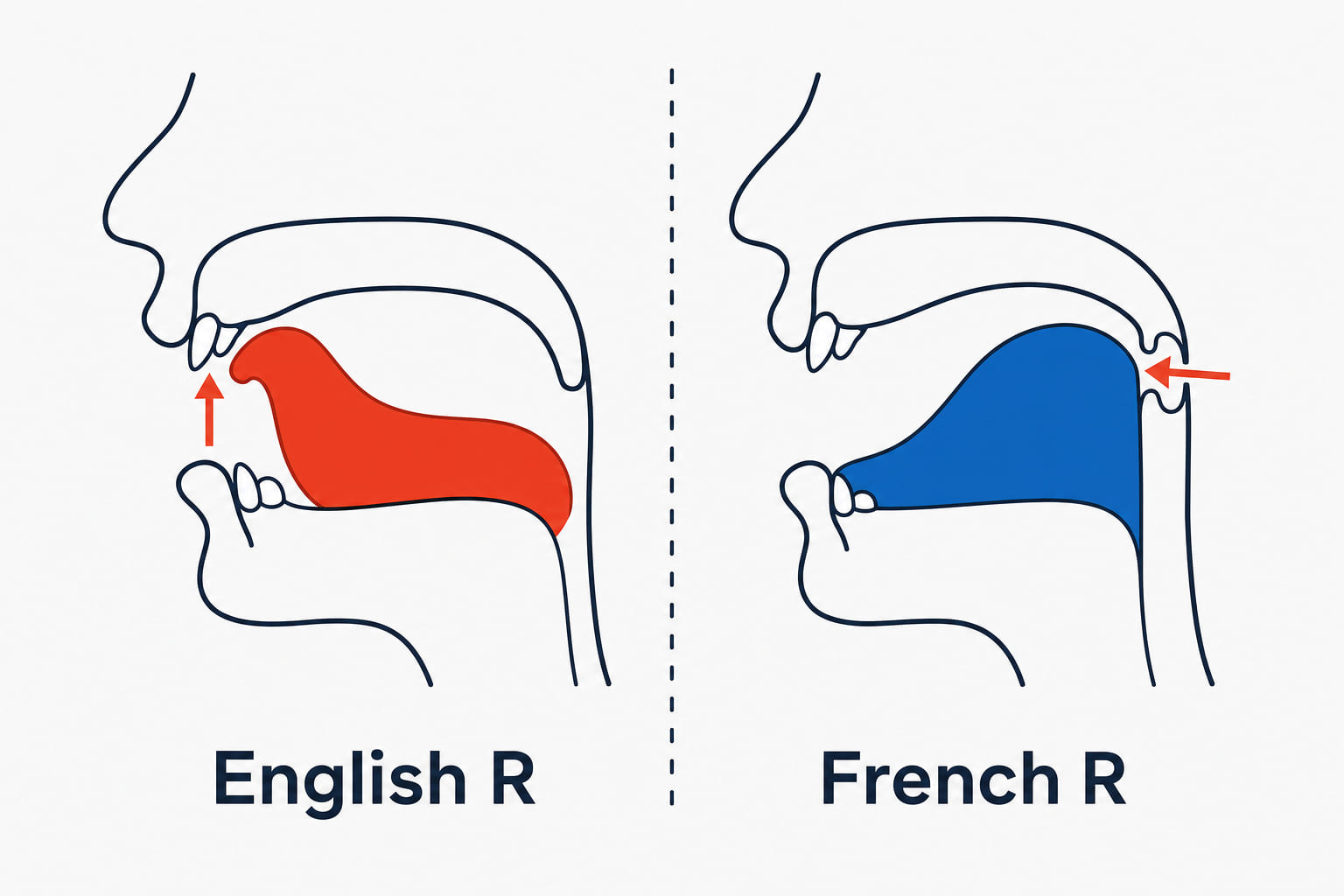
The French R is made where you say the G in "get" — you just do not close all the way.
The technical name is a voiced uvular fricative, written /ʁ/. The back of your tongue rises toward the uvula, the soft flap hanging at the back of your mouth, and air squeezes through the gap. Not the throat. Not the vocal cords. The back of the tongue.
And note what is not in that description: the tip of your tongue. It has no job here at all.
Why your English R is the thing standing in the way
English /ɹ/ and French /ʁ/ share a letter and nothing else. They are made at opposite ends of the mouth, and every feature English gives you is a feature French has to strip out.
| English R /ɹ/ | French R /ʁ/ | |
|---|---|---|
| Where | front — just behind the ridge | back — at the uvula |
| Tongue tip | raised, curled back, or bunched | down, resting behind the lower teeth |
| Lips | usually rounded | not rounded |
| The vowel before it | gets coloured by the R | stays completely untouched |
That last row is the one people miss. In American English the R reaches backwards and swallows the vowel in front of it — her, bird, more are a single r-coloured smear. French does not do this. Mère is /mɛʁ/ — a clean /ɛ/, then a separate consonant. Two things in a row, not one thing.
So when you say mère with an English R, two errors happen at once: the consonant is in the wrong place, and the vowel before it is destroyed on the way. Fixing the R fixes the vowel for free.
The tip of the tongue is the practical blocker. As long as it is lifting, the back of your tongue cannot get where it needs to go — they are the same muscle. Park the tip and half the problem disappears.
Building it in four steps
- Say "aga", slowly. Ah-gah. Feel where the back of your tongue hits the roof of your mouth on the G. That contact point is the neighbourhood. You are already there.
- Now park the tip. Press the tip of your tongue against the back of your bottom front teeth and leave it there. It does not move again for the rest of this exercise.
- Say "aga" again — but do not let the back of the tongue touch. Bring it close, leave a gap, and push air through. Instead of a clean g you get a soft scraping. That scraping is /ʁ/.
- Keep your voice on. Put a hand flat on your throat. If it is not buzzing you have made the voiceless version, which is a real French sound but not the one you want yet.
Finger test. Put one finger under your chin and say rouge, then rue, then robe. Your chin and jaw should barely move, and the finger should feel nothing pushing down. If your jaw drops or your tongue tip lifts off your bottom teeth, you have reverted to English. Reset and start from aga again.
If that four-step sequence feels familiar, it is the same trick used to build the UI sound in lui and huit: take a position you already own, hold one part still, and change one other thing.
The part nobody teaches: R has three weights
This is where most learners get stuck after the sound itself is working. They build one R — usually a heavy one — and then apply it everywhere, and the result sounds like a foreigner performing Frenchness.
The R changes weight depending on what is next to it.
| Weight | Where | Examples |
|---|---|---|
| Heavy, no voice [χ] | next to a voiceless consonant, or at the end of a phrase | trois · propre · quatre · être |
| Full, voiced [ʁ] | at the start of a word, or after a voiced consonant | rouge · rue · grand · bras |
| Light, almost a vowel | between two vowels | Paris · arrêt · mari |
The devoicing is documented, not a stylistic choice: French /ʁ/ has a voiceless variant next to voiceless obstruents and at the end of a sentence. It is why trois sounds scratchier than rouge to your ear even though the letter is the same.
And the light one matters most for sounding normal. Between vowels the R weakens almost to a vowel itself. Paris is not Pa-KHHH-ris. If every R in your French is a performance, that is the tell.
Drill 1 — Twelve words, R at the front
Start here every day. Twelve words, one minute. The R is in the easiest possible position — nothing before it to interfere.
| Word | IPA | Meaning |
|---|---|---|
| rue | /ʁy/ | street |
| riz | /ʁi/ | rice |
| rouge | /ʁuʒ/ | red |
| robe | /ʁɔb/ | dress |
| rire | /ʁiʁ/ | to laugh (two of them) |
| raison | /ʁɛ.zɔ̃/ | reason |
| radio | /ʁa.djo/ | radio |
| rond | /ʁɔ̃/ | round |
| retard | /ʁə.taʁ/ | lateness (two again) |
| répéter | /ʁepete/ | to repeat |
| regarder | /ʁəɡaʁde/ | to look at (three) |
| rarement | /ʁaʁ.mɑ̃/ | rarely (two) |
Rire is the checkpoint word. Two R's, one vowel between them, and the second one is at the end of the word so it devoices. Same letter, two different weights, in three sounds.
Drill 2 — R inside a cluster
Here the R has to follow another consonant without your tongue tip sneaking up to help. Say each column top to bottom.
| Voiceless — R goes heavy | Voiced — R stays full |
|---|---|
| trois /tʁwa/ — three | grand /ɡʁɑ̃/ — big |
| train /tʁɛ̃/ — train | gros /ɡʁo/ — fat |
| prix /pʁi/ — price | bras — arm |
| croissant /kʁwa.sɑ̃/ — croissant | drôle — funny |
| France /fʁɑ̃s/ — France | vrai — true |
| très /tʁɛ/ — very | brun — brown |
Croissant deserves a mention. That word stacks the cluster /kʁw/ on top of everything else, which is why it is the single most reliably mangled French word in English. It has its own page if you want to take it apart properly.
Drill 3 — R after the vowel
This is where English does the most damage, because this is where English R reaches back and colours the vowel. Say each one and listen for whether the vowel survives intact.
mère /mɛʁ/ · père /pɛʁ/ · heure /œʁ/ · tour /tuʁ/ · pour /puʁ/ · sur /syʁ/ · jour /ʒuʁ/ · bonjour /bɔ̃.ʒuʁ/ · merci /mɛʁsi/ · parler /paʁ.le/ · mardi /maʁ.di/ · garçon /ɡaʁ.sɔ̃/ · arbre /aʁbʁ/
The vowel test. Say mère, then stop dead before the R — just mè. Then say the R on its own. Then put them back together without letting them blend. If the full word sounds different from the two halves, the R is bleeding backwards and you are still speaking English.
Sur and pour are also the /y/ versus /u/ contrast, which is a separate fight worth having on its own.
The R you are allowed to drop
Good news to end the drilling on. In quatre, notre, autre, lettre, propre, livre — consonant plus R plus a silent E — native speakers routinely do not say the R at all.
This is not slang. In a study of casual Parisian speech, at least one phoneme was missing from 80.7% of these word-final clusters, and the R itself was absent in 42.9% of tokens. Quatre comes out [kat]. Notre comes out [nɔt].
So: quatre heures keeps the R because a vowel follows it. Quatre jours usually does not. You are not being lazy; you are doing what the corpus says people do. The dropping is part of the same compression covered in T'as, Y'a, Chuis.
Drill 4 — Ten sentences
Normal speed. Do not honour every R equally — let the weights be different.
- Bonjour, je voudrais un café. — Hello, I would like a coffee.
- Trois rues plus loin, à droite. — Three streets further, on the right.
- Ma mère et mon père arrivent mardi. — My mother and father arrive on Tuesday.
- Il préfère le rouge au rose. — He prefers red to pink.
- Quatre heures pour parler français. — Four hours to speak French.
- Regarde, le train arrive. — Look, the train is coming.
- C'est un très gros problème. — That is a very big problem.
- Je rentre rarement avant le dîner. — I rarely get home before dinner.
- Le prix du croissant a encore augmenté. — The price of the croissant has gone up again.
- Un autre verre de vin rouge, s'il vous plaît. — Another glass of red wine, please.
Sentence 10 has five R's in eight words, at three different weights. If they all came out identical, go back to the weights table.
In conversation
Serveuse : Bonjour ! Vous désirez ?
Vous : Bonjour. Un café et un croissant, s'il vous plaît.
Serveuse : Très bien. Sur place ou à emporter ?
Vous : Sur place. Je reste une heure ou deux, je travaille.
Serveuse : Pas de problème. La prise est derrière vous.
Vous : Parfait, merci beaucoup.
Serveuse : Je vous apporte ça tout de suite.
Seven lines, twenty-one R's. That is not a constructed example — that is the density of R in ordinary French, which is why this one consonant is worth more of your time than any other.
FAQ
Should I roll it like Spanish?
No. The rolled apical R was standard French once, but it started being replaced from the end of the seventeenth century. Today it survives mainly with older and rural speakers, and in classical singing and opera. If you roll it, you will sound like a recording from 1930 — charming, but not modern.
My throat hurts after practising.
You are pushing far too hard. The French R between vowels is softer than the vowels around it. If you are producing something that could be heard across a room, you have built the heavy voiceless version and are using it everywhere. Go back to step 3 and use less air.
Why does my R disappear when I speak fast?
Often it is supposed to — see the section above on quatre and notre. But if it is disappearing at the start of words too, the back of your tongue is not making the gap, and the fix is to slow down to aga speed for a few days.
Is Quebec French different?
Yes, noticeably. Quebec has a wide range of R sounds depending on region, age and register, with the uvular one now most common but a trill still frequent in clusters. If your target is Quebec, get a Quebec model. If your target is France, ignore this.
Some dictionaries write /ʀ/ instead of /ʁ/. Is that a different sound?
No. It is an older notation convention for the same phoneme. Do not read it as an instruction to trill.
The part you can't do alone
Here is the trap with this consonant specifically. Your ear cannot tell you where your tongue is.
You can feel that something is happening at the back of your mouth, and your brain accepts it as an R because you meant it as an R. Meanwhile the actual output might be a velar scrape, a devoiced rasp on every single R, or an English R with a French accent painted on top. All three feel identical from the inside, and all three are immediately audible to a French speaker.
This is a hardware problem, not a discipline problem, and the fix is an outside ear.
Say the twelve words in Drill 1 into Simply French and get each one scored the moment you say it — with the R marked as too heavy, too light, or in the wrong place. Fifteen minutes a day, free for seven days.
Keep going
- Lui vs Louis, Huit vs Oui: The French UI Sound, Drilled — the same build-from-a-sound-you-own method, on a glide
- You're Saying "Croissant" Wrong — the hardest R cluster in the language, taken apart
- T'as, Y'a, Chuis: Say Spoken French the Way It's Actually Said — what else falls off when French speeds up
- You're Stressing the Wrong Syllable — the layer above the consonants
- How to Tell If Your French Accent Is Actually Good — a self-test that includes the R
- French U vs OU Pronunciation Practice — sur/sourd, pur/pour, rue/roue: the vowels sitting next to the R
- French Nasal Vowels AN EN ON IN — rond, grand, train, croissant: the R plus the vowel it lands on
Tags
Now find out how you actually sound.
Simply French listens to you say each sentence and scores it word by word, so you can hear the difference you have just read about — and fix it while it is still fresh.
Takes about 10 minutes. No card needed to start.
Related Articles
French U vs OU Pronunciation Practice: 20 Minimal Pairs, Scored
Everyone tells you the French u is hard. Nobody tells you your ou is wrong too - English GOOSE is fronted and diphthongal, so you are missing both vowels. Build them separately, then drill 20 minimal pairs out loud.
French S vs Z: Poisson or Poison, Drilled on 20 Pairs
One S between two vowels is /z/. Two S's are /s/. English trained you to do the opposite in exactly the word where it matters most - dessert. The rule, the boundary exceptions nobody teaches, and 20 pairs to say out loud.
French Nasal Vowels AN EN ON IN: Practice Without Pronouncing the N
In a French nasal vowel the N is not a sound - it is a spelling instruction, and your tongue must never touch the roof of your mouth. The three sounds, the true minimal triples, the denasalization pairs that prove it, and 10 sentences.