
You're Stressing the Wrong Syllable: 20 French Phrases, Scored
English puts a stressed beat inside every word. French puts one at the end of the whole phrase — and makes it with length, not volume. The rule, the 12 words English speakers get wrong, and 8 phrases to say out loud.
Simply French Team
You have probably been told that French is flat, or that it has no stress. Both are wrong, and believing either one is a good way to sound foreign in French even when every individual sound you make is correct.
French has stress. It just does not put it where English puts it.

In English, the stress lives inside the word: PHO-to, im-POR-tant, CHOC-o-late. You cannot move it — PHO-to and pho-TO are one right and one wrong. In French, the stress lives at the end of the phrase, and nowhere else. So when you say a French word with an English stress pattern, you have not made a small accent slip. You have put a beat in a place French never puts one, and your listener has to stop and re-parse.
The rule, in one line
French stress falls on the last syllable of a group of words — not inside individual words — and it is made by holding that syllable longer, not by saying it louder.
Two halves, and English speakers usually break both.
Where the beat goes
French groups words into short chunks of meaning — a noun and its adjectives, a verb and what follows it, a prepositional phrase. Up to about seven syllables. Every syllable inside the chunk gets the same weight, and then the last one gets stretched.
Watch what happens to the same word as the chunk grows:
| You say | The beat lands on |
|---|---|
| un chocolat | cho-co-LAT |
| un chocolat chaud | un cho-co-lat CHAUD |
| un chocolat chaud, s'il vous plaît | …s'il vous PLAÎT |
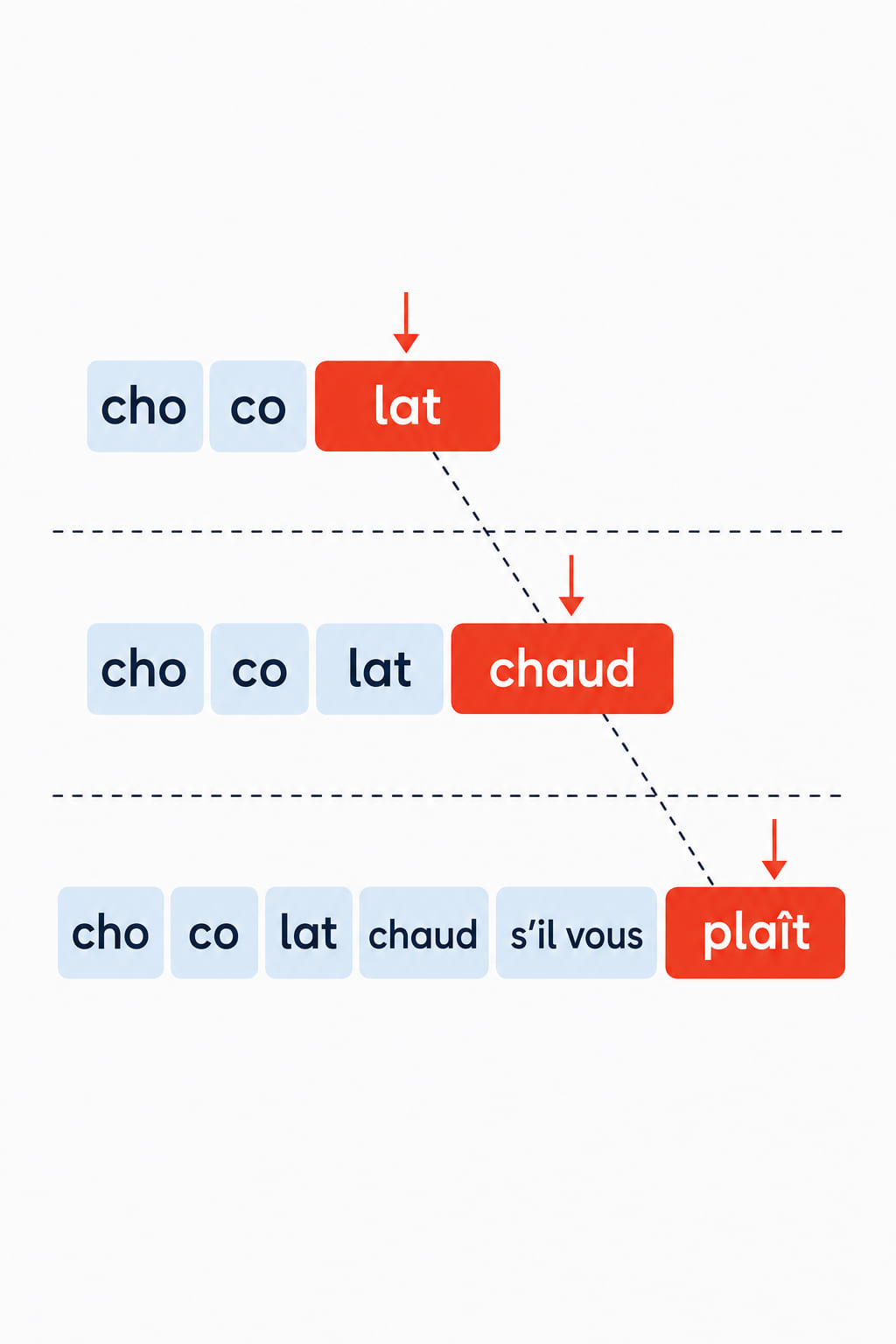
Chocolat did not change its pronunciation. It stopped being the end of the chunk, so it lost its beat. Nothing in English works like this, which is why the habit is so hard to spot in yourself.
Habit 1 — you stress the wrong syllable in words you already know
The worst offenders are the words you are most confident about: the ones French and English share. Your mouth reaches for the English shape automatically.
| Word | What English does | Say this instead |
|---|---|---|
| important | im-POR-tant | im-por-TANT |
| chocolat | CHOC-o-late | cho-co-LAT |
| restaurant | RES-tau-rant | res-tau-RANT |
| hôpital | HOS-pi-tal | ho-pi-TAL |
| télévision | TEL-e-vi-sion | té-lé-vi-SION |
| université | u-ni-VER-si-ty | u-ni-ver-si-TÉ |
| cinéma | CIN-e-ma | ci-né-MA |
| animal | AN-i-mal | a-ni-MAL |
| message | MES-sage | me-SSAGE |
| orange | OR-ange | o-RANGE |
| adresse | AD-dress | a-DRESSE |
| nature | NA-ture | na-TURE |
That is Drill 1. Say each one twice — the English way first, so you can hear what you have been doing, then the French way.
Habit 2 — you swallow the syllables that are not stressed
This one does more damage than the first, and almost nobody mentions it.
English pays for its strong stressed syllables by starving the others. The unstressed vowels collapse into a vague uh: CHOC-uh-lut, im-POR-tnt. French does not do this. Every vowel keeps its full quality, right through to the end of the word.
So possibilité is not puh-si-bi-li-TAY. It is po-ssi-bi-li-TÉ — five clean, evenly-sized beats, and only the last one is held. If you fix your stress placement but keep reducing the other vowels, you will still sound foreign, because four fifths of the word is still mush.
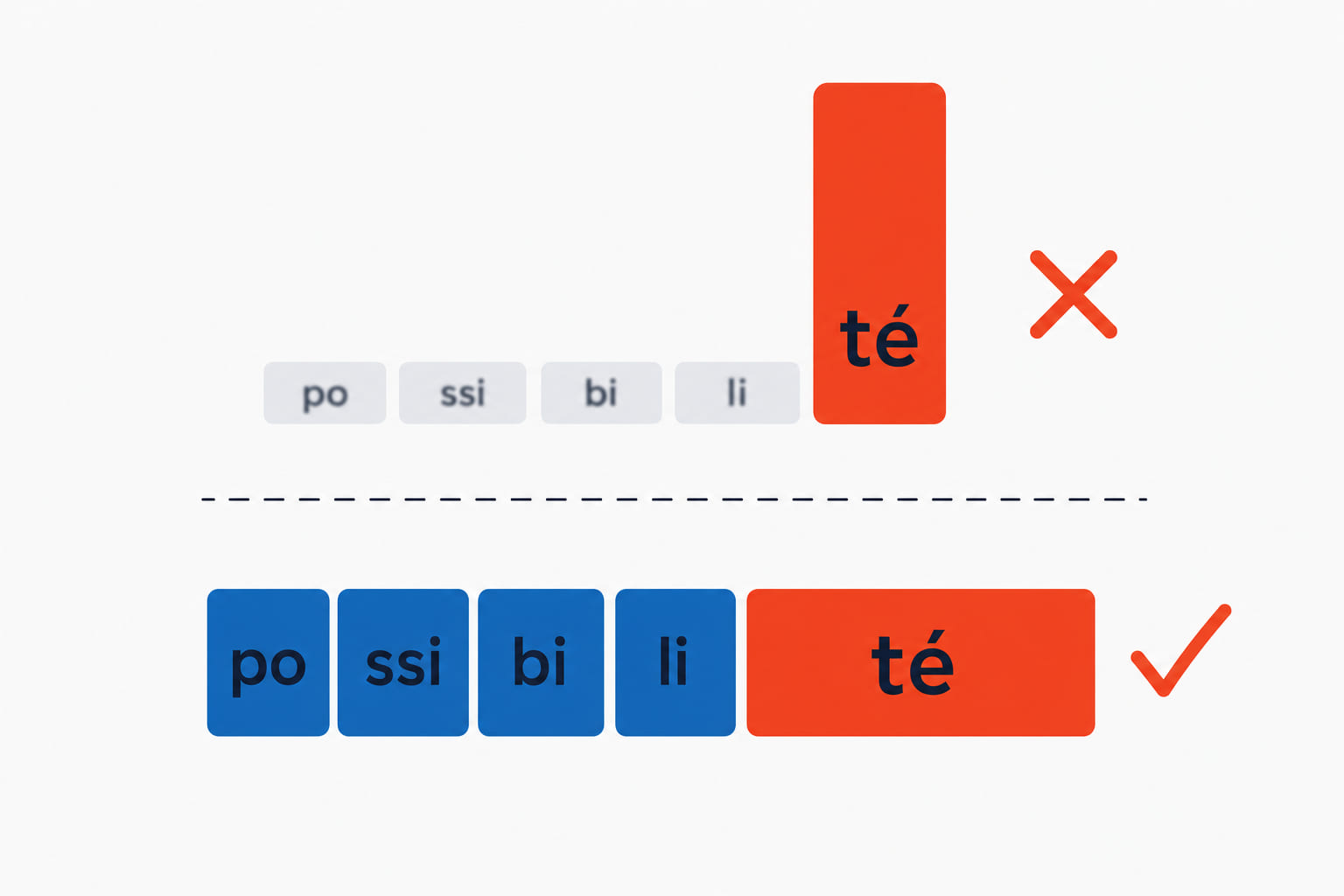
Hold it, don't hit it. The French final beat is roughly twice as long as the others, not twice as loud. English speakers who over-correct by punching the last syllable end up sounding angry or theatrical. Stretch the vowel and let the volume stay flat.
Drill 2 — 8 phrases, watch the beat move
Say each pair back to back. The first word does not change; only the location of the beat does.
| Phrase | One beat, here |
|---|---|
| C'est important. | C'est im-por-TANT |
| C'est très important. | C'est très im-por-TANT |
| Un chocolat. | Un cho-co-LAT |
| Un chocolat chaud. | Un cho-co-lat CHAUD |
| À l'hôpital. | À l'ho-pi-TAL |
| Je vais à l'hôpital. | Je vais à l'ho-pi-TAL |
| Le restaurant. | Le res-tau-RANT |
| Le restaurant est fermé. | Le restaurant est fer-MÉ |
Twelve words and eight phrases: twenty things to say out loud, and not one of them asks you to learn a new sound. Only a new place to put the beat.
A real conversation
Léa : Tu viens au restau-RANT ce soir ?
Tom : Je ne peux PAS. J'ai un examen de-MAIN.
Léa : À l'universi-TÉ ?
Tom : Oui. C'est important pour mon dip-LÔME.
Léa : Alors bon cou-RAGE. On y va sans TOI.
Read it out loud once at normal speed. Every bolded syllable is held about twice as long as the ones before it, and everything else stays flat and even. If it feels like you are barely doing anything between the beats, you are doing it right.
Frequently asked questions
Doesn't that make French sound monotone?
It sounds even, not monotone. The pitch does move — it rises or falls on that final syllable, up for a question, down for a statement. The flatness in between is exactly what makes the boundary audible. English does the opposite: movement everywhere, so the ear tracks stressed syllables instead of phrase endings.
What about when French people emphasise a word?
That is a second, separate accent — l'accent d'insistance — and it goes on the first syllable, not the last: c'était GÉ-nial, ce n'est pas MAIN-tenant. It is used for contrast and emotion, and it sits on top of the normal end-of-phrase beat rather than replacing it. Use it sparingly; learners who reach for it constantly sound like they are performing.
How do I know where one group ends and the next begins?
By meaning and by breath. A group is one small unit — le petit chat, dans la cuisine, je ne sais pas — usually under seven syllables. Speak slowly and you will make more, shorter groups, which means more beats; speak quickly and they merge. Both are correct. When in doubt, put the beat where you would naturally pause.
Related lessons
- Enchaînement: Why Your French Sounds Choppy — the other half of French rhythm: what joins the words inside a group.
- How to Tell If Your French Accent Is Actually Good — a six-part self-test, with accent tonique as one of the six.
- The Disappearing E: Why "Je ne sais pas" Becomes "Chais pas" — the vowel that drops out and takes a beat with it.
- Lui vs Louis, Huit vs Oui: The French UI Sound — a sound-level fix, once the rhythm is in place.
Practise it out loud
Stress is the one part of pronunciation you genuinely cannot check by yourself.
Individual sounds you can at least aim at — you can watch your lips in a mirror, you can feel where your tongue is. But the beat of a phrase is something your first language installed before you could read, and it runs underneath your attention. You do not hear yourself stressing IM-por-tant. You hear yourself saying important, and it sounds fine, because to your ear that is what the word is supposed to sound like.
That gap — between the rhythm you produce and the rhythm you can perceive — is exactly what Simply French was built to close: fifteen minutes a day of native-speed listening, speaking drills, and instant AI scoring that tells you which syllable you actually held. Start your free 7-day trial and run those twenty phrases until the beat moves to the end on its own.
À vous de parler.
Tags
Now find out how you actually sound.
Simply French listens to you say each sentence and scores it word by word, so you can hear the difference you have just read about — and fix it while it is still fresh.
Takes about 10 minutes. No card needed to start.
Related Articles
ILLE Pronunciation in French: Why Fille and Ville Do Not Rhyme
You were told to memorise four exceptions. The real rule is in the letter before the ILL, not the ILL itself - and half the exception lists online are out of date. Three categories, the Academie's own short list, and 20 words to say out loud.
French S vs Z: Poisson or Poison, Drilled on 20 Pairs
One S between two vowels is /z/. Two S's are /s/. English trained you to do the opposite in exactly the word where it matters most - dessert. The rule, the boundary exceptions nobody teaches, and 20 pairs to say out loud.
The French R for English Speakers: 12 Words, 5 Minutes a Day
Stop gargling. The French R is made exactly where you say the G in get - and the reason yours is not working is the tip of your tongue. Build it in four steps, then drill 12 words, three weights of R, and 10 sentences.