
French U vs OU Pronunciation Practice: 20 Minimal Pairs, Scored
Everyone tells you the French u is hard. Nobody tells you your ou is wrong too - English GOOSE is fronted and diphthongal, so you are missing both vowels. Build them separately, then drill 20 minimal pairs out loud.
Simply French Team
You say tu. It comes out tout.
You say au-dessus — above. The other person hears au-dessous — below. Same sentence, opposite instruction, and nobody stops to check.
Every guide will tell you the French u is the hard one. True, and only half the story. The half nobody mentions: your ou is wrong as well, and fixing only the u leaves the pair collapsed from the other side.

The rule, in one line
Both vowels have rounded lips. The difference is entirely where your tongue is.
| Spelling | IPA | Tongue | Example |
|---|---|---|---|
| u, û | /y/ | high and forward | tu /ty/ |
| ou, où | /u/ | high and back | tout /tu/ |
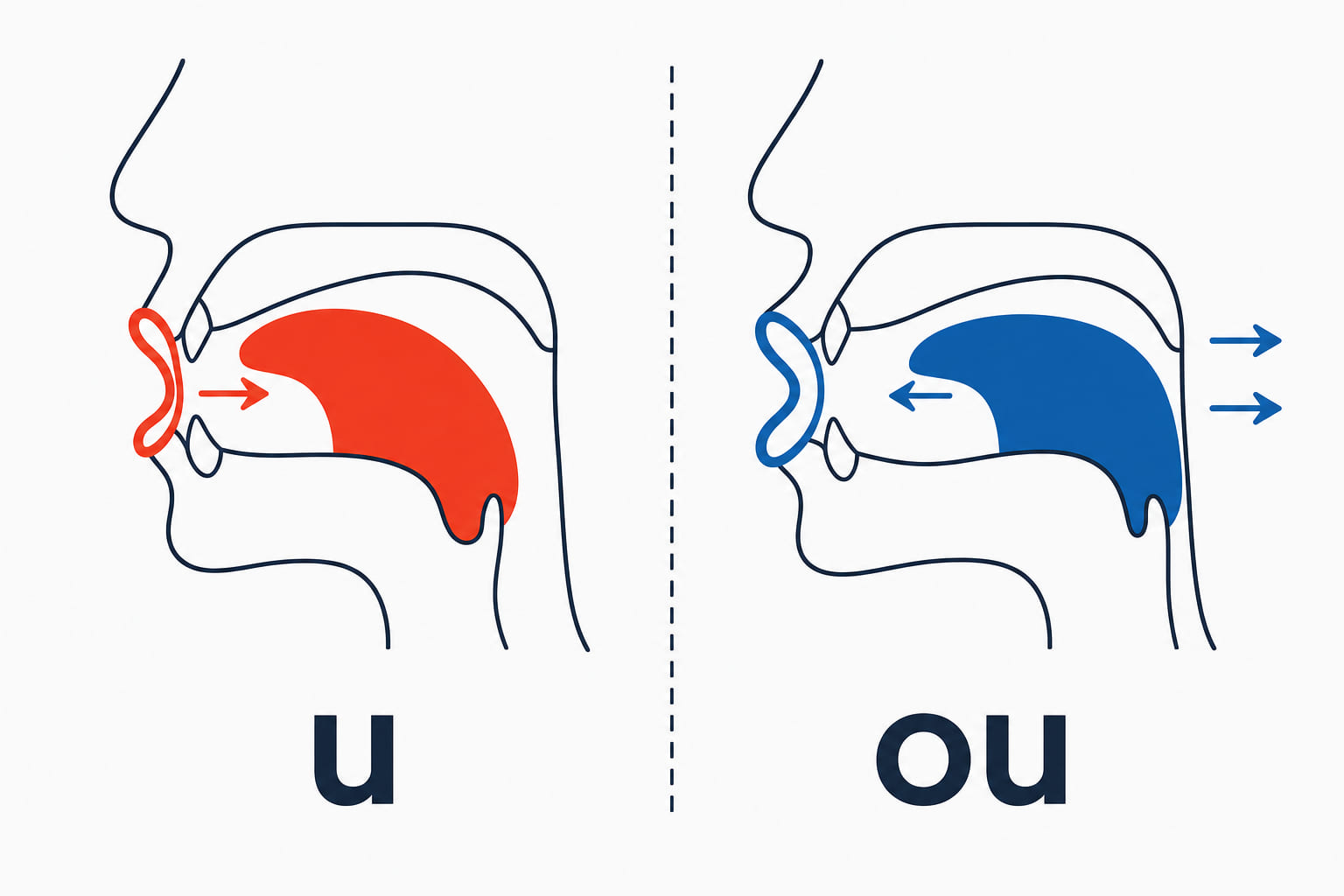
One feature: front or back. That is the whole contrast, and it separates about twenty pairs of everyday words.
Why you are missing both of them
The /y/ problem is the famous one. English has no /y/ — not a close version, not a regional version. It is simply not in the inventory. So your ear files it under the nearest thing it owns, which is the vowel in food, and tu lands on tout.
This is not sloppiness, and there is evidence for that. In a study of English-speaking learners published in Second Language Research, intermediate learners recognising a word containing /y/ were speeded up by having just heard the otherwise identical word containing /u/ — and vice versa. The two vowels were not stored as different sounds in their mental dictionary at all. Advanced learners did encode the contrast, and still mis-categorised it phonetically.
Now the part nobody tells you. You do not have a clean /u/ either.
The English GOOSE vowel is not a pure back [u]. In most modern varieties it is fronted and diphthongal — commonly [ʊu] in British English, and a genuinely central [ʉː] in Australian. GOOSE-fronting has been advancing in Received Pronunciation since the middle of the last century.
So your vous is drifting forward and moving while you say it. It is not landing on French /u/; it is landing somewhere between the two French vowels — which is the worst possible place, near enough to both that neither is clearly signalled.
That is why drilling only the u so often fails. You move /y/ into position, and /u/ is still sitting in the middle of the road.
Building /y/ in four steps
- Say "ee" as in see. /i/. Hold it. Tongue high and pushed forward.
- Freeze your tongue. This is the entire trick and the only step people skip.
- Round your lips into a small tight circle, as if you were about to whistle.
- What comes out is /y/. If it came out as ou, your tongue slid backwards when your lips moved.
The finger test. Put one finger flat against your lips and say ee — u — ee — u. Your finger should feel the lips move. Now put a finger under your chin: it should feel nothing. The documented failure mode is the tongue retracting along with the lips, which produces /u/ while you are convinced you produced /y/.
If that method is familiar, it is the same one that builds the vowel in cheveux and the glide in lui: hold the tongue of one sound, borrow the lips of another. You have done this before.
Building a French /u/
Shorter, because there is only one instruction: stop it moving.
Pull the tongue back and up, push the lips forward, then hold the position dead still for the whole length of the vowel. No glide, no drift, no travelling toward w at the end. French vowels are single positions; English long vowels are journeys.
Say vous and hold it for three seconds. If the sound changes at any point during those three seconds, that is the English diphthong showing through — and it is the same discipline the é vs è vs ê drill asks for, applied to a back vowel.
Drill 1 — Twenty minimal pairs
The main event. Each pair differs in one feature of one vowel and nothing else. Say them left, right, left, right.
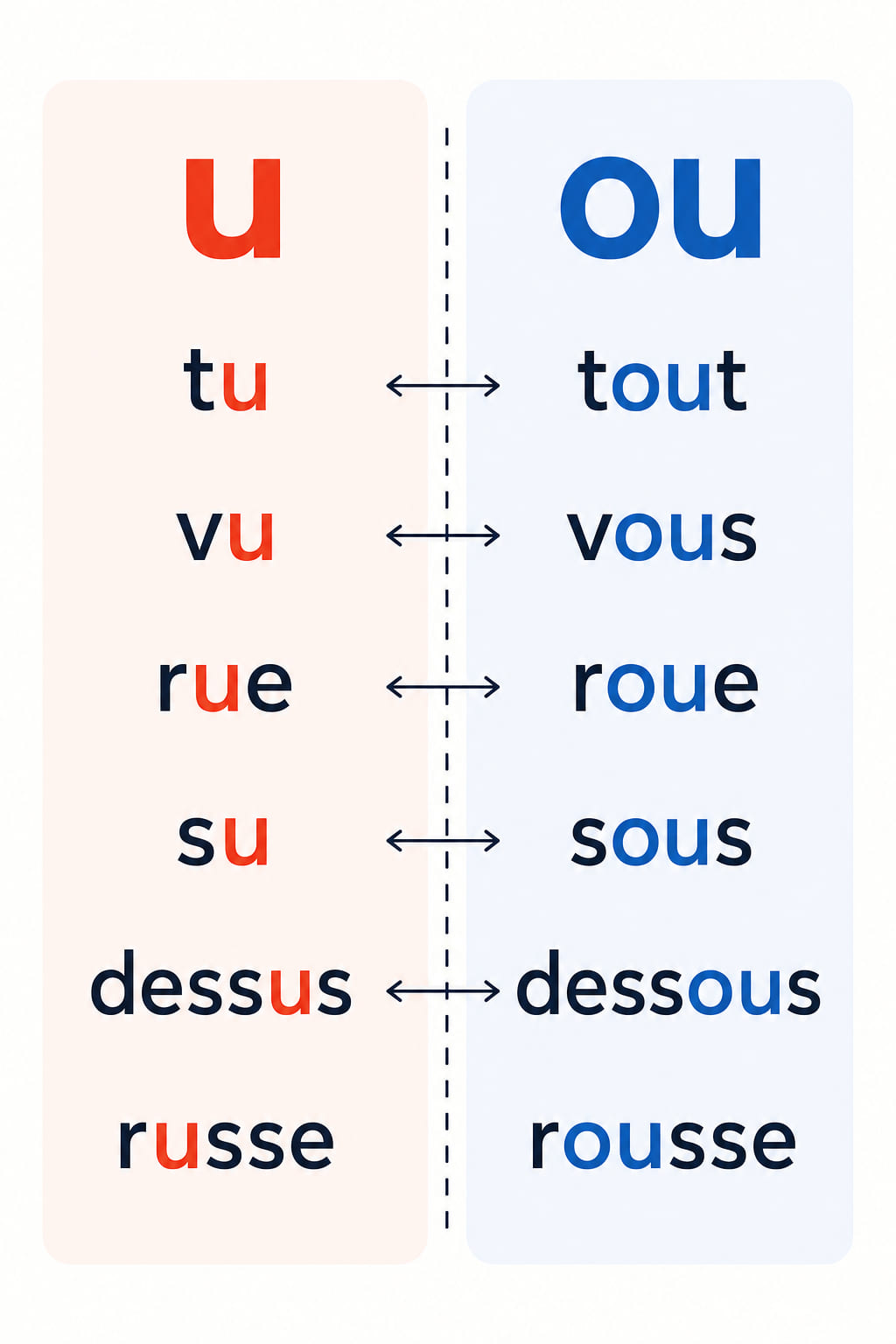
| /y/ | /u/ | ||
|---|---|---|---|
| tu /ty/ | you | tout /tu/ | all |
| vu /vy/ | seen | vous /vu/ | you (pl.) |
| su /sy/ | known | sous /su/ | under |
| bu /by/ | drunk | bout /bu/ | end, tip |
| pu /py/ | been able | pou /pu/ | louse |
| nu /ny/ | naked | nous /nu/ | we |
| lu /ly/ | read | loup /lu/ | wolf |
| du /dy/ | of the | doux /du/ | soft |
| rue /ʁy/ | street | roue /ʁu/ | wheel |
| jus /ʒy/ | juice | joue /ʒu/ | cheek |
| mule /myl/ | mule | moule /mul/ | mussel, mould |
| sur /syʁ/ | on | sourd /suʁ/ | deaf |
| pur /pyʁ/ | pure | pour /puʁ/ | for |
| bulle /byl/ | bubble | boule /bul/ | ball |
| russe /ʁys/ | Russian | rousse /ʁus/ | redhead (f.) |
| bûche /byʃ/ | log | bouche /buʃ/ | mouth |
| puce /pys/ | flea | pouce /pus/ | thumb |
| cuve /kyv/ | vat | couve /kuv/ | broods |
| buse /byz/ | buzzard | bouse /buz/ | cow dung |
| dessus /dəsy/ | on top | dessous /dəsu/ | underneath |
Rows twelve and thirteen do double duty — sur/sourd and pur/pour also make you produce a clean French R immediately after the vowel, which is where English speakers most often let the vowel collapse.
Two sets to strike from other people's lists. You will see but/bout given as a minimal pair: in France but is /byt/ with the T pronounced, so it is not one. And you will see huit/oui, tuer/touer, muette/mouette, chute/chouette — those are not this contrast at all. They are the glide /ɥ/ against /w/, a different fight, fought properly in Lui vs Louis, Huit vs Oui.
Drill 2 — Twelve /y/ words on their own
une /yn/ · tu · bus /bys/ · sur · mur /myʁ/ · dur · lune · musique /myzik/ · luge /lyʒ/ · nature · université /ynivɛʁsite/ · une heure /y.nœʁ/
Université is the checkpoint: /y/ at the very start of a five-syllable word, where there is nothing to hide behind.
Drill 3 — Twelve /u/ words on their own
nous · vous · tout · jour · rouge /ʁuʒ/ · bouche · beaucoup · ouvert /uvɛʁ/ · bougie /buʒi/ · douze · toujours · couscous
Hold each vowel for a full beat and listen for movement. Couscous is the test — four chances in one word for the vowel to drift forward.
Drill 4 — Ten sentences
- Tu as tout vu ? — Did you see everything?
- Vous avez lu ou pas ? — Have you read it or not?
- La rue est sous la roue. — The street is under the wheel.
- C'est au-dessus, pas au-dessous. — It is above, not below.
- Il a bu tout le jus. — He drank all the juice.
- Une boule dans une bulle. — A ball inside a bubble.
- Elle est russe, et rousse. — She is Russian, and a redhead.
- Nous sommes nus sous la lune. — We are naked under the moon.
- Sur le pouce, pour la puce. — On the thumb, for the flea.
- Tu es sourd ou tu es sûr ? — Are you deaf or are you sure?
Sentence 7 is the one to record. Russe and rousse differ in one vowel, sit four words apart, and the French R in front of each makes them harder to keep separate.
Dessus and dessous, because this one costs you
Most of the pairs above will be rescued by context. Rue and roue rarely turn up in the same kind of sentence.
Dessus and dessous do. They are direct antonyms with the same grammar, the same register and the same slot in a sentence — which means context gives you nothing.
- au-dessus /odəsy/ — above, over
- au-dessous /odəsu/ — below, under
A useful anchor: the "above" words carry /y/ — sur, dessus, au-dessus, par-dessus. The "below" words carry /u/ — sous, dessous, au-dessous. One vowel, one direction.
Spelling notes
- u after g or q is often just a marker with no sound: guitare /ɡitaʁ/, qui, quand. But it is genuinely unpredictable — équilibre is /ekilibʁ/ while équilatéral is /ekɥilateʁal/. Do not build a rule on it.
- û is still /y/: bûche, sûr. The 1990 spelling reform removed most circumflexes on U but kept sûr, to keep it apart from sur.
- eu is normally a different vowel altogether — but watch out for eu, the past participle of avoir, which is pronounced /y/. J'ai eu is /ʒe y/.
- aujourd'hui contains /u/ in jour and the glide /ɥ/ in -hui. There is no /y/ vowel in it at all.
In conversation
Ami : Tu as trouvé la rue ?
Vous : Oui, mais j'ai tourné deux fois. C'est juste au-dessus de la boulangerie ?
Ami : Non, au-dessous. Au rez-de-chaussée.
Vous : Ah. Sous la boulangerie, d'accord.
Ami : Voilà. La porte rouge, tout au bout du couloir.
Vous : Rouge, au bout du couloir. Je vois. Merci beaucoup.
Ami : À tout à l'heure !
Lines two and three are the article in miniature. Au-dessus and au-dessous, one vowel apart, and the correction has to be made out loud because the sound did not carry it.
FAQ
Is French /y/ the same as German ü?
Close enough to help. The same vowel exists in German and Turkish ü, Dutch u, Hungarian ü and Mandarin ü. If you speak any of those, you already own it. The Scandinavian y is slightly different — protruded rather than compressed rounding — but still far closer than anything in English.
Why does "say ee and round your lips" not work for me?
It is the right idea and an incomplete instruction. The documented failure is that the tongue retracts when the lips round, because in English those two things always happen together. The missing half is hold the tongue still. Use the finger-under-the-chin test.
Are my lips supposed to be tight or pushed out?
For /y/, compressed — pulled into a small tight circle. For /u/, protruded — pushed forward. Treating them as identical is a useful simplification while you learn, but the two shapes are not quite the same.
How bad is it really if I get this wrong?
Usually harmless, occasionally not. Most of the pairs are rescued by context. Dessus and dessous are not — and neither is the half-second of confusion on the other person's face, which is what makes people switch to English.
Is plus /ply/ or /plys/?
Both, depending on the job it is doing, plus a /z/ form before a vowel. Three pronunciations, one word. It deserves its own page.
The part you can't do alone
Here is the specific cruelty of this pair.
You can hear the difference between tu and tout when a French speaker says them. What you cannot hear is which one you just said — because your ear plays back the word you intended, not the sound you produced. The research above found learners whose mental dictionary did not separate the two vowels at all, while they were quite sure they were saying them differently.
You can drill these twenty pairs for a week, feel fine, and produce the same vowel forty times.
That is a hardware problem, not a discipline problem, and it needs an outside ear.
Say the twenty pairs in Drill 1 into Simply French and get each one scored the moment you say it — front or back, pair by pair, with the ones you are collapsing flagged. Fifteen minutes a day, free for seven days.
Keep going
- Lui vs Louis, Huit vs Oui: The French UI Sound, Drilled — the glide version of the same contrast
- ILLE Pronunciation in French: Why Fille and Ville Do Not Rhyme — juillet and aiguille put /ɥ/ next to the vowels you just drilled
- Cheveux or Chevaux? — the same tongue-plus-lips build, one vowel over
- The French R for English Speakers — the consonant in sur, pur, rue and roue
- French Nasal Vowels AN EN ON IN — the other vowel system English gives you no categories for
- é vs è vs ê: Hear the Difference, Then Prove You Can Say It — where the no-glide discipline comes from
Tags
Now find out how you actually sound.
Simply French listens to you say each sentence and scores it word by word, so you can hear the difference you have just read about — and fix it while it is still fresh.
Takes about 10 minutes. No card needed to start.
Related Articles
ILLE Pronunciation in French: Why Fille and Ville Do Not Rhyme
You were told to memorise four exceptions. The real rule is in the letter before the ILL, not the ILL itself - and half the exception lists online are out of date. Three categories, the Academie's own short list, and 20 words to say out loud.
French S vs Z: Poisson or Poison, Drilled on 20 Pairs
One S between two vowels is /z/. Two S's are /s/. English trained you to do the opposite in exactly the word where it matters most - dessert. The rule, the boundary exceptions nobody teaches, and 20 pairs to say out loud.
French Nasal Vowels AN EN ON IN: Practice Without Pronouncing the N
In a French nasal vowel the N is not a sound - it is a spelling instruction, and your tongue must never touch the roof of your mouth. The three sounds, the true minimal triples, the denasalization pairs that prove it, and 10 sentences.