
Nation, Attention, Decision: The -TION Trap for English Speakers
French -tion is not "shun" — and it is not "see-yon" either. It is one syllable: /sjɔ̃/. Fix the four stacked errors, then drill 50 words and 10 sentences out loud.
Simply French Team
You already know about a thousand French words you have never studied. Nation, attention, situation, information, condition, tradition, solution. Same spelling, same meaning, no flashcards required.
It feels like a gift. It is a trap. Because the one thing that does not transfer is the only thing that comes out of your mouth.
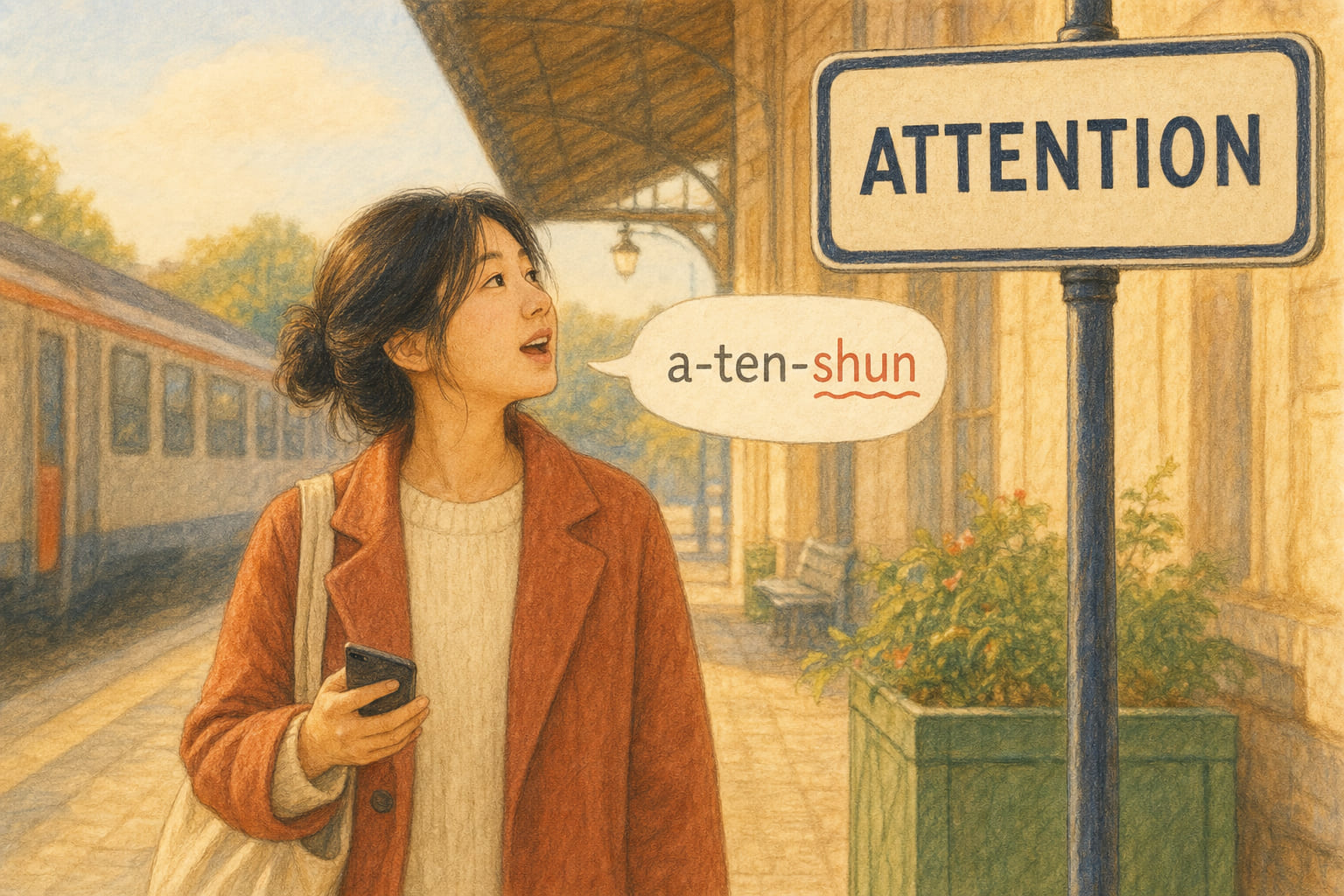
The rule, in one line
English ‑tion is /ʃən/ — "shun." French ‑tion is /sjɔ̃/.
| Word | English | French |
|---|---|---|
| nation | NA‑shun | na‑/sjɔ̃/ |
| attention | a‑TEN‑shun | a‑tan‑/sjɔ̃/ |
| information | in‑for‑MA‑shun | in‑for‑ma‑/sjɔ̃/ |
Say nation the English way, then the French way. If your tongue did the same thing twice, this article is for you — and you would not have noticed, which is the entire problem.
Why your eye overrules your ear
With an unfamiliar word, you sound it out. You are cautious. You look at the letters.
With ‑tion words you do not, because you are not reading them — you are recognising them. The shape hits your visual word memory before any phonics gets a chance, and your mouth reaches for the pronunciation it has used ten thousand times since primary school.
That is why this error survives years of study. It is not stored with your French. It is stored with your English, and it fires first.
And it is not one word. ‑tion is one of the most productive endings in the language. Get it wrong and you are not mispronouncing a word — you are mispronouncing a suffix, in every second sentence, for as long as you speak French.
Error 1 — /ʃ/ instead of /sj/
English turned /sj/ into /ʃ/ centuries ago. It is the same change that gives you sure, sugar and issue — an /s/ followed by a /j/ glide, fused into a single "sh."
French never made that change. The /s/ and the /j/ are still two separate things, said in that order, and both are still there.
The fix. Say the English word "see" and stop halfway — you want the /s/ and the start of the vowel, not the full "ee." Now say "yawn" without the n. Put them together, fast. That is /sjɔ̃/.
Error 2 — but "see‑yon" is wrong too
Here is where nearly every guide on the internet leaves you stranded. They write the ending as "see‑yon," and you dutifully say two beats: na‑SEE‑YON. Three syllables.
Nation has two syllables in French. Not three.
The reason is that the i in ‑tion is not a vowel at all. It is a glide — /j/, the sound at the start of yes. Glides do not get their own syllable. They lean against the vowel beside them and share its beat.
| Beats | What comes out | |
|---|---|---|
| English habit | 2 | NA‑shun |
| Over‑corrected | 3 | na‑see‑YON |
| French | 2 | na‑/sjɔ̃/ |
Count it on the table with your finger. Two taps for nation, three for attention, four for information, five for prononciation. If you are one tap over, the glide has swollen into a vowel.
This matters more than it looks. French rhythm is counted in syllables, evenly — and an extra beat at the end of every second word is exactly what makes an accent sound slow rather than merely foreign.
Error 3 — the stress belongs on the ending
English stresses the syllable before the ending: NA‑tion, at‑TEN‑tion, in‑for‑MA‑tion.
French does the opposite. The last syllable of the rhythmic group takes the length — so the stress falls on ‑tion itself.
- English: at‑TEN‑tion
- French: at‑tan‑sjɔ̃
Keep the English stress and you have buried the ending in an unstressed syllable, where it gets mumbled and reduced — and no amount of fixing the /sj/ will rescue it. Stress placement is doing half the work here. If that idea is new, You're Stressing the Wrong Syllable is the drill for it.
Error 4 — there is no N at the end
/ɔ̃/ is a nasal vowel. The air runs through your nose during the vowel, and then the word stops.
English has no nasal vowels, so English speakers reproduce the nasality the only way they know how: by adding a consonant. na‑see‑YONN. That final n is audible, and it is not there in French.
The test. Say nation and hold the last sound. Your tongue tip must not touch the roof of your mouth. If it rises to make an n, you added a consonant. Then pinch your nose and say it again — the sound should change dramatically. If nothing changes, you are not nasalising at all.
Four errors, one three‑letter ending, and every one of them is invisible from the inside. Together they are why attention is among the most reliably mangled words in beginner French.
‑sion splits in two
‑tion is always /sjɔ̃/. ‑sion depends on what sits in front of the s.
| Before the s | Sound | Examples |
|---|---|---|
| a consonant | /sjɔ̃/ | version · tension · excursion · dimension |
| double ss | /sjɔ̃/ | passion · mission · discussion · expression |
| a vowel (single s) | /zjɔ̃/ | décision · télévision · occasion · explosion |
That third row is not a special rule for ‑sion. It is the ordinary French rule that a single s between two vowels is /z/ — the same rule that separates poisson (fish) from poison (poison). The ending simply inherits it.
So mission has /s/ because of the double s, and vision has /z/ because a single s sits between two vowels. Nothing about the ending itself changed.
The exception worth knowing: ‑stion
When ‑tion follows the letter s, the t stays a real /t/.
| Word | IPA | Meaning |
|---|---|---|
| question | /kɛs·tjɔ̃/ | question |
| gestion | /ʒɛs·tjɔ̃/ | management |
| digestion | /di·ʒɛs·tjɔ̃/ | digestion |
| suggestion | /syg·ʒɛs·tjɔ̃/ | suggestion |
| combustion | /kɔ̃·bys·tjɔ̃/ | combustion |
| bastion | /bas·tjɔ̃/ | bastion |
This is the most useful exception in the set, because question is a word you will say on your first day in France. Kess‑tion, not kess‑sion.
One more spelling to file: ‑xion is /ksjɔ̃/ — réflexion /ʁe·flɛk·sjɔ̃/, connexion /kɔ·nɛk·sjɔ̃/. The x is already /ks/ and the regular ending follows it.
Drill 1 — Twenty ‑tion words, two jobs each
Say each one out loud. Count the beats and land the stress on the last one. The beat count is printed so you cannot cheat.
| Word | Beats | Meaning |
|---|---|---|
| nation | 2 | nation |
| station | 2 | station |
| action | 2 | action |
| portion | 2 | portion |
| mention | 2 | mention |
| option | 2 | option |
| attention | 3 | attention · careful |
| addition | 3 | the bill |
| condition | 3 | condition |
| tradition | 3 | tradition |
| ambition | 3 | ambition |
| émotion | 3 | emotion |
| direction | 3 | direction |
| intention | 3 | intention |
| solution | 3 | solution |
| position | 3 | position — note the /z/ in the middle |
| invitation | 4 | invitation |
| éducation | 4 | education |
| réservation | 4 | booking |
| prononciation | 5 | pronunciation |
Prononciation is the boss level: five beats, two nasals, and the name of the thing you are doing.
Drill 2 — ‑sion, sorted by the sound of the S
Say the left column, then the right column, then alternate. The only difference is whether your vocal cords are running during the s.
| /sjɔ̃/ — voiceless | /zjɔ̃/ — voiced |
|---|---|
| version | décision |
| tension | télévision |
| excursion | occasion |
| dimension | explosion |
| pension | confusion |
| passion | illusion |
| mission | division |
| discussion | précision |
| expression | invasion |
| impression | érosion |
Put two fingers on your throat. Left column: no buzz during the s. Right column: buzz. If both columns buzz, or neither does, the contrast is not there yet.
Drill 3 — The six ‑stion words
A short list, said slowly, then at speed. The t is a real t.
- question — Est‑ce que je peux poser une question ?
- gestion — La gestion du temps, c'est difficile.
- digestion — Une bonne digestion après le repas.
- suggestion — J'ai une suggestion.
- combustion — Le moteur à combustion.
- bastion — Un bastion de la tradition.
Number six is the whole article in three words: bastion takes /tj/, tradition takes /sj/, and they look identical at the end.
Drill 4 — Ten sentences at normal speed
Do not slow down for the target words. Slowing down is how you hide the error from yourself.
- Je voudrais l'addition, s'il vous plaît. — I'd like the bill, please.
- Attention à la marche. — Mind the step.
- Quelle est la prochaine station ? — What's the next stop?
- J'ai une question sur la réservation. — I have a question about the booking.
- La décision n'est pas une question de tradition. — The decision isn't a matter of tradition.
- Cette information demande réflexion. — That information needs some thought.
- Il n'y a pas de connexion dans cette station. — There's no signal in this station.
- La gestion de la situation était parfaite. — The handling of the situation was perfect.
- Ma prononciation s'améliore avec l'attention. — My pronunciation improves with attention.
- Une explosion d'émotion. — An explosion of emotion.
Sentence 5 is the flagship: /zjɔ̃/, /tjɔ̃/, /sjɔ̃/ — three endings, all spelled ‑tion or ‑sion, all different. If they came out identical, that is the drill you have not finished.
In conversation
Vous : Bonjour, j'ai une question sur ma réservation.
Agent : Bien sûr. Vous avez le numéro de confirmation ?
Vous : Oui, une seconde… Est‑ce que la station est loin ?
Agent : Non, direction Nord, c'est à dix minutes.
Vous : Parfait. Et pour l'addition, je peux payer par carte ?
Agent : Aucun problème. Attention, la machine est un peu lente.
Vous : Pas de souci. J'ai une autre suggestion, en fait.
Agent : Je vous écoute.
Seven ‑tion words in eight lines — and question, suggestion and station take three different endings. This is not a contrived exercise. That density is normal in ordinary French.
FAQ
Is ‑tion ever pronounced "shun" in French?
No. Never, in any word, in any region. If "sh" came out, it came from English.
Why do the two languages differ if the words are identical?
Both inherited the ending from Latin ‑tiōnem. English later merged /sj/ into /ʃ/ — the same shift that gave it sure and sugar. French never made that change, so the /s/ and the /j/ remain two separate sounds. You are not learning a French quirk; you are undoing an English one.
How many syllables is nation really?
Two. The i is a glide, not a vowel, so it takes no beat of its own. Guides that write "see‑yon" are trying to help with the /sj/ and accidentally teaching you an extra syllable. Fix the consonant, keep the beat count.
What about démocratie and diplomatie?
Those end in ‑tie, and in this small group the t is /s/ with no glide at all: démocratie /de·mɔ·kʁa·si/, diplomatie /di·plɔ·ma·si/, aristocratie /a·ʁis·tɔ·kʁa·si/. Do not generalise it — ordinary words like partie and sortie keep a plain /t/. Treat these as vocabulary, not as a rule.
Does any of this change outside France?
No. The /sjɔ̃/ ending, the /z/ between vowels and the ‑stion exception all hold in Belgium, Switzerland and Quebec. What varies regionally is the exact quality of the nasal vowel, not whether the ending is nasal.
The part you can't check alone
Everything above is checkable on paper except the four things that actually leave your mouth: whether the sh is gone, whether the ending is one beat or two, whether the stress landed on it, and whether you closed it with an n that should not be there.
You cannot hear those in your own voice. Your ear was built by English, and English is exactly what it will hear.
Say the twenty words in Drill 1 into Simply French and get each one scored the moment you say it — ending, beat count and nasal, flagged separately. Fifteen minutes a day, free for seven days.
Keep going
- You're Stressing the Wrong Syllable: 20 French Phrases, Scored — why the ending has to carry the stress
- Cheveux or Chevaux? One Vowel Between Your Hair and a Horse — another pair your eye reads faster than your ear
- Ils Parlent Sounds Like Il Parle: Say These 20 Verbs and Score — the other ending where the spelling lies to you
- How to Tell If Your French Accent Is Actually Good (Self-Test) — six checks, including the nasal one
- Enchaînement: Why Your French Sounds Choppy — what happens to these words inside a sentence
Tags
Now find out how you actually sound.
Simply French listens to you say each sentence and scores it word by word, so you can hear the difference you have just read about — and fix it while it is still fresh.
Takes about 10 minutes. No card needed to start.
Related Articles
ILLE Pronunciation in French: Why Fille and Ville Do Not Rhyme
You were told to memorise four exceptions. The real rule is in the letter before the ILL, not the ILL itself - and half the exception lists online are out of date. Three categories, the Academie's own short list, and 20 words to say out loud.
French S vs Z: Poisson or Poison, Drilled on 20 Pairs
One S between two vowels is /z/. Two S's are /s/. English trained you to do the opposite in exactly the word where it matters most - dessert. The rule, the boundary exceptions nobody teaches, and 20 pairs to say out loud.
French Nasal Vowels AN EN ON IN: Practice Without Pronouncing the N
In a French nasal vowel the N is not a sound - it is a spelling instruction, and your tongue must never touch the roof of your mouth. The three sounds, the true minimal triples, the denasalization pairs that prove it, and 10 sentences.