Ils Parlent Sounds Like Il Parle: Say These 20 Verbs and Score
Why -ent is silent in French verbs, when it is loudly pronounced instead, and 20 singular-plural pairs to drill out loud until you hear the difference.
Simply French Team
You write ils parlent. Four letters at the end, right there on the page, and every instinct you own says to pronounce them. So you say eel PAR-lent — and get a blank look, because you have just produced a word that does not exist in French.
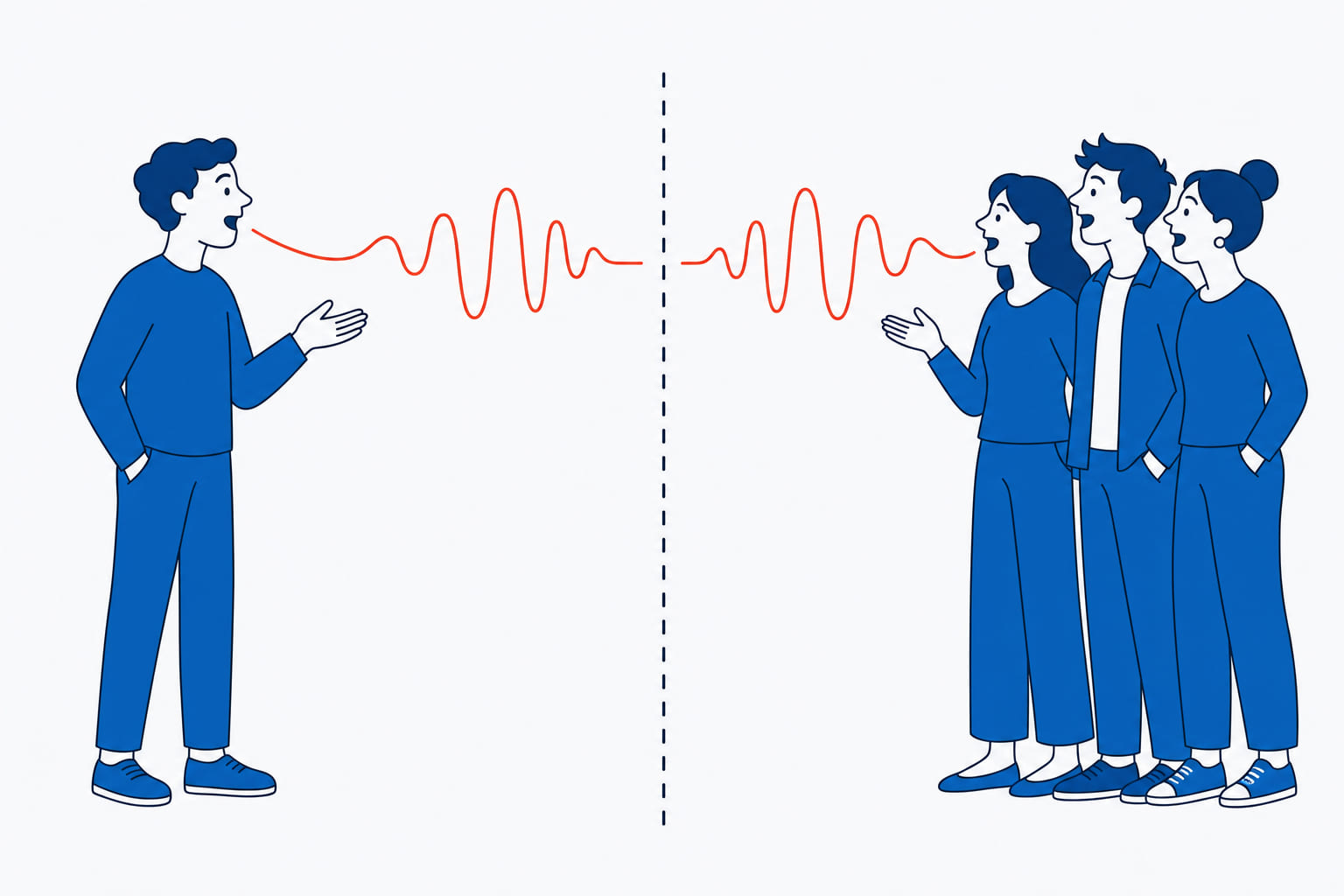
Ils parlent is eel PARL. Identical to il parle. The -ent is completely, silently gone.
Then, the same week, you meet un moment, content, lentement, le président — and every one of those -ent endings is not only pronounced but loud. It looks like chaos. It is not. There is exactly one rule, it has no exceptions worth worrying about, and you can install it in the next four minutes.
The rule, in one line
-ent is silent only when it is the third-person-plural ending of a verb. At the end of any other word it is pronounced [ahn].
That is the whole thing. Not "usually." Not "in most cases." The ending -ent attached to ils or elles is silent; a word-final -ent anywhere else is a nasal vowel (Lawless French, ENT verb ending). In the middle of a word, -ent- is just ordinary spelling and the t is pronounced normally — lentement, entretenir, sentir.
So before you decide how to say a word, ask one question: is this a verb with ils or elles in front of it?
Where -ent is loud
| Word | Pronounce | What it is |
|---|---|---|
| cent | SAHN | number |
| content | kohn-TAHN | adjective |
| différent | dee-fay-RAHN | adjective |
| un moment | uhn mo-MAHN | noun |
| le président | luh pray-zee-DAHN | noun |
| lentement | lahnt-MAHN | adverb (-ment) |
| souvent | soo-VAHN | adverb |
| il ment | eel MAHN | verb — but singular |
| elle sent | el SAHN | verb — but singular |
The last two are where learners who half-know the rule fall over. Il ment and elle sent are verbs, and their -ent is pronounced [ahn], because they are third-person singular. The silence belongs to the plural only.
Where -ent is silent
| Written | Pronounce | Notes |
|---|---|---|
| ils parlent | eel PARL | same as il parle |
| elles mangent | el MAHNZH | same as elle mange |
| ils habitent | eel-za-BEET | note the liaison on ils |
| elles regardent | el ruh-GARD | same as elle regarde |
| qu'ils parlent | keel PARL | subjunctive — also silent |
| ils parlaient | eel par-LEH | imperfect -aient — also silent |

That last row is worth a second look. The imperfect and conditional endings -aient are silent in exactly the same way: ils parlaient is eel par-LEH, indistinguishable from il parlait. Same silence, different spelling.
Why is it silent? A short answer
Because it used to be pronounced, and then French quietly dismantled the ends of its words.
Old French said the -ent out loud. Over the following centuries the ending eroded in stages: the final t stopped being pronounced along with most other word-final consonants, the vowel weakened to a schwa, and in ordinary modern speech that schwa dropped too. The spelling never moved. Modern French writing is a snapshot of a pronunciation nobody has used in a very long time — which is why so much of learning to speak it is learning what not to say.
There is a fossil you can still hear. In sung French and in classical verse, that final schwa comes back: singers voice it as a light -uh to fill out the metre, so ils parlent becomes three syllables instead of two. If a French song has ever sounded like it had one syllable too many, that is what you heard. Note that even then it is only the e that returns — the nt stays silent for good.
Drill 1 — 10 pairs that sound identical
For regular -er verbs, singular and plural are the same word out loud. There is nothing to distinguish, and trying to distinguish them is the mistake.
| Singular | Plural | Both say | English |
|---|---|---|---|
| il parle | ils parlent | PARL | speaks / speak |
| elle mange | elles mangent | MAHNZH | eats / eat |
| il habite | ils habitent | a-BEET | lives / live |
| elle regarde | elles regardent | ruh-GARD | watches / watch |
| il travaille | ils travaillent | tra-VAHY | works / work |
| elle aime | elles aiment | EM | likes / like |
| il joue | ils jouent | ZHOO | plays / play |
| elle étudie | elles étudient | ay-tü-DEE | studies / study |
| il donne | ils donnent | DON | gives / give |
| elle cherche | elles cherchent | SHERSH | looks for / look for |
Say each pair aloud back to back. The goal is for them to come out exactly the same — if your plural is even slightly longer than your singular, the -ent is still leaking out.
Drill 2 — 10 pairs that sound different (and this is how you hear plurals)
Here is the part that actually solves your listening problem. The -ent is silent in these too — but silencing it uncovers a consonant that was hidden in the singular. So the plural is audibly different, and the difference is not the ending at all.
| Singular | Plural | English |
|---|---|---|
| il ment — MAHN | ils mentent — MAHNT | lies / lie |
| elle sent — SAHN | elles sentent — SAHNT | feels / feel |
| il part — PAR | ils partent — PART | leaves / leave |
| elle dort — DOR | elles dorment — DORM | sleeps / sleep |
| il sort — SOR | ils sortent — SORT | goes out / go out |
| elle prend — PRAHN | elles prennent — PREN | takes / take |
| il vient — VYAN (nasal) | ils viennent — VYEN (real n) | comes / come |
| elle boit — BWAH | elles boivent — BWAHV | drinks / drink |
| il écrit — ay-KREE | ils écrivent — ay-KREEV | writes / write |
| elle finit — fee-NEE | elles finissent — fee-NEESS | finishes / finish |

Read down the two columns and the pattern jumps out: the plural ends in one more consonant than the singular does. Part → partent, boit → boivent, écrit → écrivent. The silent ending is not doing nothing — by sitting there, it keeps the stem's final consonant pronounceable, and that consonant is what your ear should be hunting for.
Two rows deserve a note. Prendre swaps its vowel as well: PRAHN versus PREN, nasal against oral, a genuinely hard contrast for English ears. And venir does the same — vient is VYAN, a nasal vowel with no n sound in it at all, while viennent is VYEN, an oral vowel followed by a real, audible n. Two different vowels, not one.
So how do you actually hear the plural?
Three cues, in order of reliability.
The pronoun's liaison. Il a is ee-LAH; ils ont is eel-ZOHN. That z is doing more work than the entire verb ending. Before a vowel, ils and elles announce themselves.
The stem consonant. Drill 2 above. If you hear a consonant at the end, it is plural.
Context. For regular -er verbs there is genuinely no audible difference, and native speakers rely on the subject and the situation exactly as you will. This is not a gap in your ear. The information is not in the sound.
A real conversation
Léa : Tes voisins, ils partent en vacances ? Tom : Ils partent demain. Ils prennent le train à sept heures. Léa : Et ils dorment où ? Tom : Chez des amis, dans le sud. Ils aiment beaucoup la région. Léa : Ils reviennent quand ? Tom : Ils rentrent la semaine prochaine.
Every verb there is third-person plural. Not one -ent is pronounced. But you can hear the plural in most of them — partent, prennent, dorment, reviennent — because the stem consonant became audible the moment the ending went quiet.
Two give you nothing at all. Ils aiment is EM and ils rentrent is RAHNTR, exactly like elle aime and il rentre — both are regular -er verbs with no hidden consonant to uncover. For aiment, the plural survives in the liaison on the pronoun: eel-ZEM. For rentrent, there is nothing in the sound at all. Il rentre and ils rentrent are the same noise, and only the conversation tells you which one you heard.
Frequently asked questions
Is -ent ever pronounced in a plural verb?
In poetry and classical song, yes — the final -e is voiced as a light schwa to fill the metre, so ils parlent becomes three syllables. Even there the nt stays silent, and the schwa is dropped again before a word starting with a vowel. Some formal, declamatory speech and some southern French accents also give it a faint schwa. But in the standard spoken French you are learning to produce and to understand, it is silent — treat the sung version as a special case, not a formal option.
What about the imperfect ending -aient?
Same silence. Ils parlaient is eel par-LEH, exactly like il parlait. The -aient spelling carries three silent letters after the vowel, and none of them survive into speech.
Why is -ent pronounced in "il ment" but silent in "ils mentent"?
Because the rule is about the plural ending, not the letters. In il ment, -ent is part of the singular form and it is a nasal vowel: MAHN. In ils mentent, the final -ent is the plural ending and it disappears, leaving the stem's t exposed: MAHNT.
How do I tell "ils parlent" from "il parle" when someone speaks?
You do not, from the verb. You use the liaison on the pronoun when there is one, or the context. This is not a shortcoming in your listening — it is a genuine homophone, and French speakers handle it exactly the same way.
Does this rule apply to -ment adverbs?
No, and it is worth being explicit: lentement, rapidement, vraiment all end in a loud [mahn]. They are adverbs, not verbs. Same four letters, opposite outcome. Lentement is the useful one to say out loud, because it contains -ent twice — once in the middle, where the t is pronounced, and once at the end, where it is a nasal vowel: lahnt-MAHN.
Related lessons
- Master the Phonetics French Alphabet — which letters go quiet at the end of a word, and why.
- French Pronunciation Practice — building the fifteen-minute daily habit.
- 5 Common Mistakes English Speakers Make — pronouncing written endings is at the top of the list.
- 9 Ways to Say "To Speak" in French — parler and its neighbours.
Practise it out loud
Reading this page has fixed your understanding. It has not fixed your mouth. Twenty years of English has trained you to pronounce what you see, and that habit does not dissolve because you now know better — it dissolves because you said ils parlent two hundred times and heard yourself get it right.
So go down Drill 1 until each pair is genuinely identical, then down Drill 2 until the plural consonant lands cleanly. Record yourself if you can. The leak at the end of a plural verb is almost impossible to catch from the inside.
That is the entire design of Simply French: fifteen minutes a day of listening at native speed, speaking drills, and instant AI pronunciation scoring that tells you exactly which syllable slipped — including the one you did not mean to say. Start your free 7-day trial and drill these twenty verbs until the ending stays quiet on its own.
À vous de parler.
Tags
Now find out how you actually sound.
Simply French listens to you say each sentence and scores it word by word, so you can hear the difference you have just read about — and fix it while it is still fresh.
Takes about 10 minutes. No card needed to start.
Related Articles
ILLE Pronunciation in French: Why Fille and Ville Do Not Rhyme
You were told to memorise four exceptions. The real rule is in the letter before the ILL, not the ILL itself - and half the exception lists online are out of date. Three categories, the Academie's own short list, and 20 words to say out loud.
The French R for English Speakers: 12 Words, 5 Minutes a Day
Stop gargling. The French R is made exactly where you say the G in get - and the reason yours is not working is the tip of your tongue. Build it in four steps, then drill 12 words, three weights of R, and 10 sentences.
French Nasal Vowels AN EN ON IN: Practice Without Pronouncing the N
In a French nasal vowel the N is not a sound - it is a spelling instruction, and your tongue must never touch the roof of your mouth. The three sounds, the true minimal triples, the denasalization pairs that prove it, and 10 sentences.