
French Phrases for the Airport (A1-13)
Learn essential French phrases for the airport, from check-in to baggage claim, with phonetic hints and real dialogues so you can travel with confidence.
Simply French Team
You booked the flight, you packed the bag, and now you are standing in Charles de Gaulle wondering which line is yours. The airport is often the very first place you use your French on a trip — before the hotel, before the café, before anything else. The good news: airport conversations are short, predictable, and built from a small set of phrases you can genuinely master in an afternoon.
This lesson gives you the French phrases for the airport that cover the entire journey: check-in, security, the boarding gate, the arrival hall, and the moments when things go wrong. Every phrase comes with a phonetic hint and a real example, so you can say it out loud — not just recognize it on a sign.
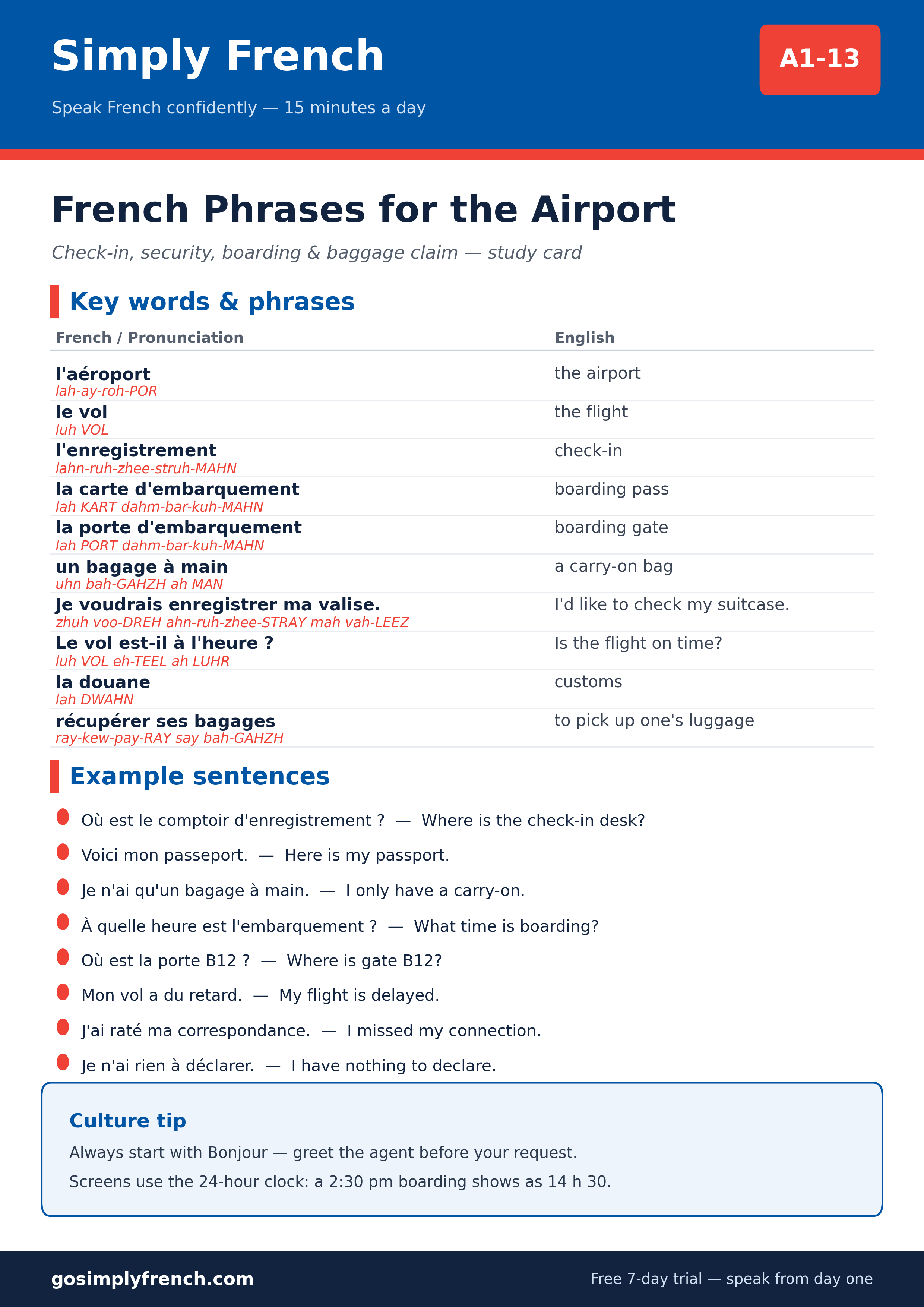
Download the printable study sheet (PDF): French airport phrases study sheet
The airport journey in five words
French airports are organized around five signposted stages. Learn these five words first and every sign in the terminal starts making sense:
| French | Phonetic hint | English |
|---|---|---|
| l'enregistrement | lahn-ruh-zhee-struh-mahn | check-in |
| le contrôle de sécurité | luh kohn-trohl duh say-kew-ree-tay | security screening |
| l'embarquement | lahm-bar-kuh-mahn | boarding |
| le débarquement | luh day-bar-kuh-mahn | disembarking |
| la livraison des bagages | lah lee-vray-zohn day bah-gahzh | baggage claim |
A learner trap worth knowing from day one: l'enregistrement (check-in) and l'embarquement (boarding) look similar but are two different stages. Check-in is where you drop your suitcase and get your boarding pass; boarding is when you actually walk onto the plane. The Larousse dictionary defines embarquement as the act of taking passengers or cargo on board — the barque (boat) hiding inside the word is a nice reminder that French borrowed it from the sea.
At the check-in desk (l'enregistrement)
Start every interaction with Bonjour — in France, greeting the agent before your request is not optional politeness, it is the price of good service. Then you only need a handful of lines:
| French | Phonetic hint | English |
|---|---|---|
| Où est le comptoir d'enregistrement ? | oo eh luh kohn-twahr dahn-ruh-zhee-struh-mahn | Where is the check-in desk? |
| Je voudrais enregistrer ma valise. | zhuh voo-dray ahn-ruh-zhee-stray mah vah-leez | I would like to check my suitcase. |
| Je n'ai qu'un bagage à main. | zhuh nay kuhn bah-gahzh ah man | I only have a carry-on. |
| Voici mon passeport. | vwah-see mohn pahs-por | Here is my passport. |
| Puis-je avoir une place côté hublot ? | pweezh ah-vwahr ewn plahs koh-tay ew-bloh | May I have a window seat? |
| Le vol est-il à l'heure ? | luh vol eh-teel ah luhr | Is the flight on time? |
Example exchange:
Agent : Bonjour, votre passeport, s'il vous plaît. (Hello, your passport, please.) Vous : Bonjour ! Voici mon passeport. Je voudrais enregistrer ma valise. (Hello! Here is my passport. I would like to check my suitcase.) Agent : Très bien. Voici votre carte d'embarquement. Embarquement à 14 h 30, porte B12. (Very well. Here is your boarding pass. Boarding at 2:30 pm, gate B12.)
Notice la carte d'embarquement (boarding pass) — you will hear it at least three times per trip, so make it automatic. And if numbers like quatorze heures trente still trip you up, our lesson on French numbers from 1 to 100 is the fastest fix.
Going through security (le contrôle de sécurité)
Security agents speak in short commands. You mostly need to understand rather than speak, but a few phrases keep things smooth:
| French | Phonetic hint | English |
|---|---|---|
| Videz vos poches, s'il vous plaît. | vee-day voh posh seel voo pleh | Empty your pockets, please. |
| Enlevez votre ceinture. | ahn-luh-vay voh-truh san-tewr | Take off your belt. |
| Est-ce que je dois enlever mes chaussures ? | ess-kuh zhuh dwah ahn-luh-vay may shoh-sewr | Do I have to take off my shoes? |
| J'ai un ordinateur portable dans mon sac. | zhay uhn or-dee-nah-tuhr por-tah-bluh dahn mohn sahk | I have a laptop in my bag. |
| Désolé(e), je ne comprends pas. | day-zoh-lay zhuh nuh kohn-prahn pah | Sorry, I don't understand. |
That last line is your safety net for the whole trip. Say it with a smile and most agents will switch to slower French or simple English.
At the boarding gate (la porte d'embarquement)
| French | Phonetic hint | English |
|---|---|---|
| Où est la porte B12 ? | oo eh lah port bay dooz | Where is gate B12? |
| À quelle heure est l'embarquement ? | ah kel uhr eh lahm-bar-kuh-mahn | What time is boarding? |
| L'embarquement commence. | lahm-bar-kuh-mahn koh-mahns | Boarding is starting. |
| Dernier appel pour le vol AF 1234. | dehr-nyay ah-pel poor luh vol | Last call for flight AF 1234. |
Announcements are the hardest listening exercise in any airport — native speed, echoing speakers, background noise. Train your ear for the two words that matter: dernier appel (last call) and your gate number. If you can catch those, you will never miss a flight. This is exactly what you'll practice out loud in Lesson A1-13: At the Airport inside Simply French — the app plays gate announcements at native speed, then has you respond aloud and scores your pronunciation instantly.
If you need to find your way across a sprawling terminal, the phrases from our guide on asking for directions in French work exactly the same indoors: où est... ?, à gauche, à droite, tout droit.
Arrival: baggage claim and customs
After le débarquement, follow the signs marked Sortie (exit) and Bagages:
| French | Phonetic hint | English |
|---|---|---|
| Où puis-je récupérer mes bagages ? | oo pweezh ray-kew-pay-ray may bah-gahzh | Where can I pick up my luggage? |
| Ma valise n'est pas arrivée. | mah vah-leez neh pah ah-ree-vay | My suitcase didn't arrive. |
| Je n'ai rien à déclarer. | zhuh nay ryahn ah day-klah-ray | I have nothing to declare. |
| Où sont les taxis ? | oo sohn lay tahk-see | Where are the taxis? |
| Où est la station de RER ? | oo eh lah stah-syohn duh ehr-uh-ehr | Where is the RER station? |
At Paris airports, the RER B train is usually the fastest way into the city — the official Paris Aéroport site lists every access option in English and French. And once you are heading into town, you already know how to handle the ticket window from our lesson on buying train tickets in French.
When things go wrong
Delays and hiccups are where a little French earns you real help:
| French | Phonetic hint | English |
|---|---|---|
| Mon vol a du retard. | mohn vol ah dew ruh-tar | My flight is delayed. |
| Mon vol est annulé. | mohn vol eh-tah-new-lay | My flight is canceled. |
| J'ai raté ma correspondance. | zhay rah-tay mah koh-reh-spohn-dahns | I missed my connection. |
| Pouvez-vous m'aider, s'il vous plaît ? | poo-vay voo meh-day seel voo pleh | Can you help me, please? |
Une correspondance means a connection (flight or train). J'ai raté... (I missed...) is one of the most useful A1 structures in existence — it works for flights, trains, buses, and croissants that sold out before you got there.
Three cultural tips for French airports
First, the greeting rule is absolute. Agents deal with hundreds of stressed travelers a day; the ones who open with Bonjour and close with merci, bonne journée get noticeably warmer service. If you want to polish this reflex, our short lesson on please and thank you in French covers the whole politeness toolkit.
Second, French airports use the 24-hour clock everywhere. Your 2:30 pm boarding time appears as 14 h 30 on every screen and every announcement.
Third, don't panic when announcements sound impossibly fast. They repeat, they follow a fixed formula (flight number → destination → gate → instruction), and they are almost always followed by an English version at international airports.
Practice out loud before you fly
Reading French phrases for the airport is step one; saying them at a check-in desk with a line behind you is a different skill. That gap — recognizing versus producing — is exactly what Simply French is built to close. Each 15-minute lesson has you listen at native speed, speak your answers out loud, and get instant AI pronunciation scoring, so phrases like je voudrais enregistrer ma valise come out smoothly under pressure. Try Lesson A1-13 and the rest of the travel track free for 7 days: start your free trial.
Related lessons
- How to Buy Train Tickets in French (A1-12) — the natural next step once you land
- How to Check Into a Hotel in French (A1-11) — for the end of your travel day
- How to Ask for Directions in French (A1-8) — works in terminals as well as streets
- Please and Thank You in French (A1-5) — the politeness that unlocks better service
Frequently asked questions
How do you say "airport" in French?
Airport is l'aéroport (masculine): lah-ay-roh-por. "At the airport" is à l'aéroport. Note the extra syllable compared to English — French pronounces both the aé vowels separately.
What is the difference between "l'enregistrement" and "l'embarquement"?
L'enregistrement is check-in: dropping checked luggage and receiving your boarding pass. L'embarquement is boarding: physically getting on the plane. They happen at different desks, at different times, and the signs will send you to different places — mixing them up is the classic beginner airport mistake.
How do I say "boarding pass" and "carry-on" in French?
Boarding pass is la carte d'embarquement; a carry-on bag is un bagage à main (literally "hand luggage") or un bagage cabine. A checked suitcase travels in la soute (the hold), which is why you'll hear bagage en soute for checked baggage.
Do airport staff in France speak English?
At international hubs like Paris-CDG, Orly, Lyon, and Nice, yes — most front-line staff speak functional English. But opening in French, even just Bonjour, je voudrais enregistrer ma valise, reliably gets you friendlier and more patient service. Staff switch to English much more happily when you have tried French first.
What French phrases do I need for customs?
Usually none — for EU arrivals you often walk straight through. If asked, the key phrase is Je n'ai rien à déclarer (I have nothing to declare). Officers may ask C'est un voyage touristique ? (Is this a tourist trip?) — a simple Oui, je suis en vacances (Yes, I'm on vacation) answers it.
How can I understand fast airport announcements in French?
Don't try to catch every word. Listen for the fixed formula: flight number, destination city, gate number, and the instruction (embarquement immédiat — immediate boarding; dernier appel — last call). Practicing with native-speed audio — the way Simply French lessons are recorded — trains your ear far faster than slowed-down classroom recordings.
Tags
Now find out how you actually sound.
Simply French listens to you say each sentence and scores it word by word, so you can hear the difference you have just read about — and fix it while it is still fresh.
Takes about 10 minutes. No card needed to start.
Related Articles
T'as, Y'a, Chuis: Say Spoken French the Way It's Actually Said
Tu becomes t', il becomes i, il y a becomes y'a. The three families of French spoken contractions, why they exist, and 50 lines to drill out loud until they stop sounding like a different language.
How to Tell If Your French Accent Is Actually Good (Self-Test)
You cannot hear your own French accent — your ear filters it through English. Six self-tests that isolate what English speakers actually get wrong, each one you can check on your own, plus a 12-point scorecard.
How to Talk About Hobbies in French (A1-21)
Learn to talk about hobbies in French with 40+ phrases, the faire de vs jouer a rule, pronunciation hints, a sample dialogue and a free printable study sheet.