
How to Talk About Your Job in French (A1-16)
Learn how to talk about your job in French with 40+ job names, the no-article rule, natural questions, pronunciation hints and a full sample conversation.
Simply French Team
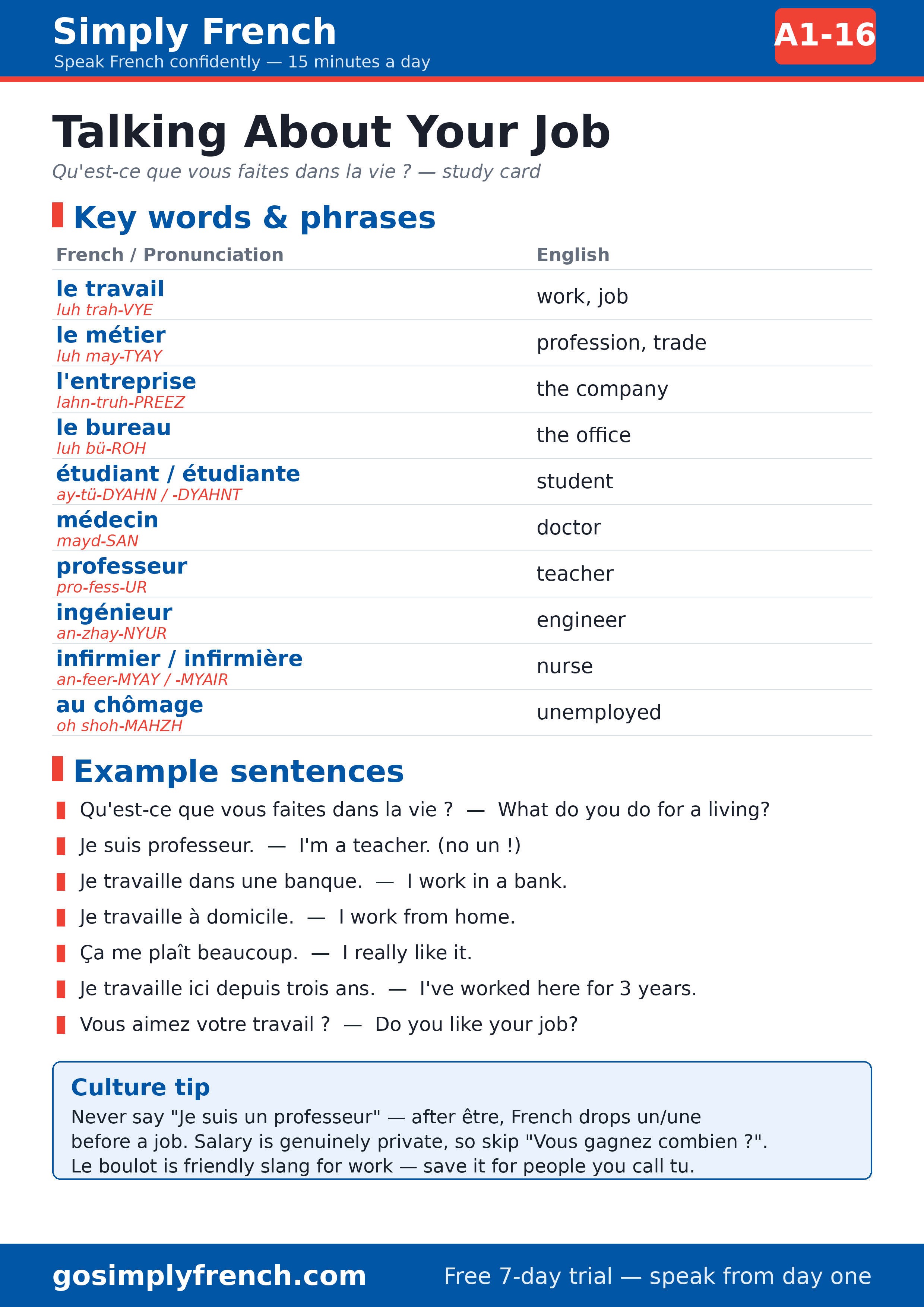
Download the printable study sheet (PDF): Talking About Your Job in French (A1-16) study sheet
Somewhere in the first five minutes of almost every real French conversation, somebody will ask you what you do. It happens at a dinner table in Lyon, at a coworking desk in Marseille, and on every train between Paris and anywhere. If you can talk about your job in French, you stop being the person who smiles and points and become the person who has an actual conversation.
The good news: this topic needs very little grammar. One verb (être), one small rule about articles, and a stack of job names — many of which look almost exactly like English. Here are the questions, the answers, the job list, and the pronunciation traps that trip up nearly every beginner.
How to ask what someone does for a living
French has several ways in, and they are not interchangeable in tone. Learn the polite one first and you will never be wrong.
| French | Pronunciation hint | English | Register |
|---|---|---|---|
| Qu'est-ce que vous faites dans la vie ? | kess-kuh voo FET dahn lah vee | What do you do for a living? | Polite, very common |
| Qu'est-ce que tu fais dans la vie ? | kess-kuh tü fay dahn lah vee | What do you do? | Informal |
| Quel est votre métier ? | kell ay VOH-truh may-TYAY | What is your profession? | Formal |
| Vous travaillez dans quoi ? | voo trah-vah-YAY dahn kwah | What field do you work in? | Casual, spoken |
| Vous travaillez où ? | voo trah-vah-YAY oo | Where do you work? | Casual |
| Et vous ? | ay voo | And you? | The follow-up you must have |
Dans la vie literally means "in life," which sounds grand in English but is completely ordinary in French. Quel est votre métier ? is a notch more formal; you will meet it on forms and in interviews more than at a dinner party. The noun métier covers a trade or profession learned through training and experience, as the Larousse dictionary entry for métier sets out.
And do not forget Et vous ? French conversation is a rally, not a serve. Answer, then bounce the question straight back.
The one rule that makes you sound French: drop the article
Here is the single most useful thing in this lesson. When you say your profession after être, you do not use un or une.
- Je suis professeur. — I am a teacher. ✅
- Je suis un professeur. — ❌ understood, but instantly marks you as translating.
The exception is easy to remember: as soon as you add an adjective, the article comes back.
- Elle est architecte. — She is an architect.
- Elle est une architecte très connue. — She is a very well-known architect.
Two other ways to say the same thing, both natural:
| French | Pronunciation hint | English |
|---|---|---|
| Je suis ingénieur. | zhuh swee an-zhay-NYUR | I am an engineer. |
| Je travaille comme infirmière. | zhuh trah-VYE kom an-feer-MYAIR | I work as a nurse. |
| Je travaille dans la finance. | zhuh trah-VYE dahn lah fee-NAHNSS | I work in finance. |
| Je suis à mon compte. | zhuh swee ah mohn KONT | I'm self-employed. |
Note that travailler comme and travailler dans do take their normal articles — the drop-the-article rule applies only to être + profession.
Jobs in French: the list worth memorising
Many job names have a masculine and a feminine form. Words already ending in -e (dentiste, journaliste, architecte) do not change at all; only the article in front of them does.
| French (m / f) | Pronunciation hint | English |
|---|---|---|
| étudiant / étudiante | ay-tü-DYAHN / ay-tü-DYAHNT | student |
| professeur / professeure | pro-fess-UR | teacher |
| médecin | mayd-SAN | doctor |
| infirmier / infirmière | an-feer-MYAY / an-feer-MYAIR | nurse |
| ingénieur / ingénieure | an-zhay-NYUR | engineer |
| avocat / avocate | ah-vo-KAH / ah-vo-KAHT | lawyer |
| vendeur / vendeuse | vahn-DUR / vahn-DUZ | shop assistant |
| serveur / serveuse | sair-VUR / sair-VUZ | waiter / waitress |
| cuisinier / cuisinière | kwee-zee-NYAY / kwee-zee-NYAIR | cook, chef |
| boulanger / boulangère | boo-lahn-ZHAY / boo-lahn-ZHAIR | baker |
| coiffeur / coiffeuse | kwah-FUR / kwah-FUZ | hairdresser |
| chauffeur | shoh-FUR | driver |
| agriculteur / agricultrice | ah-gree-kül-TUR / ah-gree-kül-TREESS | farmer |
| comptable | kohn-TAH-bluh | accountant |
| journaliste | zhoor-nah-LEEST | journalist |
| architecte | ar-shee-TEKT | architect |
| dentiste | dahn-TEEST | dentist |
| informaticien / informaticienne | an-for-mah-tee-SYAN / -SYENN | IT specialist |
| développeur / développeuse | day-vlo-PUR / day-vlo-PUZ | developer |
| fonctionnaire | fonk-syo-NAIR | civil servant |
| retraité / retraitée | ruh-tray-TAY | retired person |
| au chômage | oh shoh-MAHZH | unemployed |
Professeur deserves a footnote. Une professeure is now widely written and spoken, especially in Canada, Belgium and Switzerland, while une professeur remains common in France; both will be understood everywhere. In everyday speech people usually shorten it to un/une prof (prohf).
This is exactly what you'll practise out loud in Lesson A1-16: Talking About Your Job inside Simply French — the app plays the questions at native speed, then scores your answers phrase by phrase so the article rule becomes automatic rather than something you have to think about.
Keeping the conversation going
Naming your job is one sentence. These are the sentences that turn it into a conversation.
| French | Pronunciation hint | English |
|---|---|---|
| Je travaille dans une petite entreprise. | ahn-truh-PREEZ | I work in a small company. |
| Je travaille à domicile. | ah do-mee-SEEL | I work from home. |
| Je travaille à temps plein / à temps partiel. | tahn PLAN / tahn par-SYELL | I work full-time / part-time. |
| J'ai un travail intéressant. | trah-VYE an-tay-ress-AHN | I have an interesting job. |
| Ça me plaît beaucoup. | sah muh play boh-KOO | I really like it. |
| C'est fatigant mais j'aime bien. | say fah-tee-GAHN may zhem byan | It's tiring but I like it. |
| Je cherche un travail. | zhuh shairsh an trah-VYE | I'm looking for a job. |
| Vous aimez votre travail ? | voo zay-MAY VOH-truh trah-VYE | Do you like your job? |
| Depuis combien de temps ? | duh-PWEE kohn-BYAN duh tahn | For how long? |
Notice Ça me plaît — literally "it pleases me." French speakers reach for it far more often than j'aime mon travail, and it sounds warmer.
To say how long you have been doing something, French uses the present tense with depuis, where English uses the perfect:
- Je travaille ici depuis trois ans. — I have worked here for three years.
If numbers still slow you down, our guide to counting from 1 to 100 in French will make sentences like this one come out smoothly.
A full conversation, start to finish
— Bonjour ! Vous êtes en vacances ici ? (Hello! Are you here on holiday?) — Non, je travaille à Bordeaux. Et vous, qu'est-ce que vous faites dans la vie ? (No, I work in Bordeaux. And you, what do you do?) — Je suis infirmière à l'hôpital. Et vous ? (I'm a nurse at the hospital. And you?) — Je suis développeur. Je travaille à domicile. (I'm a developer. I work from home.) — Ah, c'est pratique ! Ça vous plaît ? (Oh, that's convenient! Do you like it?) — Oui, beaucoup. Je fais ça depuis cinq ans. (Yes, a lot. I've been doing it for five years.)
Six exchanges, one verb doing most of the work. Read it aloud twice, then swap in your own job — that substitution drill is the fastest route from reading French to speaking it.
Culture: how work talk really lands in France
Anglophones often open with "So what do you do?" as an icebreaker. In France it is perfectly normal, but it usually arrives a little later in the conversation, after the weather, the food, the trip, the town. Leading with it at a dinner party can read as slightly transactional. Let it come naturally; if you need a warm-up topic first, talking about the weather in French is the universally safe opener.
Two more things worth knowing. Salary is a genuinely private subject and asking about it is a real faux pas, even between colleagues. And the working week itself is a national reference point: the statutory 35-hour week introduced in 2000 (see the 35-hour workweek) still shapes how people talk about hours, overtime and the sacred congés — holiday time. Expect to hear about les vacances long before you hear about promotions.
Finally, le boulot is the everyday slang for "work" (Je vais au boulot — I'm off to work). It is friendly and extremely common, but keep it for people you would say tu to.
Pronunciation traps to avoid
Three words cause almost all the trouble when learners talk about their job in French:
- médecin — two syllables, mayd-SAN, with a nasal ending. It is not "medicine," and the c is soft.
- travail / travaille — the -ail and -aille endings both sound like TRAH-vye, rhyming with "eye." The final l is not pronounced as an English L.
- ingénieur — resist the English "in-jen-EER." The French g here is the soft zh of "measure": an-zhay-NYUR.
And a bonus one: entreprise means company, not "enterprise" in the grand sense. Your local bakery is une entreprise.
Related lessons
- How to introduce yourself in French — the lesson this one naturally follows; name, origin, and now job.
- How to talk about your family in French — the other half of getting-to-know-you small talk.
- How to say how are you in French — the opening move before any of this.
- Please and thank you in French — the politeness layer that makes all of it land well.
Frequently asked questions
Do I really never say "un" or "une" before a job in French?
Not after être, no: Je suis avocat, never Je suis un avocat. The article returns the moment an adjective joins in (C'est un avocat brillant) or when you use c'est instead of il/elle est (C'est un avocat is correct). For plain self-introduction, drop it.
What is the difference between travail, métier, emploi and boulot?
Le travail is work in general and also your specific job. Le métier is your trade or profession — the skill you trained for. Un emploi is a position of employment, the word used in job ads and unemployment statistics. Le boulot is casual slang for all of the above.
How do I say I am unemployed, retired, or a student?
Je suis au chômage (I'm unemployed), je suis à la recherche d'un emploi (I'm job-hunting, a softer phrasing), je suis retraité / retraitée (I'm retired), and je suis étudiant / étudiante (I'm a student). All follow the same no-article pattern.
Should I use tu or vous when asking about someone's job?
Use vous with anyone you have just met, anyone older, and in any professional or commercial setting. Tu is for friends, family, children, and colleagues who have invited you to switch. If in doubt, start with vous.
How do I ask a follow-up without sounding nosy?
Stick to the job itself rather than the money: Vous aimez votre travail ?, Depuis combien de temps ?, Vous travaillez dans quel quartier ? These are warm and welcome. Avoid Vous gagnez combien ? entirely.
Are feminine job titles standard now?
Increasingly, yes. Forms like une auteure, une professeure and une ingénieure are normal in Canada, Belgium and Switzerland and are steadily more common in France, though usage still varies by word and by speaker. As a learner you will never cause offence by using the feminine form for a woman.
Put it in your mouth today
Reading a list of jobs is not the same as answering Qu'est-ce que vous faites dans la vie ? while somebody waits for you. Pick your own answer — one sentence for your job, one for where you work, one for whether you like it — and say it out loud ten times until it arrives without effort.
Simply French is built around exactly that loop: listen at native speed, speak the line out loud, get instant AI pronunciation scoring, fifteen minutes a day. Start your free 7-day trial and answer the question out loud before someone actually asks it.
Tags
Now find out how you actually sound.
Simply French listens to you say each sentence and scores it word by word, so you can hear the difference you have just read about — and fix it while it is still fresh.
Takes about 10 minutes. No card needed to start.
Related Articles
T'as, Y'a, Chuis: Say Spoken French the Way It's Actually Said
Tu becomes t', il becomes i, il y a becomes y'a. The three families of French spoken contractions, why they exist, and 50 lines to drill out loud until they stop sounding like a different language.
How to Tell If Your French Accent Is Actually Good (Self-Test)
You cannot hear your own French accent — your ear filters it through English. Six self-tests that isolate what English speakers actually get wrong, each one you can check on your own, plus a 12-point scorecard.
How to Talk About Hobbies in French (A1-21)
Learn to talk about hobbies in French with 40+ phrases, the faire de vs jouer a rule, pronunciation hints, a sample dialogue and a free printable study sheet.