Le Héros vs L'Homme: The Aspirated H, Drilled
The h is silent in every French word — h aspiré doesn't add a sound, it blocks élision and liaison. The one rule, the words that actually matter, and 30 pairs to say out loud.
Simply French Team
You are at a counter holding a ticket. The screen says le huit. You have known this word since week one — and still something in you wants to smooth it into l'huit, because that is what French does, isn't it? It glues everything together.
Not here. Not in le héros, le hibou, la honte, le hamburger, or les haricots.
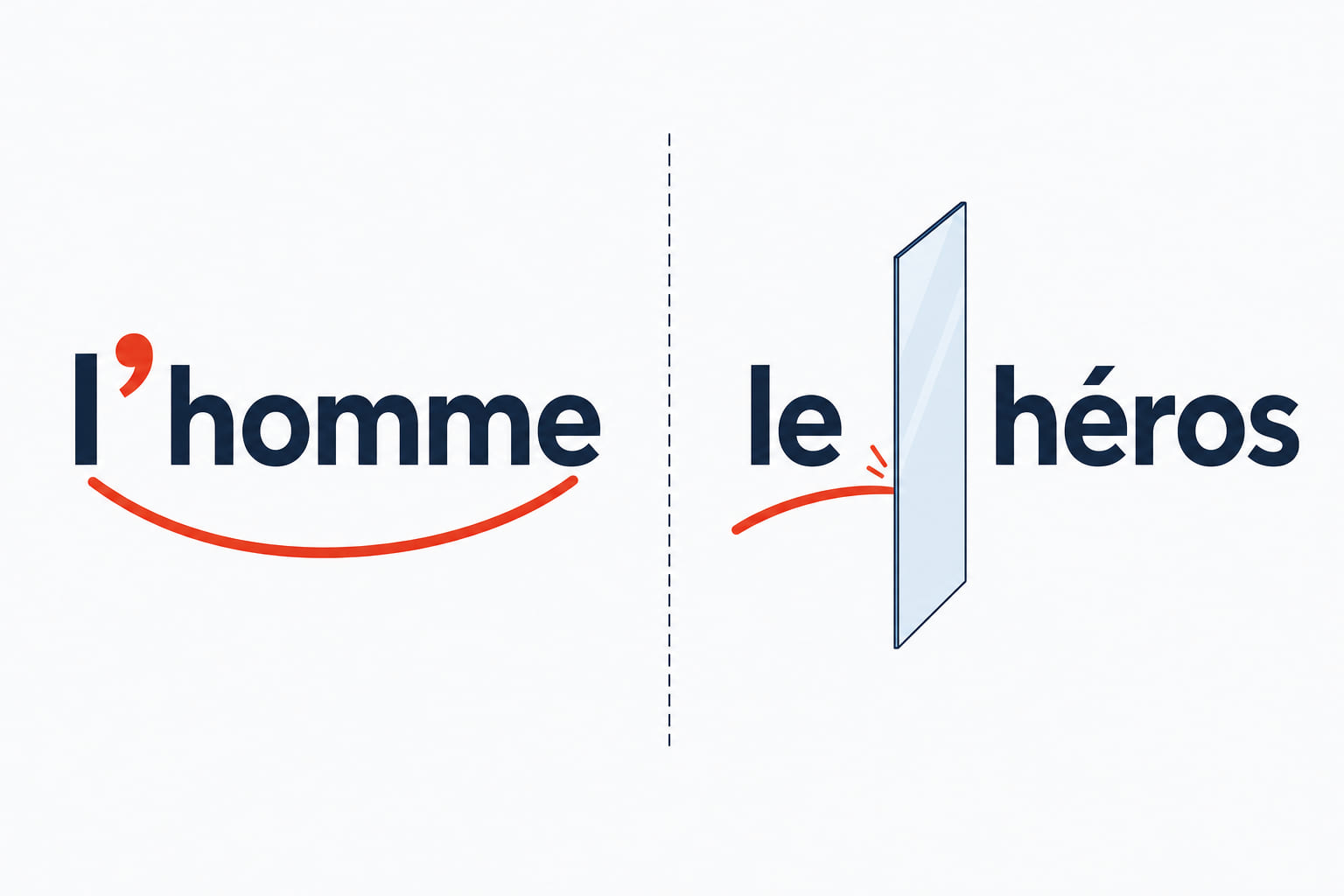
French has two kinds of h, and here is the part nobody says clearly enough: neither of them makes a sound. H aspiré does not mean you breathe out. Nothing is aspirated. It means the word has an invisible wall in front of it, and everything that would normally link across — the l', the z of a liaison, the little consonant hop — stops dead at that wall.
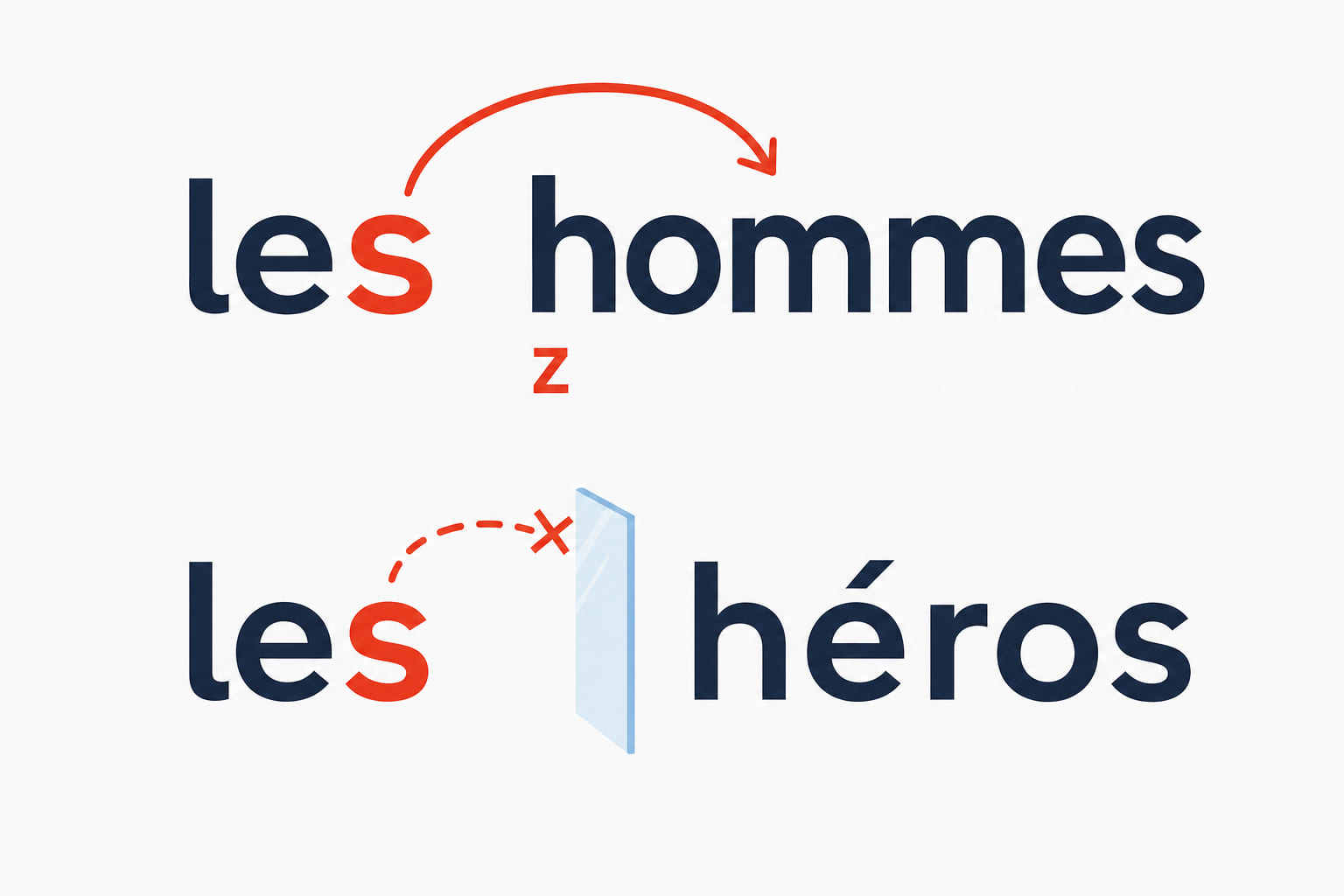
Get this wrong in the direction most English speakers do, and les héros comes out as les zéros. Your heroes become your zeroes.
The rule, in one line
The letter h is silent in every French word. The only question is how the word behaves: h muet acts like it starts with a vowel — link into it. H aspiré acts like it starts with a consonant — leave a gap.
That is the whole mechanism. The h is never a sound in either case. It is a label telling you whether the previous word is allowed to reach across.
What "aspirated" does not mean
The name is a historical accident and it has misled learners for a century. Around the 16th and 17th centuries the aspirated h really was a puff of air, inherited from the Germanic words that brought it in. That sound is gone. The label stayed.
So if you are saying le héros with a small English h at the front — luh HEH-ro — stop. That is not a French sound in any word, muet or aspiré. What you want is luh ay-RO: two clean vowels with a hairline break between them, and no puff of air anywhere.
The break is the whole signal. It is tiny, it is not a pause, and it is almost impossible to hear in your own mouth — which is exactly why this topic resists reading and only yields to saying it out loud and checking.
H muet: everything links
With h muet, the word behaves as a plain vowel and every normal linking rule fires.
| Written | Pronounce | What happened |
|---|---|---|
| l'homme | LOM | le elided to l' |
| les hommes | lay-ZOM | liaison — the s wakes up as z |
| l'heure | LUHR | elision |
| deux heures | duh-ZUHR | liaison |
| l'hôtel | lo-TEL | elision |
| cet hôpital | seh-to-pee-TAL | ce became cet, then linked |
The usual suspects are all h muet: homme, heure, hôtel, hôpital, histoire, hiver, habitude, huile, huître, honneur, herbe, horizon, humanité, hélicoptère.
H aspiré: nothing links
With h aspiré, the same words refuse to reach across.
| Written | Pronounce | What did not happen |
|---|---|---|
| le héros | luh ay-RO | no elision — never l'héros |
| les héros | lay ay-RO | no liaison — not lay-ZAY-ro |
| la honte | la OHNT | no elision |
| les haricots | lay a-ree-KO | no liaison |
| un hangar | uhn ahn-GAR | no liaison — not uhn-NAHN-gar |
| quel hasard | kel a-ZAR | no hop — the l stays put |
That last row is the one that hides. Elision and liaison are visible on the page; the third thing h aspiré blocks is not. Normally a final consonant slides forward to start the next syllable — quel ami is keh-la-MEE. Before h aspiré it cannot: quel hasard keeps its l where it is, kel • a-ZAR, with a seam you can hear.
The core h aspiré list is short enough to own: hache, haie, haine, haïr, hall, halte, hamac, hameau, hamburger, hamster, hanche, handicap, hangar, haricot, harpe, hasard, hâte, haut, hauteur, hérisson, héron, héros, hêtre, hibou, hiérarchie, hockey, homard, hongrois, honte, hoquet, hors-d'œuvre, housse, hurler, hutte.
Why there are two kinds
Because the words arrived from different places.
H muet words came through Latin and Greek, where the h had already gone quiet before French existed. The letter is pure orthographic decoration: homme from hominem, heure from hora, histoire from historia. Nothing was ever pronounced there in French, so nothing blocks anything.
H aspiré words came from Frankish and the Germanic languages, arriving with a genuine breathy h that French pronounced for centuries and then dropped. The sound died; the blocking behaviour survived as a fossil (Wikipedia, Aspirated h). Haie, haine, hache, hameau, hêtre, honte all come in that way.
And the rule is still alive. Modern English borrowings enter French as h aspiré, because French treats them as if the English h were still audible: le hall, le hockey, le hamburger, le hamster. If a word feels borrowed and recent, bet on aspiré.
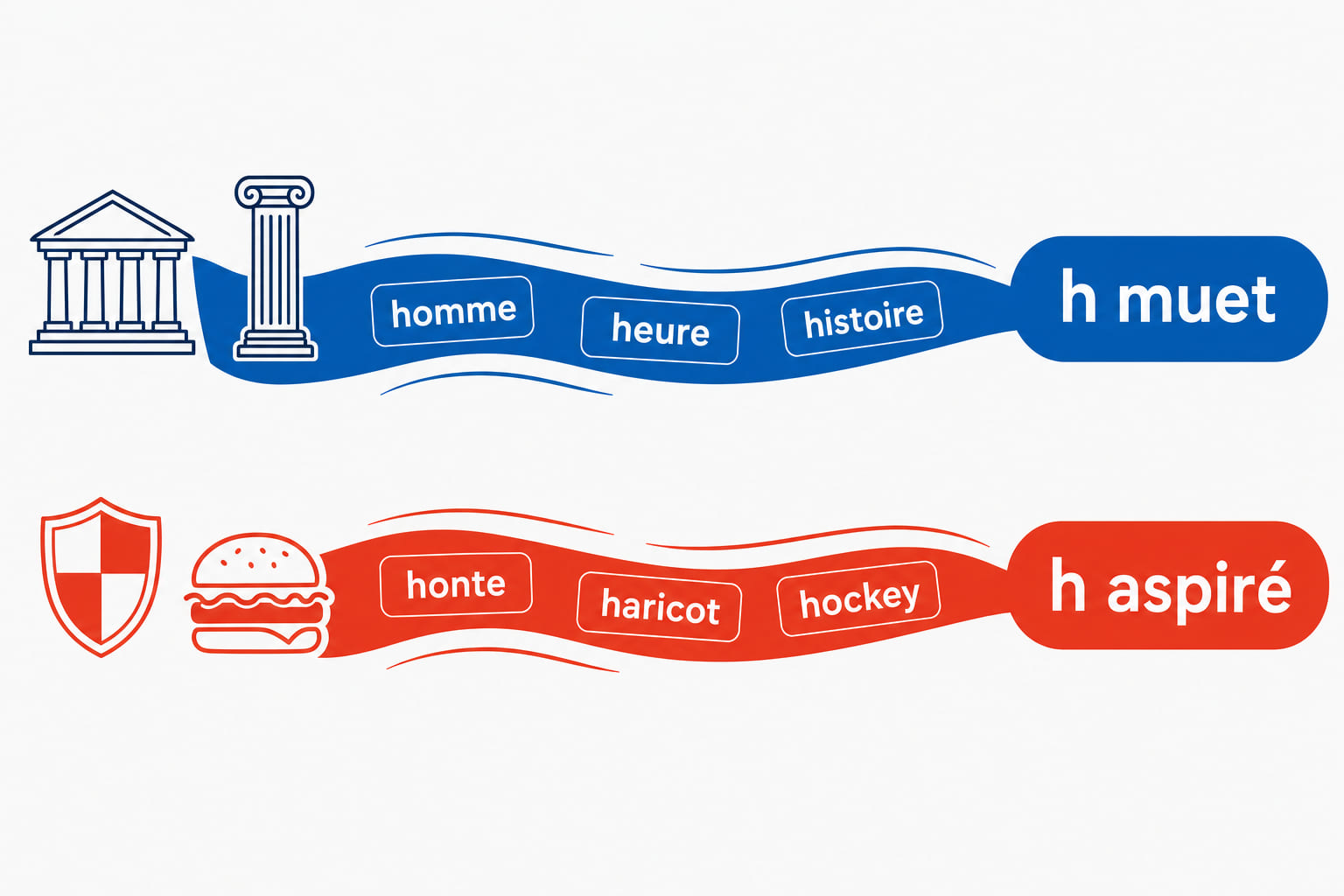
Two footnotes worth having. Dictionaries mark h aspiré with an asterisk, a dagger, or an apostrophe before the entry — _haricot — so you can always check. And onze and huit behave exactly like h aspiré words even though only one of them has an h at all: le onze mai,_ le huit mai*, no elision, no liaison.
The famous irregular pair
Le héros is h aspiré. L'héroïne is h muet. Same root, same family, opposite behaviour — and it is genuinely irregular, not a pattern you can derive.
| Word | Type | Say |
|---|---|---|
| le héros | aspiré | luh ay-RO |
| les héros | aspiré | lay ay-RO |
| l'héroïne | muet | lay-ro-EEN |
| l'héroïsme | muet | lay-ro-EESM |
| héroïque | muet | ay-ro-EEK |
The usual explanation is protective: les héros with a liaison would be lay-ZAY-ro, indistinguishable from les zéros. The feminine has no such clash, so it never needed the wall. Learn the two as a pair and you have the most-cited oddity in the whole topic behind you.
Drill 1 — 10 pairs, singular
Say each row left to right. The left column should flow as one word; the right column should have a clean seam. Nothing else about the two should differ — same speed, same volume, no puff of air on the right.
| H muet — link it | H aspiré — leave the gap |
|---|---|
| l'homme — LOM | le héros — luh ay-RO |
| l'heure — LUHR | la hauteur — la oh-TUR |
| l'hôtel — lo-TEL | le hall — luh AL |
| l'hôpital — lo-pee-TAL | le hockey — luh o-KEH |
| l'histoire — lees-TWAR | le hibou — luh ee-BOO |
| l'huile — LWEEL | la honte — la OHNT |
| l'hiver — lee-VER | le hasard — luh a-ZAR |
| l'habitude — la-bee-TÜD | le haricot — luh a-ree-KO |
| l'honneur — lo-NUR | la hache — la ASH |
| l'héroïne — lay-ro-EEN | le héros — luh ay-RO |
Drill 2 — 10 pairs, plural (this is the one that matters)
Singular mistakes look wrong on paper. Plural mistakes are audible, because the z either fires or it does not, and there is nowhere to hide.
| Liaison fires | Liaison blocked |
|---|---|
| les hommes — lay-ZOM | les héros — lay ay-RO |
| les heures — lay-ZUHR | les hauteurs — lay oh-TUR |
| les hôtels — lay-ZO-tel | les halls — lay AL |
| les hôpitaux — lay-zo-pee-TOH | les hamburgers — lay am-boor-GUR |
| les histoires — lay-zees-TWAR | les hiboux — lay ee-BOO |
| les huîtres — lay-ZWEETR | les haricots — lay a-ree-KO |
| les habitudes — lay-za-bee-TÜD | les hamsters — lay am-STER |
| les hivers — lay-zee-VER | les homards — lay o-MAR |
| les honneurs — lay-zo-NUR | les hanches — lay AHNSH |
| les héroïnes — lay-zay-ro-EEN | les héros — lay ay-RO |
Drill 3 — the words that change shape
This is where h aspiré leaks into grammar, and where a learner who has only half-learned the rule gets caught. Before h aspiré, words that had switched to their vowel form switch back.
| Before h muet | Before h aspiré |
|---|---|
| cet homme | ce héros |
| mon histoire | ma hanche |
| un bel homme | un beau hameau |
| beaucoup d'hommes | beaucoup de haricots |
| j'habite | je hais |
Ma hanche is the one that feels most wrong to a learner. The rule you memorised says mon goes before a feminine word starting with a vowel — mon histoire, mon habitude. But hanche is h aspiré, so it counts as starting with a consonant, and it takes ma.
A real conversation
Camille : Tu as vu le film sur les héros de la Résistance ? Marc : Oui. C'est l'histoire de l'héroïne, surtout. Elle se cache dans un hangar pendant huit jours. Camille : Sans manger ? Marc : Des haricots. Rien que des haricots. Camille : Quelle horreur. Marc : À la fin, elle arrive à l'hôpital, en haut de la colline, à l'heure exacte. Camille : Quel hasard ! Marc : Ce n'est pas le hasard, c'est le scénario.
Read it out loud and watch the alternation. Les héros, un hangar, des haricots, en haut, quel hasard — every one leaves a gap. L'histoire, l'héroïne, l'hôpital, à l'heure — every one links.
And note quelle horreur against quel hasard: same shape, opposite behaviour. Horreur is h muet, so the l hops forward — keh-lo-RUR. Hasard is h aspiré, so it does not — kel a-ZAR.
Frequently asked questions
Is the aspirated h ever actually pronounced?
Not in standard French. You may hear a real breathy h in parts of Normandy, Lorraine, and Wallonia, and in interjections like hop ! or ha !, where speakers use it for emphasis. None of that is something to imitate. If you are producing an English h on héros or haricot, you are adding a sound that is not there.
How do I know which one a word is?
Three ways, in order of reliability. Check a dictionary — h aspiré entries carry an asterisk, dagger, or apostrophe. Use the etymology heuristic — Latin and Greek roots go muet, Frankish and Germanic roots and recent English borrowings go aspiré. And learn the common h aspiré words as a closed list, because there are only about fifty you will meet in ordinary life, against many hundreds of h muet words. The list above covers most of them.
Why is it "le héros" but "l'héroïne"?
Because les héros with a liaison would sound exactly like les zéros. That clash is the usual explanation for why the masculine kept its wall, and the feminine — which has no homophone to collide with — did not. It is irregular, and the fastest route is to drill the pair together until the asymmetry stops feeling wrong.
I hear people say "les-z-haricots" — is that allowed?
You will hear it, and it has been heard for a long time. It is still treated as an error by usage guides and it reads as careless to most French ears — haricot is h aspiré and the liaison is not made. Say lay a-ree-KO.
Does any of this actually stop me being understood?
Mostly it marks you as a learner rather than blocking comprehension — with one real exception. Les héros and les zéros is a genuine minimal pair, and the liaison error hands your listener the wrong word. The wider cost is the same as with every linking rule in French: get the joins wrong often enough and your speech stops matching the rhythm your listener is parsing for.
Related lessons
- Master the Phonetics French Alphabet — which letters are silent, and why h is a category of its own.
- French Pronunciation Practice — the fifteen-minute daily habit these drills belong in.
- 5 Common Mistakes English Speakers Make — pronouncing letters that should stay quiet is number one.
Practise it out loud
You now know the rule, and knowing it changes nothing yet. The gap before h aspiré is somewhere between a fifth and a tenth of a second, you cannot feel it from the inside, and every instinct you own is pulling the words together because that is what French has been rewarding you for since you started.
So go down Drill 2 out loud. Not down the left column, then the right — across, pair by pair, so your mouth has to switch. Les hommes, les héros. Les heures, les hauteurs. If the z shows up where it should not, you will almost certainly not notice.
That is precisely the problem Simply French was built for: fifteen minutes a day of native-speed listening, speaking drills, and instant AI pronunciation scoring that tells you which join you made and which one you were supposed to leave alone. Start your free 7-day trial and run these thirty pairs until the wall holds by itself.
À vous de parler.
Tags
Now find out how you actually sound.
Simply French listens to you say each sentence and scores it word by word, so you can hear the difference you have just read about — and fix it while it is still fresh.
Takes about 10 minutes. No card needed to start.
Related Articles
French Nasal Vowels AN EN ON IN: Practice Without Pronouncing the N
In a French nasal vowel the N is not a sound - it is a spelling instruction, and your tongue must never touch the roof of your mouth. The three sounds, the true minimal triples, the denasalization pairs that prove it, and 10 sentences.
French S vs Z: Poisson or Poison, Drilled on 20 Pairs
One S between two vowels is /z/. Two S's are /s/. English trained you to do the opposite in exactly the word where it matters most - dessert. The rule, the boundary exceptions nobody teaches, and 20 pairs to say out loud.
The French R for English Speakers: 12 Words, 5 Minutes a Day
Stop gargling. The French R is made exactly where you say the G in get - and the reason yours is not working is the tip of your tongue. Build it in four steps, then drill 12 words, three weights of R, and 10 sentences.