
How to Talk About Your Family in French (A1-15)
Learn how to talk about your family in French: core vocabulary, mon/ma/mes possessives, and real phrases for siblings, parents, ages, and introductions.
Simply French Team
Right after "What's your name?" and "Where are you from?", the next question you'll hear in any friendly French conversation is about family: Tu as des frères et sœurs ? — do you have brothers and sisters? Family is one of the warmest, most reliable small-talk topics in France, and the vocabulary is wonderfully regular. Learn about twenty words and three little possessives (mon, ma, mes), and you can describe your whole family in French with confidence.
This guide gives you the core vocabulary with pronunciation hints, the phrases natives actually use, a model conversation, and the cultural notes that make the difference between textbook French and real French.
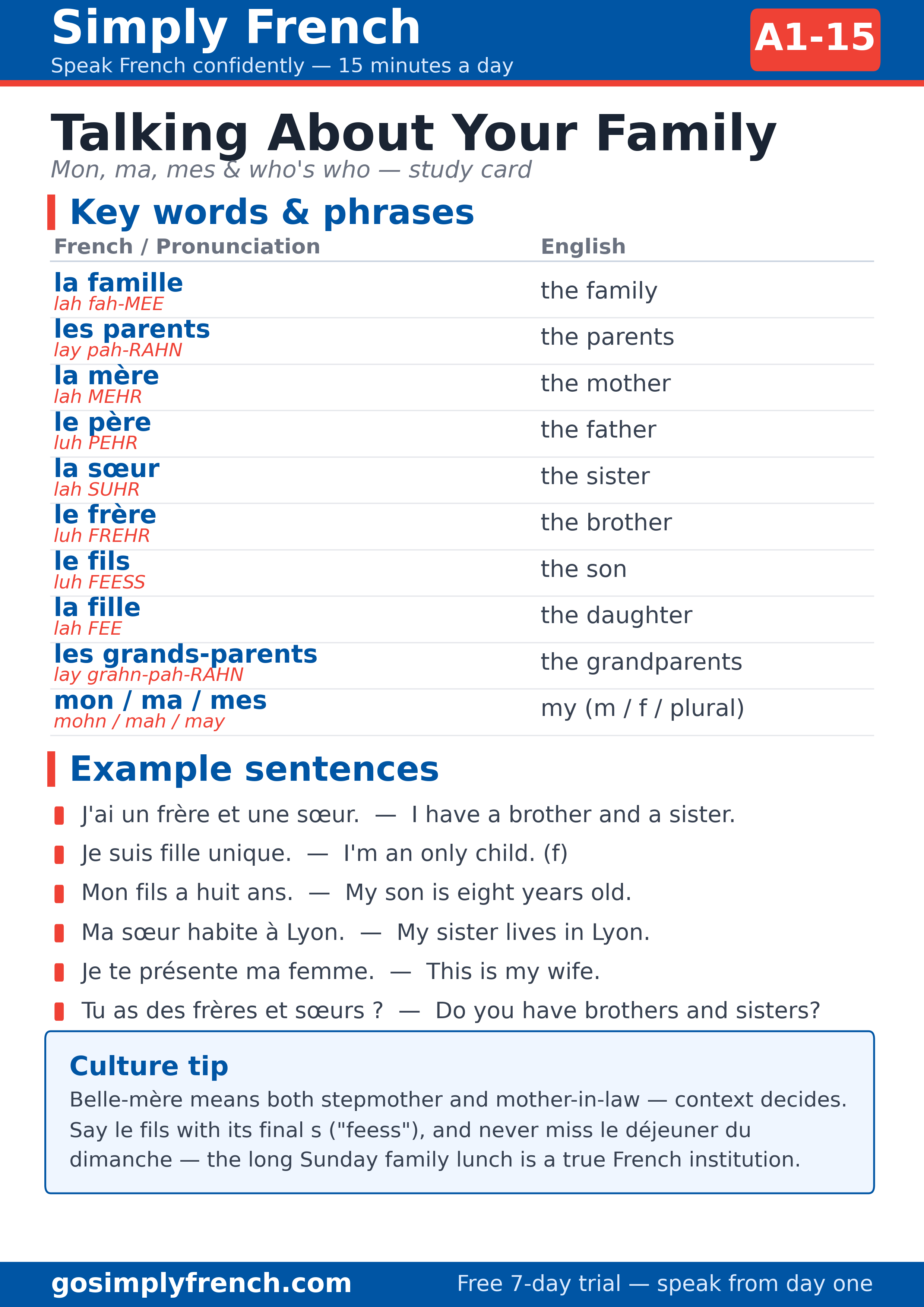
Download the printable study sheet (PDF): Family in French study sheet
Core family vocabulary
Start with the immediate family. Every noun in French has a gender, and family words make gender easy to remember because it matches the person.
| French | Phonetic hint | English |
|---|---|---|
| la famille | lah fah-MEE | the family |
| les parents | lay pah-RAHN | the parents |
| la mère | lah MEHR | the mother |
| le père | luh PEHR | the father |
| la sœur | lah SUHR | the sister |
| le frère | luh FREHR | the brother |
| la fille | lah FEE | the daughter |
| le fils | luh FEESS | the son |
| la grand-mère | lah grahn-MEHR | the grandmother |
| le grand-père | luh grahn-PEHR | the grandfather |
Two pronunciation traps: le fils (son) is pronounced "feess" — you do say the final s, unlike most French words. And la fille means both "daughter" and "girl"; the double L sounds like a y, "fee-y". The word famille itself follows the same rule — check the entry for famille in the Larousse dictionary to see its definitions and pronunciation.
For the wider family circle:
| French | Phonetic hint | English |
|---|---|---|
| le mari | luh mah-REE | the husband |
| la femme | lah FAHM | the wife (also: woman) |
| l'oncle | LOHN-kluh | the uncle |
| la tante | lah TAHNT | the aunt |
| le cousin / la cousine | koo-ZAN / koo-ZEEN | the cousin (m/f) |
| le neveu | luh nuh-VUH | the nephew |
| la nièce | lah NYESS | the niece |
| les grands-parents | lay grahn-pah-RAHN | the grandparents |
Mon, ma, mes: the possessives you can't skip
To talk about your family in French, you need "my" — and French has three versions, chosen by the noun's gender and number, not by yours:
| French | Used with | Example |
|---|---|---|
| mon | masculine singular | mon père (my father) |
| ma | feminine singular | ma mère (my mother) |
| mes | any plural | mes parents (my parents) |
So it's mon frère but ma sœur, and always mes grands-parents. One twist worth knowing early: before a feminine noun starting with a vowel, French uses mon for smoother sound — mon amie (my female friend), not "ma amie."
The same pattern works for "your" (ton, ta, tes informal) and "his/her" (son, sa, ses). Master mon/ma/mes first; the others follow the identical logic.
Saying who's in your family
Here are the sentences that carry 90% of real family conversations:
| French | English |
|---|---|
| J'ai un frère et une sœur. | I have one brother and one sister. |
| J'ai deux enfants. | I have two children. |
| Je suis fils unique. / Je suis fille unique. | I'm an only child. (m/f) |
| Je n'ai pas d'enfants. | I don't have children. |
| Ma famille est grande. / Ma famille est petite. | My family is big. / My family is small. |
| Nous sommes quatre dans ma famille. | There are four of us in my family. |
| Mon frère s'appelle Thomas. | My brother's name is Thomas. |
| Ma sœur habite à Lyon. | My sister lives in Lyon. |
Notice fils unique versus fille unique — the phrase agrees with the speaker. And for older and younger siblings, French uses aîné(e) and cadet(te): mon frère aîné (my older brother), ma petite sœur or ma sœur cadette (my little/younger sister).
Talking about ages
French uses avoir (to have) for age, never "to be": literally, you have your years.
| French | English |
|---|---|
| Mon fils a huit ans. | My son is eight years old. |
| Ma fille a douze ans. | My daughter is twelve. |
| Mes parents ont soixante ans. | My parents are sixty. |
| Quel âge a ton frère ? | How old is your brother? |
Numbers do the heavy lifting here, so if they're still shaky, review French numbers from 1 to 100 — ages, birthdays, and family sizes all depend on them.
Introducing your family to someone
When someone meets your family, these are the natural phrases:
| French | English |
|---|---|
| Je te présente ma femme, Claire. | This is my wife, Claire. (informal) |
| Je vous présente mon mari. | This is my husband. (formal) |
| C'est mon petit frère. | This is my little brother. |
| Voici mes parents. | Here are my parents. |
Je vous présente is the polite, formal introduction; je te présente is for friends. If that tu/vous choice still feels fuzzy, the same logic applies as when you introduce yourself in French — vous for strangers and professional settings, tu for friends and family.
This is exactly what you'll practice out loud in Lesson A1-15: Talking About Your Family inside Simply French — listening to native-speed questions about family and answering with your own details, with instant pronunciation scoring on every sentence.
Blended and extended families
French handles step-family and in-law vocabulary with one elegant (and occasionally confusing) trick: beau- and belle- do double duty.
| French | English |
|---|---|
| le beau-père | stepfather OR father-in-law |
| la belle-mère | stepmother OR mother-in-law |
| le beau-frère | brother-in-law |
| la belle-sœur | sister-in-law |
| le demi-frère | half-brother |
| la demi-sœur | half-sister |
Context tells you which meaning applies — if someone says ma belle-mère at their wedding, it's their mother-in-law; in a story about childhood, probably a stepmother. Note that many French couples are pacsés — joined by a PACS, a civil union that's extremely common in France — so you'll often hear mon compagnon or ma compagne (my partner) instead of husband or wife.
A model conversation
— Tu as des frères et sœurs ? (Do you have brothers and sisters?) — Oui, j'ai une grande sœur. Elle s'appelle Emma et elle a trente ans. Et toi ? (Yes, I have an older sister. Her name is Emma and she's thirty. And you?) — Moi, je suis fils unique. Mais j'ai beaucoup de cousins ! (Me, I'm an only child. But I have lots of cousins!) — Ta famille habite ici ? (Does your family live here?) — Mes parents habitent à Bordeaux. On se voit le dimanche pour le déjeuner. (My parents live in Bordeaux. We see each other on Sundays for lunch.)
That last line is no accident: the long Sunday family lunch — le déjeuner du dimanche — is a genuine French institution. Asking about it is a lovely way to keep a conversation going, much like commenting on the weather. Speaking of which, family and weather are the two classic small-talk pillars; keep talking about the weather in French in your back pocket for the moments between topics.
Cultural tips
French people genuinely ask about family, but they get specific slowly. A first conversation covers siblings and where your parents live; questions about marriage or children usually wait until you know each other better. When you're invited to a French home, greeting every family member individually — including children, with a bonjour to each — is expected good manners. And don't be surprised by la bise (cheek kisses) among family members and close friends; the number of kisses varies by region, which the French themselves happily joke about.
Frequently asked questions
How do I say "family" in French?
La famille, pronounced "lah fah-MEE" — the -ille ending sounds like "ee" with a soft y, not like "eel." It's a feminine noun, so it's ma famille for "my family."
What's the difference between "mon," "ma," and "mes"?
They all mean "my." Mon goes with masculine singular nouns (mon père), ma with feminine singular (ma mère), and mes with any plural (mes parents). The choice depends on the noun's gender, not the speaker's.
Does "belle-mère" mean stepmother or mother-in-law?
Both. French uses beau-/belle- words for step-family and in-laws alike, and context tells you which is meant. If you need to be explicit, la mère de mon mari (my husband's mother) removes all doubt.
How do I say "I'm an only child" in French?
Je suis fils unique if you're male, je suis fille unique if you're female. The noun agrees with you, the speaker.
Why does French use "avoir" for ages?
In French, you have your years: il a dix ans, literally "he has ten years." Saying il est dix ans is a classic beginner error — always use avoir for age.
Is "femme" wife or woman?
Both, depending on context. Ma femme means "my wife," while une femme is "a woman." The possessive is what signals the marriage meaning; the same happens with fille (girl/daughter).
Related lessons
- How to Introduce Yourself in French (A1-3)
- French Numbers 1-100: How to Count (A1-4)
- How to Talk About the Weather in French (A1-14)
Practice saying it out loud
Reading family words is the easy part — the win is hearing Tu as des frères et sœurs ? at native speed and answering without freezing. Simply French builds that reflex in 15 minutes a day: you listen, you speak out loud, and AI pronunciation scoring tells you instantly whether your fille and fils sound right. Start your free 7-day trial and describe your own family in French today.
Tags
Now find out how you actually sound.
Simply French listens to you say each sentence and scores it word by word, so you can hear the difference you have just read about — and fix it while it is still fresh.
Takes about 10 minutes. No card needed to start.
Related Articles
T'as, Y'a, Chuis: Say Spoken French the Way It's Actually Said
Tu becomes t', il becomes i, il y a becomes y'a. The three families of French spoken contractions, why they exist, and 50 lines to drill out loud until they stop sounding like a different language.
How to Tell If Your French Accent Is Actually Good (Self-Test)
You cannot hear your own French accent — your ear filters it through English. Six self-tests that isolate what English speakers actually get wrong, each one you can check on your own, plus a 12-point scorecard.
How to Talk About Hobbies in French (A1-21)
Learn to talk about hobbies in French with 40+ phrases, the faire de vs jouer a rule, pronunciation hints, a sample dialogue and a free printable study sheet.